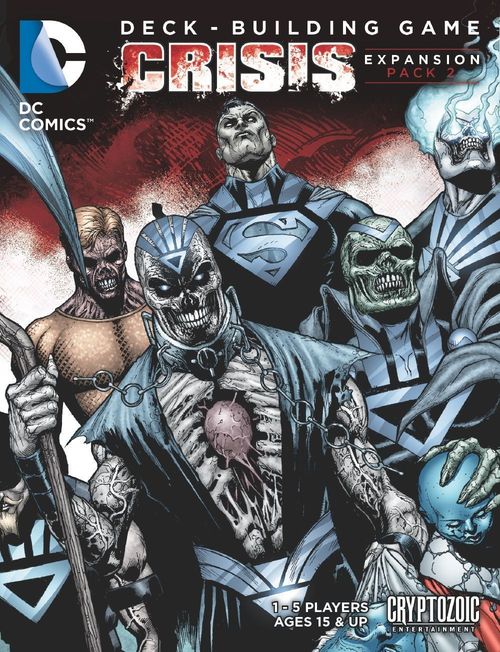
DC Deck-Building Game: Crisis Expansion Pack 2
DC Deck-Building Game: Crisis Expansion Pack 2 Rulebook
Table of Contents
Table of Contents
Contents
- 14 Oversized Super Heroes
- 14 Impossible Super-Villains
- 1 Crisis-Only Super-Villain
- 15 Crisis Cards
- 31 New Main Deck Cards
- 4 Heroes Unite Replacement Cards
Overview
Crisis Mode is a co-operative game experience where the players work together to beat a host of Super-Villains and some world-altering Crisis events. Typically, players will want to use the Crisis Super Heroes to play this mode, as they allow players to help each other. That can become important when the world is about to end. See Setting Your Crisis Difficulty below for a list of variants that can increase or decrease the difficulty of Crisis Mode.
Key changes in Crisis Mode, as printed on the first page of the source (the bullets are unlabelled there):
- When you buy or gain a Villain from the Line-Up, destroy it.
- When you defeat a Super-Villain, remove it from the game.
- Instead of refilling the Line-Up in between turns, after each player's turn has ended, add the top card of the main deck to the Line-Up.
- Before a Crisis can be beaten, your team must remove all Villains from the Line-Up.
- Before a Super-Villain can be defeated, your team must beat the current Crisis.
- If a Crisis requires each player to take action to beat it, those actions must all be done simultaneously.
- You may only attempt to beat a Crisis once per turn.
Crisis Mode Set-Up
Players
| Players | 1 or 2 | 3 | 4 | 5 |
|---|---|---|---|---|
| Crisis Cards | 12 + Immortal Villain | 10 + Immortal Villain | 8 + Immortal Villain | 6 + Immortal Villain |
| Super-Villains | 11 + Vandal Savage & Nekron | 9 + Vandal Savage & Nekron | 7 + Vandal Savage & Nekron | 5 + Vandal Savage & Nekron |
To create your Super-Villain stack:
- Place Crisis Nekron face down. He is the last Super-Villain you will face in Crisis Mode. The back of his card is different from the rest, as he is only ever used in Crisis Mode.
- Set aside Vandal Savage.
- Shuffle the remaining Impossible Super-Villain cards.
- Count out a number of cards equal to the number of Super-Villains, less two, based on the Players table above.
Crisis Mode is meant to be played with the Impossible Super-Villains.
Instead of always using the typical eight Super-Villains, Crisis Mode bases your Super-Villain count on how many players are in the game. Each Super-Villain brings with him a Crisis, so you will play with an equal number of Crisis cards and Super-Villains.
To create your Crisis card stack:
- Set aside the Crisis card Immortal Villain.
- Shuffle the remaining Crisis cards.
- Count out a number of cards equal to the number of Super-Villains, less one, based on the Players table above.
- Place those cards face down.
- Then put Immortal Villain face up on top of that stack.
- Place the Crisis stack next to the Super-Villain stack.
Example:
In a four-player game, make a stack of eight random Crisis cards, and then place Immortal Villain face up on the stack, for a total of nine Crisis cards.
The Crisis cards after Immortal Villain are randomized, so you never know what is coming next. It is recommended that you don't read the rest of the Crisis cards before playing your first game. Return all additional Super-Villains and Crisis cards to the box. Now start the game as usual by shuffling the main deck and placing the top five cards into the Line-Up.
The source prints Super-Villain stack steps 5 to 7 after this paragraph, so they are kept here in that printed order.
- Place those cards face down on top of Nekron.
- Put Vandal Savage face up on top of that stack. He is the first Super-Villain you will face in Crisis Mode.
- Place the Super-Villain stack next to the Kick stack.
Example:
In a four-player game, place seven random Super-Villains on top of Nekron before placing Vandal face up on the stack, for a total of nine Super-Villains.
For a shorter game length, cut the main deck down to 100 cards, and reduce the number of Super-Villains and Crisis Cards by 3.
Crisis Mode Object of the Game
Object of Crisis Mode:
Defeat all of the Super-Villains in the stack before time runs out. Do this, and your team wins! If you need to add a card from the main deck to the Line-Up and cannot, time has run out and your team loses the game. Win or lose, Victory Points are never counted.
If You Are Playing with Impossible Super-Villains
Beat each Crisis and defeat all of the Super-Villains before time runs out. If you do, your team wins! If you need to add a card from the main deck to the Line-Up and cannot, your team loses the game.
- When a Weakness is destroyed, return it to the stack.
- If you need to add a card from the main deck to the Line-Up and cannot, your team loses the game.
The biggest change in Crisis Mode involves buying and gaining Villains and Super-Villains:
- When you buy or gain a Villain from the Line-Up, destroy it.
- When you defeat a Super-Villain, remove it from the game.
If you gain a Villain from the top of the main deck or from the destroyed pile, it is not destroyed. "Removed from game" means back in the box. You cannot interact with cards removed from game like you can with destroyed cards, which are still a part of the game.
The second biggest change involves refilling the Line-Up between turns. Instead of filling each empty slot in the Line-Up during the end of turn procedure:
- After each player's turn has ended, add the top card of the main deck to the Line-Up.
One card is added to the Line-Up between turns, no matter how many cards are in the Line-Up. The Line-Up might grow to 7 or 8 cards, or even shrink to 2 or 3. This puts a clock on the players. You can't wait forever to make your move. The time to act is now!
Crisis Mode Rules of Play
Crisis Cards
Most Crisis cards have an Ongoing ability that will hinder your team. Any text prior to the Ongoing happens first, and just once when it flips up. Many have an effect at the start or end of each player's turn, so be sure to read the Crisis card as you start your turn. If a Crisis effect happens at the start of your turn, this is before you can play any cards or attempt to beat the Crisis. These effects are not attacks that can be avoided.
Each Crisis card will feature a "To Beat:" at the bottom of the text box. See Specific Card Clarifications below for help with specific cards. It is highly advised that you avoid reading that section before you start playing, as it's more fun if you don't know what's coming!
Before a Crisis can be beaten, your team must remove all Villains from the Line-Up. Before a Super-Villain can be defeated, your team must beat the current Crisis.
Some Crisis cards go away after certain conditions have been met. If those conditions have been met, but Villains are still in the Line-Up, the Crisis does not end. It continues to function as before. As soon as the last Villain is removed from the Line-Up, the Crisis goes away if the condition is still met.
Most Crisis cards require each player to participate in beating the Crisis. Since this is a co-operative game, it's a good idea to discuss when players are ready to help beat a Crisis. You cannot attempt to beat a Crisis while there are Villains in the Line-Up. When no Villains are in the Line-Up, you may attempt to beat a Crisis.
If a Crisis requires each player to take action to beat it, those actions must all be done simultaneously.
Example:
If each player must discard a card with cost 5+ to beat a Crisis, no player may delay discarding his own card with cost 5+. If a player doesn't have a card with cost 5+ in his hand, he should mention this to the group. No one should discard a card until all players can. Return discarded cards to hand if anyone acted too quickly.
You may only attempt to beat a Crisis once per turn.
Where coordinated actions are required of the players to beat a Crisis, those actions may only be attempted by the team once during each player's turn. Suppose a player has ended his turn and drawn a new hand of five cards. The next time you may attempt to beat a Crisis would be during the next player's turn. You cannot attempt to beat a Crisis in-between turns.
When a Crisis calls for each player to perform a game action like discarding or destroying a card, the Crisis allows the player to perform this action. You do not have to play a card that allows the action to perform a Crisis action.
When a Crisis is beaten, remove it from the stack, but do not flip over the next Crisis in the stack. Now the way has been paved to defeat the current Super-Villain. A Super-Villain may be defeated while there are Villains in the Line-Up. Only Crisis cards are concerned with Villains in the Line-Up.
When you defeat the current Super-Villain, remove it from the game. During the end-of-turn procedure, flip up a new Crisis, and then reveal the next Super-Villain. It is important to flip up the Crisis first, as it could impact the First Appearance – Attack of the Super-Villain.
New Super Heroes
The six new Super Heroes in this expansion (Deadman, Indigo-1, Kyle Rayner, Saint Walker, Star Sapphire, Red Lantern Supergirl) are great for competitive play, but may also be used in Crisis Mode. Any Super Hero from any set can be used in Crisis Mode, but it can make it more difficult.
New Main Deck Cards
There are 31 new main deck cards in this expansion. These can be shuffled right in to any main deck you want. For your first Crisis Mode game, it is recommended that you add in these new cards. The cards have a set tag on the bottom of the card so it is easy to remove them from a main deck should you want to.
Impossible Super-Villains
These Super-Villains are upgrades of the original Super-Villains from the DC Deck-building Game. You will find that their First Appearance – Attacks are more dangerous, and their play abilities are a bit stronger. They are also tougher to defeat. Crisis Mode should use Impossible Super-Villains. They are also well-suited for competitive play.
Rule Changes When Using Impossible Super-Villains
When a Weakness is destroyed, return it to the stack. If you need to add a card from the main deck to the Line-Up and cannot, everyone loses.
Some Impossible Super-Villains have Ongoing effects while they are on the stack. These are called "Stack Ongoing" abilities. They are only in effect while the card is face up on the Super-Villain stack. When played, Stack Ongoing effects are not applicable.
Setting Your Crisis Difficulty
Since there are several ways to mix and match the cards in this expansion, you can customize your Crisis Mode game difficulty to your liking with a few minor changes.
Harder:
(Check these off when you win!)
- Don't use Crisis Super Heroes.
- Don't use Immortal Villain as the first Crisis. Randomize it!
- Don't add the 31 new cards to the main deck.
- Super-Villain "Stack Ongoing" abilities are "on" even when they are not on the Super-Villain stack. They are "off" when defeated, however.
- Shuffle the remaining Crisis cards into the main deck. When they enter the Line-Up, are gained, or are destroyed while in the main deck, place them face up next to the Crisis card stack instead. You may have multiple Crisis cards affecting your team at once now. Attempts to beat them are made in the order of your choosing. You must beat them all before you may defeat the current Super-Villain.
- Leave Immortal Villain in play even after beating it. For the rest of the game, Villains with Attacks that leave the Line-Up are treated as First Appearance – Attacks against all players. You do not have to beat this Crisis again to defeat Super-Villains.
Play with any two of the above at the same time.
Crisis Solo Play
You can play solo! There are a few cards that need to change, as you don't have anyone with whom to coordinate your actions. Keep in mind you can only do the actions described if there are no Villains in the Line-Up.
Corrupted Companion:
Change the Ongoing part of this ability to:
Ongoing: At the start of your turn, he resolves his Attack against you.
Hunting Down the Lanterns, Manhunter Invasion, Missing Heroes, Rise of the Dead:
For their To Beats, you may also find the cards you need to destroy in your discard pile.
Reshaping Our World – To Beat:
Reveal the top three cards of your deck. Remove this Crisis if each of those cards has a different cost.
Shifting Loyalties – To Beat:
Put the top three cards of your deck into the Line-Up. If their total cost is 7 or greater, remove this Crisis.
Easier:
(Check these off when you win! When you have them both checked, you are ready for the standard difficulty.)
- Use regular Super-Villains instead of Impossible Super-Villains.
- Play with 8 Super-Villains, no matter how many players are in the game.
Specific Card Clarifications
New Main Deck Cards
The Atom: If there is not another card in the destroyed pile of that cost, you gain the card you destroyed.
Black Lantern Power Ring, White Lantern Power Ring: If the gained card triggers an ability when gained, you get that effect, not the player who's discard pile it ends up in.
Channeling the Emotional Spectrum: Whenever you interact with this card, no matter where it is, choose one of the colors listed. It becomes a card of the color you chose until the end of the current turn or until there is another interaction with the card.
Impossible Super-Villains
Amazo, Arkillo, H'EL: If you have the card type in one or both places, you must perform the action. If there is just one card of the type in your discard pile, you may still "choose" your discard pile.
Arkillo Example: If you have an Equipment in hand and none in your discard pile, you cannot "choose" your discard pile and avoid losing the Equipment in your hand. If you have one Equipment in your discard pile, you may "choose" your discard pile and place just that one card into the Line-Up.
Black Adam: There is a main deck and each player has a deck. You may not destroy a card that does not match types with another card in your hand.
Crisis Nekron: You cannot defeat him if you played a Villain card during your turn. As a Crisis-only Super-Villain, he has no play text. All of his text resolves when he first appears.
Graves: While his attack cannot be avoided, the additional attacks can be. This includes First Appearance – Attacks, though defeated Super-Villains are removed from the game, not destroyed. You are only hit by the two highest between the two zones, not two from each of those zones.
Vandal Savage: These attacks happen when a card with an Attack is bought, gained, destroyed, or otherwise removed from the Line-Up. It happens immediately, even during the middle of a player's turn.
Super Heroes
Indigo-1: Villains and Heroes are your usual sources of red and blue cards, but Channeling the Emotional Spectrum also works.
Kyle Rayner: Discard the revealed cards as well.
Red Lantern Supergirl: If you play a card that allows a foe to destroy a card, her ability will trigger. If multiple foes destroy a card during one player's turn, her ability only triggers once.
Crisis Booster Gold: You do not resolve the Defense text of the discarded card when you use this ability. You may discard a Defense card you have played during your turn to defend a player being attacked during your turn.
Competitive Play
Shuffle the 31 new cards into your DC Comics Deck-building Game or Heroes Unite main deck and start playing. The new Super Heroes and Impossible Super-Villains can also spice up your games quite nicely. Some Crisis Super Heroes are best left out of competitive games, however, as their abilities only help other players or are way too powerful (Shazam!). Where a Super Hero may choose "a player" or "any player" when using his ability, you can always choose yourself if you wish.
Competitive players are encouraged to use the Impossible Mode Super-Villains. But the Crisis Nekron should be left solely for Crisis Mode. For added difficulty, don't add the new 31 cards, or remove 31 random ones before starting the game. Or for the ultimate challenge, customize your very own main deck using 25 cards per player!
"Foes" in Crisis Mode
Several cards use the word "foe." In Crisis Mode, "foe" simply means "each other player."