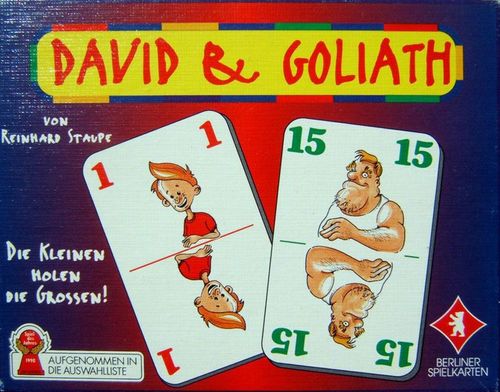
David & Goliath
David & Goliath Rulebook
Table of Contents
Table of Contents
Game Idea
Each player in turn plays out one card. The player with the lowest value gets the highest card as a prize. The player with the highest card receives all the remaining cards as a prize. The cards won are worth points at the end. The clever part: only a player who collects no more than two cards of a colour is credited with the printed value for them. If at the end you have more than two cards of one colour, each of those cards is worth only a single point.
Whoever has the most points after several rounds wins the game.
Game Material
- 90 cards (the values 1-18 in each of five colours)
- 12 replacement cards
Please also have paper and pencil ready. (Not included in the game.)
Setup
Depending on the number of players, the following cards are needed:
| Players | Cards used |
|---|---|
| 3 players | All cards with the values 1-9 (45 cards) |
| 4 players | All cards with the values 1-12 (60 cards) |
| 5 players | All cards with the values 1-15 (75 cards) |
| 6 players | All cards with the values 1-18 (90 cards) |
The remaining cards are sorted out and put aside.
Note: A few blank replacement cards are included with the game. If a card is ever lost, you only need to write the corresponding value on the replacement card of the matching colour, and the game is complete again.
The tallest player shuffles all the cards needed and deals them out evenly. Each player thus receives 15 cards and takes them into hand. The player to the left of the dealer is the starting player of the first round.
Course of Play
A game consists of as many deals as there are participating players. (The players may also agree on a different number in order to change the length of the game.) Within a deal, 15 rounds (also called tricks) are played, in each of which every player plays out one card.
The starting player chooses exactly one card of his choice from his hand and plays it out, that is, he places it face up on the table. Now all players in turn, clockwise, must likewise play out exactly one card and place it in front of themselves. In doing so, each player must follow the starting player's colour, that is, play out a card of the same colour as the first card of this round. If a player cannot follow, he plays out any other colour.
Note: Players should take care to lay out their played cards in such a way that it is still clearly recognisable who played which card.
As soon as every player has played a card, the round ends. The players now first determine the highest and then the lowest card of this round:
- The highest card is always the one with the highest number, regardless of colour. If several players have played out the highest number, the one played last counts as the highest.
- The lowest card is always the one with the lowest number, regardless of colour. If several players have played out the lowest number, the one played last counts as the lowest.
Note: In very rare cases it can happen that all players have played out a card with the same value. Then the card played last counts as the highest and the second-to-last card as the lowest.
The player with the lowest card gets the highest card as a prize. He places it face up in front of himself. The player who had the highest card receives all the remaining cards of this round as a prize. He also places them face up in front of himself, separated by colour. In addition, he becomes the starting player of the next round.
Example
Example for a game with 5 players: Andreas is the starting player and plays out the green 4, so the other players must follow green. Ben plays the green 12, then Clara follows with the green 7. Dennis has no green card, he plays the red 2. Emma is last in turn, she plays the green 2.
Ben's card is the highest, since 12 is the highest value. The lowest value is the 2, which was played by Dennis and Emma. Since Emma played her 2 later than Dennis, Emma's card counts as the lowest of this round. Emma therefore gets the highest card as a prize, Ben's green 12, and places it in front of herself. Ben receives all the other 4 cards as a prize and places them sorted by colour in front of himself. Ben becomes the new starting player and now starts a new round by playing out any card.
In the same way, a total of 15 rounds are now played, until no player has a hand card left. In this way the players receive more and more cards as prizes, which they always place in front of themselves separated by colour. Every single card must remain clearly recognisable.
End of the Game
At the end of a deal, each player receives points for the cards he has collected. Each colour is scored individually:
- If a player has collected exactly 1 or 2 cards in a colour, he is credited with points equal to the numerical value of the card in each case.
- If a player has collected 3 or more cards in a colour, he is credited with only 1 point for each card.
Note: If a player has not collected a single card in a colour, he gets 0 points for that colour.
Each player adds up his points from all 5 colours. The sum is his total result for this deal.
Scoring Example
Example: At the end of the deal, Dennis has the following cards lying in front of him:
| Colour | Cards | Points |
|---|---|---|
| Red | 4 / 10 / 11 | 3 points |
| Yellow | 8 | 8 points |
| Green | 5 / 9 | 14 points |
| Blue | 2 / 3 / 6 / 10 / 12 | 5 points |
| Purple | 10 / 12 | 22 points |
In total, Dennis is therefore credited with 52 points for this deal.
Each player's points are noted down. After that, the further deals are played out in the same way. The dealer changes clockwise after each deal. Whoever shows the most points in the sum of all deals wins the game.