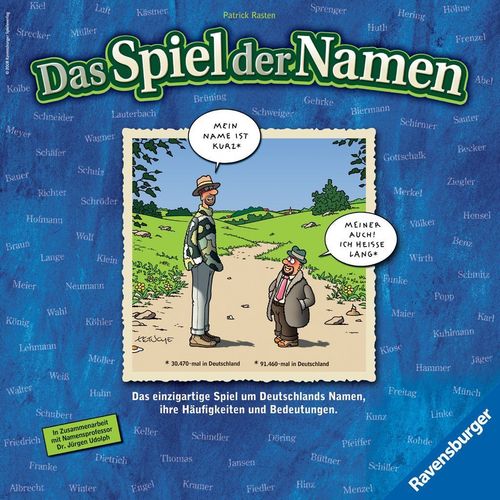
Das Spiel der Namen
Das Spiel der Namen Rulebook
Table of Contents
Table of Contents
Contents
- 165 name cards (see the illustration of a name card below)
- 1 decoder
- 15 guess stones (3 per player colour, marked "1", "2" and "3", in red, yellow, green, blue and white)
- 5 card holders
- 1 round chip
- 1 playing arena (six parts), consisting of the playing field, the Arena Staircase, the Bonus Staircase and the Jackpot
Name card. Each name card shows on its question side a surname (1) and a quiz question (2) with three answer options (3), as well as the encrypted solution (4). On its number side it shows the approximate frequency of the name in Germany (5).
- Question side (Fragenseite)
- Number side (Zahlenseite)
Note on the figures: the frequency figures are based on the telephone directory of 2006. They were extrapolated to the total population of Germany and then rounded.
Goal
Players estimate surnames by their meaning, origin and frequency. The player who does this best wins the most name cards and with them the game.
Setup
First assemble the playing arena in the middle of the table.
- The area inside the arena is the playing field.
- At the bottom edge of the arena is the round track (Spielrundenleiste), for the round chip.
- At the outer edge of the arena lie the Arena Staircase (on the left) and the Bonus Staircase (on the right). Cards are placed on the steps to the right and left of the staircases during play. The shared highest step of both staircases is the Jackpot field.
Each player takes 3 guess stones of one colour and 1 card holder, which he places in front of himself.
The player with the longest full name shuffles the name cards. He forms a stack from about half of the cards, with the question side facing up, and puts the rest back into the box. Every player receives 2 cards from the stack. Each player places them in his card holder so that he can see the number side.
Now place the decoder ready and put the round chip on field "1" of the round track. Ring the bell for round 1!
Sequence of Play
(Additional rules for 2 players are found on page 6.)
The game is divided into the guessing game (Tippspiel), the name quiz (Namensquiz) and the treasure round (Schätzrunde):
- The game begins with the guessing game. Cards are placed one after another onto the Arena and the Bonus Staircase. As many guessing games are played as needed until the Jackpot field – the shared highest step of both staircases – is reached, that is, until at least one name card lies there.
- Then comes the name quiz, in which the Jackpot is played for.
- After that comes the treasure round (Schätzrunde).
- Afterwards the next round begins again with the guessing game, and so on.
Tip for the first game: Read "The Guessing Game" first and start playing right away. Look at the rules for the name quiz and for the treasure round once the game has progressed far enough.
The Guessing Game (Das Tippspiel)
Here the players guess the frequency of surnames.
Laying out cards
The player in front of whom the card stack lies lays out the three top name cards from the stack one after another, without looking at them, next to each other on the playing field (question side up).
Placing guess stones
Every player – including the card giver – places only a single guess in this round. To do so, he places 1 guess stone on 1 card:
- Either the guess stone "1" on the name he thinks is the most common.
- Or the "2" on the one he assumes to be in second place.
- Or the "3" on the one he thinks is probably the rarest.
His other two guess stones remain unused in this round.
Important: The same guess may not appear more than once on a card (e.g. two "1"s). Therefore the players do not guess in turn order; instead the rule is: first come, first served.
When may the players guess? At the earliest as soon as the first card is lying there. This is naturally risky, because whoever has placed his guess stone may not take it back in this round.
Note: The card giver may only place his guess stone after he has laid out all 3 cards.
Evaluating the cards
As soon as all players have placed their guess stones, the name cards are turned over so that all players can see the frequencies. Whoever guessed correctly receives the corresponding name card and places it in his card holder (see below).
Card holder and point stack
- The card holder offers room for up to 4 name cards.
- If a player wins a name card in the guessing game while his card holder is completely full, he places the name card next to the card holder. However, he may also exchange a card already in the card holder for it, and place the replaced card aside instead (see Treasure Round and Tips).
- The cards placed aside form the player's point stack (Punktestapel). Cards in it cannot be removed until the end of the game.
- Each card in the point stack counts 1 point at the end of the game. The cards in the card holder do not count at the end.
Placing cards on the staircases
Cards that remain. Cards that remain on the playing field – because no guesses, or only wrong guesses, were made for them – are placed on the steps of the Arena Staircase.
Bonus staircase. If, on the other hand, the players guessed so well that all 3 name cards were distributed, one card from the card stack is placed on the Bonus Staircase as a bonus.
Reminder: the Jackpot field is the highest step of both staircases.
When placing a card onto either staircase:
- Always begin on the lowest free step.
- Only one card may lie on each step.
- Exception: several cards may lie on the Jackpot field.
Each player then takes back his guess stone (regardless of how the 3 cards were distributed).
Example 1 of the guessing game
Players A, B, C and D have given their guesses, and afterwards the three name cards on the playing field are turned over to their number sides. Zimmermann is the most common of the names, followed by Brückner in second place and Volk in third.
- A places the "1" on Zimmermann – correct – and receives this card.
- B places the "2" on Brückner – likewise correct – and receives this card.
- C places the "3" on Brückner – wrong.
- D places the "2" on Volk – likewise wrong, because Volk is the rarest of the three names.
The card Volk therefore goes onto the Arena Staircase. Because the two lower steps there are already occupied, the card goes directly onto the Jackpot field. This starts the name quiz, in which the Jackpot is played for.
Example 2 of the guessing game
If player D places the "3" instead of the "2" on Volk, he receives the card Volk. As a consequence, all cards are distributed to the players, and one card from the stack comes onto the free step of the Bonus Staircase. Next, another guessing game follows, because the Jackpot has not yet been triggered.
How play continues after a guessing game
How play continues is decided by the Jackpot field:
- Either: after the guessing game, no name card lies on the Jackpot field. Then the next player clockwise receives the card stack and starts the next guessing game.
- Or: after the guessing game, at least one name card lies on the Jackpot field. Then the player keeps the card stack, and the next challenge awaits: the name quiz.
The Name Quiz (Das Namensquiz)
In the name quiz all players try to work out the meaning of a name and so crack the Jackpot!
Asking the question
The player in front of whom the card stack lies places the top name card from the stack in the middle of the playing field (question side up). Then he reads out the quiz question and all three answer options, one after another. Only one of the answers is correct.
Choosing an answer
Every player (including the reader) chooses an answer in secret. He takes the guess stone with the matching number and places it, number side down, on the playing field.
After all players have placed their stone, the stones are turned over.
The player who asked the question takes the decoder and places it on the encrypted solution field. Then he reads out which of the three options is the correct answer.
Evaluation
- If all players are wrong, the name card whose question was asked goes onto the Jackpot field. The name quiz is then repeated with the next card from the stack. This continues until at least one player guesses correctly.
- If only one player is right, he wins all cards lying outside the arena (that is, all cards of the Arena Staircase and the Bonus Staircase, plus the Jackpot field).
- If several players are right, they divide the cards among themselves in equal shares.
Note: If cards are left over when dividing, they go back onto the steps of the two staircases: one card onto the lowest step of the Arena Staircase, the next onto the lowest step of the Bonus Staircase, the next onto step two of the Arena Staircase, and so on.
Note: If more players guessed correctly than there are cards to distribute, the Jackpot is refilled from the card stack, as far as necessary so that every player wins one card.
The name cards won in the name quiz always go directly onto the point stack (Punktestapel) of the respective player. This is independent of how many cards are currently in his card holder.
The name card that unlocked the Jackpot now still lies on the playing field. It is the subject of the treasure round that follows directly.
The Treasure Round (Die Schätzrunde)
(Example illustration for the treasure round on page 5.)
Here each player in turn can try to estimate the frequency of the name in the middle of the playing field.
The player in front of whom the card stack lies begins. The others follow clockwise.
Placing your own card
Whoever is up may (but does not have to) place one name card from his card holder next to the name on the playing field (question side up). To do so he chooses the name that, in his opinion, comes closest to the frequency of the name in the middle of the playing field.
Checking the estimates
Once everyone has had a turn, all cards on the playing field are revealed. Now it is checked who estimated best. The player whose estimate came closest to the name in the middle of the playing field wins the treasure round.
Note: It does not matter whether the estimate was too high or too low.
Evaluation
The winner receives the following three cards, which he places directly on his point stack:
- the card around which the game was played (the card in the middle),
- the card that he himself played,
- and the card with the worst estimate, that is, the number furthest away. Whoever guessed especially badly risks losing his card with it!
Note: If only one player placed a name card, he wins only two cards: the one he played himself and the one in the middle of the playing field.
A player who played a card but whose estimate was neither the closest nor the furthest away places that card directly on his point stack (not back into his card holder).
After the treasure round, the round chip on the round track is moved forward one space, and the card stack is passed to the next player clockwise.
The new round begins again with the guessing game.
Example of the treasure round
The players estimate the frequency of the name Buttler. Players A, B, C and D have each played one card. Afterwards all cards are turned over to their number sides.
Evaluation:
- Player A estimated the frequency of the name Buttler best. Between Buttler (2,460) and his own name card Breitkopf (2,650) lies the smallest difference, just under 200. He therefore wins the cards Buttler, Breitkopf (his own) and the name card with the greatest distance from Buttler, which is the card Cordes from player D. All three cards go onto the point stack of player A.
- Players B and C have placed name cards that are neither the nearest nor the furthest from the name Buttler. Therefore they place their name cards onto their point stacks afterwards.
End and Scoring
The game ends after the sixth treasure round. Each player counts the number of cards in his point stack (cards in the card holder do not count).
The player with the most cards wins. In case of a tie, there are several winners.
The Two-Player Game (Das Spiel für zwei)
In the two-player game only the rules of the guessing game change:
- First, two cards are placed from the card stack onto the playing field (question side up). Then both players make their first guess: each chooses one guess stone and places it openly on one of the two lying cards. (As before, the same number may not lie on the same card at the same time.)
- Only now does the third card come onto the playing field. So that the players cannot see it in advance, it is drawn at random from the card stack.
- Now both players make their second guess: each chooses one of his two remaining guess stones and places it on one of the three name cards. This may even be the same card on which his first guess stone already lies. (If, in this case, one of the two guesses is correct, he wins the card.) Afterwards the guesses are evaluated as usual.
Game Tips (Spieltipps für ...)
The guessing game:
- Usually it pays to wait with your guess until all three name cards are lying. It is different if the first card is an extremely common or an extremely rare name.
The treasure round:
- Whoever pays attention to collecting cards with very different frequencies in his card holder can score easily in the treasure round!
- In the treasure round it is usually worth taking part, since even players who did not give the best estimate win a point, because their own name card moves onto the point stack afterwards. Only whoever gave the worst estimate will never see his card again ...
Game length:
- Whoever wants a shorter game can simply end the game after four rounds instead of six.
Note: The answers on some of the name cards are printed rotated by 180°.