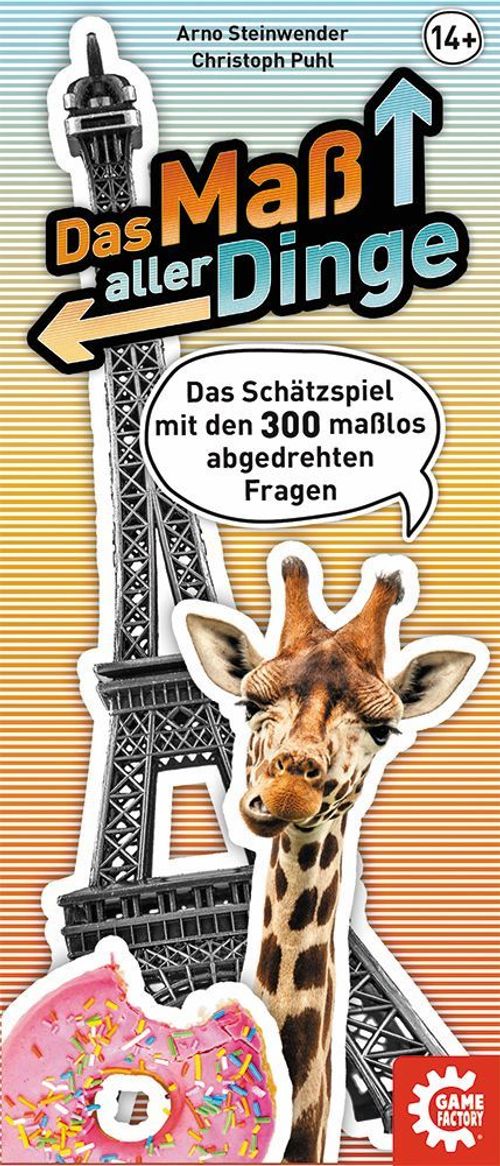
Das Maß aller Dinge
Das Maß aller Dinge Rulebook
Table of Contents
Table of Contents
Contents
- 1 "Maß aller Dinge" (the measure of all things)
- 18 estimate strips (3 each in 6 colors)
- 300 question cards
- 6 measuring tapes with slider
Object of the Game
Questions like these, and other wacky estimating questions, must be answered in "Das Maß aller Dinge" to grab the most centimeters. Or rather: you have to estimate the right solution! You decide for yourself how much risk you want to take! If you cover only a small area of the "Maß aller Dinge", you get many centimeters; if you cover a large area, you get fewer centimeters. The first player to collect 15 cm wins.
Setup
Each player receives a 20 cm measuring tape and the 3 estimate strips in the matching color.
Place the "Maß aller Dinge" in the middle of the table and next to it a stack of question cards, picture-strip side down. You will not need all the cards for one game.
The Question Cards
Each card asks for an exact value within a particular scale, for example from 0 to 20 years. You will always find the scale matching the question at the bottom edge of the question card. It is a small version of the "Maß aller Dinge". The start and end values of the large "Maß aller Dinge" always refer to the current card.
This colored scale is found again on the "Maß aller Dinge". The picture strip on the card must match exactly the strip on the "Maß aller Dinge".
(The card's side margin lists the gain: 2 cm, 3 cm, 5 cm.)
Gameplay
One card is played after the other. The player with the longest index finger takes the first card from the stack. He reads the question aloud and names the start and end point of the scale. Then he places the card, clearly visible to all, above the "Maß aller Dinge". Everyone may make an estimate - including the reader. Important! Nobody may see the back.
1. Estimating
The reader begins. He chooses one of his three estimate strips and uses it to cover the area on the "Maß aller Dinge" where he suspects the right answer. If he lays a short estimate strip, he gets more centimeters if he is right. But the risk of being wrong is of course greater. Laying a long estimate strip brings less gain, but covers a larger area.
In this way, all players in turn lay one of their estimate strips on the "Maß aller Dinge".
Is the area you want to cover already covered? No problem! You may also lay your estimate strip on top of the estimate strips already laid. It does not matter whether you lay it offset or exactly congruent.
| Estimate strip | Risk |
|---|---|
| short | small |
| medium | medium |
| long | large |
2. Resolution
Have all players made their estimate? Then comes the moment of truth: turn the question card over and read out the answer. Then lay it on the picture strip of the "Maß aller Dinge" so that the picture strip on the card lines up with that on the "Maß aller Dinge". The white arrow now points exactly to the solution of the question.
3. Scoring
Does the white arrow point to your estimate strip? Congratulations! You get as many centimeters on your measuring tape as there are marks shown on your estimate strip. This also applies to players whose estimate strips lie above that of another player. What matters is that the extension of the white arrow points to your estimate strip.
After the points are awarded, all players take their estimate strips back.
Example: Players Yellow and Blue have covered the right area. Player Yellow laid the long estimate strip and receives 2 cm. Player Blue laid the short estimate strip and receives 5 cm. Players Red and Green did not lay their estimate strips in the area of the right solution and receive no centimeters.
(In the illustration: the question "How many years would one have to let one's hair grow so that it is 22 m long?"; answer "11 years - A fast-growing hair needs 2 days to become 1 mm longer. So if you don't go to the hairdresser for 11 years, the hair should be 2 m long." [as printed]. Yellow +2 cm, Blue +5 cm.)
End of the Game
The game ends as soon as a player has reached 15 cm or more on his measuring tape. Whoever has the most centimeters now wins. In case of a tie there are several winners.
Pro Variant
If you are estimating pros, it is best to play to 20 cm.
Note
"Although the results in this game are always stated exactly, they are partly based on estimates or approximate values. Enjoy the fun and do not question every value or doubt the result if you find a differently worded source on the internet, but simply enjoy the game."