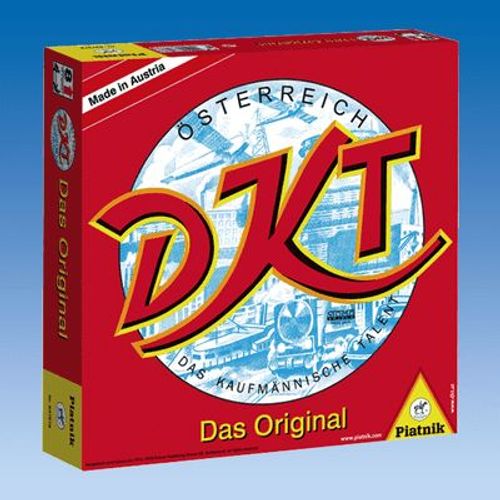
Das kaufmännische Talent
Das kaufmännische Talent Rulebook
Table of Contents
Table of Contents
Introduction
Contents
- 1 game board
- 2 dice
- 6 pawns
- 32 houses
- 8 hotels
- Play money
- 15 Risk (Chance) cards
- 15 Bank (Sparkassa) cards
- 30 property cards
The Risk (Chance) and Bank (Sparkassa) cards are placed face down on the marked spaces of the game board.
3 to 6 players and a banker may take part. If fewer than 7 people are playing, one player also takes over the role of banker.
The banker pays each other player starting capital of 1,500 from the bank's cash, as follows:
- 2 × 200 = 400
- 6 × 100 = 600
- 6 × 50 = 300
- 5 × 20 = 100
- 6 × 10 = 60
- 7 × 5 = 35
- 5 × 1 = 5
Total: 1,500
The remaining banknotes and the property cards stay with the bank. All property items are sold by the bank to the players under the following rules. The player then receives the matching property card, which shows the printed prices, such as the purchase price, the rent, the price of a house or the price of a hotel.
The Game
Objective: At the start, the players decide how long the game will last. For beginners a game of about two hours is recommended. Advanced players play faster, and the game may then last 1 hour.
The player whose assets in cash, land, houses and hotels are highest at the end of the agreed game length is the winner.
Start
The player who rolled the highest total begins. The other players then continue in clockwise order.
Each player receives one pawn, which he moves in the direction of the arrow by the number he rolled.
Course of Play
If a player's pawn lands on the property of a city, he may buy that property. He pays the bank the amount shown on the property card. The property card he receives from the bank must be laid face up in front of him.
The same applies when a player's pawn lands on a structure (Bauwerk) or an enterprise (Betrieb).
To speed up the game, the banker may, at the start, shuffle the property cards and give each player 2 of these cards. The properties shown on them must be bought from the bank.
Professional variant: If a player decides not to buy the property on which his pawn has landed, the cashier must auction it immediately. The starting bid is half of the purchase price shown on the card. All players may take part in the auction, and the property goes to the highest bidder.
When a pawn moves onto a Risk (Chance) or Bank (Sparkassa) space, the top card of the corresponding stack is taken. The instructions on it must be carried out, and the card is then placed at the bottom of the stack.
If a property is already owned by a player and another player's pawn lands on it, the latter must pay the owner the rent for that space. The amounts are shown on the property cards.
The owner must claim the rent as soon as the other pawn occupies the space. Otherwise the right to the rent is lost.
If a player rolls the same number on both dice, for example 3–3 or 4–4, he may roll again and move his pawn by the total of the dice.
If the same numbers come up on both dice three times in a row, the player must go to jail (Arrest) immediately. The same applies if his pawn lands on the space "Violation of the law" (Gesetzesverletzung).
A player who has gone to jail is skipped twice when rolling. If he wants to continue playing in the next round straight away, he may buy himself out. He pays 50 to the bank.
If a pawn lands on the jail space (Arrest) without a violation having been committed, it pays no penalty and continues its path with the next roll.
Each time a player passes Start, the bank pays him a salary of 200. A player who is leaving jail has no claim to this payment.
If a player owns all the properties of a city, that is, all the spaces of the same colour, he may at any time buy houses from the bank and build them on his properties.
Houses must be distributed evenly. A second house may be placed on a space only once the other spaces of the same colour already have a house. Up to 4 houses may be built on each property.
If the bank has fewer houses than are requested, the houses are auctioned to the highest bidder. If the bank has no houses left, any further need can only be met once the bank has got houses back.
To build a hotel, a player must have 4 houses on each building plot of one colour group. He may buy a hotel from the bank and place it on any building plot of that colour group. For this he gives the bank the four houses of that plot, plus the amount of money shown on the property card.
Only one hotel may be built on a property.
Owners of properties, structures or enterprises may sell them to other players at any time, at freely agreed prices. However, no houses or hotels may stand on these properties. If there are any, they must first be sold back to the bank at half the purchase price.
For a hotel, the bank pays half the cash price plus half the value of the four houses that were given in place of the hotel.
Houses and hotels may only be sold to the bank.
Professional variant (mortgages): Only the bank is entitled to grant loans on properties, structures and enterprises. Houses and hotels cannot be mortgaged. If houses or hotels are present, they must first be sold to the bank at half the purchase price, before the property can be mortgaged.
The interest rate is 10%.
If a mortgaged property is sold to another player, the buyer must pay the bank 10% interest, whether or not the mortgage is repaid at the time of purchase. If the mortgage stays in place, the bank is again owed 10% interest when the loan is finally repaid.
The loan amount may not exceed 50% of the purchase price of the property being mortgaged.
The property cards of mortgaged properties, structures and enterprises must be placed face down by the player, and no rent or other charges may be collected from such properties.
If a player is still unable to meet his payments even after selling his houses, hotels and so on, he hands the remaining assets over to the bank. The bank auctions them and pays the proceeds, minus any outstanding loan with interest, to the creditor.
The last remaining player wins.
Apart from loans from the bank, no debts may be incurred. Transactions, rents, risk amounts, penalties and so on must always be paid immediately.
Show your business talent.
Have fun playing the Austrian business game DKT.