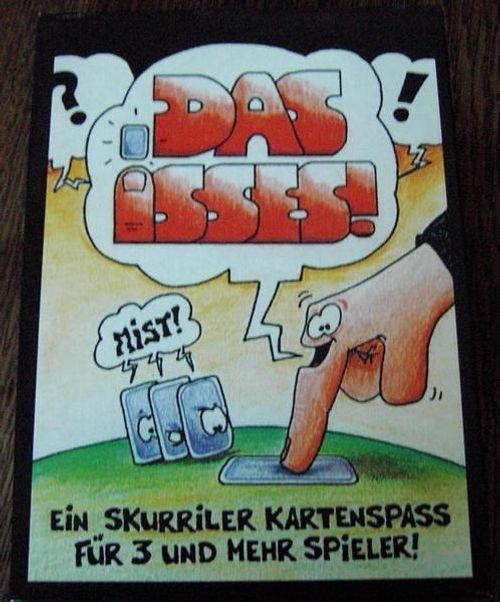
Das Isses!
Das Isses! Rulebook
Table of Contents
Table of Contents
Components
- 170 picture cards (Bildkarten)
- 60 double-sided speech-bubble cards (Sprechblasenkarten), each printed with text on both sides
- Rulebook
- An extra helping of good mood (initially invisible)
Dealing the Cards
The picture cards are shuffled, and each player is dealt 7 face-down. The remaining picture cards form a stack, picture side down.
The speech-bubble cards are shuffled as well and placed face down as a stack that all players can reach easily on the table. Since the speech-bubble cards are printed on both sides, a blank speech-bubble card is placed on top of the stack as a cover card.
Reading Aloud First
The starting player of each round is also the reader and the judge. They draw a speech-bubble card from anywhere in the stack (except the blank cover card on top). They quickly read the text on the front and back of the card, and choose the text they like better. They read this text aloud and place the card in the middle of the table so that everyone can see it.
If the text contains words printed in italics, the "reader" may choose those words freely or make up terms of their own to insert.
If the words are names, they can be replaced with the name of another player. A little imagination and malice rarely hurts here.
Filling in the Gaps
Each speech-bubble card text contains a gap, shown by dots.
The task of the other players (not the "reader") is to choose, from their 7 picture cards, the card that they think fits the gap in the speech-bubble text best. They place the chosen card face down in the middle of the table. "Fits" refers to the text in the lower bar of the picture card, not to the illustration. The illustration is "just for fun."
Once all players have played one of their picture cards, the "reader" takes all the played picture cards and shuffles them until they are absolutely certain they NO LONGER know which player played which card.
Reading Aloud Again
The "reader" now turns the picture cards face up and reads the text of the chosen speech-bubble card several times. Each time they read it, they insert into the gap the text of a different played picture card. (Depending on their linguistic skill, the "reader" should try to make the insertions grammatically correct, or supply the articles and endings as needed to make sense.)
From Reader to Judge
Once this is done, the "reader" becomes the "judge." They now have the responsible task of choosing what they consider the best formulation (whatever that small word may mean). The player who contributed the picture card to this "best" formulation then reveals themselves immediately.
They have won this round. As a reward, they may score three points. Because the picture cards played in this round are no longer needed, the winner of the round may take three of these cards and set them aside to record their score. (Caution: never mix these with the picture cards not yet used!)
Special Rule for the Indecisive
Not everyone is cut out for judging, and indecisive judges can have trouble deciding on a "best" formulation. In this case, the THREE points may exceptionally be split between TWO players. The "very best" formulation then scores two points (two cards), and the "second best" formulation scores one point (one card). Splitting the points between three equally good "very, very best" formulations is not allowed.
Next Round, New Judge
Once the administrative work is done, each player refills their hand of picture cards to 7 from the stack. (Cards that have been "won" do not count here.)
A new round begins with the next starting player / reader / judge. The previous starting player / reader / judge becomes a "normal" player again.
Who Wins?
The game ends when each player has been the starting player / reader / judge 3 times. Alternatively, a set playing time, for example 45 minutes, can be agreed in advance. When the time is up, the current round is played to the end, for fairness, meaning play continues until every player has been starting player / reader / judge the same number of times.
The player with the most points in total wins the game. (Counting the won picture cards is helpful here!)
Note
The blank cards (other than the cover card) disrupt play if left blank, so they must be sorted out in advance.
If you want to win (which, in our opinion, is not necessarily the top priority with "Das Isses"), it is very important to have at least a rough idea of what the respective "judge" considers the "best" picture card: the most realistic, the craziest, the most disgusting, the dumbest?????!!!!
Playing with Only 3 Players
"Das Isses" is best played with 4 or more players. It also works with 3, but with the following rule changes:
The judge must choose one of the two formulations, and this earns exactly one point (one card). Points cannot be split (that would be hard with a single point. You surely don't want to attack the game with scissors).
The speech-bubble card shown alongside this section does not work with only 2 played picture cards. With 3 players, the "reader" must therefore make do with the text on the back of the card if they draw this card.
Example speech-bubble card: "If I were to fuse two different objects into a work of art, I would decide on ...." (Points awarded only 2:1! Usable only with 4 or more players!)