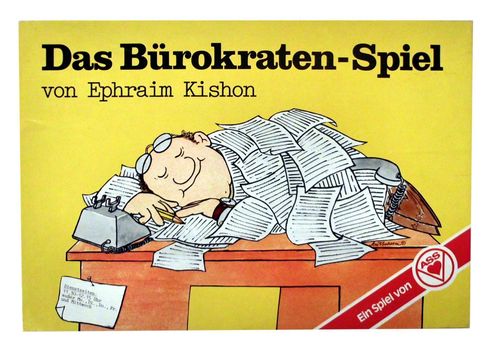
Das Bürokraten-Spiel
Das Bürokraten-Spiel Rulebook
Table of Contents
Table of Contents
Components
- 1 game board
- 12 citizens in four colours (without reference to any party affiliation)
- 16 officials (the ratio of citizens to officials corresponds largely to reality)
- 1 die (with which, judging by the results, decisions are also made in offices)
- 32 event cards (with official instructions, which are to be followed strictly and not taken too seriously)
The components list prints 32 event cards; the Setup section below prints 33. Both figures are as printed.
Number of players: 2 to 4. Each player receives 3 citizens of one colour.
Setup
The 16 officials are placed in the light-red marked "lower" offices. The desks of the "middle service" (light blue) and of the "senior service" (light green) are not yet occupied at the start of the morning (at the start of the game).
Each player places his 3 citizens on the same-coloured starting points of one of the 4 agencies. If only two or three players take part, leave some starting spaces free, but in every case all 16 offices are filled with officials (to create a realistic picture — or have you ever found an office that was unoccupied simply because there was nothing to do?).
The 33 event cards (as printed in this section; see the note under Components) are shuffled well and placed beside the game board, text side down.
Each player rolls the die once. Whoever throws the highest number presumably is related to the doorkeeper of an authority and may begin.
Object of the Game
Each player tries to bring his 3 citizens from the start, past the offices, through the various floors of the agencies, to the goal in the centre, while at the same time obstructing the other visitors as effectively as possible so as to reach the goal earlier. This aggression-releasing, pedagogically very valuable effect makes the game suitable for young people too.
Rule Set I (Spielregel I)
This way of playing is recommended to people with heart conditions, as well as to people with high blood pressure, choleric types who have already smashed a Halmabrett (an untranslated colloquial term from the printed text), and to shy people who already stutter at the doorkeeper in government offices.
Turn Sequence (Spielverlauf)
In turn, each player rolls the die and must, according to the number rolled, move one of his 3 citizens: forward, backward or sideways, as he chooses. A citizen may never move onto an occupied space. Citizens standing in one's way are simply jumped over. Each player may choose his own path to the goal. He does not have to remain in the agency in which he started. But he must always move when he has rolled, even if that means moving back again.
Each official exercises a blocking effect corresponding to his natural function. No citizen may jump over him; he must wait until the official is transferred or promoted, so that the temporarily unoccupied office can be passed to reach the next floor of the agency.
Transferring and Promoting Officials
Whoever rolls a 6 does not move, but must transfer or promote an official to another unoccupied office. Promoting means: the official is sent to the next higher service rank, that is, from a light-red "lower" office first to a light-blue "middle" office, later to a light-green "senior" office, and from there finally into retirement (he is removed from the game). It is up to the player who rolled the 6 whether he promotes or transfers. One naturally chooses, mischievously, a still unoccupied or already vacated office where the official will obstruct the other citizens most effectively. A transfer back to a lower service rank is impossible. It does not matter to which agency the official is promoted — here too, realism is preserved.
Transferring means: the official wanders clockwise or anticlockwise by exactly 6 offices and remains in his service rank (so for example he goes from a light-blue office again to a light-blue space).
A player must have at least one citizen in the agency from which he wants to throw out an official. (The printed text uses the verb "hinauswerfen" here for an official, although throwing out is otherwise reserved for citizens; it is rendered literally.) For this pleasure he gladly forgoes moving the 6 he rolled as well. He leaves his citizen in place and passes the vacated office only when he is next to move (unless, by then, another official has been set in front of his nose). However, if a player has one or more citizens in an agency all of whose offices are already vacated, he may move the number of the 6 rolled. In all other cases, officials must be transferred or promoted each time a 6 is rolled.
If a citizen is on a border space between two agencies, then when a 6 is rolled any official from either of the two agencies may be transferred.
Throwing Out
In principle, no citizen may throw out another citizen. This pleasure is offered to every citizen only on the unoccupied offices of the senior service (light green) shortly before the goal.
Event Cards
When a player with a citizen lands on an E-space (Feld E), he must take an event card from the stack, read it aloud and obey it.
End of Game
Be glad that the "Bureaucrats' Game" has an end at all. That is the only difference between the game and reality.
A citizen who has happily reached the centre point of the game board, which is outlined in black and has four colours (it must be reached with exactly the matching die number), sees all the longings and wishes a person can have fulfilled. He becomes an official and is immediately sent into retirement (that is, taken out of the game). The player who first brings his 3 citizens into the goal, passing over the space with his index finger, is the winner.
Rule Set 2 (Spielregel 2)
Before this harsher way of playing, we recommend that each player obtain a medical certificate concerning his state of health, procure a police certificate of good conduct, and tie all players to their chairs.
The following rules may be adopted as harassments (Schikanen):
- Since the agencies open at 8 o'clock, each player must roll at least 8 pips in two consecutive rolls before he may move for the first time. After that, only one roll is made each time.
- Jumping over other citizens is to be avoided. Please line up at the back.
- To be allowed to pass an unoccupied office, one must first knock at the door; that is to say, one must land with the matching number exactly on the space in front of it. Only then may one pass through.
- Any citizen who presumes to occupy a free office may be thrown out, namely a) by officials who arrive at this office in the course of a transfer or promotion, and b) by other indignant citizens who arrive at the office with the matching die number.
- The transition from one agency to another is permitted to the citizen only if he stands exactly on a border space between two agencies and can show a pass slip; that is to say, a 1 is rolled.
- On the highest floor of the agencies, shortly before the goal, the law of the elbows prevails: on all spaces behind the last 4 E-spaces, each citizen may throw out any other citizen, whereby the transition from one agency to another is permitted only via the light-green "senior" offices — provided they are of course free.
- As soon as a citizen has reached the goal and leaves the game, he may arbitrarily move a retired official back to any free office, including on the topmost or bottommost floor. In this way one can throw out a citizen who stands on one of the last offices before the goal.
Closing words as printed: And now you can invent further harassments yourself. Incidentally, any resemblance of names or appearance to real officials is purely coincidental and not intended.