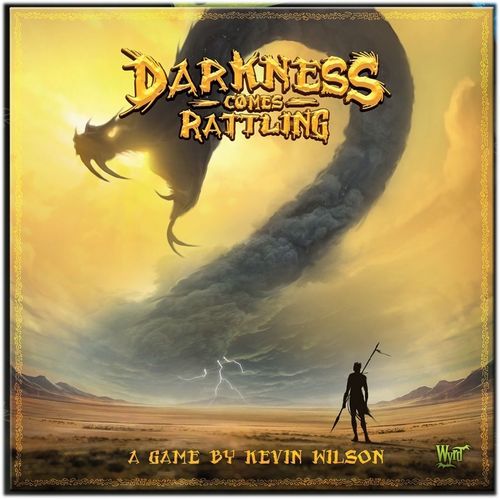
Darkness Comes Rattling
Darkness Comes Rattling Rulebook
Table of Contents
Table of Contents
Overview
Darkness Comes Rattling is a cooperative game for 2-6 players that takes approximately 1-2 hours to play. The players take on the roles of Warriors from the Tribes of Man who have been chosen to battle Darkness, a colossal snake that has swallowed the sun. The players must cooperate with each other as they face the challenges of their world and eventually choose the bravest of their number to enter the mouth of Darkness and rescue the sun.
Goal of the Game
The players must retrieve the sun from within Darkness before the snake finishes digesting it. In order to win, the players must gather spirit weapons and choose one Warrior to enter Darkness as their champion. While this champion struggles to reach the swallowed sun, the other players will have to defend their mortal realm from Shadows, the amorphous minions of Darkness, lest they corrupt the world and plunge everything into eternal night. If Darkness finishes swallowing the sun, or the Shadows gain too much influence in the world, then the players lose the game.
Winning the Game
If a Warrior enters the same space as the Sun marker and wins the Final Challenge, the game immediately ends in a victory for the players.
Losing the Game
The players immediately lose the game if:
- The Sun marker moves onto Darkness' Rattle (the last space of the Darkness Track).
- A Warrior is killed while on the Darkness Track.
- There are no Winds in play.
Components
- This Rulebook
- 1 Game Board
- 4 Wind Boards
- 6 Character Cards
- 6 Warrior cutouts
- 6 Spirit cutouts
- 12 Character bases
- 1 Custom Dark Die (black)
- 3 Challenge Dice (red, blue, and yellow)
- 6 Reference Sheets
- 65 Tokens, including:
- 20 Wound tokens
- 4 Merchant tokens
- 4 Wind tokens
- 36 triangular Corruption tokens
- 12 red (one 1, one 2, one 3, four 4s, three 5s, two 6s)
- 12 blue (one 1, one 2, one 3, four 4s, three 5s, two 6s)
- 12 yellow (one 1, one 2, one 3, four 4s, three 5s, two 6s)
- 1 Sun token
- 282 Cards, including:
- 36 North Challenge Cards
- 36 East Challenge Cards
- 36 South Challenge Cards
- 36 West Challenge Cards
- 12 Shadow Challenge Cards
- 12 Darkness Challenge Cards
- 12 Event Cards
Anatomy of Cards
Character Cards
Character cards have two sides, a Warrior side and a Spirit side.
- Warrior side: Name, Skill (upper right corner; the red, yellow, or blue icon), Wounds (heart boxes), Ability, Action Points (lower right corner), and Blessing.
- Spirit side (blue): Name, Wounds, and Ability.
Example (Lupe): Warrior side - Powerful: "Once per Day, you may increase or decrease by one the value of a Challenge Die rolled by any Warrior." Spirit side - Pack: "If you are in the same space as another Warrior or Spirit, you may face Challenges as if you were a Warrior." Keen Nose: "When you or a Warrior in this space would gain Rewards, you may suffer a Wound to draw two Rewards and gain one. Discard the rest."
Items
There are three types of Items: Equipment, Reward and Legendary, each with their own card backs. An Item card shows its Name and an Effect (for example, Bow: "When used to Modify a Challenge, you gain a Reroll.").
Events
Events are special happenings on the world of Tallil. Events are caused by Darkness, and the players should beware their coming. An Event card shows a Name, a Type (for example Bad), Flavor Text, and an Effect.
Example: "The False Maiden" (Bad): Exhausted from your day's travel, you find yourself on the shores of an enormous lake... When you awake the next morning, the maiden and her hut are gone, as are some of your possessions! Effect - Each Character discards all of their Bones.
Challenge Cards
There are three types of Challenge Cards: Region, Shadow and Darkness. Challenge Cards are how most conflict in the game is resolved. A Challenge Card shows (front) its Type, Name, Skill, Difficulty, Modifiers, Flavor Text, Pass Text and Fail Text; the back shows the Region and whether the card has the Revealed icon.
Example (East Challenge, "Carpet of Spiders"): Difficulty 9. Pass Text: "After driving the spiders off, you find the remains of an unlucky soul. Gain 1 reward." Fail Text: "The spiders crawl all over you, biting as they go before scattering. Suffer 1 wound."
Setup
- Place the board in the center of the table. The board contains the Village in the center and four Regions of varying colors (Blue is North, Orange is South, Green is East, and Yellow is West).
- Place the 4 Wind boards next to their respective Regions, attaching them to the main game board. Place the Wind tokens in the center of their matching Wind Tracks (on the 0 space).
- Place the Bonesmith Merchant tokens in the triangular North West Merchant and South East Merchant spaces, with the Bonesmith sides face up. Place the Millennium Tortoise Merchant tokens in the triangular North East Merchant and South West Merchant spaces, with the Millennium Tortoise sides face up.
- Take the Sun marker and place it on Darkness' Head (the first space of the Darkness Track).
- Shuffle the Event Cards together and place them facedown next to the board to form the Event deck. Do the same with the Reward Cards to create the Rewards deck.
- Find the four Legendary Items (North Wind's Torc, South Wind's Shield, East Wind's Mask, and West Wind's Sandals) and set them aside.
- Separate the Equipment cards into separate piles, sorted by type of Equipment, and set each pile face up near the board.
- Create the North Region deck by shuffling all of the North Region Cards together and placing the resulting deck facedown next to the board. Do the same with the East, South, West, Darkness and Shadow Cards to form their respective decks.
- Each player chooses a Character, either at random or (if the players agree) by choosing his or her favorite. The player takes the Character Card matching the character they have chosen and places it in front of them, with the Warrior side (the side with the human picture) face up. The player then places the cutout matching their Warrior in the Village in the center of the board.
- Each player places a Wound token on each empty heart box on their Character Card, until each heart box has a Wound token.
- Place all the Corruption tokens into the Corruption Bag and give it a good shake to mix them up.
- Set the three colored Challenge Dice and the Dark Die within easy reach of every player.
The Tribes of Man called out to Mother Moon, for they were cold and the world was dark. Mother Moon's heart was moved by their pleas, and so she took her knife and cut out her left eye. Then, taking the eye in her hand, she breathed power into it, causing it to glow brighter and brighter, like an ember, until it burst into flames. With that, she hurled the eye into the sky, where it hung, becoming the sun, bringing light and warmth to all the world.
The Game Board
There are two sections of the game board. The first is Tallil, the central area consisting of the Village, four Regions (North, South, East, and West), and four Merchant spaces. Each of the Regions is further divided into three spaces, which have room to hold Challenge Cards (the large boxes) and Characters and Corruption tokens (the small boxes).
The second board section is Darkness, the outer snake that is referred to as the Darkness Track. Characters cannot move back and forth between these two sections.
Board features labelled in the rulebook: Darkness' Head, Darkness' Rattle, Darkness Track space, Darkness Track Icon, North/West/East/South Region, Village, Merchant Space, Wind Board.
Turn Sequence
Game Turns in Darkness Comes Rattling are referred to as Days. Each Day is broken up into three phases, as noted below. Once a Day has ended, a new Day begins, continuing on in this manner until the players either win or lose the game.
- Dawn Phase - Each player spends his or her action points to move or perform actions (see below).
- Challenge Phase - Each player resolves a Challenge in their space (see Challenge Phase).
- Dusk Phase - Refresh the game board for the next turn (see Dusk Phase).
Dawn Phase
During the Dawn Phase, the players choose a Character to take his or her Dawn turn. Once the Character's Dawn turn has ended, the players choose another Character to take his or her Dawn turn. This continues until every Character has taken exactly one Dawn turn.
During their Dawn turn, Warriors receive action points (equal to the number in the lower right corner of their card) to spend during the turn. A Warrior may spend one action point to perform one of the actions listed below. Each action can be performed multiple times during a turn, provided that the Warrior spends one action point per action. A Warrior may choose not to spend all of their action points, but any unspent action points are lost at the end of the Warrior's turn.
Actions
- Move one space on the board (for both Tallil and the Darkness Track). Warriors can only move between adjacent spaces, but may move in any direction, even back and forth onto the same spaces multiple times.
- Scout a facedown Challenge Card in the Warrior's space. This reveals the Challenge Card by turning it face up, and triggers any Scouted effect on the card, if any.
- Purify a Corruption token in the Warrior's current space by discarding it. The color of the Corruption token must match the color of the Warrior's Skill (the red, yellow, or blue icon) in the upper right corner of the Warrior Sheet (see Corruption).
- Give a single Item in the Warrior's possession to another Warrior in the same space.
Spirits work slightly differently than Warriors. Spirits do not receive action points, but can move to any space on Tallil during their Dawn turn. Because they do not receive action points, Spirits cannot Scout, Purify, or Give.
Special Abilities
Many Characters have special Abilities or Blessings that work during certain phases. These abilities can happen at any time during that phase, not just during the Character's turn.
Merchant Spaces
A Character that moves onto a Merchant space may use the ability of the face up Merchant token in that space. These abilities frequently require the Character to discard one or more Bones, but do not otherwise cost any action points. A Character can only use Merchant spaces during their Dawn turn. Each Merchant's ability can be found on the Reference Card.
Darkness, the great serpent, was created in the same instant that Mother Moon created the sun. There could be no light without shadow, so by creating one, she created the other. Although Mother Moon created Darkness, it was not an act of intentional creation. Darkness was different from everything else she had created, and where other creatures felt love for Mother Moon, it was jealous of her power. When its mother fell asleep, Darkness crept into the sky. Unhinging its jaw like the snake it was, it swallowed the sun in a single gulp. However, Darkness was burned as it tried to absorb the sun's light, and so the snake had to hide away until it could digest its meal.
Challenge Phase
During the Challenge Phase, the players choose a Character to take his or her Challenge turn first. Each Character will then either face a Challenge Card or (if there is no Challenge Card to face) roll the Dark Die. The Challenge Phase works differently depending on whether the Character is on Tallil or the Darkness Track.
- Tallil - If a Character is in a space with a Challenge Card, the card is flipped face up (if it was facedown) and the Character faces the listed Challenge. Spirits may only face certain types of Challenges, as described under Spirits.
- Darkness Track - If a Warrior is on the Darkness Track, the Warrior looks at the top two cards of the Darkness deck and chooses one to face, discarding the other.
Once a Character faces a Challenge and resolves it, the Character's Challenge turn is over and the players choose another Character to go next. This process continues until every Character has taken exactly one Challenge turn.
Rolling the Dark Die
Sometimes, a Character on Tallil may not be able to face a Challenge (for example, there might not be a Challenge Card in their space). In these instances, the player rolls and resolves the Dark Die instead of facing a Challenge (see Dark Die for more details).
Facing a Challenge
Challenges can come from Region Cards, Shadow Cards, or Darkness Cards, all of which are collectively known as Challenge Cards. When facing a Challenge, follow the steps below:
- Roll the 3 Challenge Dice and the Dark Die.
- If you have any Rerolls, you may use them now (see Rerolls).
- Add the 3 Challenge Dice together to get your Challenge Value, ignoring any dice that are affected by Corruption (see Corruption).
- Add any Modifiers to your Challenge Value based on Items in your Character's possession (see Modifiers).
- If your Challenge Value is equal to or greater than the Challenge's Difficulty, you succeed and follow the instructions listed in the Pass Text of the Challenge Card (green background). If there is a Warrior on the Darkness Track, there may be an additional effect (see The Darkness Track). Otherwise you fail and follow the instructions listed in the Fail Text of the Challenge Card at the very bottom (red background).
- Unless the Pass Text or Fail Text of the Challenge Card notes that it "Stays in Play," discard the Challenge Card from the space. If you succeeded, any Corruption tokens in the same space as the Challenge Card are also discarded.
- Resolve the Dark Die (see Dark Die for more details).
Scouted and Special
If a Challenge Card has a Scouted effect that applies to the Challenge, the effect only applies to the Character who Scouted the Challenge Card (unless the card says otherwise). Scouted effects only ever apply on the same Day the Challenge Card was Scouted.
If a Challenge Card has a Special effect, it applies every time a Character faces the Challenge.
Skills
There are 3 primary Skills in the game: Mind (yellow icon), Body (red icon) and Spirit (blue icon).
Some Challenges possess multiple Skill icons. In these cases, a Character that matches any of the listed Skills will receive a Reroll.
Spirits count as possessing all Skills (and thus always receive a Reroll on Challenges they are facing).
Rerolls
A Reroll allows the Character to pick up any one of their dice (whether one of the Challenge Dice or the Dark Die) and roll it again, ignoring the original result. If a Character has multiple Rerolls, each Reroll is resolved one at a time. Any of the dice may be Rerolled multiple times, as long as the Character has Rerolls remaining.
Rerolls can come from several sources, including:
- When a Character faces a Challenge with a Skill that matches their own, they receive one Reroll. For instance, a Warrior with the Body (red) Skill would gain a Reroll whenever he or she attempts a Body Challenge, while a Warrior with the Mind (yellow) or Spirit (blue) Skill would not.
- Some Items may grant a Character a Reroll, as indicated on their Item Card. For instance, a Bow provides a Reroll when it Modifies a Challenge Card.
- Some Characters have Abilities or Blessings that grant Rerolls.
Corruption
If the number and color of one of the Challenge Dice match the number and color of a Corruption token in the same Region as the Challenge being faced, the number on that Challenge Die is considered to be a 0.
Sometimes, Warriors will become corrupted and have Corruption tokens placed on them. These tokens are placed on the Warrior's Character Card and apply to whatever Region the Warrior is in, just like normal Corruption tokens. Additionally, if the Warrior is on the Darkness Track, these Corruption tokens apply to the Warrior's Challenge Rolls made in Darkness. Corruption tokens on a Warrior's Character Sheet may not be removed with the Purify action.
Shadow Cards each possess a special Shadow Corruption icon on their front sides, where you would normally find the card's Type. If the number on any Challenge Dice match the number of a Shadow Corruption icon in the same Region as the Challenge being faced, the numbers on those Challenge Dice are considered to be a 0.
Corruption tokens only affect the final value of a Challenge Die. If a Character Rerolls the Challenge Die or changes its value, it is no longer affected by that Corruption token (unless, of course, its new value also matches the color and number on a Corruption token in the Region).
Example: A Warrior is in a Region containing a red 4 Corruption token. She rolls the Challenge Dice on a Challenge with Difficulty 10, and gets a red 4, and two other dice. Normally this would be enough to pass the Challenge, but because of the 4 Corruption token, the 4 on her Red Challenge Die is reduced to 0, giving her a total of 7, which is a failure. Deciding that she wants to pass this Challenge, she uses a Reroll to reroll the Red Die, and her total becomes a 12, which passes the Challenge.
(The example's other die values are shown only as icons in the source; the totals are as printed.)
Modifiers
Near the top of each Challenge Card are stylized icons depicting the various Items that will help a Character in facing the Challenge, along with the numerical bonus that the Item provides, known as its Modifier. For instance, if a Challenge has a picture of a Torch over a +2 Modifier, then a Character who has at least one Torch adds +2 to their Challenge Value while facing that Challenge. No matter how many copies of an Item a Character possesses, they only receive the Modifier for that item once.
There are three special icons on Challenge Cards that do not match the icons of Items:
- Assistance - This icon represents a Challenge that can benefit from having multiple Characters working to complete it. If a Character faces a Challenge with this icon while there are one or more other Characters in the same space, they gain the listed Modifier. This Modifier only applies once, no matter how many Characters are in the same space.
- Weapons - This icon represents the Bow, Axe, Spear, Spirit Bow, Spirit Axe, and Spirit Spear items. If a Character possesses multiple weapons of different types (such as a Bow and a Spirit Axe), they must choose which weapon they wish to use to modify the Challenge. If the icon is white, any of the above items will provide the Modifier. If the icon is blue, only spirit weapons will provide the listed Modifier.
- Bone - This icon represents a Challenge that grants a Modifier if the Character has a Bone. If the character possesses either type of Bone, they gain this Modifier (but still only once, even if the Character has different types of Bones).
Weapon Abilities
Weapons have Effects that only apply when they Modify a Challenge. If a Weapon cannot Modify a Challenge (i.e., when no Weapon is listed as a Modifier or when a different Weapon is chosen to Modify), then the Weapon's Effect cannot be used.
Dark Die
The Dark Die represents the influence of Darkness upon Tallil. Each time the Dark Die is rolled, bad things happen in the mortal realm, as determined by the result:
- 1 Rattle / 2 Rattles: Advance the Sun token forward along the Darkness Track a number of spaces equal to the number of Rattles rolled. If the Sun ends its movement on a space with a special icon (and not just moves over it), the effects of that icon are immediately resolved (see Darkness Track spaces). If the Sun ends on the Darkness' Rattle space at the end of the Darkness Track, it is extinguished and the players immediately lose the game.
- Shadow: One Corruption token is added to each space adjacent to a Shadow Card. Then, add one Corruption token to each space containing a Corrupted Challenge (Corrupted Challenges have the eyes of Darkness in their upper corners), whether face up or facedown. The Village can never receive Corruption tokens.
- Eye: One Corruption token is placed in any space in the Region of the Character that rolled this Die. If the character is not in a Region, there is no effect.
Placing Corruption
When a Corruption token is added to the board, a player randomly draws a Corruption token from the Corruption Bag and places it face up on the appropriate space. If multiple Corruption tokens are placed on the board at the same time, the player must note which space the Corruption token is being placed on before drawing it from the Corruption Bag. Continue placing Corruption tokens in this way until all necessary Corruption tokens have been placed on the board.
Corruption tokens can never be placed on spaces containing Shadow Cards or Shadow Merchants. If a Corruption token would be placed on a space containing a Shadow or Shadow Merchant, it is ignored.
If a third Corruption token would ever be placed on a space, it instead succumbs to a Shadow. See Shadows for more details.
Dusk Phase
The Dusk Phase prepares the game for the next Day. Follow the steps below:
- For each Region, deal one Region Card facedown from the appropriate deck into each space that does not already contain a Challenge Card.
- Every Spirit in play heals 1 Wound.
- Turn all Shadow Cards and Challenge Cards with the Revealed icon on their back face up. All other facedown Challenge Cards should remain facedown.
- If there are 3 Shadows in a Region, Anger that Region's Wind.
- Shuffle any discarded Darkness Cards back into the Darkness deck. Then, begin a new Day with the Dawn Phase.
Wounds
Over the course of their quest, it is almost inevitable that one or more Characters will suffer Wounds. Each Character has a number of Wounds indicated on each side of their Character Card.
When a Warrior suffers a Wound, they remove one of the Wound tokens from their Character Card. When the last Wound token is removed, the Warrior is killed. Follow the steps below:
- Discard all Corruption tokens on the Warrior.
- Flip the Character Card over to reveal the Spirit side (this side is blue). The Character is now a Spirit, not a Warrior.
- Replace the cutout representing the Warrior with the cutout representing their Spirit form, and move to the Village.
When a Spirit suffers a Wound, they remove a Wound token from their Character Card as normal. If a Spirit loses its final Wound, it is no longer able to use its Ability.
When the Tribes of Man awoke the next morning, they found that the sun was gone. In its place, Mother Moon still hung in the sky, shining as brightly as she could to make up for the lack of light. However, the Elders of the Tribes could feel her power weakening as Darkness slowly digested the sun, and knew she couldn't keep it up forever. Gathering up the greatest warriors of the Tribes, the Elders said to them, "You must find a way to retrieve the sun from Darkness' stomach, or all of Tallil will be lost to its all-consuming hunger. Seek the lost spirit weapons, those forged in the old days when the Four Winds watched over the Tribes. Seek the Sunstones, scattered remnants of the sun that still hold some of its power..."
Spirits
When a Warrior is killed, they are able to continue their quest as a Spirit. Spirits have a few special rules:
- Spirits cannot face most Challenge Cards. They may only face Shadow Cards or specific types of Region Cards as indicated on their Character Card (and even then, only if the Region Card in question is face up; Spirits may never face facedown Challenges). If a Spirit is unable to face a Challenge in their current space, they must still roll the Dark Die as normal.
- Spirits are, for all intents and purposes, immortal, but they may not use an Ability or Blessing that causes them to suffer Wounds while they do not have any Wounds to suffer. Spirits start with 0 Wounds.
- If a Spirit heals all the Wounds on the Spirit side of their Character Card, they Revive. The Character is immediately returned to life following the steps below:
- Flip the Character Card over to reveal the Warrior side. The Character is now a Warrior, not a Spirit.
- Place Wound tokens on the empty heart boxes on the Character Card, until each heart box has a Wound token.
- Replace the cutout representing the Spirit with the cutout representing their Warrior form, and move to the Village.
Turns
It is possible that a Warrior could be killed or Revived during the Dawn or Challenge Phases. Even if a Warrior became a Spirit or a Spirit returned to life as a Warrior, they still only gain a single turn during these phases. If this happens during one of their turns, the turn immediately ends after being killed or Revived.
Winds
The Four Winds are some of the most powerful spirits on Tallil. As occasional allies of the Tribes of Man, their influence is helping to hold Darkness at bay.
Each Wind has its own Wind Board that tracks the Wind's current attitude, and informs you how that attitude impacts their Region.
As the game progresses, certain effects may cause you to Please or Anger a Wind.
When you Please a Wind, move the appropriate Wind Token one step clockwise along its Wind Track. When you Anger a Wind, move the Wind Token counterclockwise along its Wind Track. If the Wind Token is unable to move counterclockwise along its Wind Track, the Wind abandons humanity and is removed from play.
The Wind's current attitude has an impact on its Region, as described on the Wind's board.
The Winds will grow angry as they watch Darkness' influence spread throughout their Region. Whenever a Shadow is placed in a Region space, Anger that Region's Wind.
If, at any time, there are no Winds left in play, the players lose the game.
Shadows
If a space ever gains three Corruption tokens, it succumbs to a Shadow and a special effect occurs, depending upon the space:
- If the space is a Region space, discard any Region Card and Corruption tokens in that space, then place a Shadow Card face down in that space from the top of the Shadow deck.
- If the space is a Merchant space, discard any Corruption tokens on it and flip the Merchant token over to reveal the Shadow Merchant on the reverse side.
At times, a Shadow will be added to the board by another effect. In these cases, treat it as a space that has just gained 3 Corruption tokens, as above.
Shadow Merchants
Every Merchant has a dark counterpart, a Shadow Merchant. These Merchants have the same effect as their counterparts, but require a darker price.
"Darkness' corruption spreads; its Shadows have already begun to consume the Wild Lands. Its shades have hidden across the land, taking on the shapes and abilities of dozens of creatures." The Elders continued, "You will need to guard each other at all times and show proper respect for the spirits. Do not call on their aid lightly, but do not forget that they are there for you, either." With that, the Elders blessed each of the Warriors. "Go now, and remember that the hopes and lives of all the Tribes of Man are now in your hands. You are our greatest warriors, and if you cannot defeat Darkness, then no one can."
The Darkness Track
The Sun starts the game on Darkness's Head and moves down its body towards Darkness' Rattle over the course of the game. Each time one or more Rattles are rolled on the Dark Die, the Sun moves that many spaces down the Darkness Track. When the Sun or a Warrior ends its movement on (not just moves past) a space with a special icon, a special effect takes place, as determined by that icon:
- Darkness' Venom: Immediately add 1 Corruption token to each Region. This Corruption token may be placed on any space in that Region, but not on spaces containing a Shadow Card.
- Nightfall: Choose one space in any Region that does not contain a Region Card. Discard any Corruption tokens in this space, then add a Shadow to this space from the Shadow deck. If there are no empty spaces in any Regions, there is no effect.
- Portents of Darkness: Resolve an Event Card.
- Rumor: A Warrior or Spirit anywhere is healed 1 Wound. The player who rolled the Dark Die, landed on this space, or resolved the Challenge that moved the Sun may choose who heals the Wound. Additionally, if the Sun lands on this space, and a Warrior has not yet entered Darkness, the players may choose a Warrior to enter Darkness.
Entering Darkness
If the Sun ends its movement on a space with a Rumor on it, the Warriors hear stories of the colossal snake and how they might trick it into swallowing one of them. The players may discuss among themselves and, if they wish, choose one Warrior to enter Darkness in an attempt to retrieve the Sun. Only Warriors with Spirit Weapons may enter Darkness; no other weapon has any hope of defeating the fearsome creatures within the evil snake.
This should not be a decision that is taken lightly. Only those Warriors who are healthy, fast, and well-armed have any hope of retrieving the Sun. Make sure the chosen Warrior has plenty of items and spirit weapons if you want them to have any chance of completing their Challenges.
It is possible that the players might decide that none of them are quite ready to enter Darkness, instead choosing to wait for the next Rumor to surface while they work to become stronger. This can give the chosen Warrior a better chance, but players are advised not to wait too long; each time they delay entering Darkness, the Sun moves further and further down the snake's body, making it more difficult to retrieve.
When a Warrior chooses to enter Darkness, they are placed on Darkness' Head on the Darkness Track. Any time a Warrior on Tallil succeeds on a Challenge Card, the Warrior in Darkness may move forward 1 space after the Challenge is fully resolved. If this movement causes the Warrior to land on a Darkness Track icon, it does not resolve.
The Final Battle
If the Warrior inside Darkness moves onto the same space as the Sun (or, more rarely, the Sun moves onto the Warrior), the Warrior must immediately face a Darkness Challenge at +2 Difficulty. Unlike normal Darkness Challenges, the Warrior does not draw 2 Darkness Cards and choose which one to face; they must face the top card of the Darkness deck, no matter what it might be. If the Warrior succeeds, they retrieve the Sun and the players win the game! If the Warrior fails, however, the Sun moves ahead 2 spaces. If a Warrior dies within Darkness, the players lose the game.
Miscellaneous Rules
Affecting Other Players
You may not move another Warrior or affect any of their dice rolls without their permission.
Equipment Supplies
There is a finite amount of Equipment in the world. If there are no remaining copies of a given piece of Equipment (because they are all owned by Characters), then the Character may not purchase or otherwise gain that Equipment. If the Equipment later becomes discarded, it can be purchased again.
Discarding
Discarded cards are placed face up next to their appropriate deck, forming a discard pile. If you ever need to draw a card and there are no cards left, shuffle the appropriate discard pile to create a new deck of that type. If you run out of Corruption tokens, place all discarded Corruption tokens in the Corruption Bag, give it a good shake, and continue drawing Corruption tokens as necessary.
Event Cards
Event Cards are special cards that describe some event that is happening in the world. When you are asked to resolve an Event Card, draw a card from the Event deck and follow its instructions.
The shamans and Elders then began a great ritual in the village, calling upon the aid of all the spirits known to be friendly to the Tribes. "Help us," they pleaded. "Send the spirits of the fallen back to us, so that they may continue their quest." The spirits listened, and Mother Moon heard, and the spirits of the fallen warriors were drawn back to their bodies and given new life.
Glossary
- Anger - Moving a Wind one step counterclockwise on its Wind Track. Usually happens when a Shadow is added to their Region.
- Challenge Card - Any Card from one of the Region decks, the Shadow deck or the Darkness deck.
- Challenge Dice - The 3 Dice numbered 1 to 6 and colored red, blue, and yellow.
- Challenge Difficulty - The number that the Challenge Value needs to equal or exceed to succeed on the Challenge.
- Challenge Value - The total of the 3 Challenge Dice and any modifiers, after Rerolls.
- Character - A Character can be either a Warrior or a Spirit. Each Character has their own Character Card, which has both Warrior and Spirit sides.
- Corruption - The vile essence of Darkness made manifest, Corruption is slowly sucking the life out of the land. It is represented by Corruption tokens.
- Dark Die - The black die included in the game that represents the influence of Darkness as Tallil succumbs to eternal night.
- Darkness - A colossal snake, born of Mother Moon, who has swallowed the Sun.
- Darkness Track - The spaces that lie on the outside of the board, which the Sun marker travels along as the game progresses.
- Equipment - A type of Item that is placed face up next to the board and can be purchased or gained in various ways.
Alternative Play
You may choose to use these rules to change some aspects of how the game is played.
Spiritual Silence
In this alternate method of playing the game, when a Warrior dies, their player cannot speak or write messages so long as they remain a Spirit. They must pantomime their actions in order to communicate with the other players.
Gone for Good
This alternate method changes the game so that when a Spirit Revives, they pass on to the next life, rather than return as the same character. When a Spirit Revives, the player must choose a new Warrior, who begins in the Village and gains all of their Spirit's Items (which have been given to them by the Villagers).
If there are no unused Character Cards, it is recommended that players cease using this alternate method of play or simply accept that the Spirit will never be able to Revive.
The Trials of Darkness
This variant significantly changes the end game and speeds up play of the game. When the players have a chance to enter Darkness, they still choose a champion. Instead of entering the Darkness Track and chasing the sun, however, the game immediately stops.
The chosen champion then faces a number of Darkness Challenges equal to twice the number of players, all in a row. If they survive all of them (they don't need to win), Darkness is defeated and the players win. Otherwise, they lose the game. This variant is recommended if you wish to play the game with only 1 player.
Difficulty Adjustments
These rules may be used to adjust the difficulty of the game by varying how different aspects of the game function.
Merchants of Darkness
You may elect to have any number of the Merchants start as Shadow Merchants. This can increase the difficulty of the game.
The Four Winds
You may choose to have the Wind's attitude start in a location other than 0. If it starts in a clockwise position, the game will be easier. If it starts in a counter-clockwise position, the game will be much more difficult.
Gifts of the Village
You may choose to have the Warriors start with one piece of Equipment each (or, possibly, a random Reward) at the beginning of the game. This decreases the difficulty of the game.
The Coming Night
You may choose to treat the Eye result on the Dark Die as a Shadow result instead. This increases the difficulty of the game, especially with multiple players.
The South Wind's Pain
You may choose to start with the South Wind not in play. As an additional rule, any player may discard a Legendary Item at the Village to bring its corresponding Wind back into play.