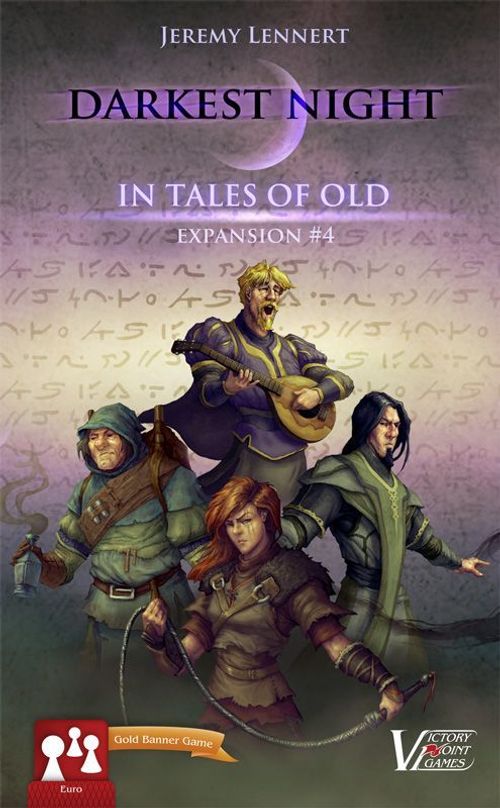
Darkest Night: In Tales of Old
Darkest Night: In Tales of Old Rulebook
Table of Contents
Table of Contents
[29.0] Introduction
In Tales of Old is the fourth expansion for Darkest Night. It adds new heroes, blights, items, and map cards, and also a new card type, mystery cards. It can be combined with any or all of the previous expansions, or used separately.
To identify cards in this expansion, a feather icon is located on the bottom right corner of each card.
Heroes: Add the new heroes to the pool of options when players select heroes to control (see 3.2).
Map cards: Shuffle the new cards into the Map Deck during Set Up (see 3.1).
Mystery cards: These new cards facilitate a new way of acquiring holy relics (see 31.0).
Blight and Item counters: These counters are used when called for by the new cards.
Clue Tracker: This token tracks the number of clues the heroes currently hold to the holy relics' locations.
[30.0] Game Equipment
Parts Inventory
- 4 standing character tokens (minor assembly required)
- 4 hero mats
- 40 power cards (10 per hero)
- 15 map cards
- 20 mystery cards
- 14 1" square blight counters
- 8 multi-shaped item counters
- 1 clue tracker
[31.0] Mystery Cards
Mystery cards are a new game mechanic introduced in this expansion and change the way the heroes acquire holy relics (7.2).
[31.1] Modified Set Up
When setting up the play area (see 3.1), shuffle all the mystery cards together to form the Mystery Deck and set it in reach of all players.
Place the clue tracker at the 0 position on the darkness track.
[31.2] Clues
Clues are a new resource obtained from mystery cards and shared in common by all heroes. When the heroes obtain clues, adjust the clue tracker upwards along the darkness track to indicate the new number of clues.
The Retrieve a Holy Relic action (described in 4.1 – Action) now requires a hero to spend 10 clues instead of discarding 3 keys.
If you wish to make the game harder, you can increase the number of clues required to retrieve a holy relic. Place a key token on the track at the cost you choose as a reminder.
[31.3] Discovering Mysteries
Keys no longer exist. Any time that a hero would obtain a key for any reason, draw a mystery card instead.
When you draw a mystery card, immediately gain the number of clues indicated at the top of the card and place the card in the specified location. If the location is listed as "random," determine its location by rolling a die and comparing it to the Necromancer's movement arrows printed on the map in the Village (this gives an equal probability for all locations except the Monastery).
Example: If the die roll is a 5, the mystery appears in the Swamp.
[31.4] Pursuing Mysteries
Each mystery card offers one or more objectives the heroes can pursue to obtain additional clues (and possibly other rewards).
If a section of the card is labeled Action, then any hero in the card's location can spend their action to trigger that effect.
If a section of the card has the outline of a key, that section will list some reward and a condition for receiving it. Each such reward can only be obtained once; place a key token over the outline once it has been completed.
Example: The Alchemist is in a location with the Defiled Shrine mystery. He chooses to spend his action to use the mystery card, which calls for him to make a fight roll; he uses his Black Powder tactic to fight with 3 dice, rolling a 2, 3, and 5.
Because he rolled a 4+, he gains 1 clue and places a key token over the first outline on the card. Because he also rolled a 5, he also gains a treasure chest and places a key token over the second outline on the card.
If the Alchemist (or another hero) spends another action to make another roll for this mystery, they can no longer earn clues for rolling 4+, but are still eligible to earn 3 more clues for rolling 6+.
Errata applied (VPG erratum, 11-4-2015): the second paragraph of this example reads "Because he rolled a 4+, he gains 1 clue…" as printed in the erratum (the v1.0 printing shows a clue icon at this point).
If a section of the card is labeled Permanent, then the mystery remains in play forever and the heroes may utilize the effects of that section as many times as they wish.
Example: The Meditation mystery appears in the Swamp, causing any hero who gains an epiphany there to also gain 3 clues. This card remains in play for the entire game, and will continue to trigger every time a hero gains an epiphany while in the Swamp.
If a mystery card has key outlines but no Permanent effects, then it should be discarded once all of its key outlines have been covered.
Errata note (VPG erratum, 11-4-2015): the erratum states that the wording of this final paragraph of 31.4 was modified and quotes only its opening, "If a mystery card has key outlines but no Permanent effects…", which matches the v1.0 text above. The erratum does not print the revised remainder of the paragraph, so the v1.0 wording is transcribed here as printed; the revision is not applied because its text is not available.
[32.0] Clarifications
[32.1] Blights
Nexus: This blight prevents all blights on the entire board from being destroyed, except for blights at the Nexus' own location. It is similar to a Shroud blight, except for the locations it affects.
There is only one Nexus token in the game, so there will never be a situation where two Nexus blights at different locations protect each other. A Nexus could be protected by a Shroud, in which case you will have to destroy that Shroud first and then the Nexus before you can destroy blights at other locations.
Stigma: This blight has no immediate effect on heroes' default Grace when it enters play, but it reduces their default Grace, which will limit the amount of Grace they can recover from many sources (such as by praying). There is no minimum value for default Grace; when two Stigma blights are in play, many heroes will not be able to gain any Grace at all from prayer.
Terror: Each Terror blight at a location gives heroes an extra die on their rolls, but forces them to discard their highest result (leaving them with their original number of dice again).
Players are always entitled to a minimum of 1 die result, regardless of all penalties to number of dice; therefore, the extra dice granted by Terror blights cannot be taken away by penalties (such as an Unholy Aura or Evil Presence blight), because that would leave no die remaining after ignoring the highest.
Example: The Tamer fights with her Whip tactic in a location with both a Terror blight and an Unholy Aura blight. Although Whip only gives 1 die, and Unholy Aura reduces the number of dice by 1, the Terror blight still forces her to roll 2 dice (and then ignore the higher of the two results).
Void: The Void counts as two blights (instead of one) when anything depends on the number of blights in the location. For instance, if you draw an event card that counts the number of blights in your location, the Void counts as two. More importantly, if anything causes a new blight to appear in the Void's location, the Void counts as two blights for determining whether it should appear at the Monastery instead (thus, a Void and two other blights, or two Voids, will cause new blights to appear at the Monastery instead).
This means that there may occasionally be "five" blights at a single location (e.g., if a Void is created in a location that already had 3 blights). If any effect depends on the number of blights in such a location and does not list a result for 5 blights, apply the result for 4 blights.
Voids have no additional effect beyond counting as two blights.
Despite counting as two blights, a Void can be attacked and destroyed in the same manner as any other blight (note its might of 7, however).
Wraiths: Wraiths function exactly like Skeletons, except that a hero who fails to defend against them must spend 2 Grace (rather than 1) to avoid dying. For any cards that respond to spending Grace, this counts as a single incident of spending two Grace, not as spending one twice. A hero that does not spend Grace only dies once. This still triggers any cards that react to a wound.
Antique Trader: A "green-backed item" is any item token with a green back; up through the current expansion, this includes bottled magic, vanishing dust, waystones, charms, soothing lyres, cursed ashes, and skull tokens.
A "gold-backed item" is any item token with a gold back; up through the current expansion, this includes treasure chests, tomes of retraining, and psion stones.
Bastion: If there happen to be no blights in the Castle when you draw this mystery, you complete it immediately.
Coded Journals: A hero in the same location as this card may spend an action to hide (with all the usual effects) and simultaneously gain one clue. This may be done as many times as desired.
Extinguished: Every time a blight in this card's location is destroyed, if there are no other blights in this card's location, the destroyed blight is placed on this card. There is no limit to the number of blight tokens that could be on this card simultaneously.
Placing a blight token on this card does not destroy any existing blights of that type, but means that any blights of that type that are created in the future (at any location) will be destroyed instantly.
[32.2] Mysteries
Ancient Riddle, Buried Secrets, Defiled Shrine: When rolling for these cards, any die that rolls greater than or equal to the lowest reward that has NOT been obtained on a previous attempt counts as a "success" (for cards that count your successes, such as Vanish). If an effect gives you an automatic success, you gain the lowest reward that has not been previously obtained.
Pray for Guidance: If a hero rolls multiple successes on a prayer roll, but their default Grace prevents them from actually gaining more than one, then they do not gain a clue from this card.
The additional Grace from the Priest's Blessing of Faith can be used to trigger this card (again, unless your default Grace prevents you from actually gaining it).
The Trials: Using this card only costs 1 action no matter how many event cards you end up drawing (you experience all penalties inflicted by the event cards, however).
[32.3] Alchemist
Tincture of Fate: Choosing to fail without rolling is described in rule 8.3. Recall that a roll only counts as a failure if NONE of the dice succeed (see 8.0).
Tincture of Isolation: This deactivates when you would lose Secrecy even if you have no Secrecy to lose.
[32.4] Bard
Melodies: Using any Melody also allows you to take another action, which means you can switch to any Melody (or no Melody) "for free" when you begin the action step of your turn.
However, if your Grace decreases for any reason, then whichever Melody is currently active is both deactivated and exhausted, so you will be unable to use that Melody again until you refresh it.
Any active Melody benefits all heroes at your location (including you).
Folk Remedy: You can choose any two types of blight to be affected by this card, but you must choose them immediately when you obtain the card and you can never change your choice.
Legend Lore: This card has a one-time effect when you first obtain it and then is completely removed from the game. For instance, it is not available to exhaust when you are forced to exhaust a power, cannot be returned to the bottom of your deck with a tome of retraining, etc.
If for some reason you wish to play without the new mystery cards, this power gives you a key instead.
[32.5] Conjurer
Invisible Barrier: If this card prevents the Necromancer's movement, then he does not change location, but still carries out other effects of the movement roll, such as creating an extra blight on a roll of 1-2 if the darkness is 20 or higher and creating a quest on a roll of 3-4 if you are playing with the Pall of Suffering variant.
Mystic Mist: This blocks the effect of Spies, Crows, and Flux Cage blights in its location (no other blights published to date have effects that alter your Secrecy). Blights' defenses (the thing that happens if you attack and fail) are unaffected. Mystic Mist also makes it easier to elude foes by lowering their awareness (see 8.0).
[32.6] Tamer
Whip: Using this tactic allows you to activate one of your Tame powers without spending an action. You do not get the action effect of the Tame power when activating it in this way; it just becomes active.
Successive uses of Whip within a single turn do not activate any powers, and so are no better than fighting without a tactic.
Tame Powers: These powers (Tame Boar, Tame Sylph, Tame Nightingale, and Tame Unicorn) can each be used as an action to gain some immediate effect and also activate themselves. However, they have no inherent active effects, so activating them does not accomplish anything except when another power interacts with them. There are four powers in the Tamer's power deck that benefit from active Tame powers:
Stalk: If no Tame powers are active, fighting with Stalk is no better than fighting without a tactic; however, it allows you to deactivate any number of your active Tame powers in order to apply their Pounce effects to this fight roll. This is the only way to use the Pounce effect on any Tame power.
Perform: This power allows you to utilize the Trick effects from your active Tame powers, at the cost of deactivating each power you use in this way. If you wish, you can use the action of a Tame power to activate it and then immediately deactivate it to also use the Trick.
This is the only way to use the Trick effect on any Tame power.
Menagerie: This power allows you to use the action effect of an active Tame power and also perform another action in the same turn, at the cost of deactivating the Tame power you use in this way.
If you wish, your free action could be to use Menagerie again on another active Tame power, or to use the same (now inactive) Tame power normally (thereby activating it again).
Distraction: This tactic is more effective if you have at least one active Tame power when you use it. It does not deactivate any cards. It does not gain any additional benefit from multiple active Tame powers.
Reference Card: Blights, Items, and Other Search Results
This reference card is printed as the back page of the rulebook. Icons are rendered as their labels (Grace, Secrecy, clue, die, wound, Darkness). The Wraith stat line uses the base game's strength and awareness terms, following the Skeleton entry in the base rulebook; the printed stat icons are a shield and a hand-like symbol.
Blights
- Enigma: Search difficulty is increased by 1. This blight affects all locations. Might: 4. Defense: No effect.
- Flux Cage: A hero that enters or leaves the affected location loses 1 Secrecy. Might: 6. Defense: Lose 1 Secrecy.
- Nexus: Blights at other locations cannot be destroyed (the nexus must be destroyed first). Might: 3. Defense: No effect.
- Stigma: Heroes' default Grace is reduced by 2. This blight affects all locations. Might: 5. Defense: Lose 1 Grace.
- Terror: Heroes at this location roll +1 die on all rolls, but discard the highest die. Might: 4. Defense: Exhaust a power.
- Void: Counts as two blights. Might: 7. Defense: No effect.
- Wraiths: At the end of each turn in the affected location, a hero must combat a wraith. Might: 4. Defense: wound. Wraith (strength 4, awareness 4). If he loses: 2 wounds.
Items
May be saved and traded between heroes.
- Cursed Ashes: Discard during your turn to ignore the effects of blights for the rest of the turn.
- Skull Token: Discard after the Necromancer's movement roll to move him to any location (except the Monastery) instead of where he would otherwise move.
- Psion Stone: Place on one of your powers during your turn; all heroes may use Tactic effects from that card as if it were theirs. May not be moved after being placed on a power.
Other Search Results
Take effect immediately when discovered.
- Inspiration: Every hero draws a power card.
- Revelation: Gain 3 clues.
- Stardust: Reduce the Darkness by 1.