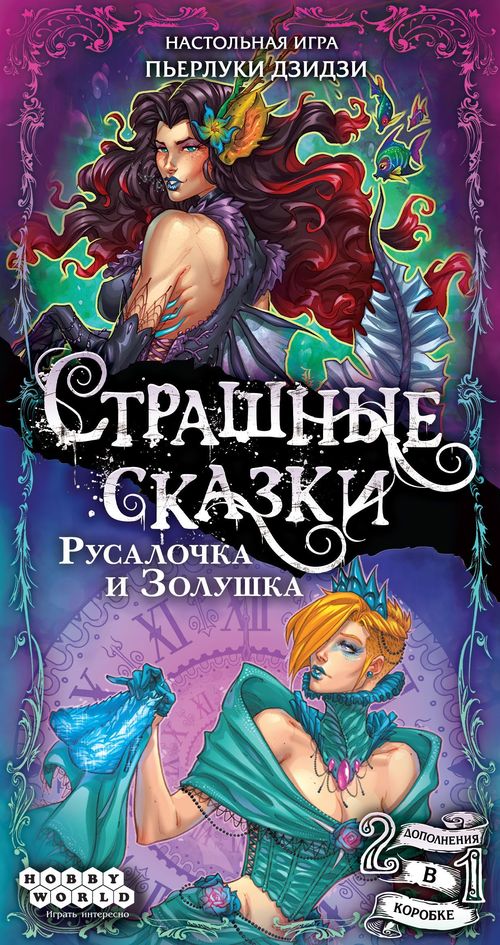
Dark Tales: The Little Mermaid and Cinderella
Dark Tales: The Little Mermaid and Cinderella Rulebook
Table of Contents
Table of Contents
Dark Tales: The Little Mermaid
Components
- A deck of 26 cards:
- 24 Playing cards
- 2 Setting cards for the basic game: A6 and B6
- A deck of 20 cards with the Sea Witch Pacts
- These rules.
Preparation
The preparation and game play proceed as the normal Dark Tales, with the following changes:
Add the playing cards from the expansion to those from the basic game before shuffling. This will increase the playing time a bit. (If you wish to play a shorter game, randomly remove 10 different cards from the basic game before adding the cards from the expansion.)
Add the two new setting cards (A6, B6) to those from the basic game before randomly selecting which two you will use for the game. (You can use these two new Setting cards with any Dark Tales game, not only games using this expansion!)
Shuffle the Sea Witch Pact cards, and place them nearby in a facedown Pact stack, separate from the Playing card deck. The Sea Witch Pact cards form a separate stack, and are never shuffled with the Playing cards (they are a different size to help you tell them apart).
The Sea Witch Pacts
Some of the cards in this expansion have a new symbol (a purple rosette ribbon medal). These are the Sea Witch Pacts. These Pacts offer a new way to score Victory Points, draw cards, or gain other benefits—for a price!
The Pact cards are kept in a separate draw pile called the Pact stack. Pact cards are not affected by normal Playing cards (such as those which tell you to draw cards from the deck or to count the number of cards in your hand, etc.), unless they show one of these two symbols:
- Draw 1 Sea Witch Pact (the medal symbol with a white arrow pointing toward it): When you play a card with this symbol, you must (unless specified otherwise) draw 1 Sea Witch Pact. This is the only way to draw Sea Witch Pacts. You can have any number of Pacts.
- Discard 1 Sea Witch Pact (the medal symbol with a red X over it): When you play a card with this symbol, you may (unless specified otherwise) discard 1 of your Sea Witch Pact.
Pact cards are kept separate from the regular Playing cards. They do not count as part of your hand when drawn, and they are never added to the Playing card deck or discard pile. Discarded Pacts are placed in their own discard pile. If the Pact stack is empty, re-shuffle the Pact discards and create a new stack.
During Phase 2 of your turn, instead of using an effect of the A Setting card, you may play 1 Sea Witch Pact, by placing it in the discard pile.
To play a Pact, you must perform the steps described in the First Condition, above the arrow. Then you gain the bonus below the arrow. Fulfilling the First Condition is required! If you cannot fulfill the First Condition, you cannot play the Pact. On the other hand, if you can't receive all of the bonus listed (such as drawing a card from the deck when it is empty), you may still play that Pact.
Once you have completed the First Condition, all players may benefit from the Second Condition. Each player, starting with you and going clockwise, chooses whether or not they will fulfill the Second Condition to gain the bonus listed. The Second Condition is always optional.
The Pact card layout is: Name; Description; Artworks; First condition (for the turn player); bonus below the First Condition arrow; Second condition (for all the players); and the Victory Point value printed at the bottom, which is scored at the end of the game if the Pact is still in hand.
Example: It is Night. During Phase 2 of your turn, you play The Stinking Concoction, placing it on the Pact discard pile. Then you play a Dragon from your hand. After resolving its effect, you take the last remaining Gold Coin from the supply (you are entitled to take 2, but only 1 is left). Then you reveal an Ogre from your hand and score 1 VP. Each of the other players, in turn, may also choose to reveal a Villain from their hand to score 1 VP, or not. After the Pact is resolved, you move on to Phase 3 of your turn, where you play a card as usual.
Note that: 1) if you couldn't play a Villain from your hand (First Condition), you could not play the Pact, and that 2) the Dragon you played for the Pact does not count as the card you must play during Phase 3.
Beware! You lose 3 Victory Points for each Pact you still have in your hand when the game ends.
Remember:
- If a Pact instructs you to draw a card from the deck, it means the Playing card deck.
- If a Pact asks you to reveal a card, the card is revealed and then it goes back in your hand.
- Even though you can hold Pacts in your hand for convenience, they do not belong to your hand, which is made up only of regular Playing cards, and thus are never counted to determine when the game ends, how many cards you have in hand, etc.
- The Witch (from the base game) does not prevent you from drawing Pacts!
- The Seventh Heaven Pact does not have a Second Condition for all players. (The printed rulebook reads "Seventht Heaven"; this is the Seventh Heaven Pact.) Even if you have more than 1 Prince or Female in play, you get the bonus only once.
Notes on the Cards
- Little Mermaid: You can only take a Prince from another player who has him in front of them if there is no Prince in the discard pile.
- Sea Witch: Remember that "all players" includes you, so you draw a total of 2 Pacts before getting the chance to discard 1.
- Shipwreck: You may choose 1 Villain or 1 Male or 1 Female you have in hand and put it into play in front of you, even if it does not have the icon. When the card enters play, you don't activate any of its effects and you do not score any victory points. However, if the card has continuous effects, these are triggered as normal (e.g., if you put the Old Sage into play, you still get victory points from him at the end of your turn if it's Day).
Dark Tales: Cinderella
Components
- A deck of 26 cards:
- 21 Playing cards
- 4 Setting cards (2 × Cinderella: A and B, 2 × basic game: A4 and B4)
- 1 special Ball at the Palace card
- 21 Cinderella tiles
- side without frame (dark)
- side with frame (light)
- 4 victory point tokens
- These rules.
Preparation
Before your first game, carefully remove the tiles from their frames.
The preparation and game play proceed as the normal Dark Tales, with the following changes:
Take one Night card from the basic game deck and put it face up in the middle of the table. Place one Day card face up on top of the Night, covering it (the game starts at day). Remove all the other Days and Nights—they won't be used. To show if it's day or night, you only use these two cards in the middle of the table, alternating them when day turns to night and vice-versa (e.g., due to the effect of Ball at the Palace or Midnight): take the required Day or Night card and put it on top so every player knows if it's day or night. The Night and Day cards may never be removed from the middle of the table. Any effect (card, item, etc.) that would move them leaves them in the middle of the table instead.
Add the playing cards from the expansion to those from the basic game before shuffling. This will increase the playing time a bit. (If you wish to play a shorter game, randomly remove 10 different cards from the basic game before adding the cards from the expansion.)
Add the two new setting cards (A4, B4) to those from the basic game before randomly selecting the two to use for the game. Add the two Cinderella Setting cards to the setting cards (A and B) that you chose. You will play the game with 4 Setting cards: A and B, plus A–Cinderella and B–Cinderella. The Cinderella Setting cards tell you the scoring for the Ball at the Palace during and at the end of the game.
Put the Ball at the Palace special card face up next to the setting cards.
Shuffle the Cinderella tiles with the side without frames up, then place them in a nearby pile, separate from the items from the basic game. Whenever the word "tiles" is used, it means the Cinderella tiles that come with this expansion.
Add the victory point tokens to those from the basic game.
New Symbols
Some of the cards in this expansion have new symbols in the top left corner, just below the victory points:
-
Cinderella Tile (a blank tile symbol): When you play a card with this symbol, before executing the card effect, you must choose either to:
- Take 1 tile from the top of the pile and put it in front of you (do not flip it to the other side!); or
- Flip 1 tile in front of you to the other side: from the unframed to the framed side or vice-versa, from framed to unframed.
Choose and repeat this action a number of times equal to the number in the Cinderella Tile symbol.
Note: You can always look at what's on the other side of your tiles. However, the points, ranking, etc. are always awarded only for what the tiles actually show.
If the pile runs out, you cannot take any more tiles. If a tile is discarded, it is available again: place it at the bottom of the pile, with the unframed side up.
These tiles can award victory points both during and at the end of the game (see Ball at the Palace).
-
Musical Notes (a music-note symbol): When the Ball at the Palace takes place (see below), Males and Females in front of you may form couples to dance, and this brings you victory points! Each dancing card in front of you awards you 1 VP, unless they show the Musical Notes symbol, in which case they award the VP stated in the symbol instead.
Notes on the Cards
- Prince: You also score for Shoes in front of other players.
- Stepmother: You also score for dancing Stepsisters in front of other players, and even during the final Ball at the Palace.
- Stepsisters: Note that even though the illustration shows both Stepsisters, this card counts as 1 Female during the Ball (after all, the Stepsisters fight over every cavalier!).
The Ball at the Palace
When a card must be removed from the game (e.g., due to the effect of a Secret Helper), put it face down on the special Ball at the Palace card instead, on one of the two spaces. The Ball at the Palace card may only hold up to two cards. When you have to add a third card, follow these steps:
- Remove that card and both cards from the Ball at the Palace card from the game;
- Day turns into night; and
- A Ball is held.
Note: It is possible to have more than one Ball during the game.
Performing the Ball
Starting with the player whose turn it is and going clockwise, each player performs the Ball. On your turn:
- Score the VP stated on the tiles you have in front of you on the side that is currently showing (some sides show no points); then, flip all Shoes you have in front of you;
- Form Male-Female dancing couples using the cards in front of you and those in the middle of the table. To form a couple, choose a Male or Female in front of you, and a partner either in front of you or in the middle of the table (note: only Male-Female couples are allowed). You may form any number of couples, but each card may only dance with one other card for each player. The same card in the middle of the table may be used by multiple players. You cannot form couples using only cards in the middle of the table (each couple must include at least one card in front of you); and
- Dancing cards in front of you score 1 VP each, unless they show the Musical Notes symbol, in which case they score the VP stated on the symbol instead. Cards in the middle of the table and non-dancing cards score no points.
Once all players have performed the Ball, discard all cards in the middle of the table that have danced (those used by at least one player). Dancing cards in front of you remain there. The Ball ends and the player whose turn it was resumes playing.
Note: if the Ball at the Palace triggers during the resolution of a card (e.g., Secret Helper), the effect of that card is suspended. The Ball at the Palace is performed, and only at the end of the Ball is the suspended card's effect resumed.
Example. William has played the Stepsisters on his turn and the situation is as shown. The card removed by the Stepsisters triggers a Ball at the Palace: First of all, the removed card and the two cards on the Ball at the Palace card are removed from play. Then, the day turns into night. Now, William scores 5 points for the tiles in front of him, and flips his Shoe to its other side. Then he makes dancing couples with the cards in front of him. He forms two couples: Stepsisters and Old Sage, and Prince and Gypsy. He scores 6 points for these (2 + 1, 3 + 0). Susan's turn is next, so she scores her tiles and forms couples for dancing (she may also use the Gypsy used by William), etc. Once all players are done, the Ball is over. The Gypsy is discarded (since she was used by at least one player).
Final Ball at the Palace
When the game ends, there is one final Ball at the Palace with slightly different rules. This last Ball at the Palace is always held, regardless of the number of cards on the Ball at the Palace card. Couples dance as before, but the tiles do not award VP as normal and Shoes are not flipped over. Instead, check who has the highest number of Pumpkins, Shoes, Mice, and Birds on their tiles, as usual counting only the face up sides (count the number of images, not tiles – a tile may show two Birds, for example).
Assign VP as follows:
- Highest number of Pumpkins: 3 VP (Carriages do not count as Pumpkins!).
- Highest number of Shoes: 5 VP
- Highest number of Mice: 5 VP, second ranked player: 3 VP
- Highest number of Birds: 8 VP, second ranked player 5 VP, third ranked player 3 VP.
Count the number of images, not tiles. If there is a tie, all tied players score the full amount of points. The rank of the other players is lowered, based on the number of tied players (so, in a two-way tie for most Birds, both players score 8 VP and the second highest total would score 3 VP).