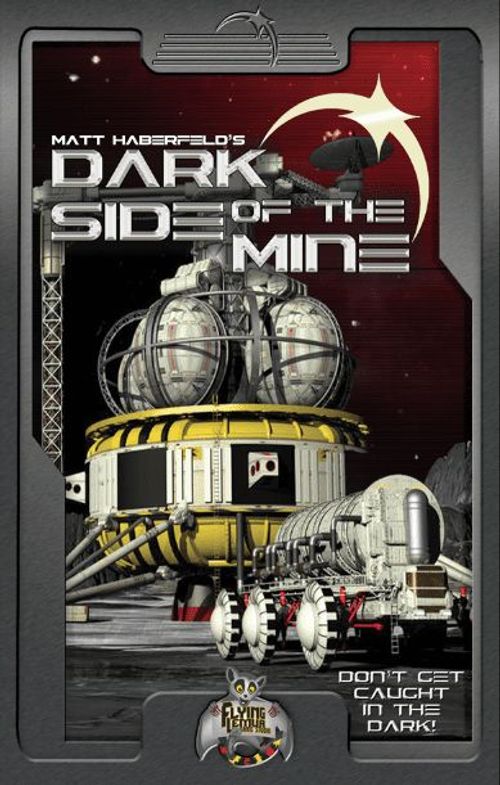
Dark Side Of The Mine
Dark Side Of The Mine Rulebook
Table of Contents
Table of Contents
Objective
Players issue orders to their robots, which move along the asteroid's surface and earn points by mining locations. As the players remain in orbit on the mothership, part of the asteroid is obscured from view. A signal cannot be sent to the dark side of the asteroid, and any robot caught there on a player's turn will power down and wait until communications can be restored.
When the asteroid deck is depleted and all players have taken an equal number of turns, the game ends. The player with the most points is declared the winner.
Game Pieces
- 80 Cards
- 4 Player Aids
- 12 robots (3 for each player)
- 4 Score Counters
Additional Components
- 3 Meeples of a single distinct color per player for 2 - 4 players
- 1 Score keeping method per player for 2 - 4 players (scores above 99 are rare but possible in 2 player games)
All cards are standard 2.5 inch by 3.5 inch US poker card size.
Game Setup
- Shuffle the deck and deal 5 cards to each player.
- Place cards face up in a circular shape to create the asteroid. a. Refer to the diagrams on the following pages to help set up the game.
[Setup diagrams omitted from this transcription; the player counts and card counts below are as printed.]
Two Player Game
- Remove any cards from the game that are marked 3P or 4P (these cards are only used in higher player counts).
- Create the asteroid by placing 8 cards in a circle around the deck, 2 face down and 6 face up.
- Place the robots as shown so that each player has two robots on the asteroid. Players place their robots in reverse turn order until each player has placed 2 robots.
Three Player Game
- Remove any cards from the game that are marked 4P (these cards are only used in a four player game).
- Create the asteroid by placing 12 cards in a circle around the deck, 3 face down and 9 face up.
- Place the robots as shown so that each player has two robots on the asteroid. Players place their robots in reverse turn order until each player has placed 2 robots.
Four Player Game
- Create the asteroid by placing 16 cards in a circle around the deck, 4 face down and 12 face up.
- Place the robots as shown so that each player has two robots on the asteroid. Players place their robots in reverse turn order until each player has placed 2 robots.
The Asteroid
[Asteroid diagram omitted. It labels the card parts: Card Type, Element, Card Text, Ore Deposits, and Inactive Robots.]
Each card that makes up the asteroid is called a location. Each location has up to 3 ore deposits on which the robots can mine. Robots always choose the first available ore deposit on the card, from left to right. If all ore deposits are occupied, then the robot will ignore that location.
When a robot mines on a location, the number on the card is the amount of points that are awarded to the player. Additionally, if the card text says "When Mined:" then the player takes the action on the card in addition to mining. These cards have a red icon and red numbers.
Note: If the card text begins with "Upgrade:" or "Prospect:" then the text is ignored. The abilities only take place when the card is played from the player's hand.
Summary of a Player Turn
Note: Players always take turns clockwise around the table and robots always move clockwise around the asteroid.
- Flip up the first card of the dark side.
- Take two actions. Each individual robot may perform up to 1 robot action.
- Draw 1 card.
- Play a card from your hand face down over the first card of the light side.
- Discard down to 5 cards (if applicable).
Available Actions
-
Prospect is a robot action where the player plays any card from their hand to the discard pile, and then moves clockwise around the asteroid to the next available location card with the same element. The robot will pass over all non-matching elements, and all matching elements where there is no available ore deposit to mine. Once the robot arrives at a valid location, it immediately mines the first available ore deposit and the player gains points equal to the number in the circle. a. Any card may be used to Prospect, and the card text may be ignored. b. Some cards have a blue icon and the word "Prospect:" in the card text. These are special Prospects that have additional abilities which may take effect when the card is used to Prospect. c. Players may not play a Prospect card if there is no valid location to move to; robots cannot travel through the dark side of the asteroid.
Example: In this example Prospect action, the red player has played a card with a gold border indicating that the red robot should mine the next available gold deposit. Moving clockwise, the red robot will skip the first location because there is no available ore deposit to mine (all the deposits are occupied by other robots). The red robot will skip the 2nd location because it is not a gold deposit. The red robot will stop at the first ore deposit of the 3rd card and then mine, scoring 4 points for the red player.
-
Communicate is a robot action where instead of playing a card, the player chooses a robot to move counterclockwise until it reaches an available ore deposit on a location with another robot. The robot will pass over all locations without a robot, and all locations in which there is no available ore deposit. Once the robot arrives at a valid location, it immediately mines the first available ore deposit and the player gains points equal to the number in the circle. a. Communicate is an action that does not require a card to play, and always results in the player drawing at least 1 card. If the player communicates with their own robot, then they draw 1 card for each of their robots at the location. b. The current player draws all their cards first, followed by each player around the table with a robot at the location. If there are no cards in the asteroid deck, then the player does not draw any cards. c. Players may not perform the Communicate action if there is no valid location to move to; robots cannot travel through the dark side of the asteroid.
The Dark Side
During each player's turn, some of the asteroid cards are turned face down, and it is possible for robots to end up on the dark side of the asteroid. If this happens, place the robot(s) on top of the face down card. Players may not perform robot actions (Prospect, Communicate) with these robots. However, the player is still allotted two actions per turn.
When the asteroid card is flipped face up, place the robots in the Restoring Comms section of the card. Any number of robots may occupy this position on the card. Communication has now been restored and orders can be issued to those robots.
End of the Game
When the last card of the asteroid deck is drawn, this signals the last round of the game. During the last round:
- Players do not draw cards on actions that normally allow them to.
- At the end of the last player's turn, the game ends (even if the deck is depleted during that player's turn). The player with the most points is declared the winner. In the case of a tie, all players with the highest score share the victory.
Frequently Asked Questions
Q: If I deploy a 3rd robot, do I get a 3rd action? A: No. Players always have 2 actions per turn, even if they have 3 robots available. Players also have 2 actions even if all their robots are on the dark side of the asteroid. In this situation the player must use the Upgrade or Recharge actions.
Q: Can I move through the dark side of the asteroid to the next available location? A: No. Any action (Prospect, Communicate) that would cause you to move through the dark side of the asteroid cannot occur and another action must be selected.
Q: When using the Communicate action, who draws first? A: The active player always draws all their cards first, followed by the player sitting clockwise around the table until all eligible players have drawn their cards. If at some point during the Communicate action the deck runs out of cards, those players do not get any benefit.