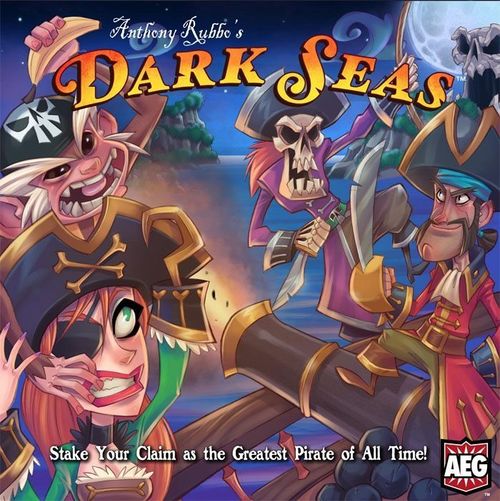
Dark Seas
Dark Seas Rulebook
Table of Contents
Table of Contents
Components
Your game of Dark Seas should come with the following components:
- 102 various hexagonal tiles, consisting of:
- 4 central island hexes
- 24 port hexes
- 8 starting plunder tiles
- 66 standard plunder tiles
- 48 black wooden cubes
- 40 natural wooden cubes
- 4 wooden ship tokens
- 4 wooden captain tokens
- 4 round scoring markers
- 1 round natural-wood round marker
- 5 dice
- 1 turn track / score board
- 32 treasure tokens, 4 each of 8 different types
- 36 doubloon tokens (24 x 1 value and 12 x 3 value)
- active player marker
Central Island Hexes
There are four central island hexes, each with a pleasant view of Skull Island. These tiles determine which color of tokens you use in the game, be it blue, green, red, or yellow.
Port Hexes
Each player's central island hex will be surrounded by port hexes in six different colors. Port hexes all have a gold bar at the top, and come in a variety of colors.
Plunder Tiles
Plunder tiles represent the varied ne'er-do-wells and shady businesses that always seem to crop up in piratey ports.
The text on each plunder tile details the fun and nefarious activities that pirates can do while they're visiting these fine establishments.
Most of the plunder tiles either have a pair of icons at the bottom, or else some fun flavor text in italics. But there are eight tiles that have the words "Starting Tile" at the bottom. These tiles are only used during setup and are never shuffled with the rest of the plunder tiles.
Turn Track / Score Board
This board tracks the progress of the game (with the natural-wood disk) and each player's score (with the colored disks).
Treasure Tokens
These two-sided tokens all have a treasure chest on one side. On the other, they have one of eight different icons, each representing a different type of treasure.
Doubloons
These tokens are used to track players' finances. Silver doubloons are worth one — no surprise there — while gold doubloons are worth three silver doubloons.
Active Player Marker
This helps you track which player went first each round.
Dice
Five custom dice are included in the game. Each side is marked with a different color and icon.
Player Tokens
Each player gets three tokens (which must match the color of that player's central island hex). Each player has a ship token, a captain token, and a scoring marker.
Pirate Tokens
These come in two types. Regular pirate tokens are natural wood, while the dreaded dread pirate tokens are black.
Setup
Preparing the Players' Islands
Separate the starting plunder tiles (the eight that say "Starting Tile" at the bottom) from the other plunder tiles. Thoroughly shuffle all the non-starting plunder tiles, and form them into a couple of face-down stacks so they are accessible to everyone.
All players set up their own personal area as follows.
All players select one of the central island hexes and set them in front of themselves. These hexes determine the players' colors. Place any unused central island hexes back into the game box. Players also retrieve their matching ship token, captain token, and scoring token.
Next, all players take a set of six colored port hexes and arrange these around their central island. These port hexes can be placed in pretty much any order — random is fine — but each port hex must be positioned so that the gold bar at the top of the hex is touching the central island hex. In addition, the port hex that is the player's color must go toward the center of the table, to help the other players see who's playing which color.
Give each player one "Dive Bar" starting plunder tile. All players place this below their bottom-most island hex. Then give one "Barkeep" starting tile to each player. All players place this at the 2 o'clock position on their board. Place any unused starting plunder tiles back in the box.
Each player then receives the following:
- 1 random treasure token (keep this hidden from the other players).
- 3 doubloons.
- 4 random plunder tiles from the shuffled stacks.
Of these four plunder tiles, players place one of them at the 10 o'clock position of their island, discard another of them, and keep the remaining two.
Each player places their ship on their bottom-most port hex (the one with "Dive Bar" attached). Finally, players place their captain on the central island hex.
Preparing the Table
- Shuffle all the treasure tokens and set them face-down.
- Place the coin tokens, pirate tokens, and dread pirate tokens in piles so that everyone can reach them.
- Place the round/scoring track in view of all the players, and place each player's scoring token on the zero space of the track. Place the round marker on Round 1 of the track.
- Determine the first player via a method of your choice (whoever most recently went to Arrrby's?). Give that player the active player marker as well as four dice. Set the fifth die aside in a central area for easy access.
How Ye Play
A game of Dark Seas always lasts 12 rounds, regardless of the number of players.
A round consists of a single player rolling the dice, with all players utilizing those dice in clockwise order around the table. Thus, in a complete game, the dice will be rolled only 12 times.
Turn Order
A single round of Dark Seas follows this structure:
- The active player rolls all four dice. The active player can then select any number of those dice and roll them again, once.
- The player may use the scheme ability of plunder tiles from his hand.
- The player may move his captain.
- The player may move his ship and resolve plunder tiles as the ship enters each port.
- The player may place a plunder tile at the ship's final port (colored island hex).
Once the active player has completed all of this, the next player to the left gets a chance to play. That player does not roll the dice again, but performs steps 2–5 using the die faces already showing in front of the active player. Once that player is finished, the chance to play passes to the left again, and the next player (if any) repeats the process.
Once everyone has used the die faces rolled by the active player, the round ends. Advance the round marker. The active player hands the active player marker and the dice to the next player to the left, who becomes the new active player and starts a new round.
1. Roll and Reroll ye Dice
Roll all four dice. Then select any die or dice that you wish to reroll and roll those again. You only get one reroll, and you must reroll all selected dice at the same time.
The goal is to match the die colors to the islands that you wish to move to, as well as to plunder tiles in your hand that you may wish to use for their scheme ability.
If you can get a result that hampers the other players' ability to use the dice, so much the better.
2. Scheme with Plunder Tiles
Many plunder tiles have a scheme ability. These are the icons shown below the line. One icon is always a die icon; the other is a black icon representing a resource you can gain. At this point, you may choose to use the scheme ability on plunder tiles in your hand.
Each die allows you to use one matching scheme ability on one plunder tile from your hand (thus, if you have one die face showing, you can only use one scheme ability, no matter how many you have in your hand). However, the effect of each scheme ability grows with the number of matching die results.
To scheme with a plunder tile from your hand, reveal it, gain the benefit, and discard it.
Each scheme ability has the following effect, depending on what kind of icon it has:
- Doubloon icon: Take doubloons from the bank equal to the number of matching dice.
- Pirate icon: Place pirates equal to the number of matching dice onto any of your islands.
- Treasure icon: Draw treasure tokens equal to the number of matching dice. Inspect them, keep one, and return the rest, face down.
Example: Chuck rolls the dice and gets two wave (blue) results, one bottle (red) result, and one skull-and-crossbones (black) result. In his hand, he has three plunder tiles that can activate from wave dice. Unfortunately, he can only activate two. He uses Trading House, getting two doubloons from the bank, one doubloon for each of the two wave dice. Then he uses Mayor and draws two treasure tokens. He keeps one, and returns the other.
3. Move ye Captain
You may move your captain to an adjacent hex on your island, either from the central island to one of the port hexes, or from a port hex to the central island or to either adjacent port hex.
You cannot move your captain to a plunder tile.
Moving the captain to a port hex will allow your ship to move through that port hex (during the phase that happens next).
Moving the captain to the central island hex gives you more resources. If the captain ends on the central island hex, whether he moved or not, you may choose one of the following options:
- Draw two plunder tiles, keeping one and discarding the other, or
- Take one doubloon from the bank.
4. Move ye Ship and Resolve Plunder Tiles
Next, you may move your ship from port to port around your island, looking for more plunder. You are not required to move, however, if you don't move your ship, you will be unable to activate any plunder tiles as described below.
Your ship can only move from a port to the next port clockwise. It cannot skip ports, move to the central island, or move counterclockwise.
Your ship can move to the next port only if:
- That port's icon is shown on at least one of the dice, or
- Your captain is on that particular port hex.
A die that has been used to activate a scheme ability can also be used to help your ship move.
Each time your ship enters a port hex, you may (but are not required to) activate either or both of the plunder tiles that are connected to that port. Note that only the two plunder tiles next to the port hex's bay water are considered connected to that port for this purpose. A given plunder tile can thus only be adjacent to one port hex.
If you choose to activate both plunder tiles on a given port hex, you may activate them in either order.
When you activate a plunder tile, follow the directions that are above the horizontal line. The plunder tile remains in place; unlike scheming, the plunder tile is not discarded.
After activating any applicable plunder tiles desired, you may move your ship to the next port, if legal, and continue your turn, activating more plunder tiles.
5. Place a Plunder Tile
After you have completed your movement, including not moving at all, you may place a plunder tile from your hand face up onto one of the two spaces adjacent to the bay water graphic on the port hex where your ship ended its movement. This is optional; you are not required to place one.
If the two spaces adjacent to the port hex are already occupied by plunder tiles, you may discard one of those to place a new one from your hand (you may not discard one without replacing it).
Note that placing a plunder tile in this manner does not cause it to be activated; it will not activate until your ship moves all the way around the island and enters the port later.
Pass ye Dice
Pass the dice to the player on your left, without changing their facing. That player schemes, moves the captain and/or ship, activates plunder tiles, and places a hex, all as desired and using the die faces showing, then passes the dice to the next player.
As soon as the dice reach the active player again, the round immediately ends (the active player does not get to use the dice a second time). The active player then passes the dice and the active player marker to the next player to the left, and a new round starts.
Miscellany
There are a few extra rules that don't properly fit elsewhere.
- Whenever you acquire a pirate (by scheming, tile effects, or what have you), you may spend 1 doubloon to make it a dread pirate instead. Dread pirates are treated just the same as normal pirates for all game effects except scoring (because they dress in black).
- When your captain is on a port hex, pirates on that port hex and plunder tiles attached to that port hex are not affected by other players' plunder tiles unless, for some reason, you want them to be.
- The fifth die is used whenever a plunder tile instructs a player to roll a die.
- You cannot have more than four pirates (regular and dread alike) on each port hex.
- If the plunder tiles run out, shuffle the discarded tiles.
Text on Plunder Tiles
Plunder tiles use some special terminology, explained here.
Here refers to the port tile to which the plunder tile is attached. That is, "Score 1 infamy per pirate here" means "Score 1 infamy per pirate or dread pirate token placed on the port tile to which this plunder tile is attached."
Matching is used when referencing a die roll. When you roll a die, the matching port hex is the port hex that has the same color and icon as the die roll result. Thus, if you roll the yellow side on the die, the matching port hex is the yellow one. Your central island is never a matching hex.
Pay means that you must do the first thing to do the second. "Pay 1 doubloon to gain 1 infamy" thus means you must have a doubloon in your hoard and pay it to the bank to gain the infamy. If you don't, you cannot gain the infamy.
Roll means to roll the fifth die and use the result of the roll to determine exactly what happens. This does not affect the four dice that were rolled by the active player at the start of the round.
Finally, text on plunder tiles always refer to each player's own island, pirates, etc., unless specifically stated otherwise. "Recruit a pirate anywhere" thus means for you to recruit a pirate on one of your port hexes, not someone else's. "Each player removes a pirate" means that each player removes a pirate from his or her own area, not from another player's.
Scoring
There are plenty of opportunities to gain infamy during the game by using the abilities on plunder tiles, but much (if not most) of a player's infamy is gained at the end of the game. Once players have completed the final round, score everyone's efforts to see how infamous of a pirate they have become. This is basically measuring your wealth and power.
Wealth
Players gain infamy based on the quantity of matching treasures they have acquired, and the larger the collection, the more infamy the player gains. Score each different type of treasure separately, as shown here.
| Number of Matching Treasures | Infamy Gained |
|---|---|
| 1 | 1 |
| 2 | 3 |
| 3 | 6 |
| 4 | 10 |
Also, gain 1 infamy for every three doubloons you have (round fractions down).
Power
Score points as follows:
- Each dread pirate you have gains you 1 infamy.
- Each port you have with at least 1 pirate on it also gains you 1 infamy.
- Each port you have with 4 pirates on it gains you an additional 1 infamy.
- Finally, gain infamy for any plunder tiles as noted in their text.