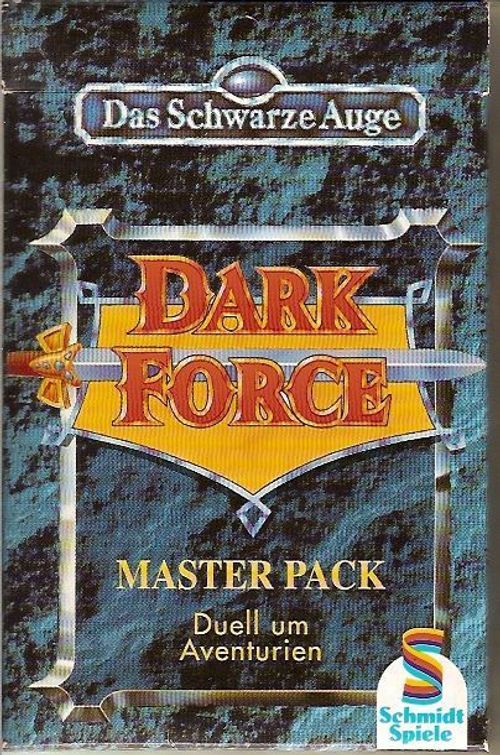
Dark Force
Dark Force Rulebook
Table of Contents
Table of Contents
0 Translator's Notes
The main text of this translation is taken from the rule book included with the original German Master-Pack starter packs first published in 1994.
Gameplay questions were answered in Aventurian Messenger (Aventurische Bote) magazine for The Dark Eye RPG (Das Schwarz Auge [sic]) issues 55 and 56. Errata from this source are marked with AB.
Game publisher Schmidt Spiele published a set of official rule changes for the Essen Open '96 tournament, probably the last Dark Force tournament before Schmidt Spiele declared bankruptcy in 1997. The original game often had players taking permanent possession of each other's cards. These tournament rules modify ensure that each player keeps the cards they own. Errata from this source are marked with Essen '96.
The Captain's Pack expansion added new card types and game rules to the game. There are new sections added to the rule book with headers that state "Captain's Pack." Short errata from this source are marked with CP.
Many of the original card names use the male and female forms of unit names as two different cards. When translating from German to English, I use established male/female forms of words when possible, such as the case with Druid and Druidess (Druiden and Druidinnen). If there are no good English equivalents, I use (M) and (F) after the card names to differentiate them, such as with Elf (M) and Elf (F) (Elfen and Elfinnen).
[I indicate errata and explanatory text not found in the original rule book in bracketed text blocks such as this one. My personal editorials are marked with "Ed."]
1 Introduction
1.1 Background
The background is given in the Table of Contents above.
1.2 Dark Force
Dark Force is a fantasy trading card game for two players. Each player builds a custom deck of cards from their Master- and Power-Packs, before playing the game. No two games are alike as every player's deck is different. A multitude of different cards - terrains, armies, heroes, magical artifacts, creatures, and spells - are available to you. But beware! Not all cards are easy to find in the Master-Packs (60 cards each) and Power-Packs (16 cards each). You can always trade cards with friends or even wrest control over your opponent's cards in the game. [Essen '96: During the game, no cards pass into the possession of the opponent.]
2 Object of the Game
Each player uses cards (armies, heroes, and creatures) to gain dominance in Aventuria. They must either conquer all opposing provinces (terrain cards) or defeat a certain amount of the opponent's forces.
3 Game Components
Unlike most card games, each player uses their own deck of cards that they construct from their personal card collection. Players do not shuffle their cards together and care should be taken that each player has their own cards at the end of the game. Players may construct their deck as they choose, and the opponent does not need to see the deck before play begins. We recommend that each deck contain at least 60 cards. Also make sure you have enough terrain cards, or you will be unable to lay out your provinces or play other cards.
[Essen '96: A constructed deck of cards may contain a maximum of 150 cards. There may be a maximum of 2 copies of each event, spell, summoned creature, and wonder card. There may be a maximum of 5 copies of each other card type and 10 copies of each terrain.]
In addition to a deck of cards, each player needs one six-sided die (d6), not included with the game.
3.1 Game Term Definitions
Each player uses their own custom deck of cards in the game. No cards may be added to the deck from outside the game, nor may cards be removed from the deck for the duration of the game. Each player draws from the top of their deck into their hand. These are the cards that may be used to take actions.
Cards may be put into play by placing them from the player's hand onto the play area (usually, the surface of a table).
The playing area consists of individual province spaces: the terrain cards (brown). Additional cards may be placed on or under your own terrain cards: terrain expansions (brown), units (green), and equipment (blue).
Units is a collective term for all green cards, including heroes, armies, and creatures. A player's group of units together in one terrain or moving together is called a stack.
Spells (red), miracles (purple), and events (blue) are not normally played onto terrain cards, but are played directly from the player's hand, unless the card text states otherwise.
Each player has two distinct discard piles for their "used" cards: all destroyed units are sent to wander (discarded) in Boron's Halls [the name of the Aventurian realm of the dead where souls of the departed wander], all other cards are placed in the discard pile [This includes events, spells, and summoned creatures that act like units].
3.2 Order of Play
In a game of Dark Force, each player takes individual turns. Each turn is divided into separate phases when they may perform specific actions. During their turn, a player may draw cards from their deck (start phase), lay out new terrains and move their units (movement phase), resolve battles (combat phase), and finally remove excess hand cards to the discard pile (discard phase).
After a player completes their turn, it is now the opponent's turn, which proceeds in the same phase order described above. Once both player turns are completed, the game round is over.
A detailed description of individual phases is found in section 4.
3.3 Card Values
A playing card in Dark Force consists of the following elements (see figure below):
- An illustration of the respective landscape, magic spell, etc.
- A card type, corresponding to the card's border color (see 3.4 Card Types).
- A terrain symbol (not shown on all card types), which indicates which type of terrain this card may be put into play on. Red symbols indicate terrains this card may not be put into play on.
- A text field that provides detailed explanations of how the card is to be used in the game.
- The name of the card.
- In the lower right-hand corner are three numerical values separated by slashes. The first value is Combat Strength, a rating of the card's value in physical combat. The second value is Magic Strength, a rating of the card's skill with and resistance to magic spells. The third value represents either Capacity, Army Size, Controllability, or Leadership, depending on the card type.
Combat Strength. The first value indicates a card's quality in physical combat. The higher the Combat Strength, the more effective it is at defeating opponent units in a fight. If the value has a number with no symbols, this card uses the value for both offense and defense and may attack and defeat opponents in combat.
- A single number means this card is skilled and relevant to the corresponding aspect of gameplay. This value may be used actively.
- A number in parentheses indicates that this card only has a defense value in combat (called Combat Defense). It may defend itself, but it may not make an attack.
- A number with a + (plus) or – (minus) is called a modifier. A modifier changes the value of another card but has no relevance in the game on its own. A modifier increases or decreases the Combat Strength of another card.
- A modifier in parentheses only changes the other card's Combat Defense.
- A single dash "-" indicates the card has no game relevance in this area.
- An asterisk (*) with a value indicates further information in the text field.
- A pound sign (#) indicates the value cannot be used with this card.
Magic Strength. The second value represents the card's skill with magic spells. If the value has a number with no symbols, the card is a spellcaster and may cast magic spells. It uses this value for both magic offense and defense strengths (the latter is also called Magic Resistance). This is true of all spellcasters.
A number in parentheses indicates the card may defend itself against magic but may not make magic attacks or cast spells. This number in parentheses is only used for Magic Resistance.
For spells and summoned creatures, the number indicates how powerful the spell is or how difficult it is to summon the creature. The higher the number, the more powerful and difficult the spell or creature is. A spellcaster cannot cast a spell or summon a creature (the source prints "creatures") with a higher Magic Strength. Spellcasters cannot normally combine their Magic Strengths to cast a powerful spell together.
Modifiers increase or decrease the Magic Strength of a spellcaster. They have no effect on the Magic Strength of a spell or summoned creature.
Heroes and armies with negative Magic Strength do not modify other cards. They just have extremely low Magic Resistance.
Capacity, Army Size, Controllability, and Leadership. The meaning of the third value differs depending on the card type.
- For terrains, this value indicates the Capacity of this province. For example, how large of an army can it handle? The higher the Capacity, the larger the number of armies that may stay here (this value incorporates factors such as vegetation, danger, and suitability for use as a deployment area for a large force).
- For armies, this value indicates the Army Size. How large is the army and how difficult is it for a leader to command? For example, an army of Orc Elites will be rougher and more defiant than an Elven army, but the orcs will also be more voracious and unbridled – they simply demand more from the province where they stay. The total Army Size of all armies located in a province may not exceed the terrain's Capacity at any time (exceptions: see Combat). If a terrain's Capacity is exceeded, the opponent may remove armies from the game until the terrain's Capacity is no longer exceeded. These out-of-game armies become the opponent's possessions, so be sure to respect the Capacity limits! [Ed.: the source prints "Capactiy".] [Essen '96:… the opponent may destroy units and send them to wander their owner's Boron's Halls until the Capacity is no longer exceeded.]
Example: An army of Marus want to move from its Swamp (Capacity 3) to an adjacent Icy Wasteland (Capacity 2). Since the army size of the Marus is 3, it cannot move to the Icy Wasteland that can only hold an army size of 2.
- For creatures, the value represents its Controllability, how easy or difficult the creature is to lead.
- For heroes, the value is the unit's Leadership. A hero may only lead as many armies and creatures as its Leadership talent will allow. The sum of values of armies (Army Size) and creatures (Controllability) the hero leads may not exceed their Leadership. Several heroes are not normally able to combine Leadership values in order to lead larger units.
Example: A Norbade hero with Leadership of 3 may lead a Mohas army 3*/(-1)/1 and a Cave Bear 3/(0)/2 together or may only lead a Wolf 2/(0)/3 by itself.
Should it be found at any time that a hero is leading creatures and/or armies in excess of its Leadership, the opponent may remove excess armies or creatures from the game. These removed cards become the opponent's possessions. Be sure to respect Leadership limits! [Essen '96:… the opponent may destroy units and send them to wander in their owner's Boron's Halls until the Leadership is no longer exceeded.]
Creatures that have a pound sign (#) for this value may not be led by a hero.
[Essen '96: The number of heroes in a terrain may not exceed the terrain's Capacity. The Capacity modifiers of terrain expansions count toward the limit of the number of creatures. If there are too many heroes in a terrain after playing a terrain expansion, the excess must be placed in Boron's Halls.]
The number of creatures cannot exceed the Capacity of the terrain. The Capacity modifiers of expansions count toward the limit of the number of creatures. If there are too many creatures in a terrain after playing a terrain expansion, the excess must be placed in Boron's Halls.
The Capacity of a terrain is counted separately for creatures and armies. [Essen '96:… and heroes.]
Example: A Mountain may normally hold three creatures. If a City is added to the terrain (+1//+2), only one creature may stay there.
If at some point later it is found that there are more creatures in a space than allowed, place these in the opponent's discard pile. [Essen '96: Should it be found at some point that the number of creatures exceeds a terrain's Capacity, place excess units into the owner's Boron's Halls until the Capacity is no longer exceeded.]
3.4 Card Types
There are ten different types of cards in this game. They differ in when, where, and how they are played and if they may be moved.
Terrain Gelände (brown)
Terrain cards represent areas of terrain that are typical of Aventuria. They are used to bring creatures, armies, and heroes into play. They may be improved with terrain expansions. In the top right corner is the symbol of this card's terrain type. Other cards use these same symbols to indicate into which types of terrain the card may be put into play. If a card has no symbol, it may be put into play in any type of terrain.
Terrain cards are always played face up and are never moved during the game. A player may take control of an opponent's terrain with a conquering army.
The first value in the lower right corner is the Combat Strength modifier given to defending units in combat in this terrain. The second value is the Magic Strength modifier, if any, for any units in this terrain. The third value indicates the terrain's Capacity, i.e. how much room there is in this terrain for armies and creatures. [Essen '96:… and heroes.]
Captain's Pack: new Terrain Types. Two new types of terrain (Ocean and Island) require new rules and terminology for use with nautical gameplay.
- Mainland: Any terrain without an ocean symbol [Ed.: the symbol is an icon that does not survive text extraction] is considered to be mainland.
- Coastal Terrain: A coastal terrain is any mainland terrain adjacent to an ocean terrain.
- Ocean Terrain: Any Ocean or Island card, those marked with an ocean symbol, is considered to be ocean terrain.
- Island: An Island may not be put into play adjacent to a mainland or coastal terrain. Once an Island has been played, a mainland or coastal terrain may not be placed adjacent to it. If a fleet is moved onto an enemy Island with no units defending it, the island is automatically conquered. If there are defending units, the attacking fleet must unload at least one unit or retreat. Unloading does not count as a move. If an Island is conquered, all terrain expansions and ocean hazards (see below) there are now controlled by the conquering player.
Terrain Expansion Geländeerweiterung (brown)
Expansions represent enhancements to a province, be they obstacles, terrain features, or structures. Terrain expansions are played face up onto the terrain card they are to improve during the movement phase. They cannot be moved after they are played. If a player conquers an opponent's terrain with an expansion, the conqueror also gains control of the expansion. Only one expansion of a type (name) may be placed on a single terrain card (i.e. do not place two castles or two rivers in the same terrain).
The first value in the lower right corner for terrain expansions indicates the modifier to defending units in combat. The second number is an additional modifier to the Magic Strengths of units there. The third number is a modification on the Capacity of the terrain.
Creature Kreaturen (green)
These are the wild animals that inhabit the terrains of Aventuria. Creatures are played (recruited) during the movement phase. The creature is placed face down under a terrain type indicated by a symbol in their upper right corner of their card. They may only move if led by a hero (see Movement). The number of creatures that may be in a terrain is limited by the terrain's Capacity (see 3.3). Defeated creatures are destroyed and sent to wander Boron's Halls.
The values in the lower right corner of a creature card represent Combat Strength (Combat Defense), Magic Strength, and Controllability.
Army Armeen (green)
These are the troops available for the player to command. Don't think of these cards as huge armies but as warbands of about 10-20 combatants each. These units form the backbone of any conquering force. Armies are played (recruited) from their owner's hand during the movement phase. They are played face down under their starting terrain card. Terrain cards may only be conquered with armies. Armies may only move when led by a hero (see Movement). Defeated armies are destroyed and sent to wander Boron's Halls.
The values in the lower right corner of an army card stand for Combat Strength (Combat Defense), Magic Strength (Magic Resistance), and Army Size.
Hero Held (green)
When a hero is brought into play from a player's hand, it must be shown to the opponent before it is placed face down under its starting terrain during the movement phase.
Example: You have a Swamp in play and a Lizard Woman card in hand. You must announce, "I am placing a Lizard Woman here." Show the card to your opponent as you place it under the Swamp.
Only heroes may move armies and creatures (see Movement). Heroes may support armies in combat (see Combat). Defeated heroes are destroyed and sent to wander Boron's Halls.
The values in the lower right corner of a hero card are Combat Strength (Combat Defense), Magic Strength (Magic Resistance), and Leadership.
Equipment Gegenstände (blue)
Weapons and armor worn by heroes and armies, as well as magical artifacts from ancient times, are all equipment. They are played from the hand face down into their starting terrain. There does not need to be anyone in the terrain to use the equipment when it is played. However, equipment may only be moved with heroes or armies that can use them. If a player conquers a terrain without a fight, they also conquer any equipment cards in that terrain. This also applies to equipment that is not being used when a terrain is conquered in combat (see Combat). Equipment that is used by losing units in combat are destroyed and are placed in the discard pile.
The values in the lower right corner of an equipment card are respective modifiers to Combat Strength (Combat Defense), Magic Strength (Magic Resistance), and Leadership or Army Size.
Important: A hero or army may have, at most, one weapon, one armor, and one other type of equipment.
Event Ereignisse (blue)
Events are cards that can influence the course of the game in various ways. The card text always states when an event may be played and how it takes effect.
[Essen '96: A type of event card may only be played once per turn. Two event cards with the same name may not be played in the same turn. This means that Succession and Internal Dispute can be played in the same turn, but two Succession cards cannot be played in one turn.
CP: The events from the Captain's Pack expansion can almost exclusively be played in ocean terrains or in connection with actions at sea. In addition to the events/ocean hazards marked with an ocean symbol, the following events may be played in an ocean or during naval combat: Healing Potion, Frenzy, Fatigue, Prisoner, and Lucky Coincidence.]
Spell Zauber (red)
Spells are magical incantations that may strengthen your own units or weaken your opponent's units. Spell cards may only be played with a spellcaster, a unit with an active Magic Strength (not in brackets) that is equal to or greater than the spell's Magic Strength (see Spellcasting).
Example: You have a Warlock in play with the values 0/5/3. You also have the spell Pandemonium in hand with a Magic Strength of 6. The Warlock cannot cast this spell because his own Magic Strength is less than the spell's.
Spells are typically played directly from a player's hand, take effect immediately, then go into the discard pile. The following heroes may cast spells: Mage (M) (Magier), Mage (F) (Magierinnen), Druid (Druiden), Druidess (Druidinnen), Witch (Hexen), Warlock (Hexer), Elf (M) (Elfen), Elf (F) (Elfinnen) (and, as an exception, the elvish armies (Elfen, Elfen-Bogenschützen) and Goblin Shaman (Goblin-Schamanin)).
[When referring to Druids and Druidesses in general, I will use the term Druids. – Ed.]
The values in the lower right corner of spell cards either represent direct values (such as the Combat Strength value of a Fireball) or are modifiers that affect the unit or terrain upon which they are cast. The second value is always the Magic Strength, used as a measure of the spell's complexity and difficulty to cast (see above).
Summoned Creatures Zauberkreaturen (red)
The best-known Aventurian summoned creatures are djinns (elemental spirits). Djinns may be summoned by Gray Mages and Druids. Demons may be summoned by Black Mages, Witches, and Warlocks. Undead may only be summoned by Black Mages. Demons and Djinns only stay in play for a short while before they go to the discard pile.
Summoned creatures have the same card values as ordinary creatures. The Magic Strength value represents how difficult the creature is to summon, just like with spell cards.
Miracle Wunder (purple)
The higher powers of Aventuria intervene in the fate of the world through miracles. A player must have a Blessed One hero (Geweihter) in play before they may play a miracle card. [Blessed Ones are the priests of the Twelvegods, the Aventurian pantheon of twelve sibling gods.] If the Blessed One works a miracle from their own god, the miracle automatically succeeds. If the Blessed One attempts to work a miracle of a different god, both the player and their opponent must roll one die. The miracle succeeds if the player's die result equals or exceeds their opponent's.
Example: You have a Blessed One of Phex in play and Efferd's Water-Conversion (Efferds Wasserwandlung) in hand. The Blessed One automatically works miracles from Phex, but this miracle is from Efferd. The player and their opponent must each roll one die when the Blessed One attempts to work another god's miracle. The controlling player rolls a 2 and so does the opponent. The miracle succeeds. If the opponent had rolled a 3, the miracle would have failed.
Miracles are typically played directly from the hand, take effect immediately, and then are placed in the discard pile. Miracles have no card values. Follow the instructions in the miracle's text box.
3.5 Captain's Pack Card Types
Ship Schiffe (yellow)
Ship is a new card type that does not count as a unit. Ships have three values in the lower right corner: Naval Combat Strength (Naval Combat Defense) / Mobility / Transport Capacity. For the first two values, see Naval Combat. The Transport Capacity is the total Army Size value of the armies that may be loaded (carried) on a ship. There may also be a number of heroes on the ship equal to the Transport Capacity. Heroes, armies, equipment, and summoned creatures are the only cards that may be loaded on a ship. Any other cards on board a ship must immediately be discarded. If at any point in time, there are more armies or heroes loaded on a ship beyond its Transport Capacity, excess units are discarded at the discretion of the owner.
Loaded heroes, armies, equipment, and summoned creatures are placed under their ship card.
Ships may only be played on an ocean terrain adjacent to their own port. They are placed on top of a terrain card, not under it like units. Ship cards are discarded to the discard pile when destroyed.
Fleets: Admirals may combine several ships into a fleet, which is then moved as a stack (i.e. with one move). Heroes, armies, equipment, and summoned creatures loaded onto each ship in the fleet remain with their ship. It costs one move to regroup cards within a fleet.
Ocean Hazard Seegefahren
Some terrain extensions, events, and creatures are considered to be ocean hazards. These can each be played [face down] under an Ocean or Island terrain card - following the restrictions printed on the cards. Ocean hazards are triggered when an opposing ship enters the associated terrain.
4 Game Play
Two players sit across from each other. Each player shuffles their own deck, then offers the deck to their opponent to cut once.
Each player draws six cards from their deck as their opening hand and rolls one die. The player who rolls higher goes first. Reroll in case of a tie.
When each player has taken their turn, this completes one game round. Each player's turn is referred to as a player turn. Player turns are further divided into individual phases, which must be played through in the following order:
- Start Phase
- Movement Phase
- Combat Phase
- Discard Phase
5 Start Phase
[Each player has two actions during their turn that may be used to either draw cards or move units. Players must decide how they wish to use these actions during the start phase.]
The active player announces if they will draw two, one, or zero cards, then draws that number of cards from their deck. Every card not drawn, the player may make one move during the movement phase (see Declare Moves in 6. Movement Phase).
So, if you don't draw any cards, you may make two moves. If you draw one card, you may also make one move. If you draw two cards, you may not move any units this turn.
Once, and only once during the entire game, each player has the opportunity to discard their entire hand into the discard pile and draw a new hand of cards, one new card for each card discarded [in other words, take a mulligan].
6 Movement Phase
During the movement phase, a player may bring new cards into play from their hand and move units to different terrains with the help of their heroes. The movement phase is divided into the following sub-phases that must be played in the following order:
- Play New Terrains
- Declare Moves
- Execute Moves
- Movement End
New terrain cards, if any, must be played first. Additionally, the active player may bring other types of cards into play at any time during the movement phase (only terrain cards must be played in order). Units and Equipment cards are normally played face down under a terrain, forming what is called a stack. Terrain expansions are played face up on top of a terrain. The active player may freely look at their own card stacks during this phase while keeping them hidden from the opponent.
Inspect Cards
At any point during the movement phase, the active player may look at their own stacks hidden under terrains they control. Any face up cards may be freely viewed by both players. However, the active player may not write down notes about the cards in their stacks! [I have no idea why this is so emphatic.]
Play New Terrains
The active player may put new terrain cards into play (from their hand to the play area) by following these guidelines:
Important: A terrain card may only be played if a unit card is played onto it at the same time. [AB: a terrain, terrain extension, and unit may be played simultaneously if the unit requires the extension in order to come into play.]
A terrain card must be played so that the upper edge of the card faces the opponent. The terrain must be adjacent to as many terrain cards already in play as possible. The new terrain must be adjacent to at least one other terrain controlled by the active player (if possible).
The first two terrain cards played must be adjacent along the upper edges of the cards (see fig. 2, example A). The next terrain cards to be played must be placed in an offset manner (see fig. 2, example B).
[By placing in an offset manner, a terrain that is completely surrounded by other terrains will be adjacent to 6 other terrains.]
Important: A player must have at least one terrain card in play before they may play any spells, events, etc.
Declare Moves
The active player declares which units (divided into stacks) will be moving and where by pointing to the appropriate terrain and announcing, "There will be a move here." This decision cannot be reversed. That is if a move is possible from that terrain, then it must be carried out. Otherwise, the move action is forfeited.
Heroes may move on their own. Armies and creatures may only move when led by a hero with a sufficient Leadership value (see 3.3). Equipment may only be carried by heroes or armies that can use them. Some or all of the cards in a stack may move together.
Example: There is a Mercenary with a Leadership value of 2 and a Noble with a Leadership value of 5 stacked with an army of Marus with Army Size 3 and Veterans with Army Size 1. The Mercenary could lead the Veterans in a move to another terrain, but not the Marus. The Noble could lead the Veterans and Marus together in a move.
[AB: Several heroes and any armies and creatures they lead may move together as a single move as long as they all begin and end the move in the same terrains together.]
Each unit may only move once. If the player has two moves, they must be split between two different stacks. There are exceptions to this that result from the effects of other cards.
However, it is entirely possible to make two movements into different terrains from the same terrain by leading with two heroes. It is also possible to move stacks from two different terrains into the same adjacent terrain.
[AB: Blessed Ones may not stack with their player's own Black Mages, Gray Mages, Druids, Witches, or Warlocks, even if two different stacks are moving to attack the same opponent-controlled terrain (see 10.2).]
Flying units (identified as such in the text field) may move across up to three terrains in one move.
Execute Moves
The active player takes the face down cards out from under the terrain where they declared a move would happen. Take the cards that should move together and place them face down on an adjacent terrain.
Plains and Roads give movement advantages to their controlling players: if a unit enters such a terrain, it may immediately move on to an adjacent terrain. This benefit does not apply to flying units.
Movement End
Moving a unit into a terrain has the following effects:
If a player moves a stack to a terrain they control, the units are immediately placed face down under the terrain card, joining any stack there. Check for terrain Capacity restrictions.
If a player moves a stack into an enemy-controlled terrain with an army led by a hero, but there are no enemy units to oppose them, the active player captures the terrain and any terrain expansions and equipment in the terrain. The capturing player now controls these cards. Rotate the terrain card so that the upper edge is facing the opponent. Place the stack face down under the terrain card and check for terrain Capacity restrictions. [Essen '96: The other player only controls these cards for the duration of the game. Captured cards are returned to their owner's decks when the game is finished. Cards may be marked with markers from the tournament management to remind players who owns which cards.]
If the player moves a stack into an enemy-controlled terrain where there are enemy units, a combat will occur for control over the terrain in the next phase.
If the player enters an enemy-controlled terrain with only heroes and/or creatures, but there are no enemy units to oppose them (or if only heroes or creatures are left in an enemy terrain after combat), these units remain face up in the terrain. The units fail to conquer the terrain without an army. This means that the opponent still controls the terrain and may recruit units there. If they do, a combat will automatically ensue afterwards.
6.1 Captain's Pack Move Rules
Ocean terrains may only be entered by ships or flying units. Any flying units that end a movement phase in an ocean terrain without a ship are discarded immediately. Other units may only enter ocean terrains if their player has a ship there.
Ships may move through any number of ocean terrains during one move. Their movement only ends when the player decides to stop, a card forces the ship to stop, or the ship enters a terrain with an opposing ship. An ocean terrain may only be moved into more than once in the same turn if required by a card or during a retreat.
Loading and Unloading Units. Only heroes, armies, equipment, and summoned creatures may be loaded onto or unloaded from a ship. The loading of these cards onto a ship is only possible from an Island or an adjacent coastal terrain. This counts as a move (exception: unloading onto an enemy-occupied island does not count as a move).
Retreat from Mainland to Ocean. A unit may only retreat from combat in a coastal terrain to an ocean terrain if its player's own ship is in the ocean. It may retreat from an island to a ship in the same terrain. The ship must then retreat to another terrain.
7 Combat Phase
Combat occurs when units from two opposing players are in the same terrain. If several combats break out after the movement phase ends, the active player decides the order that combats will be resolved in. The owner of the terrain where the combat occurs is considered the defender for the duration of this combat. The other player is the attacker.
Units must always be placed adjacent to a friendly unit already in the battlefield.
Both players now set aside their normal hand of cards. The defender picks up their stack from the contested terrain and the attacker picks up the stack that moved into the terrain. These cards must be kept separate from the players' hands of cards.
The combat is resolved in combat rounds. Each round is divided into the following combat phases, which must be carried out in the following order:
- Place Units
- Announce Intent to Retreat
- Exchange Attacks
- Retreat
- Reorganize
The combat is over when only one player has units left on the battlefield (the battlefield is an open space in the play area separate from the terrains).
7.1 Place Units
The defender starts by placing one unit face up into the battlefield. The attacker places one unit opposite the first unit, then places another unit according to the following guidelines:
Units may be placed in two battle lines on each side. Units in the front row are in close combat and may be attacked directly. Units in the back row cannot attack in close combat; they may only influence combat through ranged combat, flank attacks, magic, and flying attacks. Heroes placed in the back row behind their armies may support them in close combat.
Before a unit may be placed in the back row, at least one unit must be placed in the front row.
Equipment cards used by units in combat are placed with the units making use of them. Unlike units, they are hidden [placed face down under the equipped unit] and do not need to be revealed until the equipped unit attacks or is attacked.
Then, the defender places two units in the battlefield according to the above guidelines. This is followed by another two units from the attacker, and so on, until all units are placed in the battlefield.
Each player picks up the hand of cards they set aside at the start of the combat phase.
Both players may assign secret spells to their units (see Spellcasting).
Finally, the terrain card and all terrain expansion cards are placed next to the battlefield so that both players may see which modifiers will affect the combat.
7.2 Announce Intent to Retreat
First, the attacker announces if any of their heroes and/or armies wish to withdraw from the combat. Creatures and summoned creatures may never retreat, they always fight to the bitter end. Front row units that wish to retreat may not attack this combat round, though they may defend themselves. Units in the back row that attempt to retreat may still support, cast spells, or make ranged attacks this combat round.
7.3 Exchange Attacks
Now comes the actual fight, which is resolved in the order listed below. The individual sub-phases are carried out simultaneously by both players.
- Cast Spells
- Ranged Attacks
- Flying Attacks
- Close Combat and Flank Attacks
During the exchange of attacks, both players are free to play miracles and events at any time.
Cast Spells. First, spellcasters on both sides of the combat may cast spells (each spellcaster may only cast one spell or summon one creature per combat phase). To do this, players place the spells and summoned creatures face down on their spellcasters, then flip them all over at the same time. The spells are cast in the order of increasing Magic Strength, i.e. a spell with Magic Strength 1 takes effect before a spell with Magic Strength 3. If two spells are tied with equal Magic Strengths, roll a die to determine which one takes effect first.
Spells take effect immediately, i.e. physical attack spells are carried out at this time. Units destroyed by spells are immediately destroyed and sent to wander Boron's Halls. If a spellcaster is destroyed before their spell takes effect (has not been cast yet), the spell card is returned to the controlling player's hand.
Units that may cast spells and make ranged attacks must choose one or the other. A unit may not cast and shoot in the same combat round.
Refer to the Spellcasting section for more information.
[AB: A spellcaster in the front row may cast a spell as long as they are not engaged in a close combat pairing (see Close Combat Attacks).]
Ranged Attacks. First, the defender announces any ranged attacks their ranged attackers will make and which enemy units are the targets. Then, the attacker declares their ranged attacks. The ranged attacks of both sides are conducted simultaneously.
Ranged attackers may shoot over a friendly row or an enemy row (i.e. ranged attackers in the back row may target units in the enemy front row, ranged attackers in the front row may target units in the enemy back row). Ranged attackers in the front row cannot shoot if there is an enemy directly in front of them in the enemy's front row (they are engaged in close combat).
In a ranged attack, both sides roll one die. The attacker adds their unit's (ranged) Combat Strength value to the roll. The defender adds their unit's Combat Defense to their roll. If the attacker's total (attack roll) is higher than the opponent's total (defense roll), the defending unit is destroyed and sent to wander Boron's Halls. Since ranged attacks are simultaneous, it can happen that two ranged attackers send each other to Boron's Halls!
Flying Attacks. Flying units may now attack any unit. [AB: First the attacker declares flying attacks and their targets, then the defender.] They can target an enemy unit in any row or position to form a close combat pairing, whereby the target unit must fight the attacker. Flying attacks are carried out according to the rules of close combat (see below).
[AB: A flying unit may not make a flying attack if the unit is already paired into a close combat. If the attacker declares a flying attack on one of the defender's flying units, the defender's unit may not then choose to attack a different target in its own flying attack.]
[AB: A front row flying unit only make a flying attack if there is no enemy unit directly in front of it in the opponent's front row.]
[AB: Defending units receive the terrain's defensive Combat Strength modifiers when in a flying attacks, just as they would for close combat.]
Close Combat Attacks. Units in the front rows of both sides engage each other in close combat attacks. Each unit attacks the enemy unit directly in front of them. If there is no enemy unit directly in front, a unit must attack an enemy unit diagonally opposite it in the front row, i.e. which touches an enemy unit card's corner (Exception: ranged attackers and flank attackers (see below)). If a unit is diagonally opposite from two different enemy units, the player must declare which unit it will target. If a front row unit is not adjacent to any enemy unit and is not the target of a flying attack, then it may make a flank attack.
Each set of combatting units creates a close combat pairing in which they attack each other. The combat results for each pairing are determined as follows:
Each unit in a pairing rolls one die once and adds to that roll:
a) Its Combat Defense and corresponding modifiers. This result is the defense roll.
b) Its Combat Strength (if any) and corresponding modifiers. This result is the attack roll.
(The same roll is used for both values, although the results are often different. The defender's defense roll is modified by the terrain's Combat Strength modifier but the attack roll is not.)
It can happen that several units may attack the same target unit. The same die roll is used for the target unit's defense roll in all its combat pairings and each attack is resolved individually. Each unit's attack roll is only valid against the enemy unit directly in front of it. If a unit is not directly in front of an enemy unit, it must choose one diagonal unit to be the target of its attack roll when combat pairings are determined.
If the attack roll is higher than the opponent's defense roll, the defending unit is destroyed and sent to wander Boron's Halls. If the attack roll is equal to or less than the defense roll, the target is unaffected. Since units in a combat pairing attack each other, it is possible for two enemy units to send each other to Boron's Halls.
Example: A Seafarer (M) 2/(2)/3 attacks a Goblin 1/(1)/4 defending a Mountain terrain. The Seafarer rolls a 3 and adds his Combat Strength of 2 for an attack roll of 5. His defense roll is also 5 since he has no equipment or other modifiers. The goblin rolls a 3 and adds its Combat Strength of 1 for an attack roll of 4. It also adds a defense bonus of +2 for the Mountain for a total defense roll of 6. Both units' attack rolls fail to overcome their opponents' defense rolls.
Flank Attacks. Units in the front row that have no enemy unit in front of or diagonally adjacent to them, as well as units with the flank attacker ability, that are themselves not the target of an enemy close combat or flying attack (see fig. 4 and fig. 5), may perform a flank attack. This means they may attack a unit in the opponent's back row. First, the attacker declares their flank attacks, then the defender declares theirs. The flank attacker and the target defender form a close combat pairing in which no other units may intervene. Flank attacks are carried out according to the rules of close combat attacks (see above).
(Exception: Flying units may attack any unit from any position. This is called a flying attack.)
Support. Heroes take a special role in combat. Any hero in the back row directly behind an army unit in the front row may support that army, as long as the hero is not the target of a flank or flying attack. The hero's Combat Strength is added to the army's attack roll (a hero's support does not affect an army in defense).
Do not add bonuses from the hero's equipment when supporting. A hero may support in the same combat round that they cast a spell or make a ranged attack.
[AB: Support does not modify a ranged combat attack. Support is only for close combat.]
7.4 Retreat
Surviving units that announced an intent to retreat may now withdraw from combat into a terrain controlled by the retreating player that is adjacent and is uncontested. If it is not possible to retreat, the units are destroyed and sent to wander Boron's Halls.
[AB: An army does not require a leader in order to retreat.]
7.5 Reorganize
After the combat round is complete, players set their hands of cards aside again. Each player picks their surviving combat units and equipment back into hand and a new round begins (equipment may therefore be equipped to different units in different combat rounds).
7.6 End of Combat
The combat is over when one side or the other has no units left in the contested terrain.
If the attacker survives the combat with one or more armies, the attacker has conquered the terrain, i.e. they take control of the terrain, rotating the card so the upper edge faces their opponent. They also control any terrain expansions and equipment not used in combat that are located there.
If the attacker survives only with heroes and/or creatures, they are placed face up on the contested terrain. The attacker takes control of any equipment in the terrain that was not used in combat, but does not conquer the terrain nor any terrain expansion.
Although the attacker ignores the terrain Capacity during the duration of combat (this is the only exception to rule 3.3), they must now distribute any excess units to adjacent, uncontested terrains that the attacker controls. If this is not possible, excess units are destroyed and sent to wander Boron's Halls.
[AB: If the units do not exceed the conquered terrain's Capacity, the attacker may not distribute any units to adjacent terrains.]
7.7 Naval Combat (Captain's Pack)
A combat at sea occurs when ships or fleets from different players are in the same ocean terrain at the end of the movement phase. The attacker is the current active player this turn. Ocean hazards are not part of the fight but remain in the same terrain. Any ocean hazards take effect before the start of the combat. Ships cannot attack and cannot be attacked by units on the mainland.
Naval combat is divided into the following naval combat phases, which must be carried out in this order:
- Place Units (once at start of combat)
- Maneuvers
- Exchange Attacks
- Reorganize
Place Units. Both players secretly place their ships in a line next to each other. [The rules don't say how, presumably players flip their ship cards over – Ed.] The player will not know the order of their opponent's ships as they line up. Each player will have a flagship at the front of their line (the ship furthest to the right for the attacker and furthest to the left for the defender). Both flagships are next to each other and form the first combat pairing together. The other ships down the line (the second, third, etc.) form combat pairings with their counterparts in the opponent's line.
The fleets begin combat at a long range from each other. This range may change during maneuvers.
Maneuvers. Both players simultaneously choose one of three different maneuvers for their entire fleet:
- Approach: Attempt to shorten the distance between fleets from long to short range or to remain at short range.
- Hold: Remain at the same distance between fleets.
- Withdraw: Attempt to move away from the opponent's fleet, moving from short to long range or, if at long range, attempt to retreat.
Naval combat is similar to the original combat phase rules with the following changes:
- If both fleets approach, they are at short range for this combat round.
- If both fleets hold, they remain at the same range they were before.
- If both fleets withdraw at long range, both fleets retreat from naval combat (see Fleets/Ships Retreat, below).
- If both fleets withdraw at short range, they are at long range for this naval combat round.
If both fleets choose different maneuvers, then each player must make a maneuver roll by rolling one die. If the roll is less than the lowest Mobility value of a ship in the fleet, the maneuver is successful. If only one fleet successfully maneuvers, then follow that fleet's maneuver, above. If both fleets successfully maneuver, the player with the higher roll executes their maneuver. If both rolls are tied or if both fleets fail their maneuver rolls, the range remains the same.
Exchange Attacks. The opposing fleets now exchange a set of naval attacks simultaneously. Start with the first combat pairing of flagships, then play out the other combats in order down the line.
If the fleets are at long range, they may only attack by cannonfire. The Naval Combat Strength for attacks is reduced by 1 at long range.
If the fleets are at short range, both players must make maneuver rolls for each combat pairing against the Mobility of each individual ship to determine which type of naval attacks will be used: cannonfire or boarding. A ship maneuvers successfully if the roll is less than its Mobility. If both ships succeed, the higher of the two rolls decides on the type of combat. If both ships fail their maneuver rolls, this pairing does not exchange attacks this combat round.
If a ship is facing off against another, unpaired ship (in addition to the ship it is paired with), then its Mobility for the maneuver roll is decreased by 1 (to a minimum of 1).
Cannonfire. Only ships in combat pairings may shoot at each other. As an exception, an unpaired ship may shoot at an enemy ship that is diagonally opposite and adjacent. Roll one die for each ship's attack. If the roll is less than the ship's Naval Combat Strength (reduce the Strength by 1 if at long range), the attack succeeds and the target ship takes a number of hits equal to the die roll. The targeted player may transfer one of these hits to destroy a unit (which goes to wander Boron's Halls) or a piece of ship equipment (which is then discarded) on board.
If a ship takes a number of hits equal to its Naval Combat Defense, the ship sinks to the discard pile along with everything on board [presumably, units go to wander Boron's Halls while summoned creatures and equipment are discarded. – Ed.]. Extra dice may be used to record hits on ships. These hits are removed from surviving ships at the end of combat.
Boarding. The ships come close together and the units on board the ships engage in melee combat. Each player sets their hand aside and picks up any units and equipment from their combatting ship. A battlefield is set up and combat is carried out according to the main Dark Force rules (see 7. Combat Phase) with the following modifications:
- The maximum number of units each player may place is equal to half of the ship's Capacity (round up).
- There are no flying or flank attacks.
- Mounted units may not attack and may only defend themselves (determining if a unit is mounted should be obvious by the name (e.g. Knight, Stepperider) or illustration on the card).
If only one player has units in boarding combat, the ship is boarded and set aside. Units destroyed in boarding combat are sent to wander Boron's Halls.
Boarded Ships. Any boarded ship is set aside until the fleets end their naval combat. If only one player has ships in this terrain at the end of combat, any boarded ships are captured and placed in that player's fleet. If there are no other ships in the terrain after combat, a boarded ship is discarded to its owner's discard pile. Any captured ship card must be returned to its owner at the end of the game.
Reorganize. When ships are removed from the lines after they are sunk or retreat, they may leave holes in their line behind. Move any ships up the line from back to front to fill in these gaps. The two ships that are now in the front of the lines are now the flagships. If both fleets are still in the contested terrain, the next round of naval combat starts with maneuvers. If only one fleet remains or if both fleets have retreated, the naval combat is over.
Fleets/Ships Retreat. Retreating fleets or ships must always move to an adjacent, uncontested ocean terrain controlled by their player. If this is not possible, they may retreat to an uncontested enemy-controlled ocean terrain, but any ocean hazard there may be triggered.
8 Discard Phase
If the player has more than six cards in hand at the end of their turn, they must choose and discard any excess cards into the discard pile. The opponent's turn now begins.
9 Magic
9.1 Spellcaster
Any unit with a positive Magic Strength value that is not in parentheses is considered to be a spellcaster. This includes all mages, druids, witches, and warlocks. All spellcasters may use spells in the game and some may bring certain summoned creatures into play.
9.2 Spellcasting
Spells are cast by spellcasters. To do this, a player must name a spellcaster already in play and announce that the unit is casting a spell. A spellcaster may cast any spell with a Magic Strength equal to or less than that of the caster. For example, a spellcaster with Magic Strength of 4 may cast spells with Magic Strength of 4 or less.
Certain spells may only be cast during the combat phase or movement phase. Other spells may be cast in either of those phases or at any time. Casting restrictions are noted in the spell card's text field.
[Each spell uses one or more letter codes to note how long the spell's effects will last or how the spell may be cast.] Spells are instantaneous (S), last for a combat (K), last until the end of the game round (R), or are permanent (P). Some spells may be cast in secret (G).
- (S) Instantaneous – sofort
- (K) Combat – Kampf
- (R) Game Round – Spielrunde
- (P) Permanent – permanent
- (G) Secret – geheim
Instantaneous (S) spell cards are discarded immediately after they take effect. Combat (K) spell cards remain in play until the end of the current fight before being discarded. Game Round (R) spells last until the end of the game round, or just before the casting player's next turn, before they are discarded. Permanent (P) spell cards remain in play until they are removed by a counterspell or miracle, then they are discarded.
Secret (G) spells may be played during combat and are not immediately revealed to the opponent. After setting up all units involved in a round of combat, a player may announce that a spellcaster in combat is casting a secret spell on a valid target, stating, "Spellcaster X enchants card Y." The player then places the spell card face down under the enchanted card. The spell card is revealed as soon as the enchanted unit attacks or is attacked.
Attacks with Combat Spells. Some spells have a Combat Strength printed on them. These are handled like a ranged attack by a unit of the same strength (see Combat).
[AB: Unless otherwise noted, spells only take effect in the terrain where they are cast.]
[AB: A spellcaster may cast one spell during the movement phase and one spell during each of the combat turns.]
Spell Attacks. Many spells target the opponent's cards. In order for the spell to be effective, it must overcome the target's magic resistance. To do this, the caster rolls one die and adds the number rolled and all modifiers to the spellcaster's (Essen '96: the spell's) Magic Power (the magic attack roll). The defending player rolls one die and adds the target's magic resistance [defense Magic Strength] and all appropriate modifiers (the magic defense roll). If the magic attack roll is higher than the defense roll, the spell takes effect. If the attack roll is less than or equal to the defense roll, the spell has no effect and the spell card is discarded.
Example: A Gray Mage (M) (Magic Strength 4) attacks a Thorwal (M) (Magic Strength (1)) by casting the spell Horriphobus (Magic Strength 4). The Mage player rolls a 2 and adds the spell's Magic Strength of 4 for a total of 6. The Thorwal player rolls 4 and adds the Thorwal's magic resistance of 1 for a total of 5. The magic attack roll of 6 beat the defense roll of 5 and thus the Thorwal is hit by the spell.
If several spells are played in sequence, they take effect in the order they were played (so a Gardianum played after a Fulminictus may have no effect at all). If the spells are played at practically the same time, the spell with the lowest Magic Strength takes effect first. If the Magic Strengths are equal, roll a die to determine which one is played first.
9.3 Summoned Creatures
Djinns (elemental spirits), demons, and the undead (mummies, skeletons, etc.) all count as summoned creatures. Certain spellcasters are required to play different types of summoned creatures.
- Djinn: Gray Mage, Druid
- Demon: Black Mage, Witch, Warlock
- Undead: Black Mage
Summoning. A summon may take place during the movement or combat phase. The player names a spellcaster (the summoner) in a specific terrain and announces that they are summoning. The modified Magic Strength of the summoner must equal or exceed the Magic Strength of the summoned creature, i.e. a spellcaster with Magic Strength 4 may summon a creature with Magic Strength 4 or less. If a spellcaster attempts to summon a creature with a Magic Strength that exceeds their own, the creature appears, destroys the summoner (who wanders Boron's Halls), then the creature disappears to the discard pile.
If the summoning is successful, the summoner and summoned creature are shown to the opponent. If summoned during combat, the creature is immediately placed on the battlefield.
A summoned creature is treated like a normal creature for movement and combat purposes and must always be in the same terrain as the summoner. If a summoned creature is separated from its summoner, the creature immediately disappears to the discard pile. A summoned creature's Combat Strength and Magic Strength may not be modified with spells. Summoned creatures may not use any equipment and may never retreat from combat.
A demon disappears [to the discard pile] at the end of the game round in which it was summoned [so, just before the summoning player's next turn]. Roll one die for each djinn at the end of each game round [just before the summoning player's turn starts]. If the number is less than or equal to the djinn's Magic Strength, it disappears to the discard pile.
If summoned creatures are discovered in play that should have been discarded, the opponent has the right to remove them from the game. Any removed card becomes the opponent's possession! [Essen '96: During the game, no cards pass into the possession of the opponent.]
10 Miracles and the Twelve Gods
The Twelve Gods are the pantheon of supernatural beings that rule over Aventuria and it is the goal of every mortal ruler to gain their favor. To do so, rulers build temples and keep Blessed Ones (priests) of the twelve in wages and bread. Then – and only then – can a ruler hope for divine intervention in their favor.
10.1 Temples
Temples are terrain extensions that may be played on any terrain. Some temples modify the Magic Strength of all units in the terrain. Like all terrain expansions, temples are always revealed to both players when in play.
10.2 Blessed Ones
Blessed Ones are heroes that may only be brought into play in a terrain with a temple dedicated to their deity, i.e. a Blessed One of Boron may only be played onto a terrain with a Boron Temple. Blessed Ones may never be in the same terrain as their player's own Black or Gray Mages, Witches, Warlocks, or Druids. Should this happen, the opponent has the right to either remove the Blessed One or the spellcaster (owner's choice) from the game. Any Blessed One or spellcaster removed from the game in this way becomes the property of the opponent! [Essen '96: …any removed units are destroyed and sent to wander their owner's Boron's Halls.]
Otherwise, Blessed Ones are treated as heroes.
10.3 Miracles
Any direct intervention in the game by the Twelve Gods is called a miracle. Blessed Ones may work miracles from any of the Twelve Gods, but only miracles of their own deity will succeed automatically (example: only a Blessed One of Rondra may automatically work Rondra's Fighting Spirit). To work a miracle of another deity, both players must each roll one die. If the Blessed One player's roll equals or exceeds the opponent's roll, the miracle succeeds. If the Blessed One player's roll is lower, the miracle fails and the miracle card is shuffled back into the owner's deck of cards. The opponent may then cut the deck once.
A Blessed One need not be at a temple in order to work a miracle. Miracles may be played at any time during the game. If the effects of two miracles contradict each other, the miracle played first takes precedence. In the event that two miracles are played at the same time, a die roll determines which one is played first.
Any miracle may be used to instantly banish a summoned creature instead of using the miracle's printed effect. The banished creature goes into its owner's discard pile.
[AB: A Blessed One may use a miracle to banish a creature in a different terrain. However, if using a miracle from a different deity, they must roll to see if the miracle succeeds.]
11 Victory Conditions and Game End
The game ends when one player sends enough units to Boron's Halls or when one player conquers all opposing terrains or when one player's deck is depleted.
The game ends as soon as one player has 20 or more points in their Boron's Halls and there is at least a 5 point difference between the two players. The winner is the player with the fewest points in Boron's Halls.
The points are calculated from the sum of the third value on each card (Army Size, Controllability, or Leadership) in Boron's Halls. Uncontrollable creatures (#) count as 1 point.
The 20 point limit is only a guideline and players may play to any point total they agree to before play. Graduated values depending on deck size are also possible:
| Deck size | Points to end the game |
|---|---|
| 60 cards | 20 points |
| 90 cards | 30 points |
| 120 cards | 40 points |
Important: You may look through your opponent's Boron's Halls at any time!
When a player conquers all of an opponent's terrain cards, they game [sic: "the game"] is over and the conqueror wins.
If a player's deck is depleted and they can no longer draw cards, they lose and the game is over. [It appears that a player loses as soon as their deck is empty, not when they need to draw a card but have none to draw. – Ed.]
In all cases, the winner has the right to randomly draw one card from the loser's Boron's Halls and one card from the loser's discard pile and choose to keep one card for themselves. (Essen '96: In the game, no cards pass into the possession of the opponent.)
Essen '96 Tournament Game End Rules
Tournament Points: Tournament points are awarded to players after each game in order to determine the overall winner of the tournament.
In a Boron's Halls victory, the difference in points in Boron's Halls is awarded as a positive number of victory points to the winner and a negative number of victory points to the loser. The game must end when there is a minimum of 20 points in one player's Boron's Halls and the minimum 5 point difference is achieved. Continuing to play after this is against tournament rules and will result in a maximum loss (-20 tournament points) for both players.
In the case of a terrain conquer victory or a deck depletion victory, the winner is awarded 10 tournament points and the loser is awarded -10 tournament points.
Time: Any game must be ended immediately if not completed by the one hour time limit. Victory will be determined according to the current point values in Boron's Halls.
Other: The tournament management will decide any critical cases. Tournament management may remove players from the tournament in exceptional cases. The decisions of the tournament management must be followed!
12 Reference Charts
12.1 Card Types
- Terrain – Gelände (brown)
- Terrain Expansion – Geländeerweiterung (brown)
- Creature – Kreaturen (green)
- Army – Armeen (green)
- Hero – Held (green)
- Equipment – Gegenstände (blue)
- Event – Ereignisse (blue)
- Spell – Zauber (red)
12.2 Spell Card Types
- (S) Instantaneous – sofort
- (K) Combat – Kampf
- (R) Game Round – Spielrunde
- (P) Permanent – permanent
- (G) Secret – geheim
12.3 Sequence of Play
- Start Phase
- Player draws 0, 1, or 2 cards.
- Movement Phase
- Play New Terrains: Each terrain must be played with a unit.
- Declare Moves: Player makes 0, 1, or 2 moves.
- Execute Moves
- Movement End
- Combat Phase
- Normal Combat
- Place Units: Defender places 1, then attacker places 1, then defender places 2, attacker places 2…
- Announce Intent to Retreat: Attacker announces first.
- Exchange Attacks
- a. Cast Spells: Both players select spells in secret and reveal them at the same time.
- b. Ranged Attacks: Defender announces all ranged attacks first, then attacker. Attacks are simultaneous.
- c. Flying Attacks
- d. Close Combat and Flank Attacks
- Retreat
- Reorganize: Pick up cards, start new combat round with place units.
- Naval Combat
- Place Units (once at start of combat)
- Maneuvers
- Normal Combat