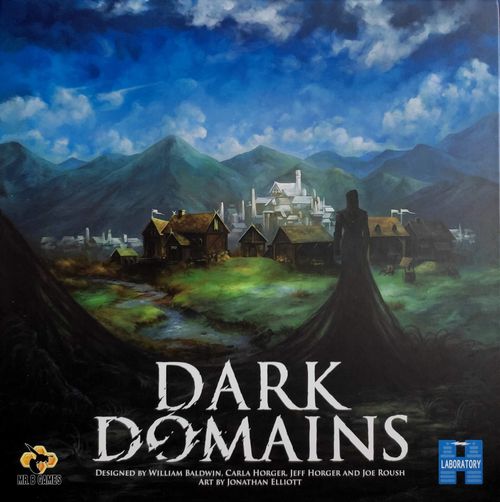
Dark Domains
Dark Domains Rulebook
Table of Contents
Table of Contents
Components
- 1 Game Board
- 1 Rules Booklet
- 5 Domain Boards
- 1 Phase Marker
- 1 First Player Token with Base
- 27 Minions (5 per player + 2 additional)
- 62 Fortune Cards
- 48 Adventurer Cards
- 40 Henchmen Cards
- 94 Building Cards
- 156 Spell Cards
- 10 Masters of the Domain (5 Cards)
- 68 Monster Tokens
- 30 Condition Tokens
- 92 Element Tokens (Earth, Wind, Fire, Water)
- 55 Coin Tokens
- 65 Evil Tokens
- 116 Resource Tokens (Stone, Metal, Wood, Workers)
- 8 Polyhedral Dice (6, 8, 10, 12-sided)
Setup
- Lay out the City Board.
- Place the Phase Tracker on the board on the "Fortune" Space.
- Separate the Fortune Cards into three decks by the game era icon on the right side of the card: the Masquerade Deck, the Revelation Deck, and the Decay Deck. Set aside the specific cards World and Death. Shuffle the 3 decks individually.
- Count out 4 cards from the Decay Deck and shuffle the Death card into them. Place these 5 cards face-down as a draw pile.
- Count out 4 cards from the Revelation Deck and shuffle The World card into them. Place these 5 cards face-down on top of the Decay Deck.
- Count out 5 cards from the Masquerade Deck and place them on top of the Revelation/Decay Deck. Do NOT shuffle this deck!
- [OPTIONAL VARIANT] Each player draws one random Master of the Domain card. If there is a pre-game advantage for your Master, take it now.
- Each player takes a Domain Board, 4 Minions of their chosen player color, and 8 Coins. Set each player's 5th Minion aside for now.
- Draw 4 Adventurers from the top of the Adventurer Deck and place them on the Green Unicorn Tavern followed by 4 more on the Yellow Swan Tavern slots. Place the first card drawn in the "Leader" Space and the second drawn in the box to the right of the leader. Always place in the Green Unicorn Tavern first before moving to the Yellow Swan Tavern.
- Shuffle the Henchmen Deck and draw from the top, placing 2 face-up on the Inn Spaces followed by two face-down on the Far Lands Spaces.
- Shuffle each Spell Deck by type (Attack, Defense, Control, and Production). Place the decks on the 4 Spell Deck spots.
- Shuffle all Buildings into a deck with the light side up. Draw 7 Buildings from the deck to fill the Architects' Guild Spaces placing them light side up. The top card on the Building Deck will be visible to all players.
- Set all Resources, Elements, Coins, Tokens, and Evil beside the board.
- Shuffle the Monster Tokens into a face-down pile. Place 6 face-up into the Nik'tmarg Spaces. Keep the remainder face-down near the board as the Nik'tmarg draw pile.
Sequence of Play
Each turn is played in the order of the Phase Tracker as it proceeds from the Fortune Phase to the End of Turn Phase. The game continues repeatedly until the "Death" card is drawn from the Fortune Deck. At that point, the current turn will play to completion and the game will end at the conclusion of the next End of Turn Phase.
One turn consists of completing all 8 phases below. The game should take between 6 and 8 turns to complete. The Phases, in order, are:
- Fortune
- Preparation
- Minion
- Resolution
- Foreman
- Adventure
- Production
- End of Turn
Key Concepts
City Board
The city board depicts the city of Harrows. The city comprises 17 distinct locations, many of which have multiple Action Spaces. When Minions are placed here in the Minion Phase, they are placed on an Action Space. This reserves that action for that Minion only. During the Resolution Phase, those actions will be carried out in the specific order indicated by the path from lowest number to highest.
Spaces are marked where card decks, markers, mercenaries, Monsters, and Buildings are to be placed. These are placed during setup and in the End of Turn Phase as many locations are tied to specific Action Spaces.
The City Board also holds the Phase Tracker. As the turn progresses and each phase is completed, move the tracking token along the track starting at the top and progressing towards the bottom (End of Turn). Every time a new phase is entered, check for the specific rules governing that phase and fully complete that phase before moving to the next phase.
Domain Boards
Each player takes a Domain Board representing his or her Domain. Each player may only place Buildings, Minions, Monsters or tokens on their own board unless otherwise specifically indicated on a card.
- An Area is a quadrant of 4 spaces of one terrain type.
- A Playing Area is the table space in front of a player, but not the Domain Board.
- The outside border of each Domain Board matches the player's color.
- A Space is one of the 16 rectangular shapes on the Domain Board.
Area — Each Area on a Domain Board consists of the 4 types of different terrain each player possesses: Forest, Urban, Plains, and Mountains. Each Area has 4 Spaces in which a player may place various tokens and Buildings.
Space — A Space is a single rectangle on a player's Domain Board that may hold 1 Building Card plus assorted Monsters and tokens.
Space, Space, and Space: Dark Domains uses 3 kinds of Spaces — Spaces in your Domain, Action Spaces to place Minions in Harrows, and Spaces to place various tokens and cards on and around the board. Because of the pervasive usage in the rules, the clearness of the concepts, and our desire not to muck it up in editing, we have left the usages in the game. We think it is very clear what type of space we are talking about at various times.
Playing Area — All Resources collected by a player are placed in their playing area. All of these game pieces residing in a player's area that have not been used are considered Stored. Players have to keep all items used in the game in their playing area or hand.
Coins, Resources, Evil, and Elements
These tokens are used by all players and should be kept near the board. When a token is spent or used it is returned to this stock for future use in the game.
Coins and Evil are meant to be semi-hidden knowledge. While these items may never be hidden, their full value does not have to be revealed. Players can place them in stacks or piles to obfuscate the total if desired. No player must reveal their full value of these items until the end of game scoring.
Resources and Elements are common knowledge and must be revealed if asked. At the conclusion of each End of Turn phase, no player may have more than 10 of each of the items, the excess being returned to the supply.
Evil represent a player's descent into evil and chaos. Evil equate to victory points at the end of the game.
Unless otherwise specifically instructed, discarding, paying, and spending of anything is considered to be a transaction with the game supply. Interaction with a player requires a specific spell or Henchman and specific instructions.
Dark Domains also provides a number of Condition Tokens that are included to ease play and aid in remembering the effects of certain spells and Fortune Cards (for example: Magic Shell, Imbue +1D6, Desecration +2D6, Gate, Queen's Command, Sanctify, 2X).
Temporary tokens, such as the "Unavailable" token, are removed from play each turn in the End of Turn Phase.
Permanent tokens are placed directly on the Building, Monster, Adventurer or Space and remain in play as long as the host is in play. When the host is Removed or Discarded, the token is also returned to stock unless directed otherwise.
Monster Tokens
Every Monster Token has numbers and icons on them that apply to various functions: a Bonus Bar, Monster Ranking, Cost, Defense Value, and Production Icon.
Examples: the Gargoyle's Bonus Bar indicates it defends with a +2 to its strength when placed on a space in the Urban Area. The Fire Elemental costs 6 Coins to hire and creates one fire token per turn in the Production Phase. The Specter has a ranking of 136 and produces one Evil during the Production Phase. The White Mask Gnoll's yellow Name Bar indicates that this Monster can be stacked with other Monsters, and can be placed on light Buildings. The Dragon has a natural defense of 18, but its Bonus Bar indicates that any Element can be spent to roll an extra 1d8.
Name Bar Color
- Black = Monster is from the Nik'tmarg. Monsters of this type cannot be stacked with each other.
- Yellow = Monster comes from a Henchman Card or the Docks and is able to be stacked with other Monsters and/or on a light Building.
Monster Ranking — This is the Monster's overall ranking and determines which Monster is most likely to be attacked by an Adventurer with the "Monster" icon. The higher the value, the more likely it is to draw the attention of the party.
Cost — The Monster's cost when purchased. Monsters without Coin values may never be purchased.
Defense Value — This is the Monster's ability to resist and survive attacks. If the Monster is alone in a Space, this is its total value. If it is stacked with a Building, add the Building Card defense to this value to determine the total value of the Space.
Production Icon — During the Production Phase, Monsters in a Domain will produce the item indicated on the lower left corner of the token. Some Monsters produce nothing.
Bonus Bar — Under a Monster's name may be a bonus ability. This will depend on either:
- The expenditure of the indicated resource.
- The requirement that the creature be placed in a specific Area terrain type.
Abilities requiring Resources are temporary and must be spent each time you want to strengthen a Monster's defense value. If you must pay a resource for the bonus, that bonus may be activated multiple times per turn, adventure, or fight.
Example: Carla's dragon is on a Building that is being attacked by Adventurers. They roll and overcome the combined defense of the dragon and Building. Carla spends a fire Element and rolls an eight-sided die (d8). The Adventurers still have the higher value. Carla spends another Element, this time a water, and rolls the d8 again. Now the defender's total is higher than the Adventurers. Carla is victorious, keeps her Building and dragon and receives 3 Evil for her successful defense.
Current Turn Order
If at any point in the game it is necessary to identify the current turn order, the player holding the First Player Token is considered first with the remaining order moving clockwise around the table. This can change at points during a turn as the first player token can move from player to player.
Remove, Replace, and Discard
- Remove means to take an object from the game and place it in the box. That item is no longer able to be used in the current game.
- Replace is a term specific to the adventuring party. Any time an Adventurer is "Replaced", it is removed from the appropriate tavern and discarded. All other Adventurers are moved one space to the left (towards leadership) and a new Adventurer is drawn and placed in the right-most position available in that tavern.
- Any time a Discard is called for, place the card face-up on its deck's discard pile. All discards must be revealed when discarded, but no one may look through a discard pile after cards have been placed.
Necromancer's Note: Be sure to keep the two taverns separate. Each group of 4 is tied to their specific tavern.
The Dice
Dark Domains uses some uncommon dice with their own terminology. On the 10-sided die there is a "0", it should be read as if it was a "10" and not a zero. The shorthand notation for each die is as follows:
- d6 = Six-sided
- d8 = Eight-sided
- d10 = Ten-sided
- d12 = Twelve-sided
The number placed before the 'd' represents how many times the die is rolled. So a 3d6 means to roll a 6-sided die 3 times and total those rolls. A 1d8 means to roll the 8-sided die 1 time.
Stored
All Coins, Resources, and Elements in a player's play area are considered Stored. Any time something affects stored items, these items may be targeted. Henchmen and spells are never stored.
Spells may be kept and used at the proper time and there is no limit to the number of spells you may accumulate. It is only Elements, Coins, and Resources that receive this label. Specifically there are many Fortune Cards and future expansion components that deal with stored items.
The Phases
Fortune Phase
Turn the next two cards from the Fortune Deck face-up.
Place the first drawn card in the left-hand box marked "#1: Fortune Card" and the second drawn card in the right-hand box marked the same. If one of the cards is Death, discard the other and resolve Death. Otherwise, resolve them in the order drawn.
Suited cards (Cups, Pentacles, Swords or Wands) have two possible effects:
- If the card's suit matches the other card's suit or is paired with an Arcana card, read and resolve the top text section.
- If the two cards are of different suits, read and resolve the bottom text of each card.
Arcana cards only have one box regardless of what they are matched with. Resolve the consequences of each card before proceeding to the next game phase.
Preparation Phase
Some buildings, spells or henchmen allow a player to perform an action in the Preparation Phase. If multiple players wish to resolve these actions, do so in current turn order.
Minion Phase
Players alternate the placing of Minions in current turn order. Minions may be placed on any empty "Action Space" on the main City Board. A Minion may also be placed on a light Building in the Domain of the player controlling the Minion. These Building Cards will be turned to dark before the City Board is resolved. It is possible for some players to have more Minions than others. Continue the phase until all Minions are placed, skipping those that are out of Minions on the current turn.
The standard number of Minions to place is 4. Some Fortune Cards will reduce that number to 3 or increase it to 5. A player that controls the Courtesan (white) Minion will have an extra Minion and the player with Benoit Hogue may pay to use him that turn.
Minion Control — Each Minion is controlled by the player whose player color matches the Minion.
Resolution Phase
Minions are resolved in a strict order. You are never obligated to perform the action associated with the Action Space where you placed your Minion. You may elect to not complete the action and simply remove your Minion from the board with no effect. When a Minion is resolved it is returned to your play area for use in later turns. The order of resolution is as follows.
In the Domains — Any Minion placed on a light Building in your Domain will cause that Building to be flipped to its dark side. All Minions placed in a player's Domain will be resolved first before going to the city board. A player may only place a Minion in their own Domain. You may not place a Minion in another player's Domain.
The Seer — Look at (not take) the top 3 cards of the Fortune Deck. That player may not show the other players the cards but may make any claims desired about what was seen. After looking, that player returns the cards face-down to the top of the deck in any order.
The Business District — Take 2 Coins. This is the same for either Space.
Temple of the Black Kult — Take 2 Evil. This is the same for either Space.
The Assassin and Street Thug — These 2 Spaces perform the same task, the difference is the quality of the action. The player resolving the Minion in either Space may eliminate (or possibly eliminate) a target as follows:
- By paying the Assassin 12 Coins you guarantee success. You may replace 1 Evil token for 2 Coins as often as you like in this transaction. For example, you can pay the Assassin 8 Coins and 2 Evil.
- If you pay the Street Thug 2 Coins you must roll 1d6 and if you roll a 1-2, the action succeeds. If you roll a 3-6, the action fails with no effect.
The target for the assassination determines the effect:
- Adventurer: Remove one Adventurer at either tavern, including the leader. Replace immediately (see Remove, Replace, and Discard).
- Henchman: Remove any Henchman Card controlled by any player or in either the Inn or the Far Lands. Do not refill yet.
- Minion: Remove a Minion from the Action Space it occupies. The player controlling the Minion may then place it on a different empty Action Space that has not yet been resolved (higher number than the Assassin or Street Thug). Because the Builders' Guild essentially has unlimited Spaces, a Minion removed from the Builders' Guild may be placed back in the Builders' Guild and in that sense is immune from assassination.
Necromancer's Note: Due to the timing of the actions along the path, you cannot use this ability to prevent a Minion from flipping a light Building, visiting the Seer, utilizing the Business District or the Temple of the Black Kult. The Street Thug cannot stop the Assassin, but the Assassin can stop the Street Thug.
The Architects' Guild — Take the Building Card associated with the Action Space. These cards are placed in your Play Area and can only be built later in the turn or later in the game (see Foreman Phase). A player does not ever have to build a Building Card they possess and may hold it indefinitely.
The Wayward Dragon Inn — Take the Henchman Card located in the associated box. Place the Henchman face-up in your playing area. You may use it as soon as the relevant phase is entered.
Builders' Guild — The Space for the Builders' Guild is purposefully an overly large Space. This Space is considered to have an infinite number of Spaces and any number of Minions from any number of players may occupy this Space and each Minion may purchase as many Resources as desired. All players may buy at the same time. There is no limit to the amount of Resources available. If the stock runs out, use a substitute if necessary. Items available at the Builders' Guild include:
- 1 Metal costs 2 Coins
- 1 Stone costs 1 Coin
- 2 Wood costs 1 Coin
- 2 Workers may be hired for 1 Coin
All purchased Resources and hired Workers are placed in your play area and not on your Domain Board. These items are considered Stored.
Towers of the Elements — Takes 2 Elements matching the Element associated with their Action Space and places them into their play area.
Library of the Shadin Council — Draw 3 spell cards off the deck or decks of their choice. Choose from any spell type, all of one type or any combination of types up to 3 spells. If not enough spells are in a deck, shuffle the discarded spells to create a new draw pile. If there are no discards to shuffle, that type of spell may not be chosen. Both Action Spaces have the same effect.
The Taverns — Replace any member of the adventuring party connected with the specific tavern with the exception of the current leader. Any Adventurer taken from the board in this manner is placed in the discard pile near the board and replaced as per the Replace rule immediately.
The Docks — Take the Foreign Mercenary Token and keep it until the End of Turn Phase. Place the token on a Space in your Domain containing a Building Card. The card may be light- or dark-side up. The Space may contain Monsters.
When the Building containing the Foreign Mercenary is attacked, it defends by rolling a D10 and adding that value to the defense of the Space. If defending multiple times, the mercenaries roll a die each time.
During the next End of Turn Phase return the Foreign Mercenary Token back on the docks.
The Far Lands — Take possession of the face-down Henchman Card associated with that Action Space. This Henchman is placed face-up in the controlling player's play area and is ready for use when the relevant phase is entered.
The Nik'tmarg — Pay the required Coins indicated on the Monster Token to the stock to take that Monster. If you cannot or elect not to buy the creature, remove your Minion with no effect.
Any Monsters taken must be placed on either an empty dark Building or an empty Space in your Domain.
Harrows Town Council — Take immediate possession of the First Player Token and 2 Coins from the stock. At this point he or she is now the first player.
The Royal Court — Take the extra (white) Minion for the next turn and 2 Coins from stock. On the next turn, that player may use the extra (white) Minion.
To show ownership of this Minion, also take the White Minion Token and place it in your play area.
When that Minion is resolved, place the token and the Minion back on the Royal Court Space.
Foreman Phase
During this phase all players may build any Buildings from their play area provided they have the required Resources.
The light side of a Building Card shows the Resources needed to build and staff the Building Card in your Domain. For example, the Market requires 1 Wood and 1 Worker to build in the Foreman Phase.
To build, return the Resources shown on the card from their stored area to the supply. Then place the Building Card light-side up on any legal Space in your Domain. A legal Space is defined as:
- The Space may not have another Building in it already.
- The Space may have no Monster from the Nik'tmarg in it at the instant of Building. This rule is suspended on the last turn of the game when a Building may be built dark-side up.
Once placed Buildings may not be moved.
Some Buildings have restrictions as to which of the 4 Areas it may or may not be placed upon.
Adventure Phase
The scourge of your existence and the only barriers to your plans are the Torin Company. These pesky do-gooders will seek out evil, your evil, and try and eradicate it from the land. Your success hinges on respecting them and preparing for them.
During this phase both adventuring parties, consisting of 4 Adventurers each, will adventure.
The two adventuring parties will choose their targets separately and adventure against their targeted Space. It is possible that both parties may decide to adventure against the same Space.
The Green Unicorn Tavern will always adventure first.
Once their adventure is complete, The Yellow Swan Tavern will adventure. Be sure to re-assess the Yellow Swan's target after The Green Unicorn has finished as it is possible to have the target change between adventures.
Adventure Party: The 4 Adventurers coming from one tavern adventure as a group that is referred to as an adventuring party or just party.
Necromancer's Note: Be aware of where these parties are going or may go. I suggest identifying targets (aloud if possible) prior to placing Minions. The last thing a true Master of the Domain wants is to be surprised by the Torin Company. The Adventurers are not random but may feel that way if you don't pay close attention.
Adventuring consists of the following steps. Each adventure should be completed in this exact order. Follow all of these steps for The Green Unicorn Tavern then again for The Yellow Swan Tavern.
- Determine the target for that party. The target is determined only by the leader of the party, the card in the left-most slot. See Determining Targets below.
- All players may play spells and Henchman.
- Only the player whose Domain will be affected may cast spells or use Henchmen to add to the defenses of the target Building or Space. This is the player's only opportunity to bolster the strength of the target Building before the attack is resolved.
- The Adventurers attack. Gather the dice for the Adventurers. The owner of the targeted Building must roll all 4 of these dice. If the roll is higher than the defense value of the target, the attack succeeds (see Victorious Party below). If the roll is equal to or lower than the defense value of the target, the Adventurers fail (see Victorious Defender below).
- Monsters with an expendable Bonus Bar action may now spend the proper items to try and overcome the attack. The defending player may utilize the Bonus ability as many times as desired as long as they have enough of the proper items to spend. Players may see the result of the Bonus Bar ability before deciding to spend more items.
NOTE: We prefer to let the player being attacked "shoot themselves in the foot". So we make them roll their own dice when being attacked. Some of you may want another player to roll the dice as the adventurers. Either way is fine, but the standard rule of the attacked player doing the rolling applies if players cannot agree.
Determining Targets
When determining the target for an adventuring party, only the leader (the Adventurer in the leader slot on the far left) is checked. At the bottom of each Adventurer are two icons. Always check the left icon first.
- If the icon is a Monster the Adventurers attack the Monster with the highest value for its ranking (they will go after #64 before #7) wherever it may be.
- If the icon is an Evil and Production icon combined, the party will attack the single Space among all Domains that produces the most Evil. If a tie, target Spaces with Buildings before Spaces without Buildings. If still tied, use Building Rank and finally Monster Rank as the tie-breaker.
- If the icon is an Area (Plains, Forest, Mountain, or Urban), then the Adventurers will attack the highest ranked Building in that Area in any player's Domain.
- The final type of icon matches the Building types: Economic, Magic, Martial, Nature, Power, and Religion. All of these types are ranked and they will target the highest ranked of them (#33 before #3).
Once a target is determined, every token and Building on the Space is subject to the attack. If the target is a lone Monster, only it will be targeted. If a Monster shares a Space with a Building Card or other token, everything in that Space will be attacked, even if it is a light Building. If the target is a Building, every token stacked with it is subject to attack including Monsters and weapons.
Necromancer's Note: Buildings are that Monster's lair and an integral part of its defense. Roaming Monsters have no lair and are more vulnerable to attacks by monster hunters.
Procedure
- Check the leader's left-most icon and see if any player has a DARK SIDE UP Building Card matching that icon or in that Area. If so the Building with the highest value is the target. OR if the icon is a Monster, look at all players' Domains and find the Monster with the highest ranking value (#43 will be targeted before #5).
- If no target matches the left icon, repeat the process for the right icon.
- If there are no dark side Buildings or Monsters matching either icon, check the left-most icon and see if any player has a LIGHT SIDE UP Building Card matching it. If so, the Adventurers will make a pilgrimage (see Pilgrimage below) to that location and pay the owner 1 Coin.
- If that does not find a match, check the right-most icon and follow the procedure in step 3 above for that icon.
- If no match for any icon can be found, the party does not adventure at all.
Necromancer's Note: It is almost impossible to have dark Buildings at the adventure phase of Turn 1 and rare (but not unheard of) to have dark Buildings on turn 2. The pilgrimage rules are in play to acclimate players to the methodology used for the adventurers to locate targets. When things do go dark, it is important that players know how and why specific Buildings are targeted.
After the Adventure
Victorious Party — If an Adventurers' attack succeeded, do the following:
- Remove all tokens and Buildings from the Space. Do not return Buildings or Monsters to stock but remove them from play.
- It may be possible for the controlling player to save a Monster through spells or other means and it may be done at this time.
- Replace the Party's leader (see Remove, Replace, and Discard).
Victorious Defender — If the Adventurers' attack failed, do the following:
- The attacked player receives 3 Evil.
- Remove the party's leader (see Remove, Replace, and Discard).
- Replace all other adventure party members that shared the icon that determined the target (see Remove, Replace, and Discard). There should be 3 Adventurers left when finished.
Pilgrimage — If the adventure party makes a pilgrimage (moves to a light-side up Building), do the following:
- The player possessing the Building where the pilgrimage occurs receives 1 Coin.
- Replace the leader of the party (see Remove, Replace, and Discard).
Nothing — If the adventure party targeted nothing, replace the party leader (see Remove, Replace, and Discard).
Production Phase
During the Production Phase, players may simultaneously take all the Coins, Elements, Resources, and other items provided by their Building Cards, Monster Tokens, Henchmen, and Spells cast during this phase. All Buildings produce the items listed on the left side of the card. Players place all items in their play area.
Necromancer's Note: Everything may be collected in any order you wish, hence you may collect Elements before using them to cast a spell that will allow you to get Resources that you may be able to use to activate a Henchman. Make the most efficient use of your production that you can.
At this point you may realize that Dark Domains is not a game that constantly requires scraping for Resources and Coins. This is on purpose. The game is about how to utilize your Resources, and not about struggling to acquire them.
End of Turn Phase
The End of Turn Phase is mostly just a clean-up and special activity period.
First, all players utilize all desired End of Turn actions. These actions must be completed before the actual clean-up of the board is undertaken. They must be done in Current Turn Order.
Once those actions have been carried out, the board will need to be reset for the next turn.
- Discard the 2 Fortune Cards in play this turn.
- Remove all Unavailable tokens from the board. These tokens are always removed during the End of Turn Phase.
- Place any Henchmen Cards still in the Inn in a discard pile beside the Henchman Deck.
- Any Henchmen still in the Far Lands are turned face-up and moved to the Inn. If the Inn is not filled, fill it from the top of the Henchman Deck.
- Fill any empty Building Card slots in the Architects' Guild by drawing from the top of the deck. If no Buildings were taken in the previous turn, remove all the Buildings and refill completely.
- Fill any vacancies in the taverns. Always fill the Green Unicorn before the Yellow Swan.
- If the mercenary was taken, replace it on the Docks Space.
- Draw two Henchmen Cards and place them face-down in the Far Lands.
- If any Monster Spaces are empty in Nik'tmarg, fill them from the Nik'tmarg supply.
- All players return any Resources or Elements in excess of 10 each back to the stock. As an example players may hold 10 Workers, 10 Stone, 10 Wood, and 10 Fire. If that player also holds 12 Earth, 2 must be returned to stock.
Ending the Game and Winning
Ending the Game
On the turn that the Death card is drawn during the Fortune Phase, the game will end at the completion of the End of Turn Phase. On that turn the other Fortune Card will have no effect.
Winning the Game
At the end of the game, total everyone's Evil. The player with the most wins the game. If there is a tie, the player with the most Evil production (Buildings and Monsters combined) among those tied is the winner. If still tied, the player among those tied with the single highest ranked Building is the winner.
Attacking
There are many instances where a Space, often including a Building Card, may be attacked. These include being targeted by an adventure party, other player's spells or Henchman Cards.
Defenses
The first step to resolving an attack is to determine the defense of the Space. Count up all the defense values on the Building, Monsters, and tokens in that Space.
Some Monsters may have variable defense capabilities shown in their Bonus Bar. The defending player may spend the required Element or resource to increase the defense as indicated. This expenditure may come after the attack total is determined.
Spells may be cast to enhance the defense or reduce the attack.
Attacks
Total up all the attack dice and roll them. The sum determines the value of the attack.
Resolution
Once the dice have been rolled, resolve the attack as explained in the Adventure Phase (see above). A value higher than the defense succeeds and eliminates the target or targets. A value of less or equal results in no effect.
Fortune Cards
Two Fortune Cards are turned up in the Fortune Phase of each turn. The first card turned over should be placed in the Fortune Card 1 Space. The second card should be placed in the Fortune Card 2 Space. The cards are either Arcana or one of four suits (Cups, Wands, Pentacles or Swords).
Each card shows a suit symbol (or Arcana symbol) and a deck identifier (Masquerade, Revelation, or Decay) — the second icon of each card determines which deck the card belongs to.
Example card, Queen of Swords: if paired with a matching suit or Arcana, all players choose 1 light Building in their Domain and place the Queen's Command token on it. That card may not be flipped, adventured against, moved, or destroyed for the remainder of the game. If paired with a different suit: if you have an empty Area (not space) in your Domain, immediately draw one Monster and place it on one of the four spaces in that Area.
Example Arcana card, Death: this is the last turn. The game will end at the completion of this turn. If there is another card showing, ignore that card and place it in the discard pile. Any Buildings completed during this turn's Foreman Phase may be built light or dark side up. (This text applies regardless of what card the Arcana card is paired with.)
In any game, only 15 Fortune Cards will be used.
Henchmen Cards
Henchman Cards list a specific phase on their cards when they can be used. This is the only phase when they may be used. If a Henchman's action requires that it be discarded, place it in the Henchman discard pile. If a card must be removed, place it in the game box; it is out of the game. If required, you must have the specific items stored in your playing area to activate a Henchman. Pay those to supply each time the Henchman is used.
Henchman Cards are not secret and must be visible at all times and open to inspection by all players.
Henchman timing rules are the same as those for casting spells (see Casting, below).
Example card, Tarpa (Gnoll Scout): place Tarpa immediately. At the start of the Adventure Phase move the Tarpa token to any space in your Domain. The yellow bar on the card indicates this Henchman comes with a neutral Monster.
Building Cards
Each Building Card shows: its type (e.g. the Grove has a Nature type), what it produces while on its light side (the Grove produces 1 Coin), its cost to build (the Grove requires 1 each of Wood, Stone, and Workers to build during the Foreman Phase), any Area restriction (the Grove must be placed in the Forest Area of the Domain), its defensive value (the Grove has a defense of 9), what it produces if flipped to its dark side (the Grove produces 4 Evil if flipped), and its ranking (the higher the number, the more it attracts adventurers — for example, the Tower of Dark Magic has a ranking of 13, produces 1 Spell and 4 Evil on its dark side).
Building Cards represent the key Buildings in your Domain. They are purchased at the Architects' Guild and are placed on your Domain during the Foreman Phase. They must be placed light side up when built. Once placed a Building may not be moved.
Flipping to Dark
A Building Card must be placed light side up when built. It may be flipped to the dark side by placing a Minion on it during the Minion Phase, and then flipping it over during the Resolution Phase. Once a Building is dark-side up it may not be returned to the light side unless specific Fortune Cards, spells or Henchmen allow or require it. There are also other ways that are less common to flip Buildings. These are identified in the Appendix.
Spells
Each Spell Card shows its name, its type (Attack, Defense, Control, or Production — e.g. Destroy is an Attack-type spell), its effect, a timing icon showing which phase it can be played in, and its casting cost in Elements.
Example card, Destroy (Attack): attack any Monster on another player's Domain Board with 4d6. If the Monster guards a Building, ignore the defensive value of that Building.
Example card, Nullification: can only be played during the Minion Phase — play after all Minions are placed, force one Minion to change its action this turn. Casting cost: 1 Wind and 1 Water Element.
Casting
Because the game is so wide open, the timing for spell casting could become chaotic. Therefore, the following restrictions have been placed on the timing of spells. Any spell that is cast is immediately placed face-up in that spell type's discard pile. If such a pile has not been started, start it now.
When spells are cast the player casting the spell must return the necessary items indicated in the casting cost section at the bottom of the card back to the stock. If these are not paid the spell will not be considered played and the player may keep the spell for later use.
Preparation — Some spells may be cast before Minions are placed. Do these in player order.
After Minions Are Placed — Once all Minions have been placed but before resolution, all players, in turn order, have one opportunity to cast spells in player order.
During the Adventuring Phase — In this phase, you may cast spells at two different times. In player order, before the adventure has begun, you may cast spells that affect the adventure party and other players. Once the Adventurers attack, only players being targeted by the Adventurers may cast spells.
Production Phase — No spells in this phase interact with other players. All players may cast simultaneously without fear of being disrupted by other players. You may NOT counter-spell anyone during this phase.
End of Turn Phase — In this phase, you must cast spells before the board is reset for the next turn. Since many spells are interactive, resolve them in player order.
In Reaction to Other Players — A very small number of spells have the ability to cancel a spell of another player and must be played immediately after the opponent's spell to counter it. These spells are marked with an exclamation point in the upper right corner. You cannot counter spells cast during the Production Phase.
If a spell is countered, all of its effects are canceled.
You may not counter a Counter Spell.
A player may wait to see the target of a spell before deciding to cancel it.
Tokens
Some spells, Fortune Cards or Henchmen call for a token to be placed in a Domain. These tokens are permanent items that last throughout the game unless specifically indicated in the text of the card (for example: Magic Shell, Imbue +1D6, Desecration +2D6, Gate, Sanctify).
Masters of the Domains
Master of the Domain cards are optional and not required for play. If there is any conflict between a Master Card and the standard rules of play, the Master Card overrules it.
Masters of the Domain cards provide special effects either at the start of the game or during play.
If a Masters of the Domain card has a pre-game benefit, take it during game setup.
If a master has an in-game benefit, treat it as if it were a Henchman.
Example: Barir Bronzehands — Take 1 Stone, 1 Metal, or 2 Coins.
Masters may not be Assassinated or Removed from play.
Appendices
The Appendices are not exhaustive. They only cover those items that are not perfectly clear on the card or that may have more details and nuance than can be shown in limited space. If you are looking for something and it's not here, take a breath and return to the item and assume the simplest possible answer. Not all entries are pictured.
Appendix A: Spells
Alchemy Formula: The caster may return 1, 2 or 3 Elements to supply. These Elements need not be the same. For every Element discarded, the caster receives 4 Coins.
Animate: Draw one random Monster from the Nik'tmarg draw pile and place it on any empty Space or dark Building Card. This new Monster may not be placed in violation of the stacking limit.
Banish: The player may target any Monster, including one in any player's Domain or in the Nik'tmarg. Remove that Monster from the game.
Black Plague: No player may hire Workers at the Builders' Guild this turn. Other means of gaining Workers are still possible. Place an Unavailable token over the Worker icon at the Builders' Guild.
Cave-In: No player may buy any Stone from the Builders' Guild this turn. Other means of gaining Stone are still possible. Place an Unavailable token over the Stone icon at the Builders' Guild.
Charm: Must be cast during the Resolution Phase as an action is resolved by a Minion. When that Minion activates, the caster may perform the same action as the player whose Minion was on the Space (even if it was their own) after that Minion performs the action for its controller.
- If the targeted Minion is on the First Player token, the player casting the spell will take the 1st Player Token from the player that took it prior. That player also gets 2 Coins.
- If the targeted Minion is on the Royal Court, the player casting the spell will take the extra Minion and token from the player that took it prior. That player also gets 2 Coins.
- If the Minion is on the Business District, Temple of the Black Kult or Towers of the Elements, Coins, Evil, Elements are taken from stock.
- If the Minion took a Building, Henchman or Monster, a random one is drawn instead. Buildings from the top of the draw deck, Monsters from the stock (and then must be purchased), spells from the deck or decks of their choice, henchmen from the Henchman Deck.
- The Seer allows the casting player to look at the cards after the original player and also replace them in any order.
- Assassin and Street Thug allows the caster to spend the required Coins and execute an assassination.
- The taverns allow the caster to swap out a second Adventurer.
- The caster may not copy a Minion placed in a player's Domain.
Confusion: After Minions have been placed, but before they have been resolved, swap the location of any 2 Minions on the City Board. If a player counters this spell it is countered for both players.
Counter Magic: Play this spell to counter any spell. That spell is discarded without effect. This may not be played during the Production Phase.
Desecration: Place a Desecration token on any Space. This acts as an extra 2d6 defense for the Space and is permanent even if a Building or Monster is removed from play. If placed on a light Building, immediately flip that Building to dark. If a light Building is placed on a desecrated Space, immediately flip it to dark.
Destroy: You may cast this spell on any Monster including Monsters on any player's Domain or in the Nik'tmarg. Attack that Monster with 4d6. No defensive modifiers may be added including a Building Card on the same Space or a weaponry token. A Monster's Bonus Bar may be utilized by its controller.
Dispel: The caster names 1 Element (Air, Earth, Fire, or Water). All players, except the caster, must discard all such Elements they have stored back to supply.
Enthrall: Cast on any Henchman. Take that Henchman and place it in your playing area. He is now your Henchman.
Gate: Move 1 Monster from any Space in any player's Domain to any Space in any player's Domain (do not violate the stacking limit). Place the Gate token on the Building from which the Monster was taken. If the Monster survives, return it to its original Space as soon as combat resolves. This Monster's combat value is used to supplement the defense value of the Building. The caster may pay to activate the Monster's bonus attributes.
Guardians of the Wood: No player may purchase any Wood from the Builders' Guild this turn. Other means of gaining Wood are still possible. Place an Unavailable token over the Wood icon at the Builders' Guild.
Imbue: Place the Imbue token on any Monster or Adventurer. This token stays with the target until it leaves play or is discarded. The Imbue token confers an extra 1d6 to the combat value of that Monster or Adventurer.
Nullification: Play after Minions are placed but before they are resolved. Choose any Minion on the City Board. The controller of that Minion must move it to a different empty Action Space or onto their Domain. The Builders' Guild has an infinite number of Spaces so a Minion nullified there can be placed right back there.
Pain: Play before the Adventurers roll. The Adventurer with the lowest die value does not roll its die for the adventure. If there are multiple Adventurers with the lowest die, the caster chooses which one will not roll.
Resurrection: Play immediately after a Monster has been killed. Instead of removing it, place it on any empty Space or unoccupied dark Building in your Domain. This may be the same Space it occupied before it was killed.
Rust: No player may purchase any Metal from the Builders' Guild this turn. Other means of gaining Metal are still possible. Place an Unavailable token over the Metal icon at the Builders' Guild.
Sanctify: Choose any dark Building in any Domain and flip it to light. Place a Sanctify token on the Building. It may not be flipped to dark again by any means for the remainder of the game.
Slay: Remove any 1 Adventurer in either party including the Leader. Slide the Adventurers to the left if necessary so that the first three slots are filled. Do not replace it until the End of Turn Phase. The party will adventure with just three Adventurers.
Spent Soul: The caster may return 1, 2 or 3 Elements to stock. These Elements need not be the same. For every Element spent, receive 3 Evil.
Summon: Play to draw one random Monster from the Nik'tmarg draw pile and place it on a dark Building or vacant Space in your Domain. This creature may not be placed in violation of the stacking limits.
Transport: Move any Monster from your Domain to any other legal Space in your Domain. You may not place the Monster in violation of the stacking limits.
Appendix B: Henchmen Cards
* State of Decay: All Henchmen marked with an asterisk require the player to be in a "state of decay" before they can use their ability. This requires that at the instant of utilizing the ability, the player controlling the Henchman has more dark Buildings in their Domain than light Buildings. This can be 2 to 1 or 7 to 3 as long as there are more dark Buildings than light.
Banchal the Greedy: Pay 4 Coins to supply to flip a Building Card in any player's Domain from light to dark.
Benar Shimon, Monster Slayer: Once per turn, he may attack any 1 Monster in the Nik'tmarg or in any empty Space on any player's Domain. Roll 3d6. If successful, remove the targeted Monster from the game.
Benoit Hogue: Each turn during the Preparation Phase, you may pay 3 Coins to use the extra Purple Minion token for the turn. Pay this cost each turn he is used. He is not discarded if you do not use him on a turn.
Chrastopheles, Guide of Spirits* : Requires "State of Decay". Discard 2 Henchman Cards and receive 3 Evil. You may do this up to 3 times per turn. Chrastopheles may not be discarded in this manner.
Erto Gourmounth, Devourer of Beasts* : Requires "State of Decay". Discard a Monster from your Domain and receive 3 Evil from stock. This may be done up to 3 times per turn.
Essoli: Place the Elf Mercenary Monster Token on any Space in your Domain. You may place it with another Monster. If you lose Essoli, remove the Elf Mercenaries as well. If you lose the Elf Mercenaries, Essoli remains with you.
Evermerista the Scroll Gatherer* : Requires "State of Decay". Discard 2 spells and receive 3 Evil. This may be done up to 3 times per turn.
Father Savonarola: Pay 1 Coin to stock to prevent any player from placing Minions on the Black Kult Spaces. Place a token on each Temple of the Black Kult Action Space.
Gnarl, Gnoll Leader: Place the White Mask Gnolls Monster Token on any Space in your Domain. It may be placed with another Monster. If Gnarl is lost, the White Mask Gnolls are removed as well. If the White Mask Gnolls are lost, Gnarl remains with the player.
Guild Master Kavai: Controller may purchase Resources for the standard Builders' Guild price. Workers may not be hired.
Hyrista the Medusan* : Requires "State of Decay". Discard 1 Stone and receive 1 Evil. This may be done up to 5 times per turn.
Istan Charon, Ferryman of Souls* : Requires "State of Decay". Discard 5 Coins and receive 2 Evil. This may be done up to 5 times per turn.
Itoril the Court Spy: When you control a Minion in the Royal Court (extra Minion) Action Space, take 2 Evil when it is resolved.
Karkhofen: One-time use. You may pay 4 Coins and 1 Evil to assassinate 1 Adventurer or 1 Henchman controlled by any player or in the Inn or in the Far Lands. Discard Karkhofen after he is used.
Karn the Builder: Build 1 Building during the Foreman Phase without paying any Workers that are necessary for that card.
Lord Winston of Harrows: May purchase 1 Monster from the Nik'tmarg, if any are currently present, for 1 Coin.
Nhoj Nomrah: After all Minions have taken Buildings, take 1 Building Card from the Architects' Guild. If no Buildings remain, Nhoj may not take a Building this turn.
Octavian: During the Production Phase the player possessing Octavian may return to the supply up to a total of three Resources. In return the player will receive 1 Coin for 1 Wood, 2 Coins for 1 Stone and 3 Coins for 1 Metal. You can sell three of the same resource or any combination of the three.
Rintalis, Corrupt Councilman: When the player possessing Rintalis controls a Minion on the City Council (1st Player) Action Space, that player also takes 2 Evil when it is resolved.
Rot, Gnoll Shaman: Discard this card to take the 1st Player token and look at the top card of the Fortune Deck.
Sizarsith, the Spellcraven Warlock* : Requires "State of Decay". Discard 1 of each Element (Air, Earth, Fire, and Water) and receive 10 Evil. This may be done once per turn.
Soojin the Elementalist: Up to three times during the Production Phase the player possessing Soojin may return 3 Coins and take any 1 Element.
Sounseril, Maw of the Abyss* : Requires "State of Decay". Discard 3 Workers and receive 2 Evil. You may do this up to 5 times per turn.
Tarpa, Gnoll Scout: As soon as Tarpa is taken, place her on any empty Space or dark Building in your Domain. Each turn, at the start of the Adventure Phase, you may move her to a different Space in your Domain. She may be placed on a Building with other Monsters. Tarpa fights with 1d8. Roll this die each time she is involved in an adventure or conflict.
Yvgenry the Totem Carver* : Requires "State of Decay". Discard 2 Wood and take 1 Evil. This may be done up to 5 times per turn.
Zartin D'Arvsil, Architect of Evil* : Requires "State of Decay". Discard 1 Metal, 1 Wood, and 1 Stone, and receive 4 Evil. This may be done up to 3 times per turn.
Zasch the Cruel, Brother of the Black Kult: During each Adventure Phase, you may discard Evil tokens to bolster the defense of a Space being attacked. For each Evil spent, roll 1d6. Add the value to the Space's defense value. Discard all Evil spent before the adventure party rolls its dice.
Zygin the Hellforger* : Requires "State of Decay". Discard 1 Metal and receive 2 Evil from stock. This may be done up to 5 times per turn.
Appendix C: Buildings
Alchemy Lab / Necromancer's Lab: When the Necromancer's Lab side is up the controlling player may draw 1 random Monster from the Nik'tmarg draw pile in the Production Phase and place it on a legal Space in their Domain. If there is no legal place to put it, no Monster may be drawn.
Castle / Fortress: When the Fortress side is up, the Fortress provides a +7 Defense value to all of the other Buildings in its Area. This ability is not added to the Fortress itself as the value is already included in its defense.
Citadel / Ruins: At the moment when a Citadel is flipped to its Ruins side, all other Buildings in its Area immediately flip from light to dark. This is a one-time-only effect and does not occur during the Production Phase.
Keep / Outpost: When the Outpost side is up, the Outpost provides a +3 Defense value to all of the other Buildings in its Area. This ability is not added to the Outpost itself as the value is already included in its defense.
Laboratory H, LLC P.O. Box 832, Worthington, Ohio 43085 https://laboratoryh.com
© 2018 Laboratory H, LLC, all rights reserved.