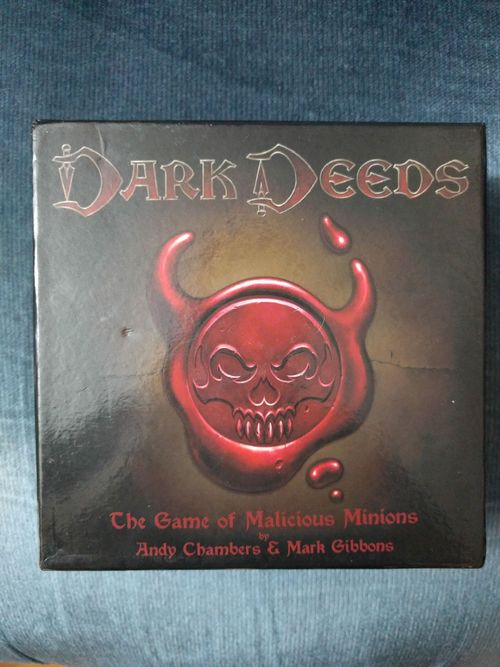
Dark Deeds
Dark Deeds Rulebook
Table of Contents
Table of Contents
Dark Deeds
Dark Deeds is a darkly humorous game for 2-4 players set in the great port-city of Anthrand. Players are cast as malicious minions in the service of a mysterious and, let's face it, evil Patron hellbent upon world domination via the city's offal-covered streets.
The crafty minions must ready themselves for the dark deeds the Patron demands by stealing, bribing, and sneaking through the streets whilst avoiding suspicion. They must also remain ever-vigilant against watchful guards, do-gooders, and most of all, each other.
Object of the Game
Weave your wicked plots in the service of a dark, intemperate master, all the while confounding the authorities and your wretched rivals alike.
The object of Dark Deeds is to score the most Favour by completing 'Dark Deeds', dastardly tasks set by your Patron. You can also earn Favour by robbing unsuspecting Citizens, defeating troublesome Guards, and facing down your Patron's Nemeses.
Components
- The Game Board. The game board depicts a typical street within the city and an abutting tavern. The street features a Street deck, 6 face-up Street cards, and a discard pile. A dagger icon indicates the direction cards move down the street. The tavern sits above the street, with slots for the Tavern deck, 2 face-up Tavern cards, and a discard pile. Between the street and the tavern runs a row of circular spots along which the Minion Pawn creeps. Below the street sit the 3 Loot decks, their respective cards, and discard piles. Each corner of the board contains a player's pitch, where Loot cards are placed, Suspicion marks are accrued and a (hopefully impressive) Score Pile grows during the game.
- The Plot Cards. 40 cards designed to aid the players' underhanded schemes and help in the fulfillment of their Dark Deeds.
- The Dark Deed Cards. 18 cards detailing the onerous tasks set by the players' mysterious Patron. The Dark Deed and Plot cards are combined to form the Tavern Deck.
- The Street Deck. 41 cards presenting a motley collection of the city's inhabitants, from its highest lords to its lowliest wretches. The Street Deck comprises 10 Nemeses, 10 Guards, and 21 Citizens (7 Artisans, 7 Clerics, and 7 Merchants).
- The Loot Decks. 3 decks of 15 cards each, detailing an assortment of Loot carried by the Citizens. There are unique Loot decks for Artisans, Clerics, and Merchants.
- Reference Cards. Handy reference cards that summarise the Dark Deeds turn sequence.
- Suspicion Marks. At either end of the Street sits a Suspicious Sack. Contained within each is a stack of Suspicion marks - Vague Suspicion marks worth 1 Suspicion each in the white sack, and Grave Suspicion marks worth 3 Suspicion each in the black sack.
- Most Suspicious Minion Coin. A token used to keep track of which player is the Most Suspicious Minion over the course of the game.
Setting Up
Deal a Reference card to each player. Dark Deeds uses 5 card decks, which are set up as follows:
1. Deal Dark Deeds and Plots
Dark Deed cards represent the demanding, often onerous chores minions receive from the Patron. Plot cards aid them in the execution of those schemes.
- Deal 2 Dark Deed cards to each player.
- Deal 3 Plot cards to each player.
2. Build the Tavern
Minions visit the city's Tavern to hatch fresh plots, receive new orders from the Patron, or to lay low when the City Watch is hot on their heels.
- Shuffle the undealt Dark Deed and Plot cards together to form the Tavern Deck.
- Place the Tavern Deck on its Tavern slot.
- Take 2 cards from the Tavern Deck and place them in the slots alongside it.
3. Lay out the Loot
Citizens unwisely carry all manner of useful loot that nimble-fingered minions can liberate to further their nefarious plans.
- For your convenience, in the Tabletopia edition of the game, you'll find the 3 Loot decks have been shuffled and dealt out, ready for play.
4. Populate the Street
Hapless Citizens, suspicious Guards and dangerous Nemeses rub shoulders along the Street, each a tempting target for an ambitious minion.
- For Tabletopia, you'll find the Street conveniently pre-populated with a motley collection of characters ripe for robbing, fighting, sneaking past or fleeing from.
Starting the Game
The player who has most recently shown themselves to be a true minion of evil goes first. If multiple players claim to be the most villainous, randomise the first player by rolling dice. The first player immediately attracts the attention of the City Watch for being so brazen and starts the game as the Most Suspicious Minion, taking the Most Suspicious Minion coin to represent this.
Play proceeds clockwise in turns.
Turn Sequence Summary
Every turn has three phases:
- Hit the Street
- Visit the Tavern
- Take Stock
During your turn you can also Play Plots and Complete Dark Deeds.
1. Hit the Street
Do the following in order:
- Pick a Target. Select a Citizen, Guard, or Nemesis as your target.
- Sneak Past Guards. Attempt to sneak by any Guards between you and your target.
- Take Your Target Down. Rob Citizen targets or Attack Guard or Nemesis targets.
2. Visit the Tavern
Choose 1 of the following 2 options:
- Dig for Dirt. Draw 1 card from those available in the Tavern.
- Lay Low. Roll 1d6 and discard that much Suspicion from your current total.
3. Take Stock
Do the following in order:
- Check for Arrest. If you have 10 or more Suspicion and are being Chased by any Guards, you are immediately Arrested: discard all your Loot cards, Suspicion Marks, and any Guards chasing you.
- Advance the Street. If there is a Guard in the last slot on the Street, it chases the Most Suspicious Minion. If there is a Nemesis in the last slot on the Street, it chases the current player. If there is a Citizen in the last slot on the Street, it is discarded. All cards are then moved as far down the Street as possible towards the last slot on the Street, dealing face-up cards from the Street Deck to refill any empty slots.
- Discard Cards. If you have more than 6 cards in your hand, discard Plot Cards until you have no more than 6 cards left in your hand. You can never discard Dark Deed cards once they've been picked up.
Turn Sequence
1. Hit the Street
The Street is where the city's heaving population gathers to conduct its business. It's also where minions creep through the shadows to stalk their next victims. Complete the following in order:
- Pick a Target
- Sneak Past Guards
- Take Your Target Down
Pick a Target
Minions can target Citizens, Guards, and Nemeses. Citizens never stray from the Street, but Guards and Nemeses will chase you down. Pick one of the following as your target:
- A Citizen, Guard, or Nemesis card on one of the six Street slots.
- A Guard or Nemesis who is chasing you (see Chasing).
Sneak Past Guards
Guards constantly patrol the squalid streets of the city in search of skulking minions and the occasional hefty bribe.
If there are any Guards between you and your intended target, you must Sneak past them. The number of Guards that may lie between you and your target depends upon whether your target is on the Street, or whether it's chasing you.
Target on the Street
If you are targeting a card on the Street, any Guards chasing you count as being between you and your target. You must sneak past each Guard chasing you, one at a time, in any order you prefer (see Chasing).
Once you sneak past any Guards who are chasing you, you reach the Street. Any Guards on the Street may also stand between you and your target. Starting at the last slot on the Street (above the right-pointing dagger), make your way up the Street, right to left, towards your target, one card at a time. If you encounter any Guards on your way, you must sneak past each in turn to progress.
The Minion Pawn is intended to mark your position on the Street as you move along it and it should begin and end every Hit the Street phase back on its Horned Seal spot.
Target Chasing you
If you are targeting a chasing Nemesis (see Chasing), all Guards chasing you count as being between you and your target. You must sneak past each chasing Guard, one at a time, in any order, to reach your target.
If you are targeting a chasing Guard, no one counts as being between you and your target, even if there are other Guards chasing you.
(Diagram: the player enters the street from the right and must sneak past each Guard between the entrance and the target.)
Sneaking
To sneak past a Guard, roll 2d6 and add any bonuses to Cunning from Loot cards you have acquired or Plot cards you play (see Playing Plots).
If the total is equal to or greater than the Guard's Perception, you successfully sneak past the Guard. You now move on to sneak by the next Guard if there is one.
If the total is less than the Guard's Perception, you fail to sneak past the Guard. This ends your Hit the Street phase in abject failure, disappointing your Patron.
If you sneak by all Guards between you and your target, or there are no Guards, move on to Take Your Target Down.
Guards
Guards are annoyingly vigilant, suspicious, and violent individuals hired by the City Watch to maintain law and order. Defeating Guards is a sure way to earn the Patron's favour, but it can be a risky proposition without helpful Loot cards for support. Because of this, sneaking past Guards to reach more desirable targets is the preferred tactic for many minions.
- Defence. How hard it is to defeat this Guard in combat.
- Perception. How hard it is to sneak past this Guard without being spotted.
- Favour. How much Favour (and Suspicion) is earned for defeating this Guard.
Take Your Target Down
Successfully robbing foolish Citizens, ambushing unwary Guards, and eliminating important Nemeses is a sure way for minions to find favour with their fickle Patron.
There are three types of Street card you can target: Citizens, Guards, and Nemeses. Citizens you target can be Robbed. Guards and Nemeses you target can be Attacked.
Robbing
To rob a Citizen, roll 2d6 and add any bonuses to Cunning from Loot cards you have acquired or Plot cards you play (see Playing Plots).
If the total is equal to or greater than the Citizen's Perception score, you have successfully stolen some Loot!
If the total is less than the Citizen's Perception, you have failed to steal any Loot. There is no consequence for this beyond the bitter sting of failure.
Unfortunately, robbed Citizens soon notice their prized possessions are stolen and cry foul. If you have succeeded in stealing a Loot card, gain a number of Suspicion equal to the robbed Citizen's Favour. Next, place the successfully robbed Citizen card face-down in your Score Pile to be counted at the end of the game (see Score Pile). Finally, select one of the following two options:
- Take one of the face-up Loot cards corresponding to the robbed Citizen type. So, if you robbed a Merchant, take one of the two face-up Merchant Loot cards.
- Gamble and take the top face-down card from the appropriate Loot Deck. So, if you looted an Artisan, take the top card from the Artisan Loot deck. If you do this, also take the two face-up cards corresponding to the robbed Citizen type and add them to that Loot's discard pile (see The Loot Decks).
Place your new Loot card face-up in front of you to show it has been added to your arsenal, then refill any of the two empty Loot slots with cards dealt from the top of the appropriate Loot deck.
Citizens
Citizens are the luckless inhabitants of the city, all of whom will soon squirm beneath the boot of your benevolent Patron. Robbing them spreads fear and confusion, earning you Favour. It also scores you some tasty Loot!
- Perception. How hard it is to rob this Citizen.
- Colour. There are three Citizen types, each with its own colour: blue for Artisans, white for Clerics, and green for Merchants. Different Citizen types are robbed for different Loot.
- Favour. How much Favour (and Suspicion) is earned for robbing this Citizen.
Loot
Loot is stolen from Anthrand's ill-fated Citizens. Artisans usually carry weapons with Strength bonuses, Merchants carry Loot that boosts Cunning, and Clerics can be counted on to 'donate' a mixture of both. Some Loot cards become permanent additions - assuming you can avoid being arrested and can keep the thieving fingers of other minions at bay - while other Loot cards are discarded after a single use.
Note: Loot cards are stackable and their effects cumulative.
- Effect. What the Loot does! Any rules written on a Loot card override the standard rules in this rulebook.
Attacking
To Attack a Guard or Nemesis, roll 2d6 then add any appropriate Strength bonuses you have from any Loot you have acquired or Plot cards you play (see Playing Plots).
If the total is equal to or greater than the target's Defence, you successfully defeat your target. Word of the attack spreads. Gain Suspicion equal to the attacked Guard or Nemesis's Favour value. Once you've done this, place the successfully attacked Guard or Nemesis card face-down in your Score Pile to be counted at the end of the game (see Score Pile).
If your total is less than the target's Defence, you have failed to overcome your target. Depending on your intended target, there are different consequences:
- Guard. If the Guard was on the Street, it leaves the Street immediately and gives chase (see Chasing), also gaining you 1 Suspicion. If the Guard was already chasing you, gain 1 Suspicion for harrying the pursuing authorities.
- Nemesis. No consequences. Although Nemeses do chase players, they do not immediately leave the Street and give chase in response to a failed attack. You're not worth the effort!
Nemeses
Nemeses are powerful individuals who pose a threat to your Patron's plans. You will certainly be favoured if you can defeat one. However, Nemeses are not easily beaten, so you are advised to properly equip yourself with Loot before taking them on.
- Defence. How hard it is to defeat the Nemesis in combat.
- Favour. How much Favour (and Suspicion) is earned for defeating this Nemesis. It's also how much Favour is lost should this Nemesis be chasing you at the end of the game!
2. Visit the Tavern
The Tavern offers a brief, booze-soaked respite from the drama of a minion's typical day. Here schemes are hatched, safe from the prying eyes of the Watch. Choose one of the following two options:
- Dig for Dirt
- Lay Low
Dig For Dirt
Plots inevitably thicken in the Tavern. And for the recklessly ambitious, fresh orders from the Patron whisper their temptations. Select one of the following two choices:
- Take one of the two face-up Tavern cards.
- Gamble and draw the top face-down card from the Tavern deck. If you do this, also discard both the face-up Tavern cards.
Once you have a card from the Tavern, which could be a Plot card or a new Dark Deed card, add it to your hand. Then refill any of the two empty Tavern slots with cards taken from the top of the Tavern deck.
Lay Low
When the street echoes to the tramp of the Watch's hobnailed boots, wise minions withdraw to the Tavern's darkest corner and nurse a warm beer as they wait for the danger to pass.
If you decide to hide amongst the thronging Tavern crowds and lay low far from the perils of the Street, roll 1d6 and discard that much Suspicion.
3. Take Stock
Smart minions pay attention to the Watch's movements, keep an eye out for new Citizens on the Street, and frequently review their plans to deal with both. Do the following in order:
- Check for Arrest
- Advance the Street
- Discard Cards
Check for Arrest
Being arrested may sound disastrous, but the Watch is happy to withdraw after a generous bribe. Indeed, some minions seek arrest just to get the authorities off their backs!
If you have 10 or more Suspicion and are being chased by one or more Guards (see Chasing), you are arrested. If you are arrested, do all of the following:
- Discard all your Loot cards.
- Discard all your Suspicion.
- Discard all Guards chasing you.
The City Watch then marches off to harass other, less impoverished minions.
Advance the Street
The Street offers industrious minions an ever-shifting wealth of potential targets, but they have to be quick because some dreaded curfew is never far away. Do the following in order:
- If there is a Guard in the last slot on the Street, it chases the Most Suspicious Minion (see Chasing).
- If there is a Nemesis in the last slot on the Street, it chases the current player.
- If there is a Citizen in the last slot on the Street, it is discarded.
- Once the last slot on the Street is emptied, move all cards down the Street, in the direction indicated by the right-pointing dagger, as far as possible.
- Take face-up cards from the Street Deck to fill any empty Street slots.
Discard Cards
A minion must balance their plots and schemes. Dark Deeds come with significant obligations, so caution should be exercised when accepting them.
If you have more than 6 cards in your hand, discard Plot cards until you have no more than 6 cards left in your hand.
Note: Once drawn, Dark Deed cards can only be completed, never discarded. The Patron's plans are not so easily abandoned!
Dark Deeds and Plots
The ability of minions to think on their feet is the difference between glorious success and painful failure. Plot and scheme... that's an order! During your turn you can Play Plots and Complete Dark Deeds.
Playing Plots
A well-played plot can confound the authorities, ensnare a victim, or place blame on a rival. Minions should ensure their hand is always filled with options.
You can play any number of Plot cards from your hand during your turn, even during the same phase you pick them up. Once the effects of a played Plot card are resolved, the card is placed in the Tavern discard pile (see The Tavern Deck).
Many Plot cards can only be played under certain circumstances as described on their cards. The Foiled! and Sod Off! Plot cards can even be played during another player's turn.
Plots
Plot cards are the cunning schemes and twisted plots cooked-up by minions to help complete their Dark Deeds. They also aid attempts to implicate, steal, cheat, deny, and otherwise get ahead of other minions.
- Effect. What the Plot card does! Any rules written on the card override the standard rules in this rulebook.
Completing Dark Deeds
The completion of Dark Deeds is expected, nay demanded, by the Patron. Woe betide the wretch that treats them with a casual (and almost certainly fatal) disregard.
You can complete one Dark Deed card per phase during your turn. This means a maximum of three Dark Deeds can be completed in a single turn.
Whenever you meet the requirements of a Dark Deed card during your turn, complete it by first revealing the card to all other players, then place it face-down in your Score Pile to be counted at the end of the game (see Score Pile).
If you meet the requirements of more than one of your Dark Deeds in a single action you must choose which of them to fulfil. The Patron does not appreciate corner-cutting.
The Patron's Dark Deeds are not to be taken lightly. Once added to your hand, a Dark Deed card may not be discarded (although it may be off-loaded to another player with the Pass The Buck Plot card). Consequently, cautious minions might avoid picking up Dark Deed cards in addition to the ones they are assigned at the start of the game for fear that they might backfire spectacularly, but such timorous creatures are forever destined to remain just minions.
Dark Deeds may not be claimed retroactively. You can only complete a Dark Deed at the moment you fulfil its requirements.
At the end of the game, lose Favour equal to the total Favour value of all Dark Deed cards still in your hand.
Dark Deeds
While random acts of mayhem and violence please the Patron, there are also sinister, many-faceted plans to complete. Dark Deeds are communiques to minions from the Patron, detailing tasks to accomplish. Taking on a Dark Deed and completing it earns the Patron's Favour. However, failing to complete a Dark Deed by the end of the game likely earns an early and spectacularly unpleasant retirement.
- Requirement. What has to be done to accomplish the Dark Deed.
- Favour. How much Favour is earned by accomplishing the Dark Deed, as well as how much is lost if the Dark Deed is not accomplished by the end of the game.
Score Pile
If minions are to win the favour of their fickle Patron, it is vital they keep track of every dastardly action they successfully perform.
At the edge of your player's pitch is the Score Pile slot, into which you should place, face-down, the cards of any Citizen you successfully rob, Guard or Nemesis you successfully defeat, and all Dark Deeds you successfully complete.
The total Favour value of all the cards in your Score Pile determines the winner of the game (see Ending the Game).
Suspicion
The darker the deed, the more the authorities take notice. Reckless minions will soon find the City Watch hot on their heels.
Suspicion measures how much the City Watch is paying attention to your activities. It is recorded with Suspicion marks, tokens that come in two sizes:
- Vague Suspicion marks worth 1 Suspicion, kept in the white Suspicious Sack.
- Grave Suspicion marks worth 3 Suspicion, kept in the black Suspicious Sack.
If your Suspicion is reduced to 0 for any reason, any Guards currently chasing you decide you're no longer worth their time and are immediately discarded (see Chasing).
Gaining Suspicion
The daily business of even the most cautious minion inevitably draws attention. Successfully managing such attention is what separates the wheat from the blood-soaked chaff. You gain Suspicion when the following occurs:
- Taking a Target Down. You gain Suspicion whenever you successfully rob or attack a target. The amount of Suspicion you gain is equal to the target's Favour (see Robbing and Attacking).
- Failed Attack on a Guard. An unsuccessful attack on a Guard earns 1 Suspicion (see Attacking).
- Playing of Plot Cards. The Snitch Plot card can increase a player's Suspicion.
Losing Suspicion
Prudent minions know that when discretion is required, a welcoming shadowy corner can always be found in which plots may be hatched anew. You lose Suspicion when the following occurs:
- Laying Low. If you choose to Lay Low in the Tavern, you lose from 1 to 6 Suspicion (see Lay Low).
- Arrested. You lose all your Suspicion if you are arrested (see Check for Arrest).
- Playing Plot Cards. Suspicion can be lowered with the Gift of the Gab and Snitch Plot cards.
Most Suspicious Minion
A point of pride or a mark of shame? The title, 'Most Suspicious Minion' means something different to every miscreant on the Street.
You become the Most Suspicious Minion when you have more Suspicion than any other player. If this happens, take the Most Suspicious Minion coin and place it by your swelling pile of Suspicion marks.
Having the same amount of Suspicion as another player is not enough to become most suspicious - you must have more Suspicion than everyone else.
If the Most Suspicious Minion loses Suspicion and ends up with less than another player, that player is immediately given the Most Suspicious Minion coin. In the event that two or more players are tied with the same amount of Suspicion, the current coin-holder decides which of the tied players receives the dubious honour of becoming the new Most Suspicious Minion.
Effects of Being Most Suspicious
Reckless are the minions that pay little mind to the consequences of their actions, for once alerted, the City Watch can put a serious crimp in even the most fiendish of plans. Being the Most Suspicious Minion means two things:
- Guards Chase You! The Most Suspicious Minion is chased by any Guards who leave the Street (see Advance the Street).
- Playing Plot Cards. The Mine! Plot card targets the Most Suspicious Minion.
Chasing
Minions frequently fall foul of the city's unscrupulous authorities, often finding themselves relentlessly pursued though its cobbled streets and beyond. When Guards and Nemeses leave the last slot on the Street, they give chase:
- Guards chase the player with the Most Suspicious Minion coin.
- Nemeses chase the player whose turn it is (see Advance the Street).
Guards also chase any player who fails in an attempt to attack them (see Take Your Target Down).
To show that a Guard or Nemesis is chasing you, place its card face-up in front of you. Once that happens, only you can attack that Guard or Nemesis.
Guards Giving Chase
The City Watch has little better to do with its time than chase suspicious minions from one end of the city to the other (and relieve them of any tasty Loot they might be carrying). The following summarises all the rules concerning Guards who are chasing you:
- Only you can target a Guard who is chasing you.
- You may not attack a Guard chasing another player unless you play a Plot card that allows it.
- Guards who are chasing you count as being between you and the Street. This means you have to Sneak past all Guards chasing you if you wish to target a card on the Street (see Sneaking).
- Guards who are chasing you count as being between you and any Nemesis chasing you. This means you have to Sneak past all Guards chasing you to target a Nemesis who is chasing you.
- If you target a Guard who is chasing you, then you don't have to sneak past any other Guards that may also be chasing you to make that attack.
- If you are ever reduced to 0 Suspicion, discard all Guards who are chasing you.
Nemeses Giving Chase
A pursuing Nemesis should be seen as less of a hindrance and more as a prime opportunity for an enterprising minion to dispose of a demanding Patron's foe.
- Only you can target a Nemesis who is chasing you.
- You may not attack a Nemesis chasing another player unless you play a Plot card that allows it.
- If you target a Nemesis who is chasing you, all Guards chasing you count as being between you and your target, meaning you have to sneak past them all (see Sneaking).
- When the Game Ends (see Ending the Game), you lose Favour equal to the total Favour value of any Nemeses who are still chasing you.
Ending the Game
Dense night fogs swirl around the city's gilded towers and the Street empties. Which minions can report success and which must confess to miserable failure?
When the last card leaves the last slot on the Street, the game is over. Do the following:
- All players reveal their hand of cards.
- All players add up the Favour value of the cards in their Score Piles (see Score Pile).
- Players then lose Favour equal to the Favour value of any incomplete Dark Deeds remaining in their hands.
- Players also lose Favour equal to the Favour value of any Nemeses still chasing them.
The player with the highest Favour total wins. Congratulations! The Patron will proceed to shower the victorious minion with unthinkable power and wealth before setting them to even more arduous and dangerous tasks.
Draws
In the event of a draw, the drawn player with the least Suspicion is declared the winner. If there is still a draw, the Patron grows exasperated at their minions' inability to successfully rise to the unremarkable heights expected of them, so orders them all rounded up and sent to the spice mines as an example to others in their service. All players lose.
Decks of Dark Deeds
The Street Deck
A wide variety of Anthrand's inhabitants can be encountered on the Street. As a sharp-eyed minion, the Patron expects you to identify worthwhile targets.
- Citizens. The unfortunate artisans, merchants, and clerics of the great port-city are collectively described as 'Citizens'. They may have useful Loot to steal, and the very act of robbing them spreads fear and confusion, thereby subtly helping your Patron's machinations.
- Guards. Unlike Citizens, Guards have nothing better to do with their time than chase the Patron's loyal minions from one end of Anthrand to the other, and since Suspicion draws Guards like dung draws flies, imprudence will swiftly see a veritable swarm of them buzzing around you. If a cunning minion plays their cards right, they can comfortably ensure that Guards are only a nuisance to their rivals.
- Nemeses. The Patron has a list of individuals they would like eliminated. Part of a minion's responsibility is to dispose of these Nemeses. Nemeses have a horrible habit of sniffing out minions and making their lives incredibly difficult. Worse, your Patron will take a dim view if you don't deal with any that decide to pursue you. Any minion determined to confront them is well-advised to equip themselves with suitable, Nemesis-confounding Loot.
- Reference Cards. Not representing an actual Anthrand inhabitant, the Reference cards are a useful addition to any minion's stash, detailing the Turn Sequence every player must adhere to throughout the game.
The Tavern Deck
Every minion's safe haven, the Tavern offers opportunity to hatch plots and collect fresh instructions from an ever-demanding Patron.
- Dark Deeds. Dark Deed cards represent the precise orders, vague instructions, and fleeting whims of their unpredictable master. Successfully completing one is a feather in any minion's black and shabby cap. In sharp contrast, there is no greater shame than a Dark Deed left undone. It's a callow minion who avoids picking up Dark Deeds in addition to the ones they are assigned at the start of the game for fear that they might fail.
- Plots. Plot cards enable minions to implicate each other, steal, and cheat in order to get ahead in the estimation of their Patron.
After Plot cards are played, they are discarded and placed in the Tavern discard pile. In the event that the Tavern deck empties entirely, the discard pile should be shuffled and placed face-down on the Tavern deck spot for players to continue drawing from.
The Loot Decks
The choice of loot a minion is seeking can often determine the type of Citizen they target on the Street. For bonuses to Cunning, target a Merchant, for bonuses to Strength, an Artisan. Clerics tend to carry loot that provides bonuses to either.
A minion may occasionally rob a Citizen only to discover the poor unfortunate is carrying nothing of value.
Note: Loot effects are stackable and cumulative. For example, you could dual-wield Daggers whilst wearing two sets of Pretty Petticoats and a pair of Pontiff's Mitres. All the associated bonuses to Strength and Cunning fully apply.
As Loot cards are discarded, they are placed in the appropriate discard pile. In the event that a Loot deck empties entirely, the discard pile should be shuffled and placed face-down on its Loot deck spot for players to continue drawing from.
Tabletopia Guide
Clicking on the Help Summary icon in the lower left corner of the screen during a game brings up the full Tabletopia menu. Listed here are a selection of tips specifically for Dark Deeds.
Setup
Whether running a 2, 3, or 4 player game, Tabletopia organises most of the setup in advance. The Loot decks and the Street deck have been pre-shuffled and laid out but the Tavern deck needs to be assembled once each player has drawn (or been dealt) their starting hand (see Setting Up).
Camera View
Each player has a preset seat camera from which to view the game, but it's useful to set up additional cameras to follow the action. Setting three cameras to focus on the street, the tavern, and the Loot decks, that can be switched between seamlessly (using the context menu), ensures you can keep a beady eye on your fellow minions' dastardly schemes.
Cards
It's important to select the right action when interacting with cards or a card deck.
- Mouse-over a deck, then right-click to open the context menu and choose from the following options:
- Take. Takes cards from the top of the deck and places them face down alongside the deck. Use Take when replacing cards from the Tavern, Street or Loot decks.
- Draw. Draws cards from the top of the deck and places them directly into your hand. Use Draw when drawing your initial Dark Deed cards and when drawing cards from the Tavern deck to keep the cards in your hand secret.
- Mouse-over a deck or individual card, then left-click and hold to select and move a card. Release the mouse button to drop the card anywhere on the board, or drag it to the bottom of your screen to add it to your hand.
- To add a card to a Discard pile, left-click and drag it to that pile and release the mouse button once the deck is highlighted orange.
- H key to show/hide the cards in your hand.
- Space Bar to enlarge any card the mouse is hovering over.
Suspicion Marks
Take or Draw Suspicion marks from whichever sack (or combination of sacks) you prefer to reach the total number of marks earned.