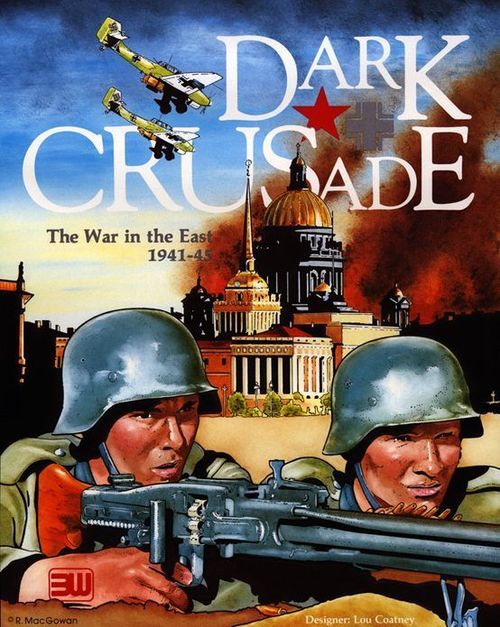
Dark Crusade: The War in the East 1941-45
Dark Crusade: The War in the East 1941-45 Rulebook
Table of Contents
Table of Contents
- 1.0 Components and Key Terms
- 2.0 Game Levels and Versions
- 3.0 Strategic Options
- 4.0 Set-Up
- 5.0 Special First Turn Rules
- 6.0 Game Turn Sequence
- 7.0 Weather and Its Effects
- 8.0 Replacements and Reinforcements
- 9.0 Strategic Movement
- 10.0 Terrain Effects
- 11.0 Stacking
- 12.0 Operational Movement
- 13.0 Combat
- 14.0 Breakthrough Movement
- 15.0 Dispersal and Recovery
- 16.0 Breakthrough Combat
- 17.0 Supply and Isolation
- 18.0 Field Fortifications
- 19.0 Soviet Partisans
- 20.0 Control
- 21.0 Soviet Parachute Units
- 22.0 Bibliography
- 23.0 Second Edition Map Changes
1.0 Components and Key Terms
A. Mapsheet
The mapsheet depicts the major objectives and lines of advance of the European Russia theater of operations. Following is a graphic description of operative map symbols:
For the most part, the map background itself has no role in the game itself -- terrain having been factored into the point/line matrix.
Map features:
- Port -- anchor symbol at the end of the Major Line.
- Major Line -- heavy solid line between points.
- Minor Line -- lighter solid line between points.
- Inferior Line -- dotted line between points.
- Arctic Weather Line -- dashed line across the north of the map (see 7.0).
- Moscow-Minsk Highway -- double line.
- Fortress -- hexagonal symbol.
- Victory City [Double] -- star symbol; Victory City Point -- star symbol at a point.
- Infantry Replacement City -- crossed-box symbol.
- Cavalry Replacement Center [Stud Farm] -- cavalry symbol.
B. Unit Counters and Markers
The unit counters and markers of the types described below appear in the game:
Unit types (Soviet and Axis):
- Armor/Panzer/Tank
- Armored Infantry/German PzGr.
- Cavalry
- Cavalry-mechanized
- Partisan
- Air-German
- Air-Soviet
- Rocket
- Artillery
- Soviet Shock
- Security
- Infantry/Rifle
- Parachutist
- Mountain Infantry
- German Army HQ
- German PzHQ
- Soviet HQ
- Factory [of the preceding types]
Unit sizes:
- XXXX = Army, or Soviet Air Force Approximate XXXX
- XXX = Corps
- XX = Division
- GP = Group
Note: German Panzer Grenadiers function in all ways like armor. Mountain Infantry units count in all ways like regular infantry. The German Cavalry Corps is treated in all ways like infantry.
Unit abbreviations:
- Alp -- Alpini
- Cos -- Cossack
- RC -- Rumanian Cavalry
- RP -- Rumanian Panzer
- RM -- Rumanian Mountain
- H -- Hungarian
- I -- Italian
- FH -- Feldherrnhalle
- GD -- Gross Deutschland
- HG -- Herman Goering
- SS -- Schutzstaffel
- GT -- Guards Tank
- R -- Rumanian
- Gds -- Guards
- Shk -- Shock
- STAVKA -- Soviet equivalent of General Headquarters
- 1.MM -- 1st Moscow Motorized (Rifle Division)
Nationality color code:
- Grey -- German Army
- Black -- Waffen SS
- Blue -- Luftwaffe
- Dark Yellow -- Hungarians
- Green -- Italians
- Yellow -- Rumanians
- White -- Finns
- Red -- Soviets
C. Key Terms
The rules contain key terms for which the following definitions apply:
- Attacker -- The player who has moved his units into combat.
- Axis Units -- Germans, Finns, Hungarians, Italians, and Rumanians.
- Axis Allies -- All Axis units other than Germans.
- Breakthroughs -- Losses inflicted on the defender by the attacker.
- Defender -- The player in combat whose units have not moved into combat.
- Defensive Fire -- Combat firing done by the defender.
- Fire Factor -- A number at the bottom of a unit counter indicating relative strength.
- German -- All counters printed black on grey, white on black, or black on blue.
- Line -- Path along which units move from point to point.
- Minor Unit -- A formation that can be destroyed by a single breakthrough or repulse. [Exception: see Section 8.C.3a -- Shock Armies.]
- Offensive Fire -- Combat firing done by the attacker.
- Owning Player -- Player who controls the piece in question.
- Point -- A city or center on the map.
D. Numerical Randomizer
A numerical randomizer in the form of one or two dice is required for weather determination, combat resolution, the Siberian Reserves Gamble, German replacements, and torpedoing enemy strategic sea movement.
2.0 Game Levels and Versions
Set-Up
Initial set-ups for all versions of Dark Crusade are provided on the separate sheet marked "22 Jun 41 Set Up". Note that some units starting in June and even more units starting in May are dispersed.
A. Game Levels
- Introductory Game:
This is a simplified version of the tournament game. Use the following forces:
At Start:
- Axis -- June 1941 set up less Headquarters units and divisions.
- Soviet -- June 1941 set up with rifle armies, tank corps, cavalry corps and partisans. No other units are used -- including Guards or Shock units.
Disregard the Order of Appearance and Extraordinary Events List except for those units eligible to be used in the Introductory Game. Soviet infantry and cavalry replacement centers function normally. The Soviet player may build infantry and tank factories only. Factories may not produce composite units. No Soviet infantry replacements are available on the first turn. All strategic options are in effect. Disregard all rules referring to units not used in this introductory game.
- Advanced Game:
In an Advanced Game, the players are free to use all rules and components possible.
B. Game Versions
- Tournament Game:
A tournament game begins in June 1941 (May 1941 at the German player's option -- see Section 3.A for details) and ends in one of three ways:
a) A player wins if he has enough victory city points during his Tournament Game Victory Determination Phase.
Consult the Victory Conditions Chart. For each year listed there are either one or two point totals: A single total, or the first of two, applies throughout the year. This is the number of victory city points that a player needs to hold at the end of an opponent's turn in order to win. These cities must be held in overland supply. The number(s) after the slash apply only in December of that year (Note: The Axis player starts with 7 victory points, the Soviet player starts with 16).
Both players have victory point totals expressed as numbers with plusses between them. The first number is the number of "home" victory points and the second is the number of "enemy" victory points that must be controlled. Example: In December 1941, the German player must hold 7 victory points of his own (all of them) and control 7 victory city points in the Soviet Union as well. Victory point cities are listed below.
Victory Point Cities:
1 Point Cities:
Arkhangelsk, Minsk, Voronezh, Stalingrad, Rostov, Dnepropetrovsk, Konigsberg, Gorki, Odessa, Sevastopol, Grozny
2 Point Cities:
Helsinki, Warsaw, Kiev, Leningrad, Moscow, Bucharest
The Axis player also gains one victory point and the Soviet player loses one victory point per pair of Soviet factories destroyed.
b) Either player may declare a draw during his own Tournament Game Victory Determination Phase after the end of the February 1942 turn. However, the player not ending the game has won if, when the game ended, he had enough victory points to win. In other words, the declaration of a draw cannot be used to stop a game where your opponent has a winning position at the end of his turn.
c) A draw may be declared at any time if both players agree to do so. If neither player has won by the end of the July 1944 turn, the game ends as a draw.
- Tournament Campaign Game:
This is the Tournament Game without the option to call a draw after February 1942. In other words, this is a "sudden death" campaign game. It may run from May/June 1941 to July 1944.
- Campaign Game:
A campaign game starts in the same way as does the tournament game, but runs from May/June 1941 to February 1945, and has different victory conditions.
a) The Axis player wins if:
i) All Soviet units are eliminated from the map at the end of each of two consecutive Axis player turns. -- OR --
ii) Leningrad, Moscow, and Stalingrad are in Axis overland supply throughout six complete and consecutive turns. -- OR --
iii) All victory cities are under Axis control. The cities need not trace supply lines. The game is over the instant this occurs. -- OR --
iv) The Soviet player has not achieved his victory conditions by the end of the February 1945 game turn.
b) The Soviet player wins if:
i) All German units on the map are eliminated at any instant before the end of the February 1945 game turn. -- OR --
ii) All Soviet victory cities are under Soviet control, as well as Warsaw and Bucharest, and 10 army sized units are sent off the board and kept in continuous supply via their exit lines. These conditions must be maintained uninterrupted for two consecutive game turns ending on or before February 1945. -- OR --
iii) Twenty army sized units are exited off the west edge of the map and kept in uninterrupted supply via their exit lines for two consecutive game turns ending on or before February 1945.
3.0 Strategic Options
A. Axis
Early Start: The Axis player may elect to start the game in May, rather than June 1941. If he chooses this option, he must make weather rolls for Mud. These rolls are made after Operational Movement and before combat. The Axis player rolls for each point under assault. An even die-roll means Good weather and an odd die-roll means Mud. The weather rolled for that point applies to that point only (Note: this procedure applies only to this May start option, not the weather encountered later in the game). Additional German and Soviet units begin the game dispersed [see the "22 June 1941 Set Up" Chart]. All Axis 1941 reinforcements arrive one turn early. Soviet factories begin producing in May 1941 and Soviet infantry replacements start in June.
B. Axis and Soviet
Free Set Up: Either player may choose this option, but the Soviet player decides first. If either player chooses this option, then both players are free to deploy their forces within the following restrictions:
-
Axis: Undispersed German units may deploy anywhere to the west of the Soviet-Axis border including Rumania and Finland except Hungary (Cluj and Firgu Mures). Only three infantry corps and one HQ unit may deploy in Memel. Rumanian and Finnish units must start in their own countries.
-
Soviet: Undispersed Soviet units which start the game on points with lines leading directly across the western Soviet-Axis border (not Finland) may re-deploy on those same points plus the port of Lepaya. Dispersed units and those not on the western Axis-Soviet border may not be re-deployed.
-
Free Set-Up Sequence:
a) German units to be deployed in Finland and Rumania are designated. If the Axis player made the initial choice for free set-up, these units are placed on the map at this time.
b) Soviet units are set up.
c) Remaining Axis units are set up.
C. Soviet -- Siberian Reserves
- Size:
The Siberian Reserve consists of three consecutive turns of infantry, armor, artillery, and cavalry units. The quantities of these units to be brought in each turn are listed on the Soviet Siberian Reserve Reinforcements table. The Siberian Reserves automatically begin entering the game in the Soviet Replacement/Reinforcement Phase of the January 1942 turn, unless committed earlier.
- Composition:
Siberian Reserve Units may enter as basic units, with each number on the Siberian Reserves Reinforcements table equalling that number of basic units of that type. The Siberian Reserves may also be taken as composite units, built up as per the composite unit section under Soviet Factories [see Section 8.C]. Shock armies, cavalry-mechanized groups, and parachute corps may be created this way. The Soviet player may also take a mixture of basic and composite units as the Siberian Reserves, holding back units from the first turn's forces to make composite units in the second turn, holding back the second turn's forces to make composite units in the third turn.
- Early Committment:
The Siberian Reserve may be brought in early by the Soviet player, at some risk. During the Soviet Replacement/Reinforcement Phase of any turn before December 1941, the Soviet player may call for the Siberian Reserve. This is announced to the Axis player. The first of three consecutive turns of Siberian Reserve units arrive during the Replacement/Reinforcement phase of the following turn. (Example: On a regular start game, the Soviet player calls for the Siberian Reserve on the first turn possible, the July 1941 turn. The first units arrive during the Replacement/Reinforcement phase of the August 1941 turn.)
These units appear on the eastern map edge and may be moved operationally or strategically. They are not dispersed on entry like replacements. The turn the Siberian Reserve units begin to appear on the map, the Soviet Replacement/Reinforcement Phase is finished by the Soviet player rolling two dice. If each die has a different number, play continues normally. This extra feature of the Reinforcement/Replacement Phase for the Soviet player continues through the December 1941 turn, or until both dice have the same number ("doubles"), whichever comes first. After December 1941, the Soviet player who has not rolled "doubles" has been successful in his gamble to commit the Siberian Reserves early. Should "doubles" appear, the Japanese have invaded the Soviet Union in the unprotected Far Eastern Military District and the Soviet player has a "Siberian crisis". Four things happen:
a) All Siberian replacements scheduled to arrive from Siberia during the crisis are lost.
b) All Siberian Reserve units not yet on the map are considered returned to Siberia. These units are not lost. Record how many and what type on scratch paper.
c) The Soviet player must commit additional forces from on-map replacement centers or on-map units to Siberia.
d) Soviet Strategic Movement capacities (on-map) are halved, with fractions rounded up. This limitation is removed as soon as the "Siberian crisis" is over.
The number of Soviet units needed to be committed to Siberia depends on the turn, after the Siberian Reserve units appear on the map, the Japanese attack.
Same turn:
- Infantry: 9
- Armor: 5
- Artillery: 2
- Cavalry: 2
18 units = at least 6 units the first turn
One turn later:
- Infantry: 13
- Armor: 7
- Artillery: 2
- Cavalry: 2
24 units = at least 8 units the first turn
Two or more turns later:
- Infantry: 15
- Armor: 9
- Artillery: 3
- Cavalry: 3
30 units = at least 10 units the first turn
At least one third of the units to be committed must be committed on the first turn of the "crisis" with the remaining units sent in the next two turns. If insufficient units are available, as many of each type available must be sent to Siberia, as soon as possible, until the correct totals are committed. Composite units may be sent, and count as their basic components for purposes of meeting commitment requirements. Units of whatever type may be sent on each turn as long as the final total of units meets or exceeds the required number of units by type and number. Units to be sent to Siberia during the "crisis" need not be moved, but must be able to trace a path to the eastern map edge. Simply pick them up and place them in the dead pile. These units are not lost. Keep track of their number and type on a piece of paper. Units returned to the dead pile are available for use as replacements as the Soviet factories and replacement centers allow. Once the required number of units have been removed from the map, the "Siberian crisis" is over. The Soviet Strategic Movement capacity returns to normal, Siberian replacements are once again available as shown on the turn record track.
All units held in Siberia, returned to Siberia, or committed to Siberia during the "Siberian crisis" (except Siberian replacements lost) begin to return to the map in June 1942. They enter in the same fashion as did the original Siberian Reserve units but at the rate of 1 unit of each basic type available, until all units have entered the map. These units may be held off the map at the Soviet player's option. They may combine among themselves in the same ways and at the same times as on-map units may combine. A composite unit counts as one unit for entry purposes, and is classed according to the basic unit type for unit type purposes. Units created from more than one type of unit may count as either basic type for entry purposes. Siberian replacements, created after the "Siberian crisis" is over and before June 1942, may be held in Siberia and used to make composite units.
4.0 Set-Up
A. Set-Up
See the "22 June 1941 Set-Up" chart. Units having their identification numbers in parentheses on this chart are dispersed only at the start of a game beginning in May 1941. Units having their identification numbers underlined on this chart are dispersed at the start of a game beginning in June 1941, as well as in May 1941.
5.0 Special First Turn Rules
A. Only in the June 1941 Game Turn of a game started in June 1941, may the Axis player use a bonus German air unit, for a total of four.
B. The Soviet player receives no infantry replacement factors during his first Player Turn, whether that is May 1941 or June 1941. However, the Soviet player DOES begin receiving factory replacement production in his first Player Turn.
C. No Axis strategic movement is allowed, and Soviet strategic movement is limited to two units.
D. The Hungarian 1st and 2nd Armies may not leave Hungary until June 1942 -- and only one of them can do so at that time. This restriction on the Axis player is lifted if the Soviet player invades Hungary or attacks either Hungarian army sized unit at any time before June 1942. Hungarian units may never enter Rumania or a point occupied by Rumanian units -- and vice versa.
6.0 Game Turn Sequence
A. Weather (and Luftwaffe Strength) Determination
B. Axis Player Turn
-
Axis Replacement/Reinforcement Phase.
-
Axis Strategic Movement Phase.
-
Axis Operational Movement, Field Fortification Phase, and Unopposed Occupation of Second Point if 1st Point is Unoccupied.
-
Axis Regular Combat Phase:
a) Air Combats.
b) Ground Combats (check Soviet arty., air, rocket supply at instant of combat, also check German HQ supply at same time).
c) Breakthrough Movement and Unopposed Occupation of 2nd Point.
-
Recovery of Dispersed Axis Units.
-
Axis Breakthrough Combat Resolutions.
-
Tournament Game Soviet Victory Determination Phase.
-
Axis Units' Supply Status Determination Phase.
C. Soviet Player Turn
-
Soviet R/RP.
-
Soviet Strategic Movement Phase.
-
Soviet Operational Movement and Field Fortification Phase.
-
Soviet Regular Combat Phase:
a) Air Combats.
b) Ground Combats (check Soviet arty., air, rocket supply at instant of combat, also check German HQ supply at same time).
c) Breakthrough Movement and Unopposed Occupation of 2nd Point.
-
Recovery of Dispersed Soviet Units.
-
Soviet Breakthrough Combat Resolutions.
-
Tournament Game Axis Victory Determination Phase.
-
Soviet Units' Supply Status Determination Phase.
7.0 Weather and Its Effects
A. Weather Determination
There are seven months of constant weather in the game, and five months of variable weather. German air unit availability will depend on the weather and the year of the game. Other units will be affected by weather regardless of the year of the game.
Weather and German Air Unit Availability (number of German air units available, by year):
| Month | Weather | Weather (second column) | 1941 | 1942 | 1943 | 1944 | 1945 |
|---|---|---|---|---|---|---|---|
| January | Snow | -- | 0 | 1 | 1 | 0 | |
| February | Snow | -- | 0 | 1 | 1 | 0 | |
| March-a | Mud (1-3) | Snow (4-6) | -- | 0 | 0/1 | 0 | -- |
Transcription note: the chart is transcribed as printed. Die-roll ranges are shown in parentheses beside the weather. Some cells in the scan (the asterisks and the slash entries) are hard to read and are transcribed as they appear; the footnote letters a to e refer to the notes beneath the table.
a) Roll one die at the beginning of the turn. The outcome determines weather for that turn and the next two that follow it.
b) All split results refer to the weather column result for air unit availability. In April 1942 the Axis player will have two air units if his weather is Good and no air unit if his weather is Mud.
c) In Good weather turns in 1944, the Axis player may choose any two consecutive Clear weather turns to have 1 German air unit available.
d) Same as note a, except the outcome for October determines November weather (only) as well.
e) Three air units in a game started in May, four air units (1st turn) in a June game.
B. Other Weather Effects
- Axis:
Axis armor units lose their breakthrough movement and assault abilities during Snow weather turns of the 1941/42 winter (only).
Any Axis attack using at least one Finnish unit against Soviets in Finland in winter 41/42 in Snow gets a +1 (plus one) on the attack die-rolls. Sixes remain sixes.
- Axis and Soviet:
All armor units lose their breakthrough movement and assault capability in Mud. Cavalry and cav-mech are unaffected.
- Soviet:
Units attacking Axis controlled points lying north and east of the Arctic Weather Line outside Finland get a plus one bonus on attack die-rolls in Snow weather during the winter 1941/1942. Sixes remain sixes. The Soviets lose this plus one to the die if half or more of the defenders are Finns. All Soviet air units are grounded by Mud (only). They defend normally.
8.0 Replacements and Reinforcements
A. Replacements
At the beginning of each Player Turn, that player may be eligible for replacement units. These units enter the game dispersed and may not move except strategically. They become undispersed during the owning player's Recovery Phase.
Replacements may be saved and accumulated.
- Axis:
a) German replacements become available starting the second turn of the game. The Axis player rolls 1 die and consults the proper year column on the German Replacements chart. A dash means no replacements. An infantry symbol means 1 infantry strength point is replaced, an armor symbol means a point of armor, armored infantry or infantry strength is replaced. Two symbols indicate a point per symbol. These points may be saved, or used immediately, to create units from those already eliminated. SS PanzerKorps cost an extra strength point per unit to replace. Units withdrawn or not yet in the game are not eligible to be taken as replacements. German replacements enter the game at Warsaw.
b) Other Axis: One Finnish, Hungarian, and Rumanian unit each may be replaced each March and September of 1942, 1943, and 1944. These replacements may be saved. They enter the game at their respective supply sources.
c) German HQ units and Italians cannot be replaced.
- Soviet:
Soviet replacements are created at replacements centers on the map and in Siberia. They are also created by Soviet factories. The mechanics and options of factory production are covered in detail in Section 8.C. Soviet replacements are limited to the counter mix and must enter the game at their point of production. Composite units must be built from basic units already in the game. [Exception: see Section 3.C.2 -- Siberian Reserves.]
a) On Board Replacement Points:
Each Soviet Victory Point city produces one regular infantry army per turn as long as it is in overland supply and under Soviet control. Rtishcheva produces one cavalry corps every March, July, and November while under Soviet control. If captured by Axis forces, these points cease production until recaptured and placed in overland supply by the Soviets. Units produced by these points appear on the points producing them.
b) Soviet Factories:
Factories in overland supply produce the basic type of unit shown within the factory symbol. Factories with numbers below the factory symbol produce a basic unit on each numbered month listed. January is the first month and December is the twelfth month. Factories marked "odd" produce every other month starting in January, those marked "even" do the same starting in February. Units produced appear at the factory.
For defensive combat, a Soviet factory on the mapboard is considered to be a minor unit with a firepower strength of one (1), unless it is entrained. An entrained Soviet factory is automatically eliminated if its point falls to Axis control. A Soviet factory is never allowed to move operationally or to retreat. A Soviet factory cannot be dispersed.
c) Siberian Replacements:
Soviet replacements from Siberia arrive according to the symbols printed on the turn record track. These units move from Siberia to the map via any line leading from the eastern map edge. Siberian replacements represent factories that start the game off the map. These replacements appear every time they are called for on the Turn Record Track. Each symbol stands for one replacement unit of that type to be taken that turn. Siberian replacement units may be held off the board indefinitely. After they have been held off for one turn, they may enter the map operationally from the eastern edge as undispersed units.
Like their Axis counterparts, all Soviet replacement units enter the game dispersed. They are placed on the map and may move only by strategic movement. Siberian replacements may be held off board 1 turn and enter undispersed, moving operationally. Otherwise, they enter by strategic movement, each unit counting against the strategic movement allowance for that turn.
d) Irreplaceable Units:
The 1st Moscow Motorized division, the STAVKA HQ unit and the 1st Polish Army units are irreplaceable Soviet units. Once lost in combat or through isolation, they may not be returned to the map as replacements or reinforcements.
B. Reinforcements
Unlike replacement units, reinforcements enter the game undispersed and may move operationally and attack after the Replacement/Reinforcement Phase on their first turn on the map. Any number of reinforcements may enter the game at their appropriate reinforcement point(s). These points are:
- Soviet: Any point under friendly control and in overland supply to the eastern or southeastern map edge; lines leading on from the eastern or southeastern map edge.
- German: German replacements appear at any point under friendly control and in overland supply to the western map edge, also on lines leading on from the western map edge.
- Rumanian: Rumanian replacements deploy at Bucharest.
- Hungarian: Hungarian replacements deploy at Cluj.
- Finnish: Finnish replacements deploy at Helsinki.
Note: Axis Allied replacements and reinforcements are lost (permanently) if control of the above points passes into Soviet hands. Also, Axis Allied troops whose capital is lost to the Soviets become Soviet controlled and must return to their home country as soon as possible and remain.
Soviet reinforcements for the game are the Siberian Reserves and the 1st Polish Army. Units to make up the Siberian Reserves are drawn from the dead pile. If insufficient dead units exist, the remaining units are brought in on the next Replacement/Reinforcement Phase after such units become available. The 1st Polish Army is deployed in June 1944. It is an irreplaceable unit. Once an Axis Allied country has been knocked out of the war or defects to the Soviets, no further reinforcements for that country appear.
Rumanian units to be withdrawn to Rumania in December 1941 need not be moved along lines back to Rumania. Simply pick them up and put them on points in Rumania. The movement of these units counts against the Axis strategic movement capacity for the December 1941 turn.
C. Soviet Factories
- Plant Expansion:
The Soviet player begins the game with 11 factories placed on the points specified on the factory counters. Each January, April, July, and October, the Soviet player chooses a factory from those not already deployed or destroyed. He puts the unit on the Turn Record Track three turns ahead of the current turn. Three turns later, this factory is deployed on the map or in Siberia and is able to produce according to the schedule of production months printed under the factory symbol. Example: In January 1942, the Soviet player decides to deploy the "B" tank factory on the Turn Record Track. In three turns, it is deployed on the point within the Soviet Union (including Siberia) under his control and is available for production. Since April is an even-numbered month, the first production month for this factory will be May.
When choosing factories, the choice is limited to the earliest lettered factory of each kind available. Tank factory "B" may not be chosen before tank factory "A". Not all factories of one type need be chosen before starting those of another type. A player might choose tank "A", then artillery factory "A", then tank factory "B", and finally aircraft factory "A". There are 13 factories available for expansion deployment and only ten opportunities to expand. Within the sequential restriction above, players may choose which ten they wish to build.
The first factory to be built under this rule is selected before the game starts and is available for production in July 1941.
- Moving Factories:
Factories that are on a point that comes under Axis control are permanently destroyed. Factories may be moved to escape destruction by Axis units by retreating them to Siberia or another map point and re-establishing production. Those factories not yet entrained defend at a value of 1, as minor units. Movement is a three-part process:
a) In the Soviet Replacement/Reinforcement Phase, a factory is flipped over and ceases production. It is now entrained. Factories may be entrained on the first turn of the game. The number of entrained factories on a given turn is limited to the number of units the Soviet player may move strategically in that turn. A factory must be in supply to be entrained (not necessarily in overland supply). Each entrained factory uses up one strategic movement factor each turn it remains entrained.
b) In the next Soviet Replacement/Reinforcement Phase, the entrained factory is moved via lines to its new location. This movement can include sea movement, but requires at least one extra turn (stopping at the port of embarkation) and the factory may be torpedoed at sea. Factories in Siberia are beyond the reach of Axis forces and cannot be destroyed.
c) When a factory reaches its destination, it is flipped back up and is no longer entrained. In the following Soviet Replacement/Reinforcement Phase, the factory is now available to produce points according to the schedule printed under the factory symbol.
d) Factories moved to Siberia may be moved back on the map by the same process that moved them to Siberia. The production capacity of Siberia present when the game starts cannot be transferred via the factory movement process onto the map.
- Composite Units:
Soviet composite units are created from the combination or conversion of other units. Once combined or converted, Soviet composite units may never be broken back down into their original components.
The Soviet units to be combined or converted must be all together on the same point (or in Siberia), undispersed and in supply during a given Soviet Reinforcement/Replacement Phase.
A Soviet composite unit is dispersed in the R/RP it is created.
There are six kinds of composite units:
a) The Shock Army is the combination of one regular rifle/infantry army and one artillery or rocket unit.
A Shock Army is a minor infantry-type unit. It has a firepower factor of 2 -- or only 1 if out of supply. Thus, an unfortified shock army requires 2 hits to be eliminated when in supply or only 1 when out of supply.
b) Cavalry-Mechanized Groups are created by adding a tank corps to a cavalry corps. The resulting unit has an attack and defense firepower of 1 and is treated for movement as an armored unit [Exception: Section 7.B.2]. It is a major unit and cannot fortify.
c) Tank Armies may be produced beginning in June, 1942, when the "Federenko Order" went into effect. Tank armies are created by joining two tank corps together. A tank army is a minor unit and has a firepower of 2, even when out of supply.
d) Guards Infantry Armies may be created beginning in 1942. They are made by combining two regular infantry armies. A Guards Infantry Army is a major, fortifiable infantry unit with a firepower factor of 2 -- in or out of supply.
e) Guards Tank Armies may be created from a regular tank army by adding an infantry army to it. They may be created on or after the January 1943 turn. There may not be a regular tank army and a Guards Tank Army on the map with the same number at the same time. Guards Tank Armies are major units with a firepower of 2 -- in or out of supply.
f) A Parachute Corps is converted from an infantry army. It is a minor unit with a normal combat value of 1 and is converted in place if undispersed and in supply during a given Soviet Reinforcement/Replacement Phase. Parachute Corps may fight as infantry and are considered as infantry for all purposes when they do so. [see Section 21.0 for Parachute Dropping Procedure. Note: Parachute units are created and used only when using the optional Soviet Parachute rule -- Section 21.0.]
9.0 Strategic Movement
A unit may move strategically by land or sea, but not both in the same turn. A unit moving strategically is dispersed at the end of the Strategic Movement Phase.
A. Strategic Land Movement
Strategic movement is available to each phasing player's unit that is undispersed and not located on Elista (near Stalingrad). During the Strategic Movement Phase, the player simply traces a line of friendly controlled points (on either side of the Axis-Soviet border) to the desired destination of the unit. Soviet units may exit the eastern map edge and re-enter on another eastern map edge line, in effect, transiting Siberia. Units may also remain in Siberia and re-enter on a following turn, using either strategic or operational movement. Those entering by operational movement may participate in assaults. Axis units have the same capability on the west map edge. Each side is limited in the number of units it may move in the Friendly Strategic Movement Phase. The Axis player may move as many units as he has victory points from cities in supply to the west of the Soviet Axis border (max = 7). The Soviet player is allowed to move as many Soviet units as he has Soviet victory points from cities in the Soviet Union in supply and under his control (max = 16). All units of any size count 1 each.
Restrictions:
-
No strategic land movement is allowed across the Kerch Straits, between Pinsk and Rovno, nor into, out of, or through Elista.
-
All other points in friendly control, connected by lines to other points in friendly control, may be used for strategic movement. The only limit to the number of units which move through a point is the Player Turn limit calculated on victory points. Specifically, operational line limits are ignored.
-
Only three units using strategic movement may finish that movement on a single point.
B. Strategic Sea Movement
Strategic sea movement follows strategic land movement. In order to move by strategic sea movement, a unit must begin the phase in a port, undispersed. That unit may then move to another friendly port in the same sea. It then becomes dispersed on entering the friendly port. For purposes of this rule, the Black Sea and the Sea of Azov are considered the sea. One unit each may move by strategic sea movement in the Baltic and Black Seas each turn. Units may move by strategic sea movement regardless of who controls the sea, but a player must control the points on either side of the Kerch Straits to move a unit into or out of the Sea of Azov. Units may be torpedoed when using strategic sea movement. A player rolls one die for each unit:
-
Units using strategic sea movement in a friendly-controlled sea are lost on a die-roll of one.
-
Units using strategic sea movement in an enemy-controlled sea are lost on a die-roll of one, three, or five.
10.0 Terrain Effects
A. On Strategic Movement: See Section 9.A.1.
B. On Operational Movement: All terrain effects on operational movement are already simulated by the transportation line matrix.
C. On Assaults: Units defending in a fortress may receive special advantages.
-
In any given battle round, the number of breakthroughs achieved against units defending in fortresses, in victory city fortresses, and in double-value victory city fortresses on their own side of the 1941 USSR border is reduced by a maximum of 1, 2, or 3, respectively. However, the number of reductions can be no greater than the number of undispersed major infantry-type units in the fortress. This protection is reduced by 1 factor if the defending units are in a fortress on the enemy side of the border.
-
The total defensive firepower of units defending in fortresses, in victory city fortresses, and in double-value victory city fortresses on their own side of the 1941 USSR border is increased by a maximum of 1, 2, or 3, respectively -- although the number increased can be no greater than the number of undispersed major infantry-type units in the fortress.
D. On Breakthrough and Assault Across the Kerch Straits: Armor breakthrough and assault across the Kerch Straits is prohibited. Supply is traceable across the Kerch Straits, but not for producing reinforcements or replacements. No strategic movement is allowed across the Kerch Straits. Retreat is possible, but only up to the operational line capacity limit.
11.0 Stacking
An unlimited number of units (from one side only) may be stacked on a point.
12.0 Operational Movement
During the friendly Operational Movement Phase, a player may move any undispersed unit from one point to an adjacent point connected by a line. If that adjacent point is empty or occupied by an entrained factory or a partisan unit, the moving unit occupies the point, automatically destroying any enemy partisan or entrained factory units. If the point is occupied by any other opposing units, these units must be attacked and eliminated, or retreated, before the moving unit can occupy the point. German units, capable of breakthrough movement, entering an unoccupied point may immediately make a breakthrough movement to a second point, if that point is also unoccupied. This also applies to points occupied by Soviet units subject to automatic elimination.
A. Lines
Lines between points are classed as major, minor, or inferior lines and have different carrying capacities by type and for each side:
- Axis:
a) Major lines can carry six units, of which four may be armor.
b) Minor lines can carry four units, of which two may be armor.
c) Inferior lines can carry two units, one of which may be armor.
- Soviet:
a) Major lines can carry four units, only three of which may be armor.
b) Minor lines can carry three units, only two of which may be armor.
c) Inferior lines can carry two units, only one of which may be armor.
B. Unit Value
Most units count as one unit for line capacity. The following units count as 1/2:
- German: Headquarters Units and SS Panzer divisions.
- Soviet: STAVKA Headquarters Unit, Rocket Units and 1st Moscow Motorized division.
When 1/2 value units are part of the "line load" total moving down a line, any remaining fraction on the total is ignored.
C. Axis Allied Army Units
Hungarian and Rumanian army sized units having a "2" in the upper left corner of the counter count as two units. They also count as 2 units in retreat. All other units, including Soviet air and parachute units, count as one unit each in retreat, except the 1st Moscow Motorized and the SS Panzer divisions. They still count as 1/2.
D. The Minsk - Moscow Highway
The Minsk - Moscow Highway is a major line with special movement rules. During any Operational or Breakthrough Movement Phase in Good weather or Mud (but not Snow), an armor unit starting on the highway may move two points rather than one, as long as both points are on the highway and the first point moved to is not occupied by an enemy unit.
13.0 Combat
Combat is resolved in any order the attacker wishes with one restriction: All attacks in which the defender's firepower is greater than the attacker's firepower are resolved first.
Attacks are resolved point by point, with all regular combat being finished at one point before resolving combat at another point. There are two types of regular combat: air combat and ground combat. Air combat takes place over a point in one round before ground combat for the same point. Ground combat then proceeds in one or more rounds until one side is eliminated or decides to retreat.
A. Air Combat
Air combat consists of battles between opposing air units at a point or between air units and opposing flak.
- Soviet Air Units:
a) Air-to-air: When air units of both sides are present, the Soviet player rolls one die, using the column of the combat table that corresponds to the number of Soviet air units present (attacking or defending) at the point. The die-roll result is the number of Soviet air units surviving. If more than one German air unit is present, a second die-roll is made, using the number of survivors from the first die-roll to determine the correct combat table column. The result is the number of Soviet air units surviving from the survivors. Repeat for each German air unit present over the point.
b) Air-to-ground: Soviet air units present at a point where there are no German air units undergo attrition through flak instead. As before, a die is rolled using the column of the combat table corresponding to the number of Soviet air units present. However, the result obtained is the number of units lost. This is done once, regardless of the number of Soviet air units or Axis ground units present, as long as at least one of each is present at the beginning of air combat.
- German Air Units:
German air units are never affected by air-to-air or air-to-ground combat.
- Surviving Soviet Air Units:
Surviving Soviet air units affect ground combat on the attack or defense:
Attack: Each surviving Soviet air unit adds one to the total attack strength of attacking Soviet ground forces. Air units can only attack with Soviet ground forces present (dispersed or not) and may not absorb Axis repulses to Soviet attacks. Soviet air units advance or retreat with Soviet ground units in the battle.
Defense: Each Soviet air unit on the defense adds one to the total defensive fire of the ground forces. Soviet air units may not defend alone and may not absorb Axis breakthroughs on the defense.
- German Air Units in Combat:
German air units present at a point affect ground combat calculations whether Axis ground units are attacking or defending.
Attack: A German air unit committed with an attack doubles the combat value of all attacking German units in supply. Two air units triple combat values, three quadruple them, and four quintuple them. This applies to regular ground combat and breakthrough attacks. German air units may advance with attacking Axis units or retreat with retreating Axis units. On breakthrough movement, a German air unit can only move with one group of German units up one line segment.
Defense: German air units present at a point defended by Axis ground units double the combat value of all Axis units in supply. Extra air units affect combat values as in the attack. Units defending against regular ground attacks or breakthrough attacks gain this defensive benefit if a German air unit is present.
- German Air Units Alone:
German air units may not attack or defend alone; nor may they absorb repulses or breakthroughs; nor may they occupy a point without an Axis ground unit present.
B. Ground Combat
- There are two types of regular ground combat, normal and simultaneous. Simultaneous combat takes place when:
a) Axis units attack in Good weather and no Soviet air units are present after air combat.
b) Axis units attack in Snow with an air unit and no Soviet air units survive air combat.
All other ground combat situations are normal.
- Normal:
In normal combat, each side fires and inflicts losses on the other side in sequence, with the defenders firing first. After the defenders fire and losses from that fire are taken, the attacker decides to continue the action or retreat. If he continues the attack, he fires and inflicts losses on the defender. After the defender apportions losses to the units of his choice, he decides to continue the action or retreat. Combat continues until one side is destroyed or retreats.
Firing Procedure: The firing player totals all undispersed unit values and selects the corresponding column of the combat table. One die is rolled and the number obtained is the number of losses inflicted on the other side. These losses are called breakthroughs if caused by the attacker and repulses if caused by the defender. These losses are immediately distributed among the units receiving the fire. Units absorbing losses are either destroyed or dispersed [Exception: see Field Fortifications] and cannot fire in their part of the combat round. Losses may be distributed in any fashion the player whose units are fired upon wishes, as long as all the breakthroughs or repulses are absorbed. Each major unit may suffer losses up to its strength point number and not be destroyed. Each minor unit may suffer one loss less than its strength point value and not be destroyed. Any unit suffering any loss is dispersed (invert the unit) and may not move or fire until it recovers in the next friendly Recovery of Dispersed Units Phase. A dispersed unit must advance if it is part of an attacking force that clears a point. The next round of combat in which a loss of more than its limit is assigned to a unit, that loss destroys it.
Example: In the first round of combat, the German Gross Deutschland Pz Corps (value = 3) absorbs a breakthrough in defensive combat. The unit is dispersed, but remains in the battle. On the second round, although it cannot fire, Gross Deutschland absorbs another breakthrough from the attacking force. On the third round, a third breakthrough is absorbed. On the fourth round of combat, a fourth breakthrough is absorbed and the unit is eliminated for taking one more loss than its value. Had the Axis player needed to absorb four breakthroughs in the first round of combat, all four could have been taken by Gross Deutschland and the unit would have been eliminated immediately.
- Simultaneous:
Simultaneous combat follows normal combat with these exceptions:
a) Firing takes place simultaneously with losses being taken after both sides fire, attacker choosing losses among his own units first.
b) Next, the attacker and then the defender declare if they wish to fight an additional round. Either side may break off, before deciding to continue, without further fire or loss.
c) If both sides have only dispersed units left at the end of a combat round, the attacker retreats and the defender holds the point.
d) If both sides have eliminated each other completely in simultaneous combat, the defender still controls the point.
- Retreat from Combat:
A player may decide to retreat rather than continue combat. Retreat is an all or nothing affair. All units involved in a battle must retreat if the owning player decides to retreat any of them. Soviet air units count as one value ground units for retreat purposes. Attacking units must retreat back down the lines they used in attack, to their points of origin. Once on these points, they are dispersed. Defending units retreat according to the following priorities:
a) Units must retreat to adjacent points controlled by their own side, until the capacity of the connecting lines is used up. All retreating units count as single units for purposes of retreat, except for Axis Allied armies, which count as two units, and SS Pz divisions and the 1st Moscow Motorized division -- which count as 1/2 unit each.
b) Units which must retreat and cannot satisfy priority 1, because of line capacity limits, may retreat towards enemy controlled points if these points are not occupied by combat units, combat support units, or an emplaced factory. They may enter an enemy controlled point with an enemy unit present only if that unit is an entrained factory or a partisan unit. Units retreating under this priority use 1/2 the line capacity, with fractions rounded down.
c) Defending units retreating from a battle may retreat to a point under attack by enemy units. In this case, the friendly units under attack must still occupy that point after the battle for the retreating units to survive. The retreating units may not take part in the battle, neither firing defensively nor absorbing breakthroughs. Units may retreat in this manner during regular combat, but not during breakthrough combat.
d) Attacking units withdrawing from a battle encountering a defender displaced to the attacker's starting point, as per priority 2, are destroyed if all retreating units are dispersed. If any undispersed units retreat down a line after breaking off an attack, these undispersed units destroy the retreated defenders they encounter.
- Advance After Combat:
Attacking units which clear a point of defenders must occupy that point, including all dispersed attacking units. Defending units which cause the retreat or destruction of attacking units may not advance after combat.
- Large Combats:
In either normal or simultaneous combat, if an attacker's or defender's total firing number exceeds the highest number on the combat table, combat is resolved for that force as follows:
Divide the total points into the fewest number of the most equal groups possible, the value of each of these groups not to exceed the highest number on the combat table.
Example: The Soviet player defends a point with 37 points. He splits that total into a group of 19 points and a group of 18 points, rolls a die for each of them and totals the number of repulses from the two rolls. If the defenders had totalled 72 points, they would have been divided into three groups of 24.
- Headquarters Units:
The Soviet STAVKA HQ is a minor unit adding up to 4 points to an attack or defense. One point per regular infantry, Shock, or Guards infantry army, or armored, or cavalry is allowed.
German HQ units support up to their fire factor in ground units attacking or defending. Each stack attacking may use one HQ. Each stack defending may use as many HQs as their are units available to be supported. Regardless of its support value, a single hit destroys a HQ.
- All Out Assaults:
Before throwing a die in the first round of combat, the attacking player may designate all or some of his units as making an all out assault. These units must be in supply and are automatically destroyed after the die is thrown. The defender may "all out" starting the 2nd round of combat. In simultaneous combat, the attacker declares before the defender and then dice are thrown. All out assault losses in simultaneous combat cannot be used to satisfy losses required by die-rolls, but this restriction does not prevent a player from using all his units in an "all out". All out assault increases the firepower of units as listed below:
- 9 -- German corps with a normal firepower of 3.
- 7 -- Soviet Guards tank armies.
- 6 -- German Panzer Corps.
- 5 -- Soviet tank armies, Guards infantry armies, and cavalry-mechanized groups.
- 4 -- German panzergrenadier corps; Axis Allied army sized units; and Soviet Shock Armies.
- 3 -- German infantry and mountain corps, German SS Panzer divisions, Soviet infantry armies, tank corps, 1st Moscow Motorized division, cavalry corps; and Axis Allied armor units.
- 2 -- German minor infantry and security corps; Soviet parachute corps; Axis infantry, mountain, and cavalry corps.
- 0 -- All other units.
Note: Soviet units may not make "all out" assaults on the first turn of the game.
14.0 Breakthrough Movement
A. Eligible Units
Certain units are eligible for a second Movement Phase, called Breakthrough Movement. These units are:
Axis:
- Panzer units.
- Armored infantry corps.
- Panzer army HQ's.
- Cavalry corps.
Soviet:
- Tank corps and armies.
- Cavalry corps.
- Cavalry-mechanized groups.
These units may advance in breakthrough movement immediately after occupying an unoccupied point in operational movement. These units may also advance after clearing a point of enemy units if the attacking eligible units are undispersed. Units using breakthrough movement to advance to a point occupied by enemy units are committed to breakthrough assault. Soviet units using breakthrough assault have their total firepower halved, fractions rounded down. German units round fractions up.
Otherwise, breakthrough assault is conducted just like regular combat. Units making breakthrough movement may split and move down more than one line.
B. Restrictions
-
Regular line capacities are reduced for breakthrough movement by one unit for each round of combat fought by the breakthrough units. Thus, a major line used for breakthrough movement after two rounds of combat can carry only four Axis units, two of which can be armor. Soviet use in this situation would be two units (one could be armor).
-
From the beginning of the game through 12/41, Soviet breakthrough capacity is reduced by one.
-
Soviet air units may not accompany breakthrough units until the beginning of Good weather 1944.
-
German air units may accompany units on breakthrough movement, provided they were present for the regular combat that preceded it. German air units may be withheld from the map until breakthrough movement and then deployed for breakthrough combat or the defense of any Axis point in the coming Soviet Player Turn. Air units deployed after regular combat support all German units in supply attacking on breakthrough movement at a point. Air units accompanying breakthrough units support only those units accompanied.
-
German armor divisions or armor HQs may not make breakthrough movement unless a panzer or armored infantry corps accompanying them may do so. Two armor divisions, a division and a HQ unit, or two armor HQ units count as a corps-sized unit. In any case, the corps-sized units need not actually make breakthrough movement down a line for the smaller units to do so, just be capable of it.
-
Units may not make more than one breakthrough move (except unopposed on the Minsk-Moscow Highway in Good or Mud weather may make their one breakthrough move through two points on the highway) each turn.
-
Units using breakthrough movement must specify which lines will be used by which units immediately after regular combat.
15.0 Dispersal and Recovery
A. A unit is dispersed in the turn it enters the game as a replacement unit, at the end of its strategic movement, or at the moment it absorbs its first repulse or breakthrough outside a fortification in combat (if indeed it is able to survive that first one -- minor units cannot). Indicate dispersal by flipping the affected unit over.
Effects of Dispersal:
-
A dispersed unit may not move except to advance or retreat as a result of combat.
-
A dispersed unit may not fire offensively or defensively.
B. All of a player's unit are recovered (re-flipped) during his Recovery of Dispersed Units Phase.
16.0 Breakthrough Combat
Breakthrough combat is conducted just like regular combat, except that each unit attacking in breakthrough combat is halved in combat strength, with fractions rounded up after modification for air units. Units dispersed are not recovered before the beginning of the opposing player's turn. Combat may be either simultaneous or normal. Points are occupied and retreats are conducted as in regular combat.
17.0 Supply and Isolation
A. Supply
For a unit to be in supply, it must be able to trace a path along map lines through points under friendly control to an appropriate supply source. This route may be as long and winding as necessary. It may include supply through a friendly port, across a friendly sea to another friendly port on that sea, and then by lines through friendly points to a supply source. Different nationalities have different supply sources. Further, armor units require normal supply to avoid isolation and armored supply to be capable of breakthrough movement and breakthrough combat.
- Axis:
- German units trace supply to any line leaving the map on the west edge, or the lines in Finland leaving the map to the north.
- Finnish units trace supply to Helsinki.
- Hungarian units trace supply to Cluj.
- Italian units trace supply to Warsaw.
- Rumanian units trace supply to Bucharest.
- Soviet:
Soviet units and the 1st Polish army unit trace supply to lines leaving the eastern and southeastern map edges. Soviet factories and replacement centers must trace supply overland (to Siberia only) in order to produce.
- Armored Supply:
Axis armored, armored infantry, and "mobile" units must be able to trace supply to Bucharest (Ploesti) or the western map edge in order to use breakthrough movement and make breakthrough assaults. Soviet armor and cavalry-mech units (cavalry is unaffected) must be able to trace supply to Grozny. Regular movement, combat, and strategic movement is not affected. Units unable to trace armor supply are not isolated.
B. Isolation
Units, except partisans and factories, unable to trace a line of supply are considered isolated. Soviet artillery, rocket, and air units which are isolated (judged at the moment of combat) may not fire. They may absorb repulses or breakthroughs. Isolated German and Soviet HQs are reduced to a support strength of 1, offensively or defensively. Isolated units which have a supply line re-opened regain full capabilities immediately. Units which remain isolated by the end of the owning player's turn are eliminated unless in fortresses.
Units in fortresses may be exempt from elimination by isolation. On each isolated fortress, two units of the owning player's choice are eliminated each turn until the garrison capacity of the fortress is reached. In Victory Point cities, the rate of loss is one unit per turn. The garrison capacity of fortresses is listed below:
Garrison capacity of fortresses:
- 1 unit: Novorossiisk, Lvov, Przemysl, Brest Tula [transcription note: the scan prints "Brest Tula"; the name is transcribed as printed, and the editor has not corrected it], Vibors [transcription note: the scan's spelling, transcribed as printed]
- 2 units: Konigsberg, Odessa, Sevastopol, Kiev, Stalingrad
- 3 units: Moscow, Leningrad
These values are reduced by one if the isolated units Axis units in a fortress in the Soviet Union or Soviet units in Konigsberg.
18.0 Field Fortifications
Certain units on both sides may fortify. Fortification allows a unit to absorb its first breakthrough without becoming dispersed. Fortifications may be built on any point on the map, including fortress and Victory Point city fortress points.
Eligible Axis:
- German major infantry type units.
- Finnish corps.
- Axis Allied army-sized units.
Eligible Soviet:
- Regular infantry armies.
- Shock armies.
- Guards infantry armies.
To fortify, units must be in supply and undispersed. Units build fortifications instead of moving during the owning player's Operational Movement Phase. To be fortified, each unit must build its own fortifications. Fortifications confer no firepower advantage on the defenders, nor do they act as limited supply centers as do fortresses. A unit's fortification is lost as soon as it moves. In combat, fortifications absorb the first breakthrough inflicted on a unit. The unit loses the fortification but remains undispersed at that point. Fortifications built on fortress points are lost before the breakthrough reduction due to the fortress is applied. Units may fortify on any turn of the game. Before the first turn of a May 1941 game, all Soviet border units may attempt to fortify. A "1" or "2" will fortify the unit. On a June 1941 game, the same procedure is applied with a "1", "2", or "3" fortifying the unit.
19.0 Soviet Partisans
The Soviet player has one partisan unit available in 1942, two units in 1943, and three units in 1944. During each Soviet Supply Status Determination Phase, the Soviet player may place any available partisan units on any points within the Soviet Union not occupied by an Axis unit. Partisan units already on the board may be repositioned to new points. A partisan unit on a point controls that point for the Soviet player and Axis supply may not be traced through it. Partisan units being repositioned from point to point on the map retain control of the point being left until an Axis unit occupies or passes through it. An Axis ground unit, moving operationally or on breakthrough movement to a point occupied by a partisan unit removes that unit without combat. The partisan unit is available for placement in the next Soviet Player Turn.
20.0 Control
Control -- Land: All points on the Soviet Union side of the Axis-Soviet Border are Soviet controlled at the beginning of the game. All other points start under Axis control. Control remains unchanged until an opposing unit occupies or passes through a point during operational or breakthrough movement.
Control -- Sea: Control of the seas is determined by control of ports.
- The Baltic is controlled by the side controlling the port of Konigsberg.
- The Black Sea is controlled by the side controlling the port of Sevastopol.
- The Sea of Azov is controlled by the side controlling the port of Sevastopol and Rostov.
21.0 Soviet Parachute Units
Commentary: Soviet employment of parachute units during World War II was characterized by a series of costly limited actions, none of which altered the course of the war to any degree. Yet the Soviets maintained the largest airborne forces in the world in the 1930's and had experimented with airborne technique and doctrine extensively. The following optional rule allows the Soviet player to use Soviet parachute units as they might have been employed had their transport, organizational, and training capabilities been as advanced as their airborne doctrine. It is also a way to balance a game when the German player is more experienced.
A. Soviet parachute units have a dual capability. They may fight as regular infantry or make parachute drops. When fighting as regular infantry, all ground combat rules and limitations apply.
B. The Soviet player may use his parachute units to make an airborne assault as part of his operational movement. Units must begin the Operational Movement Phase undispersed on a point adjacent to the point to be air assaulted. Air Assault Procedure:
-
Soviet parachute units drop from their point of origin to any adjacent point connected by a line segment. They must have an air escort to do so. That air escort unit must start from the game point as the parachute units. Air dropping DOES NOT count against operational line movement capabilities.
-
Soviet transport capacity and planning capability is abstracted as follows:
a) In 1941, one unit per turn may drop.
b) In 1942, two units per turn may drop.
c) In 1943, three units per turn may drop.
d) In 1944/45, five units per turn may drop.
-
Soviet air units act as air escort or fighter cover for the transports. As a result, at least one fighter unit per drop (not per parachute unit) must survive air combat for the dropping parachute units to survive. If all fighter units are destroyed, all dropping parachute units are destroyed as well.
-
Parachute units dropping on an Axis held point fight a special round of combat before normal combat begins. Parachute units fire offensively on any Axis infantry type units on the point. This is a free shot with no Axis return fire. However, immediately after firing, all parachute units are dispersed for the remainder of the combat at that point. They may be used to absorb repulses inflicted by the Axis player. Any losses absorbed by the Axis forces from the parachute special combat are taken before regular combat begins.
C. Should the Soviet player break off the attack and retreat, parachute units which were air dropped are automatically lost.
D. Parachute units may not "all out" when air dropping. They may "all out" when attacking or defending as regular infantry. Their value is 2 for this purpose.
E. Parachute units may air drop whenever Soviet fighter units may fly.
F. The Soviet player starts with five parachute units as listed in the set-up chart at the beginning of the game when using this optional rule. Additional parachute units are created by combining two infantry armies as per 8.C.3. They are composite units.
22.0 Bibliography
Soviet Books:
- V Nachale Voina/The Arduous Beginning, A. I. Yeremenko, 1954/66.
- Great Patriotic War Of The Soviet Union, P. N. Pospelov, 1970.
- Istoriya Ordyena Leningradskovo Voennovo Okruga, A. I. Gribkov, 1974.
- Kievskiy Krasnoznamyenniy, A. I. Bednyagin, 1974.
- Nachalniy Period Voiny, S. P. Ivanov, 1974.
- Proriv (Po Opitu Velikoi Otechestvennoi Voiny, 1941 - 1945 G.), A. I. Radziyevskiy, 1979.
- Sovietski Tankoviye Voiska, I. E. Krupchenko, 1966.
Western Sources:
Boardgames:
- Risk, Parker Brothers.
- War At Sea, Avalon Hill.
- Saratoga 1777, Rand Games.
- The Major Battles and Campaigns of General George S. Patton, Game Research Inc.
- Napoleon, Avalon Hill.
- Russia's War, Louis R. Coatney.
- Sturm Nach Osten, 3W.
Books:
- Atlas of the Second World War, Peter Young.
- Lost Victories, Erich von Manstein.
- Panzer Battles, Friedrich W. von Mellenthin.
- Panzer Leader, Heinz Guderian.
- The Road To Berlin, John Erickson.
- The Road To Stalingrad, John Erickson.
- The Russo-German War, 1941 - 45, Albert Seaton.
- Terrain Features In The Russian Campaign, U.S. Dept/Army Pamphlet 20 - 290.
- War On The Eastern Front, 1941 - 45; The German Soldier In Russia, James Lucas.
Letter:
- Dated 29 Jan. 1981 from Dr. Charles von Luttischau, Historian U.S. Army Center of Military History re: important Rollbahnen (highways) of European Russia during the Russian Campaign.
23.0 Second Edition Map Changes
-
Ignore the breakthrough columns in the Operational Movement Line Capacities Table. The "O" above the 2nd and 5th columns should actually be an armor-type symbol (an oval glyph, as used for armor units on the counters), indicating armor-type units.
-
Place infantry/replacement symbols next to Rostov and Dnepropetrovsk.
-
Przemysl and Stalingrad should be fortresses.
-
There should be a major line off the western mapboard edge from Warsaw.
-
There should be a minor line off the eastern mapboard edge from "Verkniy Brskunchak".
-
There should be a major line between Dnepropetrovsk and Stalino, between Stalino and Mariupol and between Brest and Baranovichi. There should be an inferior line between Memel and Lepaya.
-
The (unlabelled) Turn Record Track should have had an optional May 41 game-turn box.
For ease of play, players may wish, before punching out the counters, to draw east-heading steam locomotives on the back of the Soviet factory units, and a red line across the back of other Soviet units and a black line across the back of Axis units.
Editor's note: the page also shows a diagram of the original counter sheet (German, Soviet, Hungarian, Waffen SS and Rumanian counter faces) with the caption below. The diagram is a picture of counters and is not transcribed. The caption reads: "The First Edition of the game contained 300 counters. The Second Edition includes a new 100 counter sheet (the sheet with both red and grey counters on it). Players should scrap the original counters shown in the diagram above. Retain all others."