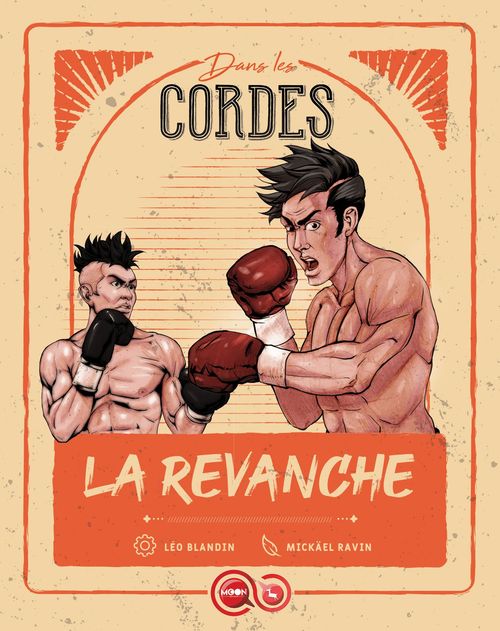
Dans les Cordes
Dans les Cordes Rulebook
Table of Contents
Table of Contents
Goal of the Game
The goal of the game is to send your opponent to the canvas.
To achieve this, you must manage your character's energy so that you can deal blows and counter those of your opponent.
But watch the time in the ring! The game stops immediately at the 3rd "GONG" of the bell.
Components
57 cards (including 2 CHARACTER cards, 1 GONG card, 13 RECOVERY cards (hourglass icon), 17 ATTACK cards (fist icon), 15 DEFENSE cards (shield icon), 9 RIPOSTE cards (fist and shield icons)), 4 markers (2 yellow and 2 red).
Setup
- Each player chooses their character and places the energy and life markers at 4.
- After setting the GONG card aside, shuffle the cards and place the pack face down to form the draw pile. Put the GONG card back approximately in the middle of this draw pile.
- Each player draws 5 cards, which form their starting hand.
- The ring is the space provided for the combat zone and the draw pile.
- The spittoon ("crachoir") is the space provided for the personal discard pile; it allows you to RECOVER 1 ENERGY POINT PER SPAT CARD.
- The player who most recently took part in or attended a boxing match starts the game.
The Coach's Advice
Only at the start of the game, each player may, if they wish, call on the coach's advice, that is, exchange all or part of their hand for the same number of new cards.
This action can only be performed once. The discarded cards are placed face down under the common draw pile.
Turn Sequence
Each turn is divided into 2 parts (three steps):
- Start of turn: Draw a card.
- ACTIVITY PHASE: PLAY AND/OR SPIT CARD(S).
- End of turn: Draw a card IF no card was played.
Keep a maximum of 7 cards in hand.
Spitting Card(s)
AT ANY TIME DURING YOUR ACTIVITY PHASE EXCEPT DURING A COMBAT, the player may spit (discard) as many cards as they wish into their spittoon (personal discard pile) and thereby add 1 ENERGY POINT for each card spat.
WARNING: A SPAT CARD IS NOT CONSIDERED PLAYED.
Playing Card(s)
To play a card, the player must spend as many energy points as the value shown at the top right of the card.
If they do not have the required energy, they cannot play the card in question.
REMINDER: It is possible to increase your energy gauge by spitting cards or through the effect of certain RECOVERY cards.
The 4 Types of Cards
ATTACK, DEFENSE, RIPOSTE, and RECOVERY.
These 4 types of cards can be played by the attacker, whereas the opponent can only respond with a DEFENSE or RIPOSTE card.
ATTACK Cards (red)
Example card: "Crochet" (hook), energy cost 3. Text: "-2 life to the opponent, -1 card to the opponent."
They initiate a combat and allow you to deal a blow to the opponent, affecting their life points.
WARNING: For the "Crochet" card, IF IT IS NOT COUNTERED, the opposing player must lose 2 life points and 1 card FROM THEIR HAND OF THEIR CHOICE. This card is therefore discarded into its owner's spittoon face down, without energy recovery.
DEFENSE Cards (blue)
Example card: "Blocage" (block), energy cost 0. Text: "Against an attack you lose 1 life."
They can only be played in response to an ATTACK or RIPOSTE card and allow you to parry a blow, cancelling or reducing the damage received.
RIPOSTE Cards (red and blue)
Example card: "Cross-Counter", energy cost 2. Text: "-1 life to the opponent against an attack of type: 'Jab' or 'Cross'."
Riposte cards can either be played as an attack (in which case there is no counter effect) OR as a defense that counters the attack and delivers a blow, which can in turn be defended against by the initial attacker.
RECOVERY Cards (yellow)
Example card: "Rafraîchissement" (refreshment), energy cost 0. Text: "+1 life."
Only one card of this type can be played per turn. It can be played either before or after a combat, but never during one. Depending on its effect, it allows you to recover life points or ENERGY, or to draw cards.
Combat
A combat is initiated by an ATTACK or RIPOSTE card and ends WHEN THE ATTACKER can no longer or does not want to play cards.
DURING A COMBAT, THE ATTACKER IS ALWAYS THE ONE WHO HAS THE INITIATIVE. The opponent can only play in response to their attacks. For each ATTACK or RIPOSTE card of the attacker, the opponent may either parry the blow (with a DEFENSE or RIPOSTE card), or do nothing and take the damage.
THE ATTACKER MAY, IF THEY WISH, play a DEFENSE card on a RIPOSTE of the defender.
REMINDER: During a combat, no player may play a RECOVERY card or spit card(s). You must therefore plan your energy gauge carefully before initiating a combat!
Round Bell
When you draw the GONG card, reveal it immediately next to the ring, and replace it in your hand with a new card from the draw pile.
Finish your turn normally.
At the end of this turn, each player recovers, of their choice, 1 life point or 2 ENERGY POINTS.
Then, remove the top card of the draw pile, face down, to indicate the number of rounds in progress (first GONG, 1 card removed; 2nd GONG, another card removed; 3rd GONG, end of the game).
Finally, shuffle the GONG card with all the played cards present in the ring and all the cards in the spittoons. This new draw pile is placed underneath the remaining draw pile.
WARNING: When the 3rd GONG is drawn, finish your turn normally; the game ends immediately afterwards and the end-of-round bonus does not apply.
End of the Game
The game can end in two different ways:
- ONE OF THE PLAYERS IS KO'D: Their opponent wins the game.
- The 3rd GONG rings: The player with the most life points at the end of the turn wins the game.