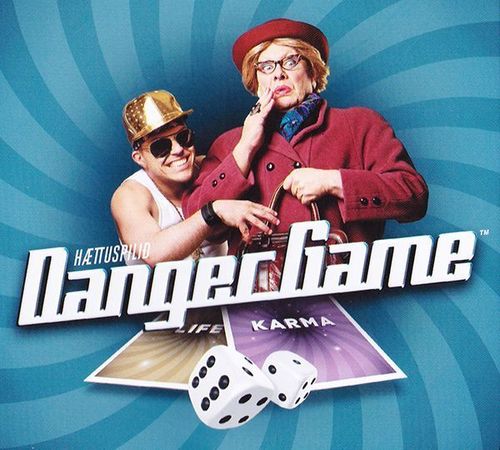
Danger Game
Danger Game Rulebook
Table of Contents
Table of Contents
- Components
- Setup
- 1. Starting Position
- 2. Moving Around the Board
- 3. Objective
- 4. Items and Hobbies
- 5. Points
- 6. Rings
- 7. Cards
- 8. The Black Ring
- 9. Intoxicant Cards
- 10. Financial Squares
- Closing Note
- Game Expansions (Spilaviðbætur)
- New Ways to End the Game
- Squares of Danger Game (Reitir Hættuspils)
- Using Destiny Cards
- Think About It (Til umhugsunar)
Components
- 1 Game board
- 2 Dice
- 6 Pawns
- 69 Brain cells
- 48 Point discs
- 6 Large character cards
- 45 Incident cards
- 44 Destiny cards
- 6 Hobby cards
- 6 Aur cards
- 6 Bank books
- 16 Insurance cards
- 18 Intoxicant cards
- 60 Item cards
- 70 Banknotes
- 36 Course of Life cards
Setup
Take all the parts of the game out of the box and sort the cards into separate piles.
Place the Destiny and Incident card decks face down in the middle of the board.
Choose one banker. The banker manages money, items, brain cells, intoxicant cards and points.
The banker begins by distributing items among the players as described in section 1: Starting Position.
Decide whether you want to use any of the game expansions on pages 16–20.
1. Starting Position
Each player starts with the following:
- 1 character card. Players decide among themselves who plays which character.
- 3 brain cells. These brain cells are indicated on the character card.
- 1 hobby card. Each player starts with the hobby card showing the character they play.
- 1 destiny card. Players draw one Destiny card and keep it in hand without showing it to the other players.
- 50,000 kr. Don't waste this money on nonsense!
2. Moving Around the Board
Players roll to decide who starts the game. The game is played by players rolling 2 dice (or using the Course of Life deck) and moving their pawns along the squares of the board.
If players land on Hreyfill, they may go directly to any square of their choice.
Each time players land on or pass the Start square, they receive 15,000 kr. (Travel by Hreyfill does not count, unless the player lands on the Start square itself.) A player must collect the money for the Start square before the next player rolls, otherwise they miss it.
3. Objective
The object of the game is to collect points. The first player to collect 25 points wins the game.
Players earn points by landing on squares showing their hobby, or on a shop showing an item they own (see section 5: Points).
Players can also earn points through Destiny or Incident cards.
4. Items and Hobbies
Hobbies. Each character starts with their hobby, which they can neither lose nor sell. Players may not acquire other hobby cards.
Items. When players land on a shop square, they may buy the item on offer, but not more than one copy of the same item.
If players cannot cover their debts, they must sell their items at half value.
On the Mynto square, players may buy any item.
5. Points
Each item and hobby has a table showing how many points players receive for landing on it. The number of points a player receives depends on how many brain cells of the same colour as the item or hobby they have.
The example above shows a player with 3 blue brain cells. He owns the blue item: a suit, vest and trousers from Kölski, and therefore receives 6 points each time he lands on the Kölski shop square, according to the table.
Point discs: 1 point and 5 points.
6. Rings
If players land on an arrow square, they go directly to the ring the arrow points to and roll one die at a time until the ring is completed. Players always end their trip around the ring back on the arrow square. Players complete their trip around the ring before the next player acts.
On the appropriate squares of the rings, players receive either Destiny cards or brain cells of the same colour as the ring. Each player may hold only 5 Destiny cards in hand at a time, and no more than 5 brain cells of each colour.
If players land on the square "straight to ring", they may go into a ring of their choice.
7. Cards
Incident cards are drawn by players landing on Incident squares on the board. The cards are read aloud and the instructions are followed.
Destiny cards are read silently without showing them to other players. Players may hold up to 5 Destiny cards at a time and may play them at any time, even while other players are acting. If players have 5 cards in hand, they may not draw a new card unless they first play out or discard one card.
Note: The wording "your friend" on cards means that the player who plays the card may choose which player is affected by it.
8. The Black Ring
If players land on the arrow at the black ring, or on the square "straight to the black ring", they must travel once around the ring (unless they hold Destiny cards that allow them to escape).
The black ring has 2 kinds of squares. Toxin squares, where players receive intoxicant cards. And moon squares. Each time any player lands on a moon square, everyone who holds intoxicant cards loses what is written on those cards.
The black ring's intoxicant cards:
FIRST INTOXICANT CARD You lose 1 point and 5,000 kr each time someone lands on a moon square. Keep 1 brain cell on the card.
SECOND INTOXICANT CARD You lose a total of 3 points and 15,000 kr each time someone lands on a moon square. Keep 3 brain cells on the card. (4 in total are inactive on cards.)
THIRD INTOXICANT CARD You lose a total of 6 points and 30,000 kr each time someone lands on a moon square. Keep 6 brain cells on the card. (10 in total are inactive on cards.)
9. Intoxicant Cards
On toxin squares, players receive intoxicant cards in the correct order: first, second, and finally third card.
Players place brain cells on the intoxicant cards as indicated on each card. While brain cells are on intoxicant cards, they do not count when points are determined.
If players holding intoxicant cards cannot pay money when someone lands on a moon square, they must sell their items at half value. If players have neither money nor points, nothing happens. Money or points cannot be owed.
Each time players holding intoxicant cards land on a hospital square, they lose one of their intoxicant cards.
10. Financial Squares
On the grey squares of the board, called financial squares, players may buy items that do not give points but have other special functions. These squares are:
VÖRÐUR (insurance) Each time a player lands on this square, they may buy insurance on one item for 10,000 kr. An insured item cannot be lost unless the player is forced to sell it. Then the insurance card is returned to the bank.
ÍSLANDSBANKI (bank) Here you may buy a bank book for 10,000 kr. The next time a player lands on the Íslandsbanki square, they may sell the book for 30,000 kr.
AUR The Aur card costs 20,000 kr. It may be used to pay for any one item in place of money, regardless of what the item costs.
Note: These items may not be bought on the Mynto square. Further explanations of their functions are on the back of the cards.
Closing Note
What follows in this booklet is intended for closer clarification and reference during play.
KEEP THIS IN MIND! If something bad happens to you, or another player is winning the game, check your Destiny cards! Perhaps you can respond at the last moment.
If you do not understand how a square works, look it up on pages 24–26: Squares of Danger Game.
If the function of a Destiny card confuses you, look it up on pages 10–13: Using Destiny Cards.
Now it's time to start playing and have a good time. Enjoy!
Game Expansions (Spilaviðbætur)
Course of Life (Gangur lífsins)
The Course of Life deck adds options to your turn instead of rolling dice. If you choose to play with the Course of Life, shuffle the cards well and place the deck in the middle of the board.
Each player receives four cards in hand. You must play out all four of your cards before you may draw four new cards.
On your turn you play one Course of Life card onto a discard pile beside the deck. You carry out what the card says, then do what the square says. The next player may then go.
When you have no card left in hand, you must draw four new cards from the Course of Life deck.
If there are no cards left in the deck, shuffle the discard pile and turn it face down.
Destiny and Incident cards: If Destiny or Incident cards affect a dice roll, they have the same effect on Course of Life cards. For example, the Clear Direction card affects "your roll" by adding one or subtracting one from the movement in your turn, regardless of which Course of Life card was played.
Rings: On the rings you use one six-sided die to move, not Course of Life cards.
Course of Life Cards
Dice cards (5 squares forward). Move forward as many squares as the card indicates.
Negative dice cards (4 squares back). Move backward as many squares as the card indicates. You may go back past the Start square.
Forward to next ring. Move your pawn directly forward to the next ring, either a coloured ring or the black ring.
Straight to the black ring. Move your pawn directly to the black ring. You must play this card, but perhaps you can get a useful Destiny card to save yourself before you do it.
Swap pawns. Swap your pawn with another player's pawn. You carry out the action of the square, not your friend's.
Draw an Incident card. You do not move and do not carry out the action of the square, but you draw one Incident card and carry out what is on it.
Lucky! You receive 20,000 kr but do not move and do not carry out the action of the square. You skip it because you found 20,000 kr on the street.
New Ways to End the Game
Here are suggestions for new ways for the game to end. Make sure everyone agrees which rules are followed before you begin. You may play with all, or none, of these additional rules.
New Incident card (Game over). The game includes one new Incident card that ends the game immediately when it is drawn. Before you begin, shuffle this card into the bottom half of the Incident deck. This way the game will not end until at least half of the Incident cards have been drawn.
Happiness over money. If you agree to these rules, you may also win the game by collecting all 15 brain cells. These brain cells may not be placed on intoxicant cards.
Points by number of players. The standard rules have the winning target at 25 points. To shorten the game in proportion to the number of players, you may use this table:
- 2–4 players: 25 points or 15 brain cells
- 5 players: 20 points or filling two colours of brain cells
- 6 players: 15 points or filling two colours of brain cells
Squares of Danger Game (Reitir Hættuspils)
Shop squares (Verslunarreitir). Here you may buy the item shown on the square. If you already own the item, you receive points for it (see section 5: Points). You may not buy 2 copies of the same item.
Hobby squares (Áhugamálareitir). You start with your character's hobby. You can neither lose this hobby nor acquire others. When you land on your own hobby square, you receive points for it (see section 5: Points). On other players' hobby squares nothing happens.
Incident squares (Atvikareitir). Here you draw one Incident card, read it aloud and follow its instructions. If the instructions contain the words "your friend", it means a player of your choice.
Hreyfill (taxi). When you land on the Hreyfill square you may go directly to any square on the board, before the next player acts. You receive no money for passing the Start square by Hreyfill. If you travel directly to the Start square itself, you receive your 15,000 kr.
Hospital squares (Sjúkrareitir). When you land on a hospital square and have one or more intoxicant cards, you lose one of them.
Start square (Byrjunarreiturinn). Each time you pass or land on the Start square, you receive 15,000 kr. If you forget to ask for the money before the next player has rolled, you miss it (unless the other players choose to show you mercy).
Mynto. Here you may buy all items for sale in the game except financial items (the Aur card, insurance and bank books).
Straight to ring (Beint á hring). When you land on this square you may go directly into a ring of your choice before the next player acts (see section 6: Rings).
Straight to the black ring (Beint á svarta hringinn). If you land on this square you must go directly into the black ring before the next player acts (see section 8: The Black Ring).
Arrow squares (Pílureitir). When you land here you go directly into the ring the arrow points to. In the ring you roll one die and go all the way round the ring before the next player acts. You end the trip around the ring back on the arrow square. You do not go to another ring or onto the main board, even if you roll a higher number than needed to finish the ring.
Brain cell squares (Heilasellureitir). Here you receive one brain cell of the same colour as the square. If you already have 5 brain cells of the same colour as the square, nothing happens.
Destiny squares (Örlagareitir). Here you draw one Destiny card. Read it silently, keep it in hand and play it out when it suits you. You may not hold more than 5 Destiny cards at once. If you land on this square with 5 cards in hand, you must play out or discard a card before drawing a new one. You may also keep your 5 cards and skip drawing.
Double Destiny squares (Tvöfaldir örlagareitir). As Destiny squares, except that here you may draw 2 cards at once. If you have 4 cards in hand, you may first draw one card, then decide whether to play out a card or discard one, before drawing the second card.
Moon squares (Mánareitir). Each time any player lands on a moon square, everyone who has intoxicant cards pays money and loses points as stated on the intoxicant cards.
Toxin squares (Eiturreitir). Here you receive one intoxicant card. If you have no intoxicant card, you receive the first card: Brennivín (an Icelandic schnapps). If you have the Brennivín card, you receive the next card: Cannabis, amphetamine and ecstasy tablets. If you already have the first and second cards, you now receive the third card: Acid and syringe. If you already have all 3 cards, nothing happens on the square.
Using Destiny Cards
Note: The booklet's own cross-references point to pages 10–13 for the rules on using Destiny cards. The examples below are printed on pages 28–31 of the booklet.
NOTE: It is not possible to decide to move yourself (by playing a Destiny card) after an Incident card has been read in order to avoid its effect.
Admiration (Aðdáun). Is one of your rivals winning the game? Wouldn't it be wise of him to let you enjoy his success and give you 3 points? That would at least bring you closer to victory.
Dad picks you up (Pabbi sækir þig). Are you about to go into the black ring? Wouldn't it be more sensible to have Dad pick you up, go to the Start square and receive 15,000 kr. as pocket money instead of a night-life trip?
Earthquake (Jarðskjálfti). Do you have few or perhaps no expensive items? Have you perhaps shown the foresight to insure your most expensive items? If so, an earthquake might turn out worse for most others than for you.
Clear direction (Skýr stefna). Did you land on a hobby that is not yours? One square ahead is an arrow square that sends you directly into a ring! Are you perhaps one square from your best item? Then it would be no bad thing to add to your dice roll and collect a fair number of points.
Hreyfill. How about playing this card to go straight to an item you own that gives you lots of points? Did you perhaps just buy an expensive item? How about going the shortest route to Vörður to insure it?
Grandma gets mixed up (Amma ruglast). Was Grandma winning at Lotto and about to give your friend a 40,000 kr. item? Wouldn't it be convenient if she got a little mixed up and gave you the item instead?
A friend indeed (Vinur í raun). Just bought yourself a computer? If you had more green brain cells, it would give you more points. Is your friend perhaps bragging? One of his brain cells moving over to you will surely take the wind out of his sails!
Generous friend (Rausnarlegur vinur). If only you had a bit more money to buy the coffee machine you have always wanted. Wouldn't it be good to have a good friend?
Cruising with Siggi Sýra (Á rúntinn með Sigga Sýru). Did your friend land on an item that gives him points? Perhaps enough to hand him the victory? Then isn't it a suitable time to send him instead on one trip around the black ring? Note that you must play this card before the next player rolls.
Divine providence (Guðleg forsjón). Oh, what bad luck! Straight to the black ring. Perhaps you should roll again? Was your opponent about to get a lucky roll? Perhaps he won't be as lucky if he has to roll again.
Communism (Kommúnismi). Did someone say all your items are insured? But not your friend's car? How about playing this communism card now. You choose your friend's car and he takes your uninsured item, which is... nothing!
No swimsuit! (Engin sundskýla!) Is there someone who should be set back 2 points from victory? He perhaps deserves some humiliation for something he has done to you?
Laziness (Leti). A lazy person does not win the game for the time being. Perhaps there is someone who could afford to lose 3 points?
Siggi Sýra makes friends (Siggi Sýra vingast). Is one of your opponents showing off his intelligence? Perhaps he would benefit from becoming one brain cell poorer?
I don't think so! (Ég held nú síður!) Did you get a Destiny card that makes you lose points, money, or perhaps a brain cell? You would escape the consequences if the effect of the card were cancelled! Note that this card also cancels other "I don't think so!" cards.
Closed! (Lokað!) Did your friend land on an arrow square and is about to go into a ring to collect Destiny cards and brain cells? Not if the ring is closed! No one receives points on a closed square either.
Robbery! (Rán!) What do you say? Did your friend land on an item he can barely afford? If, unfortunately, he were now robbed, perhaps he would no longer have enough.
Gambling addiction (Spilafíkn). Was your friend overinvesting? Does he not have a penny? But how sad it would be if he had to sell his items at half value to pay his gambling debts.
No thanks! (Nei takk!) Did you stumble onto a toxin square in the black ring? If you just say "no thanks", nothing happens. Note that once you already have an intoxicant card, it is too late to say "no thanks".
Misunderstanding (Misskilningur). Wouldn't it be fun if the 5 points your friend just got for his hobby went to you instead? That could even deprive him of victory or secure it for you!
Depression (Þunglyndi). Is your friend cocky? Does he have 5 Destiny cards and think he can handle anything? If he suddenly lost all his Destiny cards, perhaps it would be easier to keep him in check. Do not worry, he could not play anything against it.
Brazen (Frekja). Is your friend on 20 points and now getting 5 more, which would secure him victory? Wouldn't it be more enjoyable if instead he lost 5 points and ended up with 15 instead of 25?
Sale (Útsala). Do you see an exciting item on the shop square you just landed on? Wouldn't it be fun if it were on sale and cost 10,000 kr. instead of 20,000 kr.?
Think About It (Til umhugsunar)
Printed in the booklet as a prevention note, prepared for the Icelandic Association of Alcohol and Drug Problems (SÁÁ).
Addiction is a chronic brain disease characterised by strong craving, loss of control and compulsive use of alcohol or drugs, despite the use having negative consequences. Repeated use of drugs can lead to changes in the structure and function of the brain, which leads to a pathological craving for the drug and reduced ability to resist that craving. People who struggle with addiction are no longer able to control their use, despite repeated attempts to cut down or stop and a strong wish to quit.
In Iceland it is estimated that about 22% of men and 10% of women develop an addiction at some point in their lives (www.saa.is). The younger a person begins drinking or using drugs, the greater the likelihood that they will develop an addiction. Social pressure, tension and curiosity are often reasons why young people try alcohol or drugs. In adolescence the ability to foresee consequences is not fully developed, so young people are more likely to underestimate the dangers of drugs and to try them.
We will all find ourselves in situations where alcohol, and perhaps other drugs, are being used around us. We will probably also be offered alcohol or even other drugs. Trying something new can be exciting and fun, especially if your friends are doing it. But here you need to pause and think carefully. Dabbling with alcohol and other drugs can lead to addiction or to serious addiction problems. Nobody sets out to end up there or believes it could happen to them, but reality is that it sometimes takes no more than trying. Many people, young and old, who have fallen into addiction and sought help from SÁÁ can attest to this. They made the decision to try it for the first time. It was perhaps fun at first and some control was kept over their use, but later the use developed into a loss of control and had negative effects on their lives. That is why it is so important to be prepared for how to respond in situations where alcohol and/or drugs are on offer. Think the situation through to the end and bear in mind that the decision to try can change your life in the future.
Remember that no drug is harmless, whether it is cannabis or alcohol, even though alcohol is a legal drug. Do not let impulsiveness and excitement blind you, and find ways to resist pressure from your peers, for example by preparing sentences you can say if you are offered alcohol or drugs. By not giving in to group pressure and curiosity, you take control and take responsibility for your own life, and you significantly reduce the risk of developing an addiction while improving your quality of life.
If you are already misusing alcohol or other drugs, it is not too late to turn things around. If you find that your use, however large or small, is disrupting your life or having a negative effect on your wellbeing, it may be worth reassessing your habits. Addiction is judged by the consequences of the problem for the user's daily life and wellbeing. If your habits are affecting your performance, your ability to handle tasks, your ambition, or you are even unhappy with the situation, it may be useful to look at the matter more closely. Not everyone who wants to stop or change their habits needs long-term treatment. The first step is usually to talk the matter over with a professional and consider what suits you and your circumstances.
If you want to look into the matter further, you can book an interview with an alcohol and drug counsellor at SÁÁ's outpatient clinic by phone at 530-7600, or see the services available at www.saa.is
If you feel unwell and need to talk to someone right away, the Red Cross Helpline can be reached at 1717, or via its online chat at www.1717.is
On behalf of SÁÁ (Samtök áhugafólks um áfengis- og vímuefnavandann, the Association of People Interested in the Alcohol and Drug Problem).