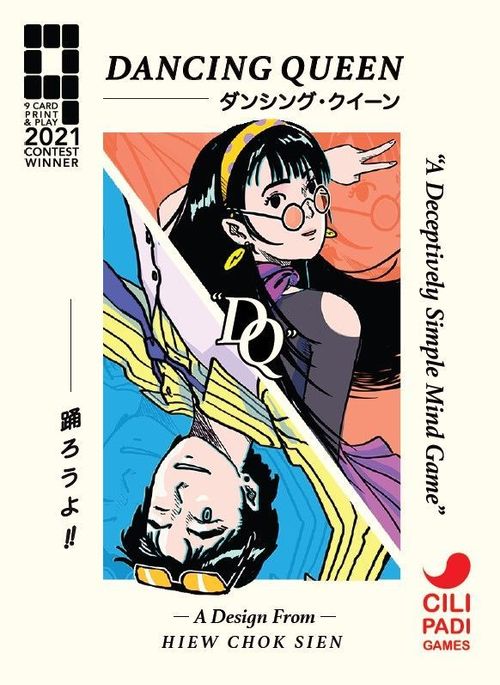
Dancing Queen
Dancing Queen Rulebook
Table of Contents
Table of Contents
Game Components
- 9 cards
- 7 yellow cubes - trophies
- 1 black cube - microphone
Objective
During a game round, players take turns inviting friends to a dance party. When a round ends, whoever's lead dancer scores more points wins a trophy. Play a number of rounds until one player wins 4 trophies, and thus wins the game.
Concepts
- Secret: Cards are always played face-down. You may peek at cards you have played at any time.
- Gender: Every card can be a boy or a girl. When you play a card, the half facing the opponent is the gender of the card. Only abilities in that half of the card apply.
- Lead dancers and backup dancers: You always have one active dancer in front of you, and you may have one to three backup dancers in play on the side.
- Partners: A card you play must be partnered with an opponent's card whenever possible. Lead dancers always partner with each other. If you play a new card to be your lead dancer, it replaces your previous lead dancer. The previous lead dancer becomes a backup dancer, and will try to partner with your opponent's lone backup dancer (if any). If you play a new card to be a backup dancer, it will partner with your opponent's lone backup dancer (if any). Backup dancers, once partnered, never change partners.
- Open-minded: It is not mandatory to have a partner of the opposite gender.
Layout notes from the rulebook's diagrams: the "Game in progress" diagram shows the opponent's lead dancer and backup dancers above, your lead dancer and backup dancers below, the draw deck, the microphone, and the trophies won by each player. The partnering example shows the opponent with 2 backup dancers and you with 1 backup dancer in play: you play a new dancer to replace your lead dancer, your previous lead dancer must now partner with your opponent's lone backup dancer, and backup dancers once paired never change partners. The gender example shows "Only icons and text in this half have effect" and "Your opponent has 2 girls in play" / "You have a boy and a girl in play".
Setup of a Round
- Shuffle deck.
- Deal one card to each player.
- Players decide which half to use and simultaneously play their cards face-down. These initial cards are their lead dancers.
- The player with the microphone goes first. If it is the first round, give the microphone to the younger player.
Playing a Round
- A player turn:
- Decide whether to draw a card or to propose to end the round.
- Drawing a card:
- Give the microphone to your opponent first (if you have it).
- Draw a card then play it face-down as your new lead dancer or as a backup dancer.
- If the gender you play has a rotate icon, you may rotate another card in play, changing its gender. You may rotate your own lead dancer or any backup dancer, but you may not rotate your opponent's lead dancer.
- Proposing to end the round:
- If your opponent has one card more than you, end the round immediately.
- If your opponent has the same number of cards as you do, he may draw a card. After that you may end the round, or instead decide to draw a card. If you draw, give the microphone to your opponent and resume play as normal.
- After any card is played and resolved, if the instant-win condition (star) on your lead dancer is fulfilled, reveal it immediately. The round ends and you win a trophy.
- Once both players have 4 dancers, the round ends.
Example (rotate): You may play this card to rotate another card in play, except for the opponent lead dancer. The opponent lead dancer may not be rotated. Once rotated, this boy becomes a girl.
Example (instant win): You immediately win the round because you fulfil the exact condition for an instant win (star icon). You win immediately because the game situation fits ABBA exactly: 2 girls and 2 boys.
Example (end of round): Once the 8th card is played, both players reveal their lead dancers. In this example, you score 4 points and your opponent scores 3 points, so you win the round.
End of a Round
- Reveal the lead dancers and resolve their scoring abilities.
- The player with more points wins the round.
- In the case of ties, the player with the microphone wins the round.
- If no one has 4 trophies yet, start a new round. The microphone does not change hands.
Hints for New Players
- Cards score from 1 to 4 points.
- Beware the cards with instant-win conditions (star), e.g. ABBA. Avoid setting up for your opponent to win.
Special Situation
Cards with the rotate power and instant-win conditions: When a card with a rotate power is played, and the rotate power is used, check for the instant-win condition only after both the card is played and the rotate power is applied. E.g. A player plays a Girl card, creating a situation of 2 Girls and 2 Boys. The player uses the Girl card just played (which has a rotate icon) to rotate a Boy card, resulting in a situation of 3 Girls and 1 Boy. The ABBA card does not trigger an instant-win because this condition is checked after the rotate power is applied.
Card Clarifications
- We're Odd (boy): The total number of cards in play is an odd number.
- We're Even (girl): The total number of cards in play is an even number.
- You're Odd (boy): Your opponent has an odd number of cards in play.
- You're Even (girl): Your opponent has an even number of cards in play.
- Boyzone (boy): Instant win is only possible with 7 Boys and no Girls.
- Girl Power (girl): Instant win is only possible with 7 Girls and no Boys.
- Ballroom Dancing (boy): Scores 0 if total cards in play is an odd number. Scores 0 if there is any same gender pair.
- Rainbow Parade (girl): Scores 0 if total cards in play is an odd number. Scores 0 if there is any opposite gender pair.
- Perfect Balance (girl): Scores 0 if total cards in play is an odd number.
- ABBA / Cranberries / Queen / Spice Girls: These instant win conditions are fulfilled only at the specific number of boys and girls. If you have more than the required number, the condition is not met.
Flow of Play
The rulebook's "Flow of Play" diagram, in order:
- Start your turn. Choose one of two branches.
- Draw branch: Pass the microphone, draw a card, play it as a girl or a boy, play it as a lead or backup dancer, rotate if the card has a rotate icon. Then check: is there any instant win (star)? If yes, go to "End round". If no, check whether 8 cards are in play. If 8 cards are in play, go to "End round"; otherwise, the turn passes to the opponent.
- Propose end round branch: Check whether you have fewer cards than your opponent. If yes, go to "End round". If no, check whether the opponent agrees to end. If yes, go to "End round". If no, the opponent draws and plays a card, and the flow returns to "Start your turn".
- End round: Check for an instant win. If there is an instant win, the player wins a trophy. If not, check whether one player has more points. If one player has more points, that player wins a trophy. If neither has more points, the player holding the microphone wins the trophy.
Dancing Queen Reference Sheet
The final page of the rulebook. Each row lists a girl card on the left and its matching boy card on the right. The left scoring column is the girl card's scoring and the right scoring column is the boy card's scoring. Points are shown as hearts in the original and are written here as "points"; the instant-win star is written as "instant win".
| Girl card | Girl scoring | Boy scoring | Boy card |
|---|---|---|---|
| We're Even | 2 / 4 / 6 / 8 cards in play: 4 / 3 / 2 / 2 points (no score if odd number of cards) | 3 / 5 / 7 cards in play: 1 / 2 / 3 points | We're Odd |
| You're Even | Opponent has 2 cards: 1 point. Opponent has 4 cards: 3 points | Opponent has 1 card: 3 points. Opponent has 3 cards: 1 point | You're Odd |
| Girls' College (rotate) | All girls: 2-4 cards: 1 point; 5 cards: 4 points; 6+ cards: instant win | All boys: 2-4 cards: 1 point; 5 cards: 4 points; 6+ cards: instant win | Boy School (rotate) |
| Girl Power | More girls than boys: by 1-2 cards: 1 point; by 3-6 cards: 3 points; by 7+ cards: instant win | More boys than girls: by 1-2 cards: 1 point; by 3-6 cards: 3 points; by 7+ cards: instant win | Boyzone |
| Rainbow Parade (rotate) | Only same gender pairs. 1 / 2 / 3 / 4 pairs: 1 / 2 / 4 points / instant win. No score if odd number of cards | Only opposite gender pairs. 1 / 2 / 3 / 4 pairs: 1 / 2 / 4 points / instant win. No score if odd number of cards |
Icon notes: the rotate icon appears on Girls' College, Boy School, Rainbow Parade, Ballroom Dancing, The Romeo, The Rose, Spice Girls and Queen. In the sheet, "ALL" followed by a girl or boy face marks the gender counted by Girls' College and Boy School. The face shown inside the scoring cells of The Romeo and The Rose is the single minority gender named in the row. This reading of the face icons is the transcriber's interpretation of the picture-only layout and is disclosed here for review.