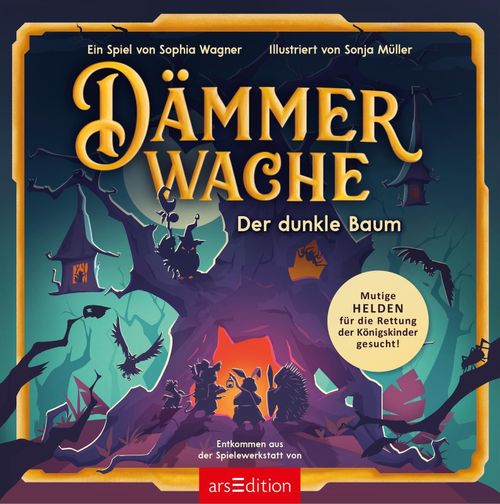
Dämmerwache
Dämmerwache Rulebook
Table of Contents
Table of Contents
Game Overview
The goal of the game is to collect as many gold coins as possible! Whoever manages to reach the top of the Witch Tree receives a treasure chest and the chance to free the royal children. But to win you do not necessarily have to reach the top – the more valuable loot is often found on the lower floors!
Components
- 1 game board (the Witch Tree)
- 4 × 6 character cards (6 per guild)
- 3 royal children tokens
- 1 start marker
- 1 die
- 4 treasure chests
- 3 experience markers
- 6 character markers (dark blue)
- 4 guild markers (black)
- 1 sticker sheet
- 92 room tiles:
- 21 × 1 gold
- 15 × 2 gold
- 15 × giant spider
- 10 × grim spirit
- 8 × thorn beast
- 14 × empty room
- 9 × torch
Before the first game: stick the character stickers onto the dark blue character markers, and stick the guild stickers onto the black guild markers.
Setup
-
Choose a guild. Each player chooses a guild and takes:
- the 6 character cards of that guild (identified by the guild symbol), placed face up in front of them with the non-upgraded side showing (identified by the symbol)
- 1 guild marker belonging to that guild
-
Starting position. Each player places their guild marker on the ground floor of the Witch Tree (the staircase). This marker represents the group of your guild.
-
Place room tiles. Shuffle all room tiles thoroughly. Place one face-down room tile on each space (three per floor). Keep the remaining room tiles as a face-down draw pile.
-
Place special tiles. Place one treasure chest per player and the three royal children, face down, in the Owl Room at the very top of the tower.
-
Set out character markers. Place the six dark blue character markers face up in a row beneath the Witch Tree. This is the display (Auslage).
-
Distribute the start and experience markers. The smallest person at the table receives the start marker and the die. Going clockwise, the next person receives the experience marker with one star, the next the marker with two stars, and the fourth player the marker with three stars.
Gameplay
Order of Play
The game is played clockwise. The person holding the start marker begins.
Turn Sequence
-
Choose a character. Choose one of your characters with which you want to explore the tower this turn. Take the corresponding character marker from the display. IMPORTANT: Other players can no longer choose this character for the rest of the round.
-
Roll the die. Roll the die. The result shows how many floors (0, 1 or 2) higher than your guild marker you may place your character marker.
-
Place your character. Choose a floor and place your character marker in the small antechamber to the right of the staircase on the chosen floor. Several character markers may be stacked there. You may also place your character marker on a floor that is at the same height as or lower than your guild marker.
-
Move your guild marker up. If you placed your character marker on a floor higher than your guild marker, move your guild marker up one floor immediately (but never more than one floor per turn).
-
Open doors. Turn over all still face-down room tiles of the chosen floor and leave them face up.
-
Carry out actions. Try to defeat monsters with your character or sneak past them. Collect items if possible.
Opening Doors
After you have placed your character on a floor, you open all remaining face-down doors on that floor. To do this, you turn over the remaining face-down room tiles of the chosen floor and leave them face up. Now you check how far your character can advance from left to right along the branch. You leave the character marker in the antechamber, while the guild marker stays on the staircase. This represents your group waiting for the character to return:
- Most room tiles show a monster or a reward (for example gold or a torch).
- Defeat monsters according to your character's abilities, or sneak past them if possible.
- Only when your character defeats or sneaks past a monster can it reach the rooms behind it and defeat further monsters or collect items.
- Sometimes you find empty rooms. These are simply placed on the discard pile, unless the upgraded Thief finds them. In that case you place them in front of you – they are worth 2 gold at the end of the game.
Important Notes
- All characters may collect items – except the Dragon! (Dragons have no pockets!)
- Items that are not collected stay face up on their space. Monsters that were snuck past also stay in place.
- This way the other players can see what awaits them there in later turns.
Example
You open the doors on a floor and reveal the following tiles: one gold coin, one giant spider and one torch. Depending on the character you chose, you have the following options:
- With the Guardian you can collect the gold, defeat the giant spider and then collect the torch.
- With the Thief you can collect the gold, sneak past the giant spider (it stays in place) and take the torch.
- With the Dragon you defeat the giant spider, but cannot take any items – you simply walk past them. Gold and torch remain where they are.
Defeated Monsters
Whenever you defeat a monster with your character, you take the corresponding room tile and place it face up in front of you.
Each defeated monster gives you experience points. The number of experience points is shown by the green stars on the tile. You can later use experience points to upgrade your characters (see "Upgrading Characters").
Note
Only defeated monsters give experience points – you receive no points for monsters you sneak past.
Example
With the Dragon you defeat a thorn beast (2 green stars) and a giant spider (1 green star). You place both tiles in front of you and now have 3 experience points in total.
Tip
Collect experience points deliberately so you can upgrade your characters early in the game and use their improved abilities!
Upgrading Characters
For every 3 experience points (stars) you may upgrade one of your characters at the start or end of your turn:
- Give up 3 experience points (you may combine them freely, including with experience markers) or give up a torch. Monster tiles used in this way go to the discard pile.
- If you do not have exactly the 3 experience points you need, you may "exchange" with the discard pile. Translator's note: the German word "wechseln" is used here without further explanation in the rulebook; the sentence is transcribed as printed.
- Turn the character card over to its back side (the upgraded side).
- Upgraded characters have better abilities, which are available to you from now on.
- Each upgraded character is worth +3 gold at the end of the game.
Torches
When you find and collect a torch with your character, place the torch tile face up in front of you.
Upgrading characters: At the start or end of your turn you may discard a torch to upgrade a character immediately.
Gold at the end of the game: If you still have unused torches at the end of the game, each torch is worth 1 gold.
Note
- Only characters that may carry items can pick up torches. The Dragon cannot collect torches.
- Torches that you used for upgrading go to the discard pile and no longer count as gold.
End of Turn
After completing your turn (character marker placed, guild marker placed, doors opened, monsters defeated or snuck past, and items collected), check whether empty spaces have arisen on the floor where you played.
Empty spaces are filled as follows (see the example below):
- Slide tiles down. All room tiles on the floors above slide down to fill the gaps.
- Place new tiles. On the topmost floor, free spaces are filled with new face-down room tiles from the draw pile.
Important Notes
- No new tiles are placed on the lower floors – only tiles from above slide down.
- In this way the tree is constantly changing, and new challenges and opportunities arise for the next turns.
End of Round
A round ends as soon as five character markers are in the tree (regardless of the number of players) and only one remains.
- All character markers return to the lower edge of the Witch Tree.
- The start marker passes to the person who would choose the next character.
- Experience markers remain with their owners (if they have not yet been used).
Reaching the Top of the Tree
When your guild marker reaches the top floor of the tree (not the Owl Room), you immediately take a treasure chest (5 gold).
The three royal children are then placed, face down, as a stack on the middle room of the top floor. The tile that was there is set aside (discarded).
From this point on you no longer need to roll the die or move your guild marker – you may choose freely where to place your character marker.
Rescuing the Royal Children
As soon as the first guild marker reaches the top floor (not the Owl Room), the royal children are placed there.
When your character reaches the middle room with the royal children, you rescue one of the children and take a royal child tile (3 gold). The Dragon can also rescue the royal children!
- If the last royal child is taken, the game ends immediately – all children have been rescued!
- If tiles slide down, the royal children slide down with them.
- If the remaining royal children reach the bottom floor, the game ends immediately. The children that remain are then safe – they run quickly home to their mother!
End of the Game and Scoring
The game ends immediately when:
- the last royal child has been taken from the game board, or
- one or more royal children reach the bottom floor.
Gold Scoring
Count all gold coins you have collected from room tiles, treasure chests and royal children. Then add the following bonuses:
- +3 gold for each upgraded character
- +1 gold for each unused torch
- +1 gold for every 3 unused experience points (only for the upgraded Dragon)
- +2 gold for each empty room found by the upgraded Thief
Whoever has the most gold wins the game!
Tie-breaker: In case of a tie, the person with more rescued royal children wins. If there is still a tie, the tied players share the victory.
Guilds
The four guilds are (names as printed in the German original):
- Die Laubläufer
- Die Beerenwächter
- Die Silberzweig-Allianz
- Die Schwesternschaft der Schwarzen Pfote
Each guild has its own set of six character cards, one per character, and its own guild marker. The guild overview in the rulebook lists the four guilds only; it does not describe any guild-specific abilities.
Character Abilities
Here you will find all the abilities of your characters. Abilities marked with the crown symbol are available only after you have upgraded the character.
Icons in this section are pictorial. Where the rulebook shows an icon, it is described in words below; monster icons are: giant spider (Riesenspinne), thorn beast (Dornenbiest) and grim spirit (Grimmgeist). The sword icon means "defeat", the mask icon means "sneak past", and the sack icon means "cannot collect items".
Thief (Dieb)
- Base: Can sneak past every monster (giant spider, thorn beast and grim spirit).
- Upgraded: Collects empty rooms. For each empty room the Thief collects, you receive +2 gold at the end of the game.
Dragon (Drache)
- Base: Defeats all monsters. Has no pockets and cannot collect items.
- Upgraded: For every three unused experience points at the end of the game you receive +1 gold.
Treasure Seeker (Sachensucherin)
- Base: When the character reaches the last room of a floor, it may look at one more room tile from the draw pile. If it is gold or a torch, it may keep that tile. Otherwise it places it face down back on the pile. Can sneak past giant spiders.
- Upgraded: When the character reaches the last room of a floor, it may look at two more room tiles from the draw pile. If among them there is gold or a torch, it may keep the corresponding tiles. Otherwise it places them face down back on the pile. Can sneak past giant spiders and thorn beasts.
Mage (Magierin)
- Base: Adds +1 to the die roll, to determine how many floors up the character may move.
- Upgraded: The guild marker may always move up one floor, regardless of where the character marker was placed.
Seer (Wahrsager)
- Base: If all three room tiles of the floor on which the character is placed are face up, it may replace one of them with the top tile from the draw pile. The original tile is placed on the discard pile.
- Upgraded: Can defeat grim spirits.
Translator's note: the German rulebook refers to the Seer with the feminine pronoun "sie" in some places; the wording above follows the ability text.
Guardian (Wächterin)
- Base: Can defeat giant spiders.
- Upgraded: Can defeat giant spiders and thorn beasts.
Character Overview
| Character | Base ability | Upgraded ability |
|---|---|---|
| Thief | Sneak past any monster | +2 gold per empty room at game end |
| Dragon | Defeat all monsters; no items | +1 gold per 3 unused experience points |
| Treasure Seeker | After crossing all rooms, look at 1 tile and possibly keep it; sneak past giant spiders | After crossing all rooms, look at 2 tiles and possibly keep them; sneak past giant spiders and thorn beasts |
| Mage | +1 on die roll | Guild marker always moves up one floor |
| Seer | Swap 1 tile | Defeat grim spirits |
| Guardian | Defeat giant spiders | Defeat giant spiders and thorn beasts |