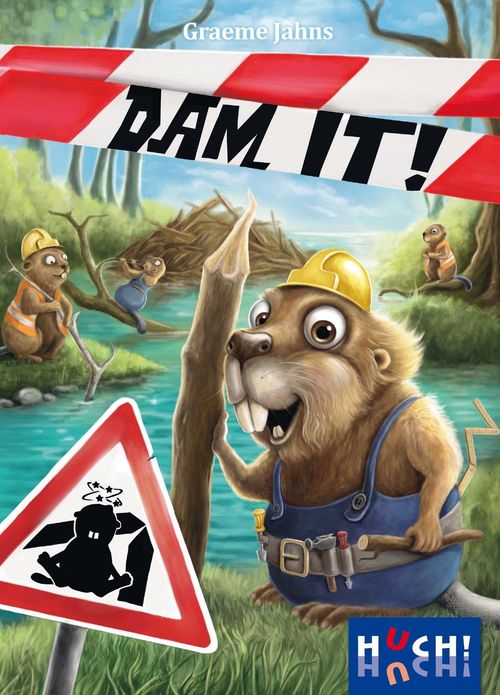
Dam It!
Dam It! Rulebook
Table of Contents
Table of Contents
Contents
- 66 river cards:
- 42 tree cards (6 x 7 types)
- 12 garbage disposal cards
- 12 garbage cards
- 15 dam cards
- 16 "stepping stone" wood cubes
Object of the Game
You score points for dams you build that exclusively use different types of trees in their construction. Collect driftwood from the river and use it to erect the most beautiful beaver lodges. But, as much as possible, avoid getting garbage into your dams, since that leads to a loss of points at the end of the game.
The beaver garbage disposal is a wildcard that helps you by either disposing of garbage right away or supporting you in building your dams. The player with the most points at the end of the game wins!
Set-up
a. Each player gets 4 wood cubes (stepping stones in the river for the beavers). If there are fewer than four players, put any excess cubes back into the game box; they are not needed for this game.
b. Divide the dam cards into five groups according to their building costs (11, 9, 7, 5, 3). Sort each group according to victory point value, so that the card with the highest value is on top and the one with the lowest at the very bottom. Place the cards on the table (as shown in the illustration) so that all players can see the values.
c. Shuffle the river cards and put them on the table as a face-up draw pile.
d. Draw 4 river cards and lay them in a row to the left of the draw pile. They form the river, with the draw pile as the source of the river.
The player who last used a toothpick becomes the starting player.
(Illustration: example of the game set-up for 4 players — the display of dam cards, the river cards, the face-up draw pile, the general discard pile, and players 1–4.)
Course of the Game
On your turn, you may carry out one of two actions:
a) Pick a river card from the river, or b) Build a dam
a) Pick a river card from the river
On your turn, you may take one card from the river.
The first river card (i.e., the one that is furthest away from the draw pile) may be taken for free.
If you want to take one of the cards further up river, to the right, you have to throw wood cubes into the river in order to pick it. For jumping over the first river card, you put one of your cubes on this card. Now you can take the next card – or you can put a wood cube on this second card as well in order to pick the third card, etc. You can throw a maximum of four wood cubes into the river. If you put a wood cube on each of the four river cards, you take the topmost card from the draw pile.
That means you have to put a wood cube on each card you want to jump over (even if there are already cubes lying there).
Example: Tina has put one wood cube each on the first two cards in order to take the third card out of the river.
If you take a card from the river that has one or more wood cubes on it, you also take the wood cubes from this card and add them to your supply. (It doesn't matter who put the wood cubes on the card.)
Example: Benny picks the first card from the river, which has two wood cubes on it. These cubes will be available to him on later turns.
The River cards
There are 3 kinds of cards in the river: tree cards, garbage cards, and garbage disposal cards.
Tree cards
If you pull a tree card out of the river, you take it into your hand. Later on, you can use tree cards from your hand to build dams, which you collect as a pile in front of you.
Garbage cards
If you pull a garbage card out of the river, you have to
- immediately discard a garbage disposal card from your hand (see below) and put it on the general discard pile along with the garbage card,
- (if you are not able or not willing to give up a garbage disposal card) keep the garbage and add it to your pile of built dams. With this, the garbage is built into the dam and can no longer be removed.
Garbage cards give you minus points at the end of the game.
Example: Tina takes a garbage card and puts it along with her garbage disposal card on the general discard pile.
Beaver garbage disposal
If you pull a garbage disposal card out of the river, take it into your hand. These cards are wildcards that can either protect you from garbage or help you in building dams.
As described above, you can discard a garbage disposal card when you take a garbage card out of the river (put any wood cubes that might be on this card into your supply). Put the garbage disposal card along with the garbage card on the general discard pile.
Alternatively, you can use one garbage disposal card per dam you build. In this case, it counts as a tree card with 2 branches; i.e., it has a building value of 2.
Refilling the river
As soon as you have taken a card from the river, the cards to the right of it are moved one position to the left, and the topmost card from the draw pile is added face up next to the source of the river, revealing a new draw pile card. If the player pulled the top card from the river draw pile instead, then the river cards don't need to be moved.
(Illustration: this card is picked; the next card moves to the left; the top draw pile card is placed in the empty space.)
b) Build a dam
If you want to build a dam on your turn, you may not take a card from the river. Instead, in order to build a dam, you play tree cards (plus up to one garbage disposal card) from your hand. Each type of tree has a specific building value; this number (1, 2, or 3) is printed on the card.
Attention! Each dam you build may contain any type of tree only once. That means you may not use two cards of the same type for one dam. (This applies also to the garbage disposal cards: Per dam, you may use a maximum of one of these cards as an additional tree card with a value of 2.)
(Illustration: a dam may not be built this way, since two of the tree cards are identical.)
If you have a correct combination of cards, you may take the top card of one group of dam cards; the total value of the tree cards that you put on the discard pile must be equal to or greater than the building value of the desired dam card. Collect your dam cards as a face-down pile on the table in front of you.
Example: Tina plays tree cards with a total value of 5. In return, she takes the top card from the group of dam cards with a building value of 5. At the end of the game, this dam is worth 7 victory points. The tree cards played are put on the general discard pile.
End of the Game
The game ends immediately if
A. the river can no longer be refilled after a player's turn, i.e., if fewer than five river cards are on display (including the draw pile), OR B. one player takes the last dam card from the display when building a dam.
Now all players tally their victory points. You score victory points for your dams and for the wood cubes that you have at this moment. You get minus points for garbage cards in your pile of dam cards.
- Add up the victory points on the dams you have built (i.e., collected).
- For every 2 wood cubes you have in front of you, you earn 1 victory point.
- Garbage cards that you have collected in your dam card pile give you a point deduction depending on how many of these cards you have: 1 garbage card gives you minus 1 point; 2 garbage cards, minus 4 points; 3 garbage cards, minus 9 points; 4 garbage cards, minus 16 points; and 5 or more garbage cards, minus 25 points.
The player who has the most victory points in the end wins the game. In case of a tie, the players involved add up the values of the tree cards they have left in their hand; the player with the highest total wins. (Other than that, tree cards that you weren't able to convert into dams are worth nothing at the end of the game.) If there is still a tie, the tied players share the win.
Example: At the end of the game, Benny scores for the following cards and for the wood cubes he has: Benny gets 43 victory points for the 5 dam cards. For the 3 wood cubes, he earns 1 additional victory point. For the 3 garbage cards, he has to deduct 9 victory points. So, his final score is: 43 + 1 - 9 = 35 victory points.