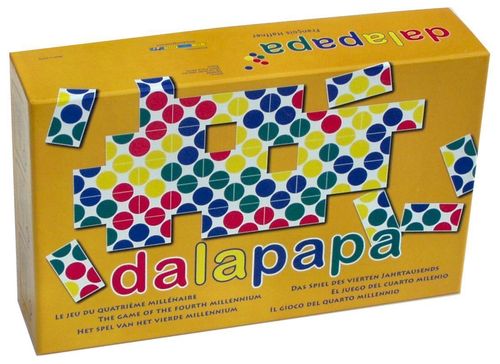
Dalapapa
Dalapapa Rulebook
Table of Contents
Table of Contents
Contents
120 double-sided wooden domino's, called dalapapas, and one little cloth pocket. Rules of the game.
You will also need pen and paper to note down the scores.
Aim of the Game
Players can score points by placing their dalapapas correctly onto the playing field:
- either by creating discs
- or by creating groups of discs
The first player to reach a certain score (60 to 240 points, agreed before the game) wins the game. 60 point games involving three players take about half an hour.
Placing Rules
Each dalapapa contains a central disc and 6 semi-discs. Every dalapapa has to touch at least one other dalapapa on the playing field, creating one or more discs. New discs cannot consist of more than one colour.
When placing a dalapapa onto the playing field, a player can create up to 6 new discs.
(The rulebook shows two examples of correct moves and two examples of incorrect moves as diagrams.)
Placement
All dalapapas are shuffled in the little pocket and each player draws one dalapapa. The youngest player begins by placing the dalapapa on the playing field. Then, the other players follow clockwise, putting the dalapapas they have drawn onto the gaming field without breaking the placement rules. These first dalapapas merely constitute the starting point of the game and do not yield any points.
As soon as all players have placed their dalapapa, each player draws two dalapapas from the pocket. Now, the real game can begin.
Development of the Game
Everyone plays in clockwise rotation, starting with the first player. Each player places one of his dalapapas on the playing field without breaking the placement rules.
Players can score points by creating discs and disc groups.
Disc Groups
A group of discs contains one or more discs of one and the same colour, constituting an isolated entity without touching semi-discs of the same colour.
The example shown alongside contains 6 groups of discs:
- A is worth 1 point
- B is worth 6 points
- C is worth 2 points
- D is worth 7 points
- E is worth 5 points
- F is worth 1 point
Scoring
Disc Points
Each disc created by placing a dalapapa, is worth 1 point.
Furthermore, the player gets two points per disc as from the third disc.
In other words: the first two discs are worth one point each while the following discs are worth 2 points. The aim is to create as many discs as possible.
Group Points
When placing a dalapapa creates a disc group (see definition above), the player gets 1 point per disc in the group.
When a player places a dalapapa creating several groups, each group is worth a certain score.
Placement of a Second Dalapapa
If a player wants, he can also place his second dalapapa, though he has to pay 4 points, to do so. Those points will be deducted from his total score. However, sometimes it can be interesting to pay the 4 points if it helps to create several discs or disc groups.
The points of the two dalapapas are calculated separately and then added afterwards. Do not forget to deduct the 4 points from the total score.
Note: by changing the order in which the dalapapas are placed, it is possible to increase your score.
End of a Player's Turn
When a player has placed his dalapapas, the disc points and group points are calculated, potential penalties for placing a second dalapapa are deducted and the scores are noted. Then the player draws 1 or 2 dalapapas so as to have 2 dalapapas in his hand.
End of the Game
When a player achieves the score agreed before the game, the game is over. However, the players finish the round so every player has had an equal number of turns.
The winner is the player with the highest score. It is possible to have joint winners.
Some Examples
Example 1
When placing the dalapapa on the left of the figure, the player gets:
- Points for discs: 2 points (no bonus)
- Points for groups: 7 points (the yellow group)
Giving a total score of 9 points.
Example 2
When placing the dalapapa on the left of the figure, the player gets:
- Points for discs: 4 points
- 1 punt for each of the first two discs
- 2 points for the third disc
- Points for groups: 8 points
- 3 points for the red group
- 5 points for the yellow group
Giving a total score of 12 points.