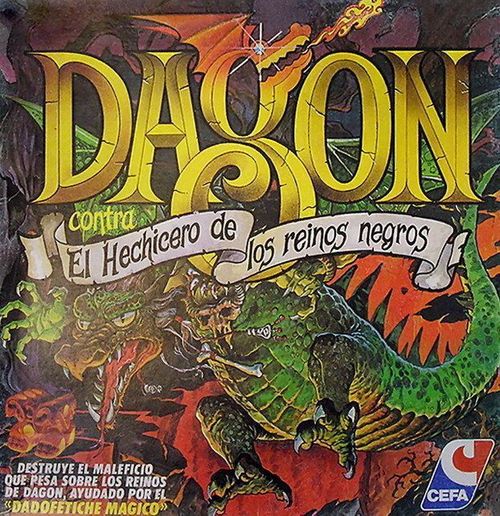
Dagon contra el Hechicero de los Reinos Negros
Dagon contra el Hechicero de los Reinos Negros Rulebook
Table of Contents
Table of Contents
Components
- Game board.
- 4 Heroes (pawns).
- 12 weapons (3 per Hero).
- Dagon Symbol (plastic ark).
- 4 "Wizard" cards.
- 16 Knight cards.
- 22 "Spell" cards.
- 12 Black Towers.
- 1 magic fetish die ("dadofetiche").
Object of the Game
Go in search of the "Dagon Symbol" and bring it to one of the cities. This "symbol" is located in the center of the board.
For this mission you will be knighted as a "Knight of the Kingdom."
The first player to be knighted three times, by three different cities, wins.
How to Play
Each player receives one Hero and three weapons (which are set aside, off the board). The Heroes start on the starting space (Zharot).
The Dagon Symbol (ark) is placed at the tail of the "Creature of the Lagoon."
The Knight cards are sorted by colour and placed near the game board.
The Spell cards are shuffled and placed face down, forming a draw pile beside the board.
The twelve Black Towers, the 4 Wizard cards and the fetish die are prepared in the same way.
The player who starts is determined by chance.
Starting the Game
The players begin one after another on the starting space, the city of Zharot.
Each player moves their Hero, of their choice, one circle along the route line, in either direction.
A player may move forward and then back within the same move, but may not return to the same point from which the move started.
Only free spaces may be moved onto (exception: to attack another Hero).
The player whose turn it is must move (exception: the Hero is temporarily blocked and therefore does not play on that turn, because at that moment it holds the Wizard card).
Symbolic spaces (Spell, Black Tower, Whistle, Thrones, Lagoon) count as one space when moving; in addition they have a particular meaning, explained below.
It is not possible to move over the following spaces:
- Spells.
- Spaces occupied by another Hero.
- Spaces occupied by a Black Tower or the Whistle.
Within a single move a player may pass over all other spaces. The particular effect of a symbolic space applies only when a Hero stops on that space, and not when it is merely passed over.
Weapons
The three weapons are the special strengths of the Heroes who set out on the adventure. A Hero loses one weapon each time it attacks another Knight or when it loses a combat against the "Wizard's Spells."
When a Hero has no weapons left, it may continue the game and go looking for the Dagon Symbol, but it may not fight the Wizard's Spells, nor attack another Hero.
When a Knight has only one weapon left, it may not attack any other Hero that is standing on a Spell (since it would then have no other weapon for the combat against the Wizard's Spell.
[Editorial note: the printed sheet omits the closing parenthesis after "Wizard's Spell" in this sentence; it is transcribed as printed.]
In the cities of the thrones, Heroes can recover their strength.
A player who arrives at a city receives one weapon back in return. However, a Hero may never carry more than three weapons, since a Hero that already has three weapons receives no more.
The Dagon Symbol (Ark)
From the moment a Hero reaches the tail of the creature, which is its vulnerable area, it may take the Dagon Symbol (ark). (It may do so only if it lands on the white circle at the tail.)
The bearer of the symbol may pass over all obstacles. Of course, if it stops on a Spell it must fight it. The symbol must be carried to the city of KROMT.
The Spells
A player who lands on a Spell must fight it. The strength of a Spell is unknown at first. The player must turn over the top Spell card of the pile. The number on the Spell shows its strength (1 to 6). The player now rolls the fetish die to fight the Wizard's Spell.
If, once the fetish die is rolled, the player obtains the same number of points or more than the Spell card, the player has won the duel. Thanks to this victory the player has regained strength and may play again, moving one more space. Furthermore, the player may also pass over other Spells, Black Towers, the Whistle and the opponents' pieces.
If the player obtains fewer points on the fetish die than the number shown on the Spell card, the player has lost the duel: it loses one weapon and sits out one turn.
The Wizard Card
A Hero that has lost a duel against a Spell is given the Wizard card. When it is that player's turn again, the player may not move its piece, and the only thing it can do is return the Wizard card. On the third turn the Hero has recovered its strength and may continue on its way.
When the bearer of the Dagon Symbol loses a duel with a Spell, it also loses the Symbol. It may place the Symbol on a space of its choice (never on a symbolic space, nor on a space occupied by a Black Tower, the Whistle or the Lagoon), but that space must be in another city, leaving the Symbol (ark) on the chosen circle.
The Hero that loses the Symbol sits out one turn.
The Lagoon
A player who is attacked by another player is moved by the attacking player to a symbol (Lagoon) space of the attacker's choice.
The Cities of the Thrones
A player who reaches a city carrying the Symbol receives the "Knight of the City" card. The player must then place the Symbol on a space of its choice in another kingdom. Furthermore, for having brought the Symbol, the player receives, if it needs them, two weapons for its return journey. The Hero stops in the city even if it moved only one space.
Players who stop in a city, even if they do not hold the Symbol, receive one weapon back if they need one.
The curse of the city has been broken. A Hero that is in a city (throne) may not be attacked.
The Black Tower
A player who stops on a Tower space must introduce a Black Tower into the game. Black Towers may be placed on all free white spaces (never on symbolic spaces).
Once a Black Tower is placed on a space, its effect is that no one may stop on that space, or pass over it, with the exceptions of the bearer of the Symbol and the winners of a duel with a Spell. When the reserve of Towers is exhausted, of course no more may be placed.
The space on which the Symbol is located may not be occupied by any Black Tower, and therefore may not be blocked in such a way that it could not be reached.
The Whistle
A player who reaches this space must move a Black Tower that is already on the board to a free space of its choice (except a symbolic space).
Attack Between Heroes
When a player lands on a space, or a symbolic space, on which another Knight is standing, it attacks that piece. This attack costs the attacker one weapon.
The attacked player moves its Hero to a symbol (Lagoon) of its choice. The attacker must remain on the space of the duel. When the player carrying the symbol is attacked, the attacker also captures the Symbol.
When a Hero standing on a symbolic space is attacked, the first thing to do is move it to the Lagoon symbol. The attacking player gives up one weapon and moves the rival Knight to a LAGOON space.
[Editorial note: the printed sheet is internally inconsistent on who chooses the Lagoon space when a Hero is attacked. The "Attack Between Heroes" section says the attacked player chooses its Lagoon, while "The Lagoon" section and the last paragraph say the attacking player chooses/moves it. Both are transcribed as printed; the sheet gives no further resolution.]
End of the Game
The game ends when a player has been knighted a certain number of times in different cities, a number decided at the start of the game. Normally the game is played to win three thrones in three different cities. For a shorter game, the objective may be limited to two thrones in two different cities.