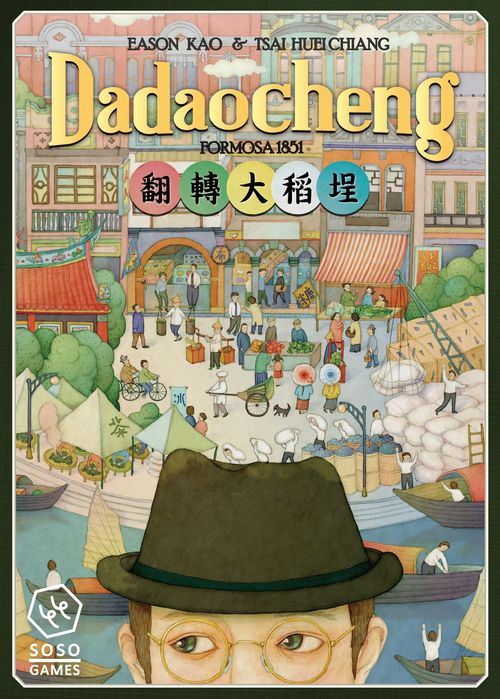
Dadaocheng (Second Edition)
Dadaocheng (Second Edition) Rulebook
Table of Contents
Table of Contents
Components
- 1 game board
- 4 player resource boards
- 4 player shipping boards
- 16 resource discs
- 14 historical event cards
- 12 building cards (2 Mansions, 2 Veggie vendors, 2 Herbal shops, 2 Workshops, 2 Numerology halls, 2 Grain shops)
- 50 resource cubes (10 each of sugar/red, rice/white, tea/green, camphor oil/yellow, opium/black)
- 36 player markers (4 colors, 9 each of color)
- 1 red die
Card Anatomy
- Card name
- Ability
Resource Disc
- Represents current resource (i.e. yellow/camphor oil)
- Represents resource at the other side of the disc (i.e. green/tea)
- Sun, side labeled thereby is face up at start of game
- Resource space
Note: A blue cube represents a cube of any color.
Setup
- Place the game board at the middle of the table. Place the die on the City God Temple.
- Turn the resource discs with the side having the sun facing up. Place the 4 opium resource discs at the four corners, randomly. Place the remaining resource discs randomly on the circles. No more than three resource discs of the same color can be in a contiguous group.
- Place the 6 types of building cards (2 Mansions, 2 Veggie vendors, 2 Herbal shops, 2 Workshops, 2 Numerology halls, 2 Grain shops) face up next to the game board. In a 2 player game, with the exception of the mansions, use only one building card for each type of building.
- Take the historical event card "1851" and use it as the event card for the first round. Shuffle the remaining historical event cards, and place them face down on the historical event card space on the game board.
- According to the name of the company at the side of the game board facing the player, each player takes a player resource board of the corresponding company name, a player shipping board, and 9 player markers. Place the player markers on the starting spaces (with white frames) on the player resource boards and player shipping boards.
- Place a black cube on the space showing calendar "1" on the turn track.
- Place all remaining cubes next to the game board to form a supply, reachable by players.
Flow of the game
The game is played in 6 rounds. The player who most recently drank tea is the start player, and play continues in clock-wise order.
Player turn
In each round, starting with the start player, player turns are taken in order. A player's turn includes, in order, the following stages: warehouse stage, resource disc manipulation stage, work stage.
Warehouse stage
In the warehouse stage, players can choose any 2 warehouse spaces, take all cubes thereon, and skip the resource disc manipulation stage and enter directly the work stage.
Resource disc manipulation stage
1. Manipulate resource discs
The player must perform 2 actions, each of which being one of the following:
- Swapping the positions of any 2 resource discs.
- Or flipping any 1 resource disc.
Note
- A player's objective is to create 3 or 4 resource discs of the same type in a straight line.
- Players may take the same action twice, such as swap-swap, or flip-flip.
- Prior to taking an action, if a cube is on a resource disc you want to use for the action, move the cube to the warehouse space of the same row of the active player.
- Full warehouse: when moving a cube to a player's warehouse space, if the space already has two cubes, then the player gains the cube, usable in the work stage on the same turn.
2. Gain resource
When 3 or 4 resource discs of the same type are in a straight line, the player does the following in order:
- Gain cube(s): The player gain cube(s) of the corresponding resource type. For 3 or 4 resource discs of the same type in a line, gain respectively 1 or 2 cubes. E.g., if 3 red resource discs are connected in a line, take 1 red cube from the supply.
- Flip resource discs: Flip all resource discs in said connected line. If a cube is on a resource disc, that resource disc is not flipped.
- Place cube(s): If after flipping a resource disc, the resource disc shows a resource space, take a cube corresponding to the color of said resource space from the supply, and place the cube on the resource disc.
- Repeat 1-3 until no resource discs are connected in a line (of 3 or 4 discs), and the resource disc manipulation stage ends.
Note
- If all same-colored resource discs in a connected line each have a resource cube thereon, move these cubes on the resource discs to the active player's warehouse spaces of the corresponding rows, gain cube(s) of these resource discs' color, and flip the resource discs.
- Resource disc's connected lines cannot be diagonal.
- When connected lines form a T or an L shape, the player may resolve only one line.
- When the supply runs out of cubes of a particular color, take a cube of that color from any warehouse space.
Prior to the work stage
The player checks the current count of stores. If the cubes gained in the current round is greater than the number of stores, return the excess amount to the supply. The player may choose which types of cubes to return.
Opium point deduction
According to the number of black cubes gained in the current round and kept after returning excess amounts, advance the opium point deduction track on the shipping board. Advance one space for each gained black cube.
Note: In order to reduce other players' downtime, the next player may begin their turn at this point.
Work stage
In the work stage, the player may take the following actions: resource board action, shipping board action, wish at the City God Temple, building card ability, and historical event effect.
By paying 1 black cube, two cubes of any color(s) may be taken from the supply for use.
1. Resource board action
Use 1 cube, and advance the player marker corresponding to the cube type by 1 space, and execute the effect on the arrived space.
Description of spaces:
- Sail: Advance any 1 space on the shipping board without paying the cube requirement. The shipping line must be unlocked.
- Building: Gain the building card from the supply. If the building card is not in the supply, the player may advance an extra space on the row.
- Resource cube: Gain 1 resource cube from the supply, available to use immediately.
- Remove opium point deduction: Move back 1 space on the opium point deduction track.
- 5 prestige points: At the end of the game, gain 5 prestige points.
- Die: May roll the die once, and gain resource cube according to the roll.
- Mansion: Points at the end of the game.
- Store: Advance the store track by 1 space.
2. Shipping board action
Pay the cube requirement between shipping spaces, to advance the marker 1 space to the right.
Description of spaces:
- Order: Count points at the end of the game.
- Unlock: Unlock shipping line.
- Resource warehouse advance: Advance any 1 space on the resource board, without paying the resource cube.
- Store track: Indicates the number of resource cubes the player can keep prior to the work stage.
- Opium point deduction: When gaining opium before the work stage, advance 1 space on the point deduction track. At the end of the game, each space on the point deduction track deducts 5 prestige points.
3. Wish at the City God Temple
Pay 1 white cube, or any 2 cubes, to roll the die 2 or 3 times respectively. Gain cubes according to the rolls. The player may do this only once per turn.
4. Use building card ability
Use a building card ability once. Each card can be used at most once per round.
Description of building abilities:
- Mansion: At the end of the game, gain the mansion(s) on the card.
- Veggie Vendor: Exchange 1 cube for 1 of any other non black cube.
- Herbal Shop: Advance the left-most marker on the resource warehouse 1 space to the right.
- Tea shop: Pay 1 green cube, to advance any 1 marker on the shipping board; the shipping line must be unlocked.
- Grain Shop: Before the player's turn, gain 1 white cube.
- Numerology Hall: After rolling the die, can adjust the value by plus or minus 1.
5. Historical event card effects
Use the historical event card effect which is triggered during the work stage.
End of player turn
When a player turn ends, all unused resource cubes are returned to the supply.
End of a round
When all players have taken a player turn, the round ends. Turn over 1 new historical event card, and advance the black cube on the calendar 1 space downward.
End of the game
After six rounds have been carried out, proceed to final scoring.
Final scoring
When all players have taken the needed turns, the game ends, and all players score prestige points according to the following:
- Resource board: the prestige point below the left-most marker.
- Full warehouse: if a marker on the resource warehouse is on the last space, gain 5 prestige points.
- Shipping board: for the first, second and third shipping lines, respectively gain 1, 2 and 3 prestige points per space.
- Multiply the order total passed on the board by the number of mansions. Do not count the icon under the player markers.
- Historical event card scoring.
- Deduct 5 prestige points for each recorded opium.
After adding the above, the player with the most prestige points wins. In case of a tie, the player with the most orders wins.
Solo mode
Game objective
Carry out 6 rounds, and gain title of different types of merchants.
Titles:
- 60 prestige points: Apprentice merchant
- 85 prestige points: Experienced merchant
- 110 prestige points: Grand merchant
Setup
All setups are the same, with the following two exceptions:
- Do not use historical event cards.
- Use 2 mansions, and 1 each of the other types of building cards.
Solo mode rules
- When passing a building space, can choose between gaining a building card, or advancing 1 space for free.
- Can hold at most 3 building cards.
Description of historical event card effects
- 1851 The first commercial store was opened in Dadaocheng: At the start of the game, players take 0/1/2/2 cubes according to turn order, and use immediately, before the game starts.
- 1853 Dingxiajiao Conflict: Prior to the work stage, return 1 cube to the supply.
- 1859 Establishing of Xia-Hai City God Temple: During the work stage, may roll the die once, and gain cube according to the roll.
- 1860 Tamsui Treaty Port opened: During the work stage, advance 1 space on the shipping board for free; the shipping line must be unlocked.
- 1865 English merchant, John Dodd completed the tea manufacturing process in Taipei: During the work stage, may gain 1 green cube or 1 yellow cube.
- 1878 Establishing of Fazhugong Temple: During the work stage, may roll the die twice, and gain cubes according to the rolls.
- 1884 Construction of Taipei City Walls: At the end of the game, each mansion icon gains 1 prestige point.
- 1891 The first rail station in Taipei was completed: During the work stage, may gain 1 white cube or 1 red cube.
- 1895 Taiwan under Japanese rule: At the end of the game, each order icon on the shipping board deducts 2 prestige points.
- 1898 Establishing of Dadaocheng Public School: During the work stage, the player can use 1 white cube to move back 1 space on the opium point deduction track.
- At the end of the game, all players gain 1 additional mansion.