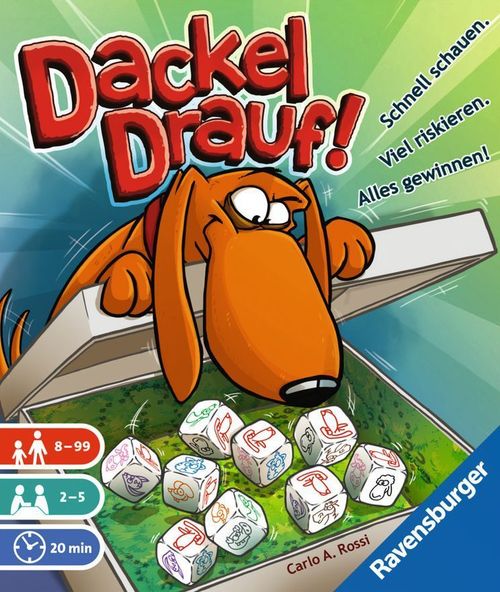
Dackel Drauf!
Dackel Drauf! Rulebook
Table of Contents
Table of Contents
Game Idea
At the start it is easy to remember the animals on the 15 dice lying in the box. But then someone suddenly says "Dackel… " — sorry, "Deckel drauf!" ("Lid on!") — and suddenly you can see nothing and have forgotten everything: Were there three pigs, or only two? How many dogs were there? How many cats? Rabbits? Ducks…?
The winner is the player who manages to get rid of the most of their animal cards.
Components
- 100 game cards
- 90 animal cards (18 per player)
- 9 special cards
- 1 overview card
- 15 dice
- 1 box
Setup
Shuffle the 9 special cards (red backs) and place them face down as a draw pile at the edge of the table. Place the overview card next to them, with the side facing up that matches the number of players.
Each player chooses a set of animal cards in a colour of their choice. Each of the 9 animals appears twice in each set. Shuffle your 18 cards and place them in front of you as your own face-down draw pile. Draw the top 10 cards and take them into your hand, so that the other players cannot see them.
You may look at these 10 cards and memorize them until the starting player begins (see below). However, you must not rearrange or sort them; you may only hold them the way you drew them!
The player with the most convincing "Dachshund look" begins. This player receives the 15 dice and the box.
Course of Play
When you have looked at your 10 cards long enough, the starting player says "Cards down!", and everyone, including the starting player, must now place their cards face down in front of them. Be careful not to mix them up with the cards in your draw pile!
The starting player then does the following: take all 15 dice, put them into the box, and put the lid on: "Dackel… Deckel drauf!" Then shake the box several times and place it in the middle of the table so that everyone has an equally good view into the box.
Now lift the lid. You can all see the 15 dice. Try to memorize as many of the rolled animals as possible.
At some point — the starting player decides when, entirely at their discretion! — put the lid back on the box. Be careful that no die changes position while doing so.
Now the guessing game begins! Which animals were visible? And how many of each?
Each player now takes their 10 cards back into hand, exactly as they lie.
The starting player begins by placing one of their hand cards face up directly next to the box. The animal on it should also appear on at least one of the 15 dice on top.
Then the next player clockwise plays one of their cards face up next to the first card, and so on. In this way, over several rounds, you build a chain of face-up animal cards.
Important! Every card you play "uses up" a matching die in the box. You must keep this in mind with every further card you play, because eventually all the pigs, ducks, cats and so on in the box will be used up. Or perhaps not yet…?
So be careful: whoever has played a card for which there is no animal die left later loses the whole round! So pay attention and do not get overconfident!
As soon as you see no way to play a card, you pass. Announce this aloud, and as a sign of it, return your remaining hand cards to your draw pile.
Once all players have passed, the animal showdown comes: the starting player carefully lifts the lid and then places a matching animal die on the first card, starting with the card directly next to the box: a matching die on the first card, then a matching die on the second card, then on the third card, and so on.
If at some point they reach a face-up card for which no matching die is left (any more) in the box, they simply skip that card and continue with the next one. This continues until all 15 dice have been placed or all face-up cards have been checked. Then comes the evaluation:
Players with wrong animal cards: everyone who has the bad luck that at least one of their face-up cards has no die on it must now return all of their face-up cards to their draw pile. That includes the ones that do have a die on them!
In this round you have therefore achieved nothing, and you will play the next round again with the same 10 cards.
+1 special card: as consolation, each of you may take one special card from the corresponding pile and look at it in secret. The three kinds of special cards are explained below.
All others who have a die on every one of their cards are now finally out: place all of your face-up cards on a common open discard pile. Well done!
Then each of you draws 10 cards again from your draw pile and takes them into your hand, in the order they come. They can now be memorized again…
The next player clockwise becomes the new starting player: they put all the dice back into the box, close it, shake it well, and then open it again, and so on.
Note: if at some point the cards are no longer enough to get up to 10 hand cards, simply continue playing with fewer cards.
Special Cards
1 animal card placed face down: when you use this card (while playing cards), you may exceptionally play your animal card face down, so that only you know it. This will confuse your opponents considerably!
1 additional card played: when you use this card (while playing cards), you may play any other card directly after your first card. In that case you play 2 cards in a row.
+1 "Joker die" — a wrong animal card is right!: when you use this card (after the evaluation), you may designate one of your played animal cards as "right", even though no die lies on it. That is, through this special card you place an imagined matching die on this animal card.
During one round you may use any number of special cards (including identical ones, and including several in a row). Afterwards, return all used special cards face down to the bottom of the special card draw pile.
End of Game
To win, you must get rid of as many cards as possible. The overview card shows, for each number of players, when a player wins.
If a player, after the evaluation, has no more than the number of hand cards shown on the overview card, they win the game immediately. If several players achieve this at the same time, the player with the fewest remaining cards wins. If that number is also equal, there are several winners.
Example: with 3 players, the winner is the one who, after a round, first has only two or fewer animal cards left.
Note: the exact per-player-count thresholds are printed on the overview card, which is an illustration in the original rulebook and is not reproduced in the text of this file.
Variant (for real animal memorizers!)
In this variant, at the moment when no die can be placed on a player's animal card, that player must take back all of their face-up cards, i.e. the dice already placed on them become available again to the other players, as do future ones.
So if you are already sure, while a fellow player is playing, that they have just made a mistake, you may ignore their animal cards and play those animals yourself. But if you are wrong about this, you are probably the one left empty-handed …
And note: what happens if the fellow player uses a "Joker die" card? — the original rulebook poses this question without printing an answer in this section.