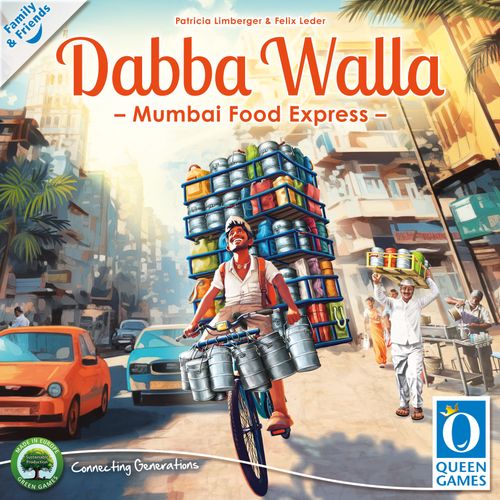
Dabba Walla
Dabba Walla Rulebook
Table of Contents
Table of Contents
The story of the Dabba Walla
The story of the Dabba Walla begins in 1890, when a banker had the idea of hiring a young man to deliver his home-cooked lunch to his office. This idea has grown into a network of over 5000 Dabba Walla who deliver over 200,000 dabbas every day. Organized in small teams, the Dabba Walla perform a daily organizational and logistical miracle in the busy and chaotic streets of the metropolis of Mumbai.
The Dabba Walla have also attracted international attention from researchers, companies and the media. Case studies and reports, such as those from Harvard Business School, BBC, Arte and National Geographic, praise the highly efficient system, which works almost entirely without modern technology and at the same time functions almost flawlessly.
One working day of the Dabba Walla
- Early in the morning: The food is cooked at home and packed in dabbas.
- 7-9 a.m.: The food is collected from the front door by a Dabba Walla.
- 9-10:30 a.m.: The Dabba Walla teams of a region meet at a central point and sort the dabbas for further transportation.
- 10:30 a.m.-12 p.m.: The dabbas are transported to the destination station by train - the teams have 20-40 seconds to load the crates.
- 12 p.m.-1 p.m.: The dabbas are delivered on time to the offices, some of which are far away, with 99.999% reliability.
- 2-6 p.m.: The now empty dabbas are collected from the offices and transported back to the households.
What are dabbas?
The Indian lunch box known as a "dabba" consists of several bowls into which the various components of the lunch are packed. They are stacked on top of each other and connected by a snap-lock system.
The whole thing is packed in a metal outer container or a heat-retaining bag to keep it warm.
Who are the Dabba Walla?
"Dabba Walla" refers to the traditionally male profession of dabba vendors, who can be recognized by their white clothing and headgear, the so-called Gandhi cap. They are a unique sight in the cityscape of Mumbai.
What does the sorting code on the dabbas mean?
In real life, the dabbas are labeled with a sophisticated code that is a combination of several numbers, symbols and colors indicating where it was picked up, via which intermediate stops it was transported onwards and to which destination it should arrive at the end. The symbol of the destination train station is shown most prominently in the middle. For the game, we have only used such a central symbol, which should assist people with color vision deficiency in playing the game.
Game idea and objective
Join the Dabba Walla during their working day:
In the first half of the game, move your Dabba Walla through the busy streets of Mumbai to collect cards. Play one card per turn to pick up the dabbas shown on the card and load them onto your bicycle trailer, handcart or crate. You will soon be stacking the load higher and higher until all the dabbas have been loaded after 13 rounds.
In the second half of the game, you deliver the dabbas: Level by level, you unload the tiles and receive tips for the food you have transported. Everyone plays one card face down - and then everyone may benefit from all the values in the bottom half of the cards played.
Once all the dabbas have been delivered, the winner is the one who has collected the most tips.
Have fun and "Apane bhojan ka aanand len"!
Components
- 76 dabba tiles, 19 each in the colors yellow, red, blue and green, with 1 to 4 dabbas: three tiles with 1 dabba, six tiles with 2 dabbas, six tiles with 3 dabbas (in two shapes), four tiles with 4 dabbas (in four shapes).
- 12 bonus dabba tiles, 3 in each color.
- 76 dabba cards, one card for each dabba tile.
- Note: The side parts of the game board are also the lids for the sorting boxes!
- 15 empty dabba tiles.
- 25 tickets.
- 1 double-sided game board, consisting of 3 parts: front side for the PICK-UP PHASE, reverse side for the DELIVERY PHASE.
- 4 scoring markers (to be used in the DELIVERY PHASE).
- 2 sorting boxes with lids. Lid 1 is also the right side part of the game board. Lid 2 is also the left side part of the game board.
- 1 sorting box with lid, with the turn overview on the lid. This lid shows the number of cards to be removed during game setup.
- 8 double-sided player boards, 2 each in 4 colors, with 4 vehicles: grids with 9 squares (bicycle trailer, handcart), grids with 6 squares (crate, wheelbarrow).
- 36 chai tiles (see below): 2 of each light-blue-background tile, 3 of each orange-background tile.
- 4 level markers, 1 each in 4 colors.
- 4 70/140 tips markers, 1 each in 4 colors.
- 4 Dabba Walla with cardboard bases, 1 each in 4 colors.
- MODULE 1: 4 double zero tiles (see Rules for the modules).
- MODULE 2: 3 double-sided order cards with 6 different orders (see Rules for the modules).
Note: The chai tile that looks like a 1-dabba tile is only used to distinguish it from the "normal" 1-dabba-tile!
Assembly instructions for the 4 boxes
Box 1:
- Sort the individual parts of box 1. The components of this box can be identified by the clouds.
- Insert the inner dividers into each other as shown. The colored edges must always point downwards.
- Place the dividers on the base of the box and fold up the side panels. Pay attention to the matching colors at the bottom of the dividers.
- Carefully insert the side panels - start at the back and close the front corner last.
- Sort the different dabba tiles, chai tiles and tickets into the three sorting boxes as indicated on the bottom of the boxes. Lid = side part of the game board.
Box 2:
- Sort the individual parts of box 2. The components of this box can be identified by the small birds.
- Insert the inner dividers into each other as shown. The colored edges must always point downwards.
- Place the dividers on the base of the box and fold up the side panels. Pay attention to the matching colors at the bottom of the dividers.
- Carefully insert the side panels - start at the back and close the front corner last.
- Sort the different dabba tiles, chai tiles and tickets into the three sorting boxes as indicated on the bottom of the boxes. Lid = side part of the game board.
Box 3:
- Sort the individual parts of box 3. The components of this box can be identified by the clear blue sky.
- Insert the inner dividers into each other as shown. The colored edges must always point downwards.
- Place the dividers on the base of the box and fold up the side panels. Pay attention to the matching colors at the bottom of the dividers.
- Carefully insert the side panels - start at the back and close the front corner last.
- Sort the different dabba tiles, chai tiles and tickets into the three sorting boxes as indicated on the bottom of the boxes. Lid = turn overview.
Box 4: Fold up the side sections and insert the side panels.
Hint: A few materials, such as level and scoring markers, do not have a designated compartment in the sorting boxes. They can be stored with the dabba tiles between games and set aside during setup, until they are needed.
Setup for the Pick-up Phase
(For the Delivery Phase setup, see the Delivery Phase section below.)
- Assemble the three pieces of the game board and place it in the middle of the table as shown.
- Place the three sorting boxes filled with their designated contents next to the game board. This is the common supply.
- As a group choose which vehicle you would like to play with in this game. Choose a player color, take the player board with the chosen vehicle in your color and place it in front of you. Note: We recommend playing with the bicycle trailer first.
- Take the Dabba Walla and the level marker in your player color. Place the marker in the cutout on the edge of the player board at the height of the 1.
- Take 6 tickets each and place them next to your player board as your personal supply.
- Shuffle all the dabba cards. Depending on the number of players you need: 35 cards for 2 players, 50 cards for 3 players, 65 cards for 4 players. From this, form a face-down draw pile and place it next to the game board. Put the remaining cards back in the box, unseen.
- Take the top six dabba cards from the draw pile and place them face up in the cutouts along the long edges of the game board. This is the card display.
- Draw 2 dabba cards from the deck and put them into your hand.
- Unused game material remains in the game box.
The different vehicles
The vehicles are the bicycle trailer and handcart (9-square-grid), and the crate and wheelbarrow (6-square-grid). All players always play using matching player board grids - decide as a group which one you want to use. Each vehicle offers a different game experience, because the available space per level and the layout of the squares are different.
Gameplay
A game of Dabba Walla is divided into two phases:
1st PICK-UP PHASE: In the PICK-UP PHASE, you move your Dabba Walla through Mumbai and collect dabba cards. Then you play one of the 3 cards from your hand and load the dabba tile depicted on the played card onto your player board. If you connect chai symbols, you will receive additional bonuses.
2nd DELIVERY PHASE: In the DELIVERY PHASE, you all play 1 card per dabba tile level at the same time. Everyone can benefit, as the values of the cards are added up to determine the tip for the various dabbas.
Whoever has the most tips after unloading all the levels wins.
1st Pick-up Phase
The game is played clockwise. The player who last ate Indian food starts (if it's been a while, look at the QR code on page 3 of the printed rulebook).
When it's your turn, carry out the following two steps one after the other:
- a) Move your Dabba Walla, spending tickets if applicable. b) Take a dabba card.
- Play a dabba card and place the dabba tile.
You may also use Chai tiles during your turn (for the effects of the Chai tiles, see The Chai Tiles below).
1a) Move your Dabba Walla, spending tickets if applicable
There are six spaces on the game board, each with an assigned dabba card.
Structure of the dabba cards: A dabba card is divided into two parts. You receive the depicted dabba tile when playing the card in the PICK-UP PHASE. There is space on the card for placing tickets spent during the pick-up phase without covering important information. The tip values specified on the card count when playing the card in the DELIVERY PHASE.
First turn: When it is your first turn, you place your Dabba Walla on any space. You can also choose a space on which one or more other Dabba Walla are already standing.
All further turns: You must move your Dabba Walla at least 1 space clockwise or counterclockwise:
- If you only move your Dabba Walla 1 space, the movement is free.
- If you move more than 1 space, you must place 1 ticket from your personal supply on each card corresponding to the space(s) you pass, not including the one you stop on. You may move clockwise OR counterclockwise, but you may not change direction during your move.
Note: Several Dabba Walla may stand on the same space of the game board.
Example: Neele (purple) decides to move her Dabba Walla 3 spaces clockwise. To do this, she must place 1 ticket on the cards assigned to the first two spaces over which she moves. Now her Dabba Walla is on the destination space and she takes the corresponding card and the ticket on it.
1b) Take a dabba card
After concluding your movement, take the card corresponding to the space your Dabba Walla is now on into your hand. If there are one or more tickets on the card you took, you put these tickets in your personal supply. You immediately fill the free card space in the card display with a card from the draw pile.
2) Play a dabba card and place the dabba tile
Choose one of your three cards and place it face up on the table in front of you. Take the dabba tile depicted on the card and place it on your player board or on the tiles placed in previous turns, according to the rules for placing dabba tiles (see below).
As soon as you place the first tile on a new level, move the level marker one level higher - thus it will always show your current level number.
Note: If you reach more than 10 levels, start again at 1.
The cards you have played form your personal discard pile.
Important: In your discard pile, which you can look through at any time, you can see which tiles you have placed on your player board in which order, therefore you should not change the order of your discard pile!
Example: Mattis places the first tile on the second level and moves the level marker to the 2nd level.
The end of the PICK-UP PHASE is triggered when the card display can no longer be replenished to 6 cards. This will occur after exactly 13 turns per player.
Now, in turn order, play the two remaining cards from your hand: Place them on your discard pile, take the corresponding dabba tiles from the supply and place them on your player board in any order, according to the usual rules. You can still earn chai tiles and/or add empty dabbas at this point.
Then, the DELIVERY PHASE begins.
Rules for placing dabba tiles
- Before placing the tile, you can rotate and turn it over as you wish.
- The tile must not protrude beyond the grid. The edges must be flush with the squares.
- During the course of the game, you can stack dabba tiles on your player board to form new levels. Tiles in those levels must always lie completely on top of other tiles, meaning tiles must be fully supported. You do not have to have completely filled a level to start the next level up. You may still place tiles in an incomplete, lower level later.
- If you do not have any matching dabba tiles to fill a gap, you can take any number of empty dabba tiles from the common supply at any time and add them. Important: But be careful! For every empty dabba tile you load onto your player board, you lose 2 tips in the DELIVERY PHASE!
- Once a tile has been placed, it may no longer be moved or lifted.
- Each dabba tile has half a Chai symbol on it. If you place two dabba tiles together on the same level so that they form a fully visible, whole Chai symbol, you immediately gain a random Chai tile from the supply. You may look at it and place it face down next to your player board. The chai tiles and their effects are explained in The Chai Tiles section.
2nd Delivery Phase
Preparation of the Delivery Phase
- First, take the Dabba Walla from the game board and turn it over.
- Place the Dabba Walla on the "0" space of the tip track.
- The remaining 5 cards form the card display form the common discard pile, as shown.
- Place 1 scoring marker each on the "0" space of the corresponding scoring track.
- Now count the tickets you still have. You receive 1 tip per ticket. Move your Dabba Walla forward on the tip track accordingly. Then put the tickets back in the sorting box.
Gameplay of the Delivery Phase
In the delivery phase, you all play simultaneously. The number of scoring rounds played depends upon the level markers: The highest value of all players determines the number of scoring rounds. You start by delivering the highest level, then the next lower level is delivered in each subsequent round until all player boards are empty again and the lowest level has been delivered.
Important: Only those who have placed one or more tiles in the level that is currently being scored can receive tips in this round.
Example: Laureen (orange) has stacked tiles on 7 levels, Mattis (turquoise) and Neele (purple) on 6 levels and Maria (light green) on 5 levels. 7 scoring rounds are played. In the first scoring round (level 7), only Laureen can receive tips. In scoring round 2 (level 6), Laureen, Mattis and Neele can receive tips. Maria will begin collecting tips on the third round (level 5).
Everyone is always involved in each round. Each delivery round consists of the following 4 steps, which are carried out in this order:
- a) Choose a dabba card and play it face down. b) Add 1 or more chai tiles.
- Reveal cards and tiles and adjust scoring markers.
- Deliver dabba tiles and receive tips.
- Preparation of the next scoring round.
1a) Choose a dabba card and play it face down
Take your discard pile into your hand. At the same time, each of you choose one of your cards and place it face down in front of you. This is also done by those who have no dabba tiles in the current level.
1b) Add 1 or more chai tiles
If you want to add one or more chai tiles, place them face down on the card you have played.
2) Reveal cards and tiles and adjust scoring markers
As soon as everyone has played their card and chai tiles, the cards and tiles are revealed. Now only the bottom section of the cards is important. The tip values for the different scoring tracks are shown there. The chai tiles also show tip values of +1 or -1.
For each of the four colors add up all the tip values on all cards and chai tiles and adjust the scoring markers according to the results.
Important: The scoring markers cannot exceed 4 on the tracks - any excess is forfeited.
Note: Cards with "0" at the bottom may also be played.
Now the value of each scoring track has been determined.
Place the played cards on the common discard pile and return the chai tiles to the box.
Example: The depicted cards and chai tiles were played. The total value for blue is 2; the total value for red is 5, but the marker can be advanced a maximum of 4 steps, so the excess step is forfeited. Yellow is moved one step to 1. Because the values of the card and the chai tile cancel each other out for green, this marker is not moved and remains at 0.
3) Deliver dabba tiles and receive tips
Everyone who has dabba tiles in the current level now delivers them and receives tips:
For each dabba on each tile, you receive as many tips as the scoring marker on the scoring track of the corresponding color indicates. Advance your Dabba Walla on the tip track accordingly.
Immediately put the tiles for which you have received your tip back into the corresponding compartments of the sorting boxes.
For each empty dabba tile, you lose 2 tips (move your Dabba Walla back 2 spaces). If a scoring marker has not been moved so that it still indicates "0", you do not receive any tips for the dabba tiles of the corresponding color.
Note: If you move over the "0" space after completing one round on the tip track, take the 70/140 tip marker of your color from the box and place it in front of you with the 70 facing up. If this happens a second time, turn the marker to 140.
Example: For the depicted tiles, Laureen receives tips according to the scoring marker values of the corresponding colors: Red: 4 x 4 tips = 16 tips; Yellow: 3 x 1 tip = 3 tips; Green: 2 x 0 tips = 0 tips. She moves her Dabba Walla 19 spaces forward on the tip track.
Example: For the depicted tiles, Mattis receives tips according to the scoring marker values of the corresponding colors: Red: 5 x 4 tips = 20 tips; Blue: 2 x 2 tips = 4 tips; Empty dabba: 1 x -2 tips = -2 tips. He moves his Dabba Walla 22 spaces forward on the tip track.
4) Preparation of the next scoring round
Once everyone has received their tips and all the tiles of the current level have been delivered, move all scoring markers back to the "0" space of their tracks and adjust your level markers. Then continue with the next scoring round, in which the next lower level is unloaded.
End of game
Once all player boards have been completely emptied, you now receive 2 tips for each chai tile that you have gained and not yet used.
Whoever is furthest ahead on the tip track wins! In the event of a tie, all tied players share the victory.
The Chai Tiles
The chai tiles have different effects that you can use immediately or later in the game. After you have used a chai tile, place it on the edge of the playing field (do not put it back in the sorting box yet!).
In the rare case that you are allowed to take a chai tile but the supply is depleted, you will not receive a chai tile.
You can use the following chai tiles (light blue background) during your turn in the PICK-UP PHASE:
- Bonus dabba: You immediately receive the depicted Bonus dabba tile and can place it. These tiles do not show a half chai symbol. The chai tile depicted on them is for sorting purposes only!
- Jump: Instead of your regular movement, jump with your Dabba Walla to any space without spending any tickets.
- Swap a card: Swap a card from your hand with any card in the card display.
You can use the following chai tiles (orange background) in the DELIVERY PHASE:
- +1 / -1: Increases or decreases the value on the corresponding scoring track (see Gameplay of the Delivery Phase, step 2). Note: It is also possible to play without the "-1" chai tiles! Thus the scoring tracks may only be positively influenced. Sort and put aside all "-1" chai tiles and the veto tiles during setup, to do so!
- Veto: All "-1" chai tiles played in this round are invalid and discarded, and then the values of the scoring tracks are calculated.
- Play your card later: First, reveal only this tile, and not your card or other chai tiles. Look at the cards and tiles played by the others. Now you may exchange your card, and swap, add or remove chai tiles before revealing them. Now adjust the values of the markers on the scoring track.
Rules for the modules
There are several ways to create new challenges in Dabba Walla, which can be combined with each other as desired: The numerous possible combinations of vehicles and order cards, in particular, provide plenty of variety.
Module 1
Additional components: 4 double zero tiles.
Setup: Shuffle the four double zero tiles face down and then turn over two random tiles one after the other. Place the first tile on the left-hand side of the game board and the second tile on the right-hand side. These remain there until the start of the DELIVERY PHASE.
Example: The red tile was revealed first, the green tile was the second.
After turning over the game board, place the tile previously placed on the left-hand side on the scoring track of the matching color, so that it now has two zeros. The other tile is placed over the "0" and "1" of the track of the matching color.
Example: The track for red has been extended by an additional 0: The scoring marker is moved forward by 3 steps according to the cards and chai tiles - it lands on the space with value 2. The track for green has been shortened: 2 steps through cards and chai tiles are enough to move the scoring marker to 3.
Gameplay: There are no rule changes for the PICK-UP PHASE.
In the DELIVERY PHASE, the scoring markers no longer all start in the same place: one of the scoring markers must now be moved at least two spaces before you can receive any tips when delivering dabba tiles of that color, while one step is sufficient to gain 2 tips per dabba for another color. This should be taken into account when selecting the dabba cards.
Module 2
Additional components: 3 double-sided order cards with 6 different orders.
Note: If you wish, you can also use two or three orders in one game.
Setup: Select any order and place it next to the game board.
Gameplay: The order cards offer you additional opportunities to receive further tips during the DELIVERY PHASE.
Order 1: Presorted delivery (front side) - At the beginning of each delivery round, count the number of different colors you have placed in the current level and receive tips according to the table below. You must have completely filled the current level to receive a tip for this order. Empty dabbas do not count as a separate color, but can be used to completely fill a level.
| Number of colors | 1 | 2 | 3 | 4 |
|---|---|---|---|---|
| Tips | 10 | 5 | 2 | 0 |
Order 2: Colorful mixture (reverse side) - At the beginning of each delivery round, count the number of different colors you have placed in the current level and receive tips according to the table below. You do NOT need to have completely filled the current level to receive a tip for this order. Empty dabbas do not count as a separate color.
| Number of colors | 4 | 3 | 2 | 1 |
|---|---|---|---|---|
| Tips | 10 | 5 | 2 | 0 |
Order 3: Small packages (front side) - At the beginning of each delivery round, count the number of dabba tiles you have placed in the current level and receive tips according to the table below. Empty dabbas are NOT counted. You do NOT need to have completely filled the current level to receive a tip for this order.
| Number of tiles | 6+ | 5 | 4 | 3 |
|---|---|---|---|---|
| Tips | 15 | 9 | 5 | 2 |
Order 4: Skillful high stacking (reverse side) - At the start of the delivery phase, receive 5 tips for each level in which you have placed at least 1 tile. A level with ONLY empty dabbas does NOT count. You do NOT have to have completely filled a level to receive the 5 tips per level granted by this order.
Order 5: The more chai, the better (front side) - Instead of receiving 2 tips per unspent chai tile at the end of the delivery phase as usual, receive tips according to the total number of your unspent chai tiles using the following table:
| Number of chai tiles | 1 | 2 | 3 | 4 | 5+ |
|---|---|---|---|---|---|
| Tips | 2 | 5 | 9 | 14 | 20 |
Order 6: Chai Master (reverse side) - All those who have the most unspent chai tiles at the end of the delivery phase receive 4 tips (instead of 2) per tile. All others receive 2 tips as usual.