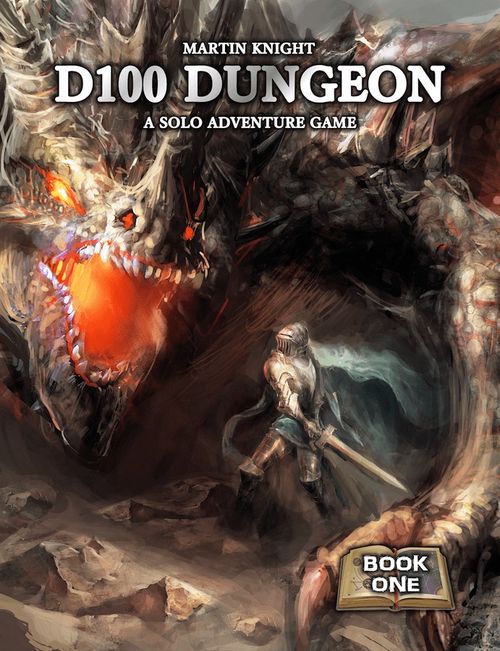
D100 Dungeon
D100 Dungeon Rulebook
Table of Contents
Table of Contents
- Creating a Character
- Abilities
- Skills
- Skill Tests
- Experience Tracks
- Other Characteristics
- Equipping Items
- Belt Checks
- Item Repair
- Combat
- Monster Reaction
- Hit Location
- Offset Damage to a Shield
- Defence Bonus
- Monster Characteristics
- Monster Abilities
- Unarmed Combat
- Instead of Attacking
- Choosing a Quest
- Completing and Failing Quests
- Time Track
- Before Your Next Quest
- Turns
- Notes on Mapping
- Table A – Armour (D100)
- Table B – Boosts (D100)
- Table C – Curses (D100)
- Table D – Doors (D100)
- Table E – Encounter (D100 + or – Encounter Modifier)
- Table F – Find (D100)
- Table G – Geographic (D100)
- Table I – Items (D100)
- Table J – Investments (D100)
- Table L – Legends (D100)
- Table M – Mapping (D100)
- Table P – Parts (D100)
- Table Q – Quests (D100)
- Table R – Required (D100)
- Table S – Spells (D100)
- Table TA – Treasure A (D100)
- Table TB – Treasure B (D100)
- Table TC – Treasure C (D100)
- Table W – Weapon (D100)
- Handy Sheets
Creating a Character
CHARACTERISTICS - There are 3 characteristics used in the game, STRENGTH (STR), DEXTERITY (DEX) and INTELLIGENCE (INT). When a player creates a character for the first time they assign any one characteristic with 50 primary points, another with 40 points, and the remaining characteristic with 30 primary points, how these are assigned is entirely up to the individual, for instance a player could apply 50 points to STR and 40 to DEX and 30 to INT or 50 to DEX, 40 to INT and 30 to STR.
SKILL BONUS - Each character begins the game with 2 skill bonuses to represent some experience gained in the world before becoming adventurers. Choose 2 skills from the skills section of the character sheet and write +5 in each. Note that all characters have all of the skills listed on the character sheet, but some will grant them a bonus to tests.
REPUTATION - Now add 1 point of REP (reputation) to the character sheet. Some quests reward Reputation when they are successfully completed, while others reduce reputation should they be failed. Reputation can never be raised above 10 or be lowered to below 1.
EQUIPMENT - Characters begin the game with some basic equipment, that they have managed to scraped together. Roll once on Table W and three times on Table A for starting equipment, if you happen to roll a second piece of armour that is assigned to a location you've already equipped armour in you may either keep the new armour rolled (discard the old piece of armour) or roll again. Record all details from the table to the correct location on the front of the character sheet, each dot of an items condition shades in one pip of its repair track. Add 20 Oil, 10 food and 15 Picks to the Supplies area of the adventure sheet, and 3 Lesser Healing Potions (Restore 4 lost HP) to characters Belt Slots.
FINISHING - Add 20 Health Points (HP), 3 FATE and 3 LIVES to the Character Sheet.
Abilities
When a characteristic has reached 50 points it gives the character an ability. Until the ability is unlocked the character is unable to use it and should the characteristic drop below 50 at any time during an adventure the ability is locked and can not be used.
MIGHTY BLOW – During combat when a natural (an unmodified result) 6 is rolled on the damage dice the dice is rolled again and the two results are added together for a final result, if another natural 6 is rolled on the second dice you roll again and so on.
PERFECT AIM – During a combat round when rolling for HIT LOCATION you may re roll the dice once and choose either your first or second result.
SPELL CASTER – Until the SPELL CASTER ABILITY is unlocked characters can only use magic through the use of scrolls. Once unlocked the characters spell book becomes active and the character may use any spells they have collected. Even before the spell caster ability is unlocked, characters may still add spells to their spell books, they simply can't use them yet.
The spells that are available to a character is based on their current INT value, for instance a character with an Int of 55 can use all spells listed in spell book within the INT level range of 50+ (the first 5), while a character with a Int of 67 can add use all of the spells they have in their spell book including and up to the 60+ INT level (see character sheet). If a character loses Int in such a way that a spell falls outside this parameter then the spell is not lost, but simply cannot be used again until the characters Int value is raised high enough to include the spell again.
Example: A character with Int 67 has filled his spell book with 6 spells, but suffers a curse and loses 12 INT, his Int is now 55, the sixth spell in his book is no longer available to him and cannot be used. Later the character slips on a Ring of Wisdom (Int+10) making his Int now 65, the sixth spell is now available again.
Spells are added to the book as they are acquired, should a player no longer want a spell or wish to replace a spell it is removed from the book, spells can never swap position in their spell book and are added at the first available space in the spell book.
To use a spell the character must spend the cost (HP) and perform a spell test below.
CAST SPELL – Test: INT (+/- Spell Bonus) [S:Cast] [F: Roll on TABLE C - CURSES] (Magic)
Skills
Characters have access to all the skills listed on their character sheet, as they gain experience the skill gains levels in multiple of +5 up to a maximum of +20. Unless a skill has a bonus it does not add to the characteristic but the character can still earn experience (see Experience Tracks). When a test is called for the rules will detail which skills can be used, the player uses all of the skills listed and can apply all of the benefits those skills provide to the test.
Skill Tests
At times in the game a character will need to make a test to perform a task or achieve goals. The game mechanics will make reference to skills as "Test: Str -5" or "Test: Int +10" in either case the player temporarily applies the modifier to their characteristic and rolls the d100, the result is compared to the Characteristic and if it happens to be equal to or below the characters current value the task has been accomplished, if it is higher then the task has failed. Each task will list the effects for a success and failure as "[S: +5 gp] [F: -1 hp]" in this case if the character succeeds they receive 5 Gold Pieces (GP) or if they failed they lose 1 Heath Point (HP).
Some results of a test give the player a choice, for instance a "[S: +5 gp/Table I]" result offers a choice and the player can have either the 5gp or roll on Table I but not both, the slash symbol "/" always offers a choice, while a result of "[F: -5 hp, -1 Str]" offers no choice and the player is forced to suffer both consequences. The comma "," never offers a choice.
Example: Harry has found a trapped chest and will attempt to pick its lock. Harry has a Dex of 65 and the skills Locks (+5) and Traps (+10).
TRAPPED CHEST – Test: Dex -10 [S:+30 gp/ roll x1 Table TA] [F:-10 hp] (Locks, Traps)
To open the chest Dexterity is tested and is reduced by 10 points (Dex -10), Harry has bonuses in both of the skills listed and with a Dex of 65 he deducts the 10 and adds +5 for his Locks skill and +10 for his Traps skill to give a Dexterity value of 70 for this test (65–10, +5, +10 = 70). Harry rolls the d100 and scores 68, just enough, the chest opens and he avoids the trap. Harry looks at the result for a success [S:+30 gp/ roll x1 Table TA] and chooses to roll once on Table TA – TREASURE A.
Experience Tracks
The Characteristics and skills have Experience tracks that track a characters experience through the game, as they perform tasks and accomplish objectives their knowledge and skill in the task may improve. When a natural roll (unmodified dice roll) is made during a test, including combat tests that is equal to or less than 10 the player may shade in any single pip on the characteristic experience track that was involved during the test or any 2 pips on any of the experience tracks of any skills involved during the test.
Example: Judith is attempting to avoid a PENDULUM TRAP, she rolls an 8 on her dice. She can either shade in one pip on her Dex experience track or two pips on any of the skills shown for the test. She decides to shade in 1 pip on her Trap Skill and 1 Pip on her Lucky Skill.
PENDULUM TRAP – Test: Dex -10 [S: Avoid Trap] [F:-4 hp] (Traps,Aware,Lucky)
Once the Experience track has been completely shaded, add +5 to the characteristic or skill (where applicable), then erase all of the shading on the track and begin again working towards the next experience improvement. Once a skill reached +20 or Characteristic has reached 80 they can no longer be increased and have reached their maximum.
Other Characteristics
Other characteristics are defined by the items a character has currently equipped and may provide a bonus to skills or characteristics
DEFENCE (DEF) - is totalled and deducts from an attackers damage result.
DAMAGE (DMG) - is totalled and added to your damage dice roll after making a successful attack.
HEALTH POINTS (HP) BONUS – When a character is created they begin with 20 Health Points as their primary characteristic. Some items collected give the player a bonus to their HP.
STR, DEX, INT BONUS - Added to the characteristic and the total is applied to the applicable adjusted section of the character sheet.
FATE POINTS - Fate points are rare blessings that the gods have offered a character because they have fallen into their favour. They can be spent to re-roll any dice of a roll they have just made (damage dice (d6), the percentile dice (00), the tens dice (1-9), or combination of any dice used for the roll). If the player is unhappy with the new result they can spend again and again fate points in order to re-roll any of the dice.
LIVES (L) - Like a cat has nine lives and can cheat death on several occasion, our characters are blessed with the same luck and have a number of lives which can be used each time they would lose enough HP to be killed. If a characters HP is reduced to zero or less the player may use one of their lives to cheat death and instead restore their HP to their maximum. Sadly when a character has no lives remaining and lose their last HP they have died and it is time to start a new character.
Equipping Items
As items are acquired the player has the option to either backpack the item (record on the reverse of the Character Sheet) or Equip. When an item is equipped it must be recorded in the correct slot on the character sheet and only one item per slot is allowed. Weapons either need 1 hand or 2 hands to wield, when equipping one handed items the player can record one weapon in the characters main weapon slot and one in the off weapon slot. Two handed weapons always use both slots and thus prevent the use of a shield (which is always equipped to the off weapon slot) and two handed weapons only use one repair track (the main weapon track).
Belt Checks
At times the rules may instruct you to make a "Belt Check", roll 1d10 and any item equipped in the slot that matches the result rolled is destroyed (remove from character sheet).
Item Repair
When items are equipped there is a risk they may get damaged. The character sheet provides each item with a repair track, and as damage is dealt to the items an equal number of pips must be shaded. When the track is full the item is beyond repair and is destroyed (removed from Character Sheet). If an item is unequipped that has been damaged it must be recorded in the backpack (reverse side of the Character Sheet) with the damage it has sustained and you must adjust the new item repair track accordingly.
Combat
When a Monster appears it is added to the Combat Track and providing the monster is defeated will remain on the track, the next monster encountered is added directly below the last defeated monster, thus creating a list of defeated monsters, if a monster or character escapes an encounter, the monster is removed from the track immediately (only defeated monsters remain on the track). The track offers characters rewards as monsters are defeated and when such a reward follows the details you've added of a defeated monster the character gains that reward. You will notice that the progress of the track is slow to start and speeds up as more monster are defeated. The combat track continues over into a new quest and when full you begin another.
When combat is imminent follow the steps below. The character attacks first, followed by the monster, however all attacks happen simultaneously and so even if the character kills the monster is will still have its attack roll.
- Roll on the monster reaction chart to determine its action in the forthcoming round, then continue to step 2.
- The character rolls a d100 to attack the monster and must score equal to or below his Str or Dex depending on the weapon being used – Hand Weapons (H) uses STR, Ranged Weapons (R) uses DEX to hit the monster. If the character has two weapons equipped either may be used, but not both. If the result scores a hit go to step 3 otherwise go to step 4.
- Roll the damage dice (d6) and the location dice (d10) together and apply the damage modifier of the location rolled, the Weapons DMG modifier (if any) and any damage bonus provided by other equipped items to the damage dice, then deduct the monsters DEF from the modified damage dice. The remaining amount is the number of HP that is dealt to the monster or monsters if encountering more than one (such as packs).
- Now roll for the monsters attack, roll 1d100 equal to or below the monsters Attack Value (AV) value. If the result scores a hit go to step 5 otherwise start a new combat round.
- Roll the damage dice (d6) and the location dice (d10) together and apply the damage modifier of the location rolled to the damage dice, then apply the monsters DMG modifier and deduct the characters DEF value for any armour worn on the location that has been hit. The remaining amount is the number of HP that is dealt to the character, how ever the character can offset up to 2 damage to armour/weapons equipped to the location struck in the form of repair damage and shade in 1 pip on the repair track for each point of damage deflected to the armour. If the monster survived a new combat round begins.
Monster Reaction
At the start of each combat round roll for the monsters reaction.
| D10 Roll | Monster's Reaction |
|---|---|
| 10 | Monster will Escape |
| 9 | Monster damaged last Round it will Escape |
| 8 | Monster has less than Half HP it will Escape |
| 7 | Monster will Attack as normal |
| 6 | Monster will Attack as normal |
| 5 | Monster will Attack as normal |
| 4 | Monster will Attack as normal |
| 3 | Monster will Attack as normal |
| 2 | Monster has less than ½ its HP gains AV+5 |
| 1 | Monster has less than ½ its HP gains AV+10 |
Hit Location
| Location Roll | Location Hit | Damage Mod |
|---|---|---|
| 1 | Head | +3 |
| 2 | Back | +2 |
| 3 | Torso | +1 |
| 4 | Arms | - |
| 5 | Hands | - |
| 6 | Main Weapon | - |
| 7 | Off Weapon | - |
| 8 | Waist | Belt Check |
| 9 | Legs |
Offset Damage to a Shield
When a shield is equipped a character can use it to off set a number of damage equal to its Shield rating. For Example: A shield with a defence rating of S4 could be used to deflect up to 4 points of damage from an attack striking any location. Each point shades just half a pip of the shields repair track.
Defence Bonus
Some items provide a character with a Defence Bonus rather than providing DEF to a slot. The character sheet defines a DEF rating as a Bonus by using a + symbol. All + symbols in the DEF column are added together (only add the DEF ratings that have a + on the character sheet) for a combined total which is recorded at the bottom of the characters Equipped Item section as the characters Defence Bonus or DB. During combat when a monster rolls equal to or less than the character DB on its damage dice, the damage rolled is reduced by the characters DB.
Example: Denny has a Defence Bonus of 2 and a monster with a DMG value of +2 has just scored a hit to her head (+3 damage), luckily for Denny she is wearing a Mail Coif with a DEF of 2. She rolls the monsters Damage dice and scores a 2. She modifies the result with the monster DMG value +2 and +3 because the strike hit her head for a total of 7 (2+2+3=7), however because the monster rolled a natural 2 which is equal to and less than her Defence Bonus (2) she can instantly deduct her damage bonus from the monsters damage score which brings the damage score down to 5 (7-2=5), lastly because she is wearing the Coif she can now deduct its DEF (2) from monsters damage score (5-2=3) and she suffers 3 damage.
Monster Characteristics
Monster have their own set of Characteristics that are used for combat and show the rewards that are offered should it be killed as shown below.
GIANT RATS [C] AV:25 DEF:0 HP:3/2/2 DMG: -2 [K:Table P] (Disease, Pack)
Each Monster has a Name, a type [C] for creature, [H] for Humanoid, [UD] for Undead and [D] for demon, an Attack Value (AV), a Defence rating (DEF), Health Points (HP) sometimes listed in multiples signifying that the monster is made up of individuals, and a damage modifier (DMG).
Some monsters have Abilities which are shown in italics, they effect your encounter with them and must be observed.
In the above example the Giant Rats gain a bonus to their AV for each individual HP remaining beyond the first (pack) and they will inflict disease when they score a natural 1 on their damage dice (Disease).
Once a monster has been defeated the player checks the section marked [K] for Killed and rolls on the table for the reward, sometimes the dice roll is modified and sometimes a choice of tables is offered, all results may be added to the character sheet.
Monster Abilities
ATTACKS – The Monster will attack a number of times equal to its attack rating during a round of combat, once all attacks have been made, roll a damage dice for each attack that hit for a combined damage total.
DARK MAGIC – Spell Casters found in the dungeons have attuned themselves with Dark Magic. Roll 1d10 at the start of each combat round to see which magic spell they will use for the round. 1-2) Dark Strike: +20 Monsters AV, 3-4) Shadowy Cloak: +4 Monsters DEF, 5-6) Evil Touch: +2 Monsters DMG, 7-8) Drain Life: Each HP character loses adds to Monsters, 9-0) Death Bolt: Character loses 2 HP.
DEATH TOUCH - Death Touch is an attack that ignores some of the characters DEF, while encountering the monster the Characters has -2 DEF.
DISEASE – When a monster scores a natural 1 on their damage dice they infect the character with disease and the player shades in one pip on the disease track of the character sheet. Each time the time track is refreshed they character must roll a d10 and if they score equal to or less than the number of disease pips shaded they suffer 1 HP of damage.
ETHEREAL - The monster has no substance, normal weapons will simply pass through them. All attacks made against an ethereal monster must be with a legendary weapon or a form of spell (scroll) in order to inflict any kind of damage.
FEAR – The monster may strike fear in any character that comes face to face with it. At the start of each combat round the character must make a fear test. FEAR – Test: Int -15 [S: Attack as Normal] [F: Forfeit next attack] (Bravery)
FIRE – The monster in addition to its normal attack has some sort of fire attack that may strike a character, each time a natural 1 is rolled for its damage the character may be set alight by its fire attack AVOID FIRE – Test: Dex -5 [S: No Effect] [F:-2HP] (Dodge)
FLY - A character fighting a flying monster suffers -10 STR when making an attack roll. If using a ranged weapon (Dex) no effect.
FREEZE - The monster in addition to its normal attack has some sort of freeze attack that may strike a character, each time a natural 1 is rolled for its damage the character may be frozen AVOID FREEZE – Test: Dex [S: No Effect] [F: -1HP, -2 DEF Next Combat Round] (Dodge).
LARGE – The Monster is exceptionally large and will often deals more damage when it hits a character than smaller monsters, therefore all damage dice results of 1 and 2 are re-rolled.
PACK – At the start of each combat round each monster still alive beyond the first adds +5 to its AV. Example if an encounter has 4 monsters still alive, they get AV+15 when they attack.
PHASE - The monster can phase in and out of reality making it a hard target to strike. The character suffers -10 to their Str and Dex while attacking a monster with the Phase ability.
POISON - When a monster scores a natural 1 on their damage dice they infect the character with Poison and the player shades in one pip on the poison track of the character sheet. Each time the time track is refreshed they character must roll a d10 and if they score equal to or less than the number of poison pips shaded they suffer 1 HP of damage and remove one pip from the poison track.
RESURRECTION – The monster once killed may resurrect and come back to life again. When a monster has been killed and before it has been looted, roll 1d10, if a 1 is rolled it immediately returns to life just as when it was first encountered (Full HP) and the character must once again do battle.
REGENERATE – The monster has the ability to restore lost HP, each time they roll a natural 1 on the damage dice they deal no damage but instead restore lost 1HP.
STUNNED – The monsters attack may cause a character to become stunned. Each time the monster deals damage to the Character, they must make a Dazed test. DAZED – Test: STR-15 [S: No Effect] [F: Forfeit next attack, No Escape, cannot use belt slots] (Dodge).
SURPRISE – The monster may surprise the character when it first appears. At the start of a combat with a monster that has the Surprise Ability make a surprise test. SURPRISE – Test Int-10 [S: No Effect] [F: Monster has free attack, then start combat normally] (Aware).
TOUGH - The monster is particularly resilient and maybe made of stone or have very tough skin. Whenever fighting a monster that has the Tough Ability to deal each HP of damage will instead require 2 damage results.
WEB – At the end of each combat round the monster is alive the character makes an Avoid Web Test. AVOID WEB – Test: Dex +20 [S: Attack as Normal] [F: Forfeit next attack, No Escape] (Dodge)
Unarmed Combat
There is no unarmed combat, an Adventurer that has no weapon is forced to flee each encounter, the monsters are too fierce and tough to be killed with bare hands.
Instead of Attacking
Characters have other options instead of making an attack during step 2 of the combat round.
Change Weapon
Whatever a character has equipped as his main weapon or off Weapon at the time of combat determines the weapon he must use for the combat, however he may forfeit his attack for that round to change his weapon, just make the alterations on the character sheet.
Cast a Spell
Instead of making an attack the character can instead cast a spell from their spell book (see the Spell Caster Ability).
Use a Belt Item
Instead of making an attack a character can may use an item from his belt slots. Elixirs, Potions and Scrolls are the only items that can be equipped to a belt.
Escaping
To escape a monster the character forfeits his attack for the round and makes an escape test -
ESCAPE COMBAT – Test: Dex -10 [S:Remove Monster] [F:-2 HP] (Escape)
When a monster attempts to escape the player can simply allow it to escape, they may still perform an attack if they wish, however if the monster is not killed by this attack it is removed from play and does not provide any XP or Treasure.
Alternatively the character may forfeit their attack to block the monsters escape and force it to remain in the combat by making a block escape test -
BLOCK ESCAPE – Test: STR-10 [S:Start Combat at Step 3] [F:Remove Monster] (Escape)
Monsters that are removed from combat must be removed from the combat track as they no longer offer the character a reward.
Choosing a Quest
After creating a fresh character the player selects the first quest listed on the Quest Table (TABLE Q – QUESTS) as their starting quest, after the first quest has been played, they should choose the second quest listed and so on until all 5 quests entitled "Dungeon Training" have at least been attempted and the character has gained some experience and gear to start attempting some of the more challenging quests and begin rolling a d100 for their next quest.
After the first 5 quests have been attempted the player rolls on TABLE Q – QUESTS for their future quests, roll a number of times equal to the characters Reputation value, the more reputation a character has the more his services are required and the more quests they have to choose from. When you complete a quest tick its check box on the Quest table to keep track of which quests you have won. If you happen to roll a quest that has been ticked, you may roll again.
Some quests have an encounter modifier, these quests force a player to modify their dice roll when rolling on TABLE E – ENCOUNTERS. The player must use this modifier at any time during the quests when rolling on Table E – ENCOUNTER.
Once a quest has been chosen write it on the reverse of your Character sheet under Current Quests and add an attempt to the quest log, then take a blank dungeon sheet (grid paper with entrance marked at the bottom), the quest is now ready to begin.
Completing and Failing Quests
Each Quests has an objective that determines how a character will win the game, once the objective is met the current quest has been accomplished and the character receives the reward listed and adds 1 point to the completed section of their Quest log.
Sometime in a game its better to cut your losses and knowing when to quit is an important part of the game and survival of your characters. Therefore at any time (except when in combat) the player can end the game, they add 1 point to the failed section of their Quest Log and suffer the fail costs associated with the current quest. If the cost cannot be met the character is not permitted to end the game and must press on, even if it means they will perish as a result, (see below for how costs are paid).
- When a fail cost asks – ½ gp, the player divides his characters current gold (not including any gold in items or investments) in half (rounding up) and that is the number of gold pieces (gp) the character loses.
- Costs that effect skills such as -5 Skill or -10 Skill must be deducted from any skill that has enough of a bonus to be removed. For instance -5 Skill would require the chosen skill to have at the least a +5 bonus. If -5 was removed from a skill that had a +10 bonus then the skill would be reduced down to a +5 bonus.
- The fail cost of -1 CHA, reduces a primary characteristic by the amount shown.
- Costs that reduce REP (Reputation) can only be failed if the character has more than 1 REP, as reputation can never be reduced to below 1.
Time Track
Time is important to track in the dungeon, as characters attempt to solve certain tasks time ticks away and there is a chance a wandering monster may surprise them or their lantern may need refuelling. The time track covers a full 12 hours (½ a day). When the rules instructs a player to add time to the track it will look something like this "+1" in this case the player shades in one clock of the time track on their adventure sheet. At various times the track will trigger an effect and ask the player to spend a flask of oil, eat some food or roll to see if they encounter a wandering monster. When the last clock face is shaded the player refreshes the track by removing all of the shading and leaving it blank and removing any bonuses in the bonus section.
If a character can not spend the required flask, because their supply is empty they are thrown into darkness and are solely relying of what little light the dungeon may be emitting itself, until they can spend a flask of oil again all of their characterises are reduced by 20. As a reminder shade in the sun at the top of the character sheet.
When a character does not spend a food from their supply they lose 1 HP as they become fatigued and weak.
Each time the wandering monster symbol shows on the Time Track there is a chance that a monster may appear, the player rolls 1d10 and if the result is equal to or below the number shown a monster has appeared, roll on Table E to see what has turned up.
Before Your Next Quest
Before a new quest the player must perform a number of tasks in preparation for the forthcoming adventure. The Reputation (REP) plays a great part in the procedures and the higher it is the better choices the character has.
-
REFRESH TRACKS – Remove all Keys and Levers from their tracks (Keys and Levers only open doors in a specific dungeon and are not carried over to your next quest), Refresh the Time track (you do not need to eat a food or use oil) and remove any Objectives. The character may seek the services of a healer and remove each Poison pip for 40 gp's and each Disease Pip for 65 gp's and restore lost HP's for 20 gp's each.
-
REPAIR ITEMS – You can repair each pip of damage an item has sustained by spending 1/5 of the items total value rounded (remove pip). Example an item worth 120gp would cost each pip 24gp's, most items have the Rep. (Repair) Cost listed for your convenience.
-
SELL ITEMS – You can remove any items from the Equipped, Belt, Backpack and Potions section of the character sheet and receive the sold items value in gp.
-
BUY REQUIRED ITEMS – Some items are essentials and need to be equipped for the next adventure. You can buy a maximum of 20 + your Reputation of items from Table R – REQUIRED buy paying the gp costs listed and adding them to the appropriate sections of your Character Sheet.
-
SEARCH THE MARKETS – Roll on tables with the market symbol a number of times equal to your characters Reputation value and choose one item to buy. You can roll on any of the tables but the maximum number of times you can roll is based on your REPUTATION value. Example Elric's Character has a REP of 3 and decides to roll on TABLE A - ARMOUR twice and TABLE W - WEAPONS once.
-
TRAINING – You may seek training from a scholar or coach to improve skills or characteristics. Your REPUTATION determines the quality of the trainer and therefore you may shade in a maximum number of pips on the experience tracks equal to your REPUTATION value split amongst either skills or characteristics. It costs 200 GP to shade each pip on a Skill experience track and 2000 GP to shade in each pip on a Characteristic experience track.
The character invests by purchasing shares in the four different types of investments, the amount of gold each share is worth is shown on the Empire building section of the Character Sheet. When a share is bought the character deducts the gold from his gold pieces and adds one share to the selected investment.
After a quest has been played (regardless if it failed or succeeded) the character rolls on the investment table cross references the result with the investment they have shares in. Example: Wilma has invested 3 shares in Finance and 2 shares in Holdings, she rolls the dice and cross references the result firstly with Finance and then with Holdings.
The investment Table (J – INVESTMENTS) will either instruct an investment to loose one share or pip, have no gain, or gain one share or pip. When a share is lost or gained simple remove or add one share to the investment total, when a pip is lost or gained either remove on pip or shade one pip of the investment. A pip is worth 1/5 of a share, so when the investment track is full, you can remove all pips and add one share to the investments total. When pips are removed and you do not have enough to meet the required amount (i.e. you need to remove 4 pips, but you only have 3 shaded on the track), remove first as many pips as you can, then deduct one share and refill the track to 5 pips and continue removing pips until you have met the requirement.
Investment rolls effect each share a character has invested, so if a character is instructed to lose 3 pips and they have 4 shares, they will lose 12 pips in that investment. Example: Wilma has 3 Shares in finance and 2 pips shaded. She needs to remove 4 pips, first she erases the 2 pips from the track, leaving a balance of 2 pips that still need to be paid. She deducts 1 share (leaving 2 shares in finance) and shades in all 5 pips of the track. Lastly she erases the 2 outstanding pips.
After all investment rolls have been made the character is free to sell or buy shares for the values shown, pips can never be bought, but they can be sold for 1/5 of a full share value. An adventurer however may not hold more than 10 shares in any one investment.
Turns
Once a quest has been selected the player begins playing turns and follow a number of steps as detailed below.
- ADJUST EQUIPMENT – The player can equip or unequipped any number of items from their equipment slots to and from their backpack.
- TIME TRACK - Shade +1 to the time track, if it triggers an effect you must deal with it first.
- EXITS - choose an exit to move through and rotate the map so the exit is furthest from you. If a door blocks your way, it must be open in order to proceed. You may attempt to open doors as many times as you like, just follow the instructions for the door on TABLE D – DOORS. If you want to change to another exit, simply rotate the map so the new exit is furthest from you (you must observe any geographic features that may block this exit or require a test to use) and continue until a exit is either clear (no door) or the door is open (mark on map).
- AREA – If the area has already been mapped you may use any of the features it holds, if a monster is present, you must encounter it. If the area hasn't been mapped roll on TABLE M – MAPPING for the area and add it to the map, the orientation of the area has to be added to the map as it is shown on TABLE M – MAPPING you are not permitted to rotate a result. If there are any doors roll on TABLE D – Doors and mark the result next to each door. If the area is yellow, proceed. If the area is Red roll for an encounter, if it is green roll and follow the instructions on TABLE G – GEOGRAPHIC and if it is blue check your current quest to see if it has any significance.
- SEARCH – You may now search the area and hunt for anything of interest by rolling on TABLE F – FIND to see what you might find. You may only search an area once during a quest, mark each area you have searched with an S in a circle to show that it has been searched. Whether you searched an area or not the turn is now over and a new one begins from step 1.
Notes on Mapping
When Mapping you should be recording as accurately as you can, add the features with reference numbers for more detailed areas. The grid paper uses 3 x 3 square blocks for each area you roll on Table M – Mapping.
Which coloured area rolled on the table may be important later on (like when searching) and should be recorded on the map, use the top right corner and record the areas as (Y) for Yellow, (GR) for Green, (B) for Blue and (R) for red.
The areas have been drawn so all exits will line up with each other, they meet directly in their middle and are of the same dimensions. When an exit is drawn that does not line up with an area already mapped (i.e. ends in rock) the exit is a dead end and does not go anywhere. It is recommended that you shade dungeon rock with a hash shading ///// (see diagram).
When a door is shown on a section, add it to the map and roll for what kind of door it is. Add its details if it is not open. Open doors should be marked "OPEN", the other door types should be marked with their type and then add their reference number (i.e. TLD (54) or MS (44)).
If you escape a monster, mark the monster in that section, the next time you encounter it, it will be back to full health.
Some geographic features span across an area from corner to corner blocking exits on opposite sides. Draw on the features and mark them on the map with a reference number. Others have something to interact with, like levers, when they have been interacted with Mark as close to the bottom right of the area with an (I) on the map.
Sometimes the dungeon will block your progress, maybe the only available door is magically sealed (MS) and you don't have an open scroll or spell, or perhaps all exits are blocked, in these rare occurrences you are permitted to add a secret passage through any solid rock of any area you have mapped to continue with the quest.
Table A – Armour (D100)
Each armour item's Condition track shades one pip per point of damage sustained (see Item Repair).
| D100 | Slot | Item | Defence | Value | Rep. Cost |
|---|---|---|---|---|---|
| 1-4 | Legs | Leather Tasset | 0 DEF | 23 gp | 5 gp |
| 5-8 | Torso | Leather Cuirass | 0 DEF | 34 gp | 7 gp |
| 9-12 | Hands | Leather Gauntlets | 0 DEF | 27 gp | 6 gp |
| 13-16 | Arms | Leather Arm Guards | 0 DEF | 21 gp | 5 gp |
Table B – Boosts (D100)
| D100 | Effect |
|---|---|
| 1-5 | STRONGER: A surge of power flows through the body, add +5 STR to the Time Track. |
| 6-10 | FASTER: Senses sharpen and a feeling overwhelms you with vigilance, add +5 DEX to the Time Track. |
| 11-15 | WISDOM: Thoughts become clearer as a strangeness passes the mind, add +5 INT to the Time Track. |
| 16-20 | TOUGHNESS: Your skin becomes more resilient, add +1 DEF to the time track. |
| 21-25 | MIGHTIER: A feeling of extreme power overwhelms you, add +1 DMG to the time track. |
| 26-30 | ITEM: A surge of power strikes the floor in front of you and an Item appears, Roll on TABLE I – ITEM to see what has magically appeared. |
| 31-35 | DOOR RELEASED: Somewhere in the dungeon one of the doors you could not open is opened. On your map change any door that is still closed to Open. |
| 36-37 | HEAL MINOR WOUNDS: Some of your wounds heal instantly, restore up to 3 lost HP. |
| 38-39 | TREAT DISEASE: Remove up to 3 shaded Disease pips from your character sheet. |
Table C – Curses (D100)
| D100 | Effect |
|---|---|
| 1 | DIVINE WRATH: Reduce your HP to 1, FATE points to 0, and lose 2 LIVES or if you do not have the lives to lose your adventure is over. |
| 2 | ARCANE DEVASTATION: Shade in 4 pips of all of your Equipped and Backpacked items that have a Repair Track. |
| 3 | LASTING ILLNESS: A feeling of overwhelming sufferance flows deep inside, suffer -4 to your primary HP. |
| 4 | UNSKILLED: Roll d10 for a skill and suffer -10 from its bonus, if the skill does not have enough of a bonus instead suffer -7HP. |
| 5 | CLUELESS: A burst of stupidity surges through your mind, -4 INT to your primary characteristic. |
| 6 | AWKWARD: Your abilities seem hindered -4 DEX to your primary characteristic. |
| 7 | POWERLESS: Everything seems more of a burden, -4 STR to your primary characteristic. |
| 8 | STILLING OF TIME: For a while you are entirely stuck in time and cannot move [+3]. |
| 9 | ARCANE DESTRUCTION: Shade in 2 pips of all of your Equipped and Backpacked items that have a Repair Track. |
Table D – Doors (D100)
You need to have a pick in order to pick a lock.
| D100 | Door Type | Effect |
|---|---|---|
| 1-29 | OPEN (OPEN) | The door is open |
| 30-31 | LOCKED (LD) | Roll equal to or less than the number of keys you have to open, if successful delete 1 key; or pick the lock LOCKED DOOR – Test: Dex [S: Open] [F:-1 Pick, +1 ] (Locks) |
| 32-33 | TRAP LOCKED (TLD) | To open test TRAP LOCKED DOOR – Test: Dex [S:Open] [F:-1 Pick, -1 hp, +1 ] (Locks,Traps) |
| 34-35 | JAMMED (JD) | To open test JAMMED DOOR – Test: Str [S: Open] [F:-1HP,+1] (Strong) |
| 36-37 | LEVER (LVD) | Roll equal to or less than the number of Levers you have to open, [S: Opens, Remove 1 lever pip] [F: Closed/To open test JAMMED DOOR – Test: Str [S: Open] [F:-1HP,+1] (Strong) |
| 38-39 | TRAPPED (TD) | To open test TRAPPED DOOR – Test: Dex [S: Open] [F:-1HP] (Traps) |
| 40-41 | MAGIC (MS) |
Table E – Encounter (D100 + or – Encounter Modifier)
| D100 | Monster Encountered | AV | DEF | DMG | HP | Loot | Special |
|---|---|---|---|---|---|---|---|
| 1-10 | Giant Rats (C) | 25 | 0 | -2 | 3/2/2 | [K:Table P] | Disease, Pack |
| 11-20 | Giant Bats (C) | 25 | 0 | -3 | 2/3/3 | [K:Table P] | Fly, Surprise, Pack |
| 21-25 | Giant Ants (C) | 20 | 2 | -2 | 3/2/3/3 | [K:Table P] |
Table F – Find (D100)
Column key: +0 to ROLL / +10 to ROLL / +5 to ROLL / +20 to ROLL. The number shown for each result is the amount added to the Time Track.
| D100 | Time | Effect |
|---|---|---|
| 1-5 | +2 | As you move away some junk you hear a click and wonder if you have triggered a trap, roll 1d10 on TABLE G. |
| 6-10 | +2 | With your backed turned a Monster jumps out from its hiding, roll on TABLE E – ENCOUNTER and fight, it has SURPRISE. |
| 11-15 | +2 | Moving through some of the rubbish strewn around the floor a small snake lashes out and bites your hand injecting its venom into a vein, shade in two pip of your Poison track. |
| 16-20 | +1 | Searching through some of the larger heaps of debris you abruptly stop as you the pile is made up of diseased and rotting corpses, shade in 2 pips of your Disease Track. |
| 21-25 | +1 | While searching around a piece of your equipment gets caught in a crevices of the dungeon wall, carefully you prise it free but it has suffered some minor damage, roll one d10 for location of the item and shade in 1 pip of its repair track, if no item is equipped roll again until you select an item that is equipped. |
| 26-30 | +1 | You accidentally stumble and fall landing on your side, make a belt check. |
Table G – Geographic (D100)
| D100 | Effect |
|---|---|
| 1 | GIANT BALL TRAP: Part of the dungeon wall has been rigged to drop down into the floor and release a huge stone ball that will roll itself towards anyone entering the area and crush them. Test - BALL TRAP – Test: Dex-5 [S: Avoid Trap] [F:Belt Check, -6 hp] (Traps,Aware,Lucky) |
| 2 | POISONOUS GAS TRAP: A short vapour of green poisonous gas has been set to billow out from hidden slots in the dungeon floor. Test - GAS TRAP - Dex [S: Spotted Trap] [F:-3 hp, +1 ] (Traps,Aware,Lucky) |
| 3 | PENDULUM TRAP: Several large axes have been suspended above and rigged to swing out from hidden slots in the dungeon wall. Test - PENDULUM TRAP – Test: Dex -10 [S: Avoid Trap] [F:-4 hp] (Traps,Aware,Lucky) |
| 4 | SNAKE PIT TRAP: Part of the dungeon floor has been rigged to fall away, dropping anyone foolish enough into a deep pit where a giant snake waits for his next meal. Test - SNAKE PIT TRAP – Test: Dex -15 [S: Spotted Trap] [F:Belt Check, -2 hp, encounter GIANT SNAKE, +1 ] (Traps,Aware,Lucky). GIANT SNAKE – AV:55 DEF:3 HP:16 DMG:+2 [K:Table P +10] (Poison) |
| 5 | SPIKED PIT TRAP: Part of the dungeon floor has been rigged to fall away, dropping anyone foolish enough into a deep pit furnished with razor sharp spikes. Test - SPIKED PIT TRAP – Test: Dex [S: Spotted Trap] [F:Belt Check, -2 hp, roll SPIKES, +1 ] (Traps,Aware,Lucky). SPIKES – Roll 1d10, odds spikes missed, even spikes hit -2 HP. |
| 6 | PIT TRAP: Part of the dungeon floor has been rigged to fall away, dropping anyone foolish enough into a deep pit. Test - PIT TRAP – Test: Dex -5 [S:Spotted Trap] [F:Belt Check, -2 hp, +1 ] (Traps,Aware,Lucky) |
Table I – Items (D100)
| D100 | Item | Value |
|---|---|---|
| 1-2 | PESTLE AND MORTAL: Well used, but still functional. | 2gp |
| 3-4 | SPICES: A small tin contains some aromatic spices used for cooking. | 3gp |
| 5-6 | LEATHER BAG: A little clean up should make this sell for a few gold. | 4gp |
| 7-8 | A TINY WHISTLE: Very well made with tiny initials etched into it. | 6gp |
| 9-10 | WOODEN ABACUS: A little damaged but intact to be of use. | 7gp |
| 11-12 | WORN KEY: You find a worn Key (Shade in 1 Key Pip) | 8gp |
| 13-14 | FOOD: You find a pouch contains some dry rations (+1 Food) | 10gp |
| 15-16 |
Table J – Investments (D100)
Maximum of 10 shares in each of the four investments. 1 Share = Trade 100gp / Finance 300gp / Holdings 500gp / Wars 1000gp. 1 Pip = Trade 20gp / Finance 60gp / Holdings 100gp / Wars 200gp (pips can only be sold, not bought).
| D100 | Trade | Finance | Holdings | Wars |
|---|---|---|---|---|
| 1-6 | -3 Pips | -4 Pips | -1 Share | -2 Shares |
| 7-16 | -2 Pips | -3 Pips | -4 Pips | -1 Share |
| 17-30 | -1 Pips | -2 Pips | -3 Pips | -4 Pips |
| 31-40 | No Gain | -1 Pips | -2 Pips | -3 Pips |
| 41-50 | +1 Pip | No Gain | -1 Pips | -2 Pips |
Table L – Legends (D100)
Replace "LEGEND" with the name of the item found.
| D100 | Legend Name | Adjustment | Value | Rep. Cost |
|---|---|---|---|---|
| 1-8 | LEGEND of the Crab | +1 DEF | 500gp | 100gp |
| 9-17 | LEGEND of the Sky | +5 Int | 750gp | 150gp |
| 18-26 | LEGEND of the Bear | +5 Str | 750gp | 150gp |
| 27-31 | LEGEND of the Spider | +5 Dex | 750gp | 150gp |
| 32-36 | LEGEND of the Giants | +3 DMG | 900gp | 180gp |
Table M – Mapping (D100)
Table M is a printed sheet of 100 numbered dungeon-area tile diagrams (not text) that a player rolls d100 against and copies onto their mapping grid, orientation as shown, without rotating it. Each tile is a 3x3-square area outline colour-coded by type:
- Yellow/Orange border = Nothing
- Red/Pink border = Roll Encounter
- Green border = Roll Geographic
- Blue border = Objective, See Quest
Rolls 1-90 are a mix of Nothing/Roll Encounter/Roll Geographic tiles (see the printed sheet for which colour applies to each specific number), and rolls 91-100 are all Objective tiles (see current Quest). Consult the printed Table M sheet for the exact tile shape and colour for the number rolled, and draw it onto the mapping grid exactly as depicted, in the orientation shown.
Table P – Parts (D100)
Add the monster's name in front of the part rolled as a Prefix.
| D100 | Part | Description | Value |
|---|---|---|---|
| 1-3 | EARS | You've heard that they are worth a lot, enough said really. | 10gp |
| 4-6 | BONE | Keys, fire pokers, and kebabs sticks, everything has its uses. | 11gp |
| 7-9 | ARM/WING | This guy called "Icarus" you met in a tavern once said he will pay handsomely for such a prize and will enhance the limb with some emu feathers in a hope to fly. | 11gp |
| 10-12 | TOOTH | Well they come in all shapes and sizes and are generally sharp enough to rip through flesh, they are going to be needed by someone, surely. | 12gp |
| 13-15 | NAIL/CLAW | Ground down and used to cure headaches, so they say. It's a headache removing it from the foot. | 12gp |
| 16-18 |
Table Q – Quests (D100)
| D100 | Quest | Objective | Enc. Mod | Reward | Fail |
|---|---|---|---|---|---|
| 1-2 | Dungeon Training 1 | Basic dungeoning, loot 3 Parts. | -40 | 50gp | - ½ gp |
| 3-4 | Dungeon Training 2 | Basic dungeoning, loot 3 Weapons. | -40 | 50gp | - ½ gp |
| 5-6 | Dungeon Training 3 | Basic dungeoning, loot 3 Armour. | -30 | 80gp | - ½ gp |
| 7-8 | Dungeon Training 4 | Basic dungeoning, loot 1 Weapons, 1 parts and 1 Armour. | -30 | 80gp |
Table R – Required (D100)
Essential Items needed for Adventuring.
| D100 | Item | Value |
|---|---|---|
| 1-15 | LOCK PICK: Easy to break (+1 Pick) | 5gp |
| 16-30 | FOOD: Dried Rations (+1 Food) | 10gp |
| 31-45 | OIL: Leather flask contain Lantern Oil (+1 Oil) | 15gp |
| 46-50 | BREW OF LESSER POWER: Drink to gain +1 DMG for your next DAMAGE Dice roll. | 35gp |
| 51-55 | BREW OF LESSER STRENGTH: +3 Str for your next dice roll. | 45gp |
| 56-60 | BREW OF LESSER DEXTERITY: +3 Dex for your next dice roll. | 45gp |
| 61-65 | BREW OF LESSER INTELLIGENCE: +3 Int for your next dice roll. | 45gp |
| 66-70 | BREW OF LESSER DODGE: Drink to gain +1 DEF before a Monster rolls its DAMAGE dice. |
Table S – Spells (D100)
Can be cast at anytime, except during combat (see Combat).
| D100 | Spell | Cost |
|---|---|---|
| 1-4 | OPEN MAGIC: Opens magic sealed doors. | -1 HP |
| 5-8 | RESURRECTION: Add "RES" to the characters LIVES section of the character sheet, when the character next dies they are resurrected instead of using a LIFE, remove the "RES" from the character sheet instead of using a LIFE. | -5 STR |
| 9-12 | HEALING: Restores a characters HP to maximum. | -2 STR |
| 13-16 | HEAL: Restores 10 lost HP. | -1 STR |
| 17-20 | FIRE BLAST: Deal 2 HP of damage to a Monster at the start of the next combat round. | -1 HP |
| 21-24 | FIRE BALL: Deal 1d10 damage to a Monster at the start of the next combat round, deduct the Monsters DEF from the result. | -2 HP |
| 25-28 | ICE STORM: Deal 1d10 damage to a Monster at the start of the next combat round, deduct the Monsters DEF from the result. If the monster is still alive it is frozen for the next combat round and you gain +10 to your attack for that round. |
Table TA – Treasure A (D100)
| D100 | Item | Value |
|---|---|---|
| 1-3 | SILVER PIECES: You find a small bag of Silver pieces that are worth a decent amount of Gold. | 70gp |
| 4-6 | BREW OF FINER POWER: Drink to gain +2 DMG for your next DAMAGE Dice roll. | 70gp |
| 7-9 | BREW OF FINER STRENGTH: +5 Str for your next dice roll. | 75gp |
| 10-12 | BREW OF FINER DEXTERITY: +5 Dex for your next dice roll. | 75gp |
| 13-15 | BREW OF FINER INTELLIGENCE: +5 Int for your next dice roll. | 75gp |
| 16-46 | OBJECTIVE ITEM: You have found an Item you need to complete a Quest (Add one Objective), if you do not need an objective item or you have all the objective items you need, you may just take it for its gold value to sell after your quest. | 100gp |
| 47-49 | BREW OF FINER DODGE: Drink to gain +2 DEF before a Monster rolls its DAMAGE dice. |
Table TB – Treasure B (D100)
| D100 | Item | Value |
|---|---|---|
| 1-3 | BREW OF GREATER POWER: Drink to gain +3 DMG for your next DAMAGE Dice roll. | 105gp |
| 4-6 | GOLD PIECES: You find a small bag of gold pieces. | 140gp |
| 7-9 | BREW OF GREATER DODGE: Drink to gain +3 DEF before a Monster rolls its DAMAGE dice. | 150gp |
| 10-12 | BREW OF GREATER STRENGTH: Drink to gain +10 Str for your next dice roll. | 150gp |
| 13-15 | BREW OF GREATER DEXTERITY: Drink to gain +10 Dex for your next dice roll. | 150gp |
| 16-46 | OBJECTIVE ITEM: You have found an Item you need to complete a Quest (Add one Objective), if you do not need an objective item or you have all the objective items you need, you may just take it for its gold value to sell after your quest. | 150gp |
| 47-49 | BREW OF GREATER INTELLIGENCE: Drink to gain +10 Int for your next dice roll. |
Table TC – Treasure C (D100)
| D100 | Item | Value |
|---|---|---|
| 1-3 | BREW OF SUPERIOR POWER: Drink to gain +4 DMG for your next DAMAGE Dice roll. | 140gp |
| 4-6 | BREW OF SUPERIOR DODGE: Drink to gain +4 DEF before a Monster rolls its DAMAGE dice. | 200gp |
| 7-9 | BREW OF SUPERIOR STRENGTH: Drink to gain +15 Str for your next dice roll. | 225gp |
| 10-12 | BREW OF SUPERIOR DEXTERITY: Drink to gain +15 Dex for your next dice roll. | 225gp |
| 13-15 | BREW OF SUPERIOR INTELLIGENCE: Drink to gain +15 Int for your next dice roll. | 225gp |
| 16-46 | OBJECTIVE ITEM: You have found an Item you need to complete a Quest (Add one Objective), if you do not need an objective item or you have all the objective items you need, you may just take it for its gold value to sell after your quest. | 250gp |
| 47-49 | GEM STONES: You find a small bag of gem stones that are worth a decent amount of Gold. |
Table W – Weapon (D100)
Type: (H) = Hand Weapon (uses STR to hit), (R) = Ranged Weapon (uses DEX to hit), (H,R) = usable as either.
| D100 | Type | Weapon | Adjustment | Value | Rep. Cost |
|---|---|---|---|---|---|
| 1-2 | (R) | Sling | -2 DMG | 12 | 3 |
| 3-4 | (R) | Catapult | -2 DMG | 15 | 3 |
| 5-6 | (H) | Baton | -2 DMG | 23 | 5 |
| 7-8 | (H) | Stave | -2 DMG | 32 | 7 |
| 9-10 |
Handy Sheets
The final pages of the book are a two-page condensed Quick Reference (a summary of Combat, Hit Location, Escaping, Turn order and Monster Abilities as already given above in full) intended to sit next to the character sheet during play, followed by the Character Sheet, Combat Track Sheet and Mapping Sheets themselves.
Skills
The Character Sheet lists the ten skills a character always has access to (see Skills and Skill Tests): Agility, Aware, Bravery, Dodge, Escape, Locks, Lucky, Magic, Strong, Traps. Each has its own Experience Track (max +20) recorded on the sheet.
Character Sheet Fields
The Character Sheet (two pages) records: NAME, REP (Min 1, Max 10), GP, FATE, LIVES and QUEST ENC. MOD at the top; Primary and Adjusted values with Experience Tracks for Strength, Dexterity and Intelligence (each unlocking its Ability at 50, per Abilities above); the ten equipment slots (Head, Back, Torso, Arms, Hands, Main Weapon, Off Weapon, Waist, Legs, Feet, Neck, Ring x2) each with Hit Location Roll, Damage Mod, item name, characteristic bonuses, HP, DEF, DMG, Value and a Repair Track; Belt Slots (1-10, for Brews, Potions and Scrolls); Keys and Lever tracks; Poison and Disease tracks; the Skills list with Experience Tracks; a Spell Book with INT level thresholds (50+, 60+, 70+, 80+, 90+, 100) and HP casting cost per spell; Health Points (Primary/Adjusted); a Time Track (12 clock faces, with the wandering-monster, oil and food trigger icons noted in Time Track above); Objectives Met; a Backpack for unequipped items with the same Value/Repair columns; Unequipped Potions and Non-Slot Items; a Quest Log (Attempted/Completed/Failed and Current Quest); and the Empire Building investment tracker for Trade (1 Share = 100gp, 1 Pip = 20gp), Finance (1 Share = 300gp, 1 Pip = 60gp), Holdings (1 Share = 500gp, 1 Pip = 100gp) and Wars (1 Share = 1000gp, 1 Pip = 200gp); Supplies with maximums of Oil 20, Food 10 and Picks 30; and a Notes area.
Combat Track Sheet
A running checklist of encounter boxes, each recording AV, DEF, DMG and HP for the monster faced; the character checks a box per encounter added to the track (see Combat). At set positions along the track a milestone reward is printed that the player receives on reaching that point regardless of the outcome of the fight: Gain 50 gp; Gain 300 gp; Shade any 1 Skill Pip; Roll on Table B; Shade any 1 Characteristic Pip; Gain +1 Reputation; Gain +1 Fate point; Gain +1 Lives.
Mapping Sheets
Blank 3x3-square-per-area grid paper (see Notes on Mapping) with an entrance marked at the bottom, used to draw the dungeon layout rolled from Table M as a quest is explored.