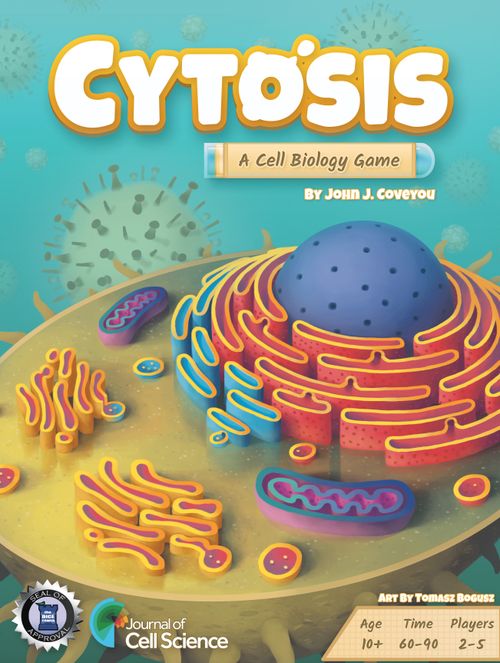
Cytosis: A Cell Biology Board Game
Cytosis: A Cell Biology Board Game Rulebook
Table of Contents
Table of Contents
Components
Components - Base Game
43 Cell Component Cards
- 10 Enzyme Cards
- 6 Protein Hormone Cards
- 6 Steroid Hormone Cards
- 5 Steroid Hormone Receptor Cards
- 5 Protein Hormone Receptor Cards
- 4 Additional Resource Cards
- 7 Detoxification Cards
5 Goal Cards
12 Event Cards
1 First Player Marker
Player Pieces
- 20 Flasks (4 of each in 5 different colors)
- 10 Transport Vesicle Disks (2 of each in 5 different colors)
- 15 Player Markers (3 of each in 5 different colors)
2 Grey Flasks
30 ATP Tokens
66 Macromolecule Resources
- 18 mRNA Resources (Black)
- 18 Protein Resources (Red)
- 15 Carbohydrate Resources (Green)
- 15 Lipid Resources (Yellow)
7 Epigenetic Modification Cards
1 Game Board (double-sided)
Components - Virus Expansion
6 Cell Component Cards
- 2 Ebola Virus Attack
- 2 Influenza Virus Attack
- 2 Rhinovirus Virus Attack
2 Goal Cards
3 Event Cards
5 Player Mats
5 Antibody Dice
15 Antibody Markers (Tan)
Game Setup
If you're playing the Base Game, remove all the components from the Virus Expansion and the 7 Epigenetic Modification Cards and place them back into the box. You won't use these components.
-
From the Event Cards, remove the 3 Virus Event Cards.
-
From the Cell Component Cards, remove the 6 Virus Attack Cards.
-
From the Goal Cards, remove the two Virus Expansion Goal Cards ("Virus Attack" and "Immune Response").
-
Remove the 5 Antibody Dice, 15 Antibody Markers and 5 Player Mats.
-
Remove the 7 Epigenetic Modification Cards.
-
Place the board in the center of the play area with the Base Game side of the board face up. Then, separate the macromolecule resources into like colors, placing them in piles near the board. Now, place the ATP Tokens in a pile near the board. These macromolecule resources and ATP Token piles make up the general resource stock. Place the 2 Grey Flasks on the Grey Flask area of the board.
-
Separate the three types of cards: Event Cards, Goal Cards, and Cell Component Cards. Shuffle the 12 Event Cards. If playing a 2 or 3 player game, randomly remove 2 Event Cards and place them back into the box. If playing a 4 player game, randomly remove 1 Event Card, and if playing a 5 player game remove none. Now, place the remaining Event Cards face down as a deck near the game board.
-
Shuffle the Goal Cards and place a number of them face up above the game board, equal to the number of players plus 1 (Exception: In a 5 player game without the Virus Expansion, use all five Goal Cards.) Place any unused Goal Cards back into the box.
-
Shuffle the Cell Component Cards and flip four of these cards face up into the four available spots of the Cell Component Card Area of the board.
-
Deal each player three Cell Component Cards. Each player should secretly choose two of the three to keep and shuffle the one unchosen Cell Component Card in with the remaining Cell Component Cards. Place the remaining Cell Component Cards face down as a deck to the right of the Cell Component Cards Area just off the board.
| Player count | Flasks | Transport Vesicle Disks | Markers |
|---|---|---|---|
| 2 or 3 player game | 4 Flasks | 2 Transport Vesicle Disks | 3 Markers (1 Health Marker, 2 Goal Markers) |
| 4 player game | 3 Flasks | 2 Transport Vesicle Disks | 3 Markers (1 Health Marker, 2 Goal Markers) |
| 5 player game | 2 Flasks | 2 Transport Vesicle Disks | 3 Markers (1 Health Marker, 2 Goal Markers) |
- Each player should place one of their Markers on the number 0 on the Health Track (the numeric track surrounding the game board). This is a player's Health Marker, which tracks that player's score along the Health Track.
- Whoever was sick most recently receives the First Player Marker and 2 ATP. The player to their left receives 3 ATP, the next player 4 ATP, and so on until all players have ATP. This is each player's starting personal resource stock.
- Each player chooses 2 additional resources (any combination of ATP, mRNA or Lipids) to add to their personal resource stock.
You are now ready to play!
Here's what setup for a 3 player game looks like
Gameplay
Game Summary
Cytosis is played in rounds and each round is divided into two phases. During Phase 1, players will place their flasks in order to collect resources and take actions with the goal of completing Cell Component Cards and thus scoring Health Points. Once all players have placed all their flasks, Phase 1 is over and Phase 2 begins. During Phase 2, an Event Card will be revealed and the board will be refreshed.
This process continues until the last Event Card is revealed, after which one more round is played and then players will add up their final number of Health Points.
Phase 1: Flask Placement
Every round, the player holding the First Player Marker will be the first player to take their turn, then play continues clockwise.
On their turn, a player must place exactly one of their flasks on any available spot on the board and then must also immediately collect the resources or take the action associated with that spot. Then, the player to their left (i.e. clockwise) now takes their turn. This flask placement process continues clockwise with each player placing flasks in this fashion, one at a time, until all players have placed all of their flasks.
Instead of placing a flask, a player may choose to collect a single mRNA, Lipid, or ATP, exhausting one of their flasks. Any exhausted flasks may not be placed again that round.
Only one flask may be placed on each spot. If a spot is occupied, it is not available again during that round.
There are four main types of flask placement spots in the base game:
- Collecting Resources (to add to your personal resource stock),
- Purchasing Cell Component Cards (to add to your hand),
- Completing Cell Component Cards (these cards are completed over multiple turns),
- Taking the First Player Marker (and Placing a Goal Marker or Taking 1 ATP)
Phase 2: Event Card Revealed and Board Refreshed
- All players should retrieve the flasks they placed during Phase 1 and return the Grey Flasks to the Grey Flask Area of the game board. (Transport Vesicle Disks and any resources on them should stay on the board.)
- Now, reveal the top Event Card from the Event deck and follow the instructions on that card. This new Event Card is the only active Event Card. Any Event Cards from previous rounds become inactive.
- Remove the left-most Cell Component Card from the Cell Component Card Area and place it in the Cell Component Card discard pile. Now, without changing the order of the cards, slide any remaining face up Cell Component Cards to the left-most open space(s). Then fill any newly opened spots with Cell Component Cards from the top of the Cell Component Card deck.
If there are no cards remaining in the Cell Component Card deck, shuffle the Cell Component Card discard pile and place it face down as the Cell Component Card deck.
Ending the Game
Revealing the last Event Card marks the last round of the game. Play through Phase 1 one last time and instead of going through Phase 2, skip directly to Scoring.
Flask Placement Spots
The game board contains a number of spots on which players can place their flasks.
Collecting Resources (to add to your personal resource stock)
All placement spots with numbers in them allow players to collect resources in some way from the general resource stock. The number in each spot indicates how many resources they collect. Players should add these resources to their personal resource stock.
Nucleus (DNA Transcription) If a player places a flask on the spot marked with a 3, they receive 3 black mRNA resources. If a player places on the spot marked with a 2, they receive 2 black mRNA resources.
Free Ribosome (mRNA Translation) If a player places a flask on the mRNA Translation spot, they may trade any number of black mRNA resources from their personal resource stock for the same number of red Protein resources.
Smooth ER (Lipid Synthesis) If a player places a flask on the spot marked with a 3, they receive 3 yellow Lipid resources. If a player places on the spot marked with a 2, they receive 2 yellow Lipid resources.
Plasma Membrane (Glucose Transporter) If a player places a flask on the spot marked with a 2, they pay 2 ATP from their personal resource stock and receive 2 green Carbohydrate resources. If a player places on the spot marked with a 1, they pay 1 ATP from their personal resource stock and receive 1 green Carbohydrate resource.
Mitochondria (ATP Production) If a player places a flask on either of the spots marked with a 2 or 3, they receive 2 or 3 ATP Tokens respectively. If a player places on the bottom-most spot, they must pay 1 green Carbohydrate resource from their personal resource stock, and receive 6 ATP. (If 6 ATP are not available, they may take less than 6 ATP.)
Extra resources added by Event Cards If an Event Card adds a resource of any type to a location on the board, that resource is awarded to the first player to place on any spot within that location on the board at no additional cost. (See Event Cards for more details.)
Purchasing Cell Component Cards (to add to your hand)
If a player places a flask on any of the spots within the Cell Component Card area, they should pay the ATP cost (indicated to the right of their flask) and select the card just below their flask, placing that card into their hand.
Completing Cell Component Cards
These cards are completed over multiple turns. A player must have at least the number of macromolecule resources required by the Cell Component Card they are completing on their Transport Vesicle Disk, but may have more.
Smooth ER If a player places a flask on the lower portion of the Smooth ER (Alcohol Detoxification or Steroid Hormone Synthesis) they must do one of two things:
- Option 1: Alcohol Detoxification. If a player places a flask to complete an Alcohol Detoxification Card, they must pay the amount of ATP shown on the card and then immediately gain 1 Health Point.
- Option 2: Steroid Hormone Synthesis. The process of completing Steroid Hormone Cards starts by placing a flask in the Steroid Hormone Synthesis area of the Smooth ER. If a player places a flask in this spot, they must:
- Place one of their Transport Vesicle Disks on any one of the available Budding Transport Vesicle Locations (yellow rimmed circles) in the Smooth ER.
- Place a number of Lipid resources (just Lipid resources — Carbohydrate resources must be placed on their Transport Vesicle Disk in the Golgi Apparatus) from their personal resource stock onto that Transport Vesicle Disk according to the quantity required by the Steroid Hormone Card that player is trying to complete.
Rough ER (Protein Hormone Synthesis / Receptor Synthesis) The process of completing a Protein Hormone, Protein Hormone Receptor, or Steroid Hormone Receptor Card starts by first placing a flask in the Rough ER. If a player places a flask on any of the spots within the Rough ER they must:
- Place one of their Transport Vesicle Disks on any one of the available Budding Transport Vesicle Locations (yellow rimmed circles) in the Rough ER.
- Trade the number of mRNA resources from their personal resource stock (according to the Cell Component Card they are trying to complete) for the same number of Protein resources from the general resource stock. Then, place those Protein resources onto the Transport Vesicle Disk placed in Step 1.
Note: You must start with mRNA resources in the Rough ER. You may not place Protein resources from your personal resource stock here.
Golgi Apparatus The Golgi Apparatus is the second step in completing a Protein Hormone, Steroid Hormone, Protein Hormone Receptor, or Steroid Hormone Receptor Card. If a player places a flask on either of the spots within the Golgi Apparatus, they must:
- Move one of their Transport Vesicle Disks (and all resources on it) from either the Smooth ER or the Rough ER, onto an available Budding Transport Vesicle Location in the Golgi Apparatus.
- Place one Carbohydrate resource or one Lipid resource from their personal resource stock onto that Transport Vesicle Disk, according to the Cell Component Card they are trying to complete. (This spot does NOT allow a player to trade a Carbohydrate resource for a Lipid resource or vice versa.)
Note: If the active player places a flask on a spot in the Smooth ER, Rough ER, or Golgi Apparatus, and no Budding Transport Vesicle Locations for that area are available, that player chooses one Transport Vesicle Disk (and all resources on it) to remove from the board and return to the player who owns it. The active player must now place (or move) their Transport Vesicle Disk and appropriate resources onto the newly opened Transport Vesicle Location.
Plasma Membrane (Exocytosis) The exocytosis of the Plasma Membrane is the final step in completing a Protein Hormone, Steroid Hormone, Protein Hormone Receptor, or Steroid Hormone Receptor Card. If a player places a flask on any of the spots within the Plasma Membrane labeled Exocytosis, they must:
- Reveal the Cell Component Card they are completing.
- Move one of their Transport Vesicle Disks from the Golgi Apparatus, through the Plasma Membrane, and out of the cell.
- Immediately pay the ATP cost indicated on that Cell Component Card.
- Place all the macromolecule resources from the Transport Vesicle Disk back into the general resource stock. The Transport Vesicle Disk goes back to the player who owns it.
- Gain Health Points according to the number indicated on the Cell Component Card just completed.
Cytoplasm (Enzyme Synthesis) The Cytoplasm is the final step in completing an Enzyme Card (once a player has Protein resources from the Free Ribosome). If a player places a flask on the spot within the Cytoplasm labeled Enzyme Synthesis, they must:
- Reveal the Enzyme Card they are completing.
- Immediately pay the ATP cost indicated on that Enzyme Card.
- Pay a number of Protein resources (and a Carbohydrate resource if required) from their personal resource stock, as indicated on that Enzyme Card.
- Gain Health Points according to the number indicated on the Enzyme Card just completed.
Taking the First Player Marker (and placing a Goal Marker or taking 1 ATP)
Laureates in Biology If a player places a flask on the spot in the Laureates in Biology area, they must take the First Player Marker (and keep it for all subsequent rounds until the First Player Marker is claimed by another player) and they may choose to do one of the following:
- Take 1 ATP and add it to their personal resource stock, or
- Place one of their two Goal Markers on one of the available Goal Cards above the game board. (Once a Goal Marker has been placed, it may never be moved.)
The first Goal Marker placed on each Goal Card immediately awards that player 3 Health Points. (See Goal Cards for details.)
Cell Component Cards
There are five types of Cell Component Cards in the base game: Hormone Cards, Hormone Receptor Cards, Enzyme Cards, Alcohol Detoxification Cards, and Additional Resource Cards.
With the exception of the Additional Resource Cards, which simply give players additional resources, each card indicates the placement spot to begin that card, the resource cost (macromolecule resources and ATP) needed to complete that card, and the number of Health Points it will immediately score once it is completed.
The Hormone Receptor Cards may score a player additional points throughout the game (see Hormone Receptor Cards for details), while Enzyme Cards or Alcohol Detoxification Cards may score a player additional End Game points (see Enzyme Cards and Alcohol Detoxification Cards for details). A quick reference for these additional points is shown at the bottom of each card.
Cards in a player's hand are kept secret from other players until completed, while completed cards should be kept face up in front of the player who completed them. Completed cards are useful in tracking End Game points.
Hormone Cards
There are two different types of Hormone Cards: Protein Hormones (red background) and Steroid Hormones (blue background).
Hormone Cards (as with most cards) are completed over a series of turns by placing flasks in the required spots: first in the ER (either the Smooth ER or the Rough ER), then in the Golgi Apparatus, and finally in the Plasma Membrane (Exocytosis).
First, a player must place a flask in the ER (Smooth ER for Steroid Hormone Cards, or Rough ER for Protein Hormone Cards), which allows that player to immediately place one of their Transport Vesicle Disks in the ER, along with the required Protein or Lipid resources. Next, a player must place in the Golgi Apparatus, pulling their Transport Vesicle Disk (and all resources on it) from the ER and adding the additional Carbohydrate resource (or Lipid resource, for Steroid Hormone Receptor Cards). Finally, a player must place in the Exocytosis area of the Plasma Membrane and pay the ATP cost. That player then gains the number of Health Points shown on the card just completed.
All macromolecule resources shown on a Hormone Card must have been placed on a Transport Vesicle Disk in the process just outlined to complete a Hormone Card.
A detailed example of how to complete a Protein Hormone Card
This example assumes the player has already collected mRNA resources previous to their first placement, a Carbohydrate resource previous to their second placement, and enough ATP previous to their third and last placement.
For the first flask placement, place a flask in the Rough ER, and do all of the following:
- Place your Transport Vesicle Disk on one of the available Budding Transport Vesicle Locations.
- Trade two mRNA resources from your personal resource stock for two Protein resources to match the quantity required by the Protein Hormone Card you are trying to complete.
- Place those Protein resources onto that Transport Vesicle Disk.
For the second flask placement, place a flask in the Golgi Apparatus, and do all of the following:
- Move your Transport Vesicle Disk (and all resources on it) from the Rough ER into an available Budding Transport Vesicle Location in the Golgi Apparatus.
- Place one Carbohydrate resource from your personal resource stock onto that Transport Vesicle Disk.
For the third flask placement, place a flask in the Exocytosis area of the Plasma Membrane, and do all of the following:
- Reveal the Protein Hormone Card you are completing.
- Move your Transport Vesicle Disk (and all resources on it) from the Golgi Apparatus, through the Plasma Membrane, and out of the cell.
- Immediately pay the 2 ATP indicated on that Protein Hormone Card.
- Place the macromolecule resources from that Transport Vesicle Disk back into the general resource stock. The Transport Vesicle Disk goes back to you! Gain the 7 Health Points shown on the Protein Hormone Card you've just completed.
Hormone Receptor Cards
There are two different types of Hormone Receptor Cards: Steroid Hormone Receptor Cards and Protein Hormone Receptor Cards. Both types of Hormone Receptor Cards are completed in the exact same way as the Hormone Cards, with two exceptions. First, BOTH Hormone Receptor Cards begin in the Rough ER. Second, Steroid Hormone Receptor Cards will receive a Lipid resource (rather than a Carbohydrate resource) in the Golgi Apparatus.
The major benefit of Hormone Receptor Cards is that players who have completed them will score Health Points when opposing players complete Hormone Cards. Any time an opposing player completes a Protein Hormone Card, all players with a completed Protein Hormone Receptor Card will gain 2 Health Points for each Protein Hormone Receptor Card they've completed. And any time an opposing player completes a Steroid Hormone Card, all players with a completed Steroid Hormone Receptor Card will gain 2 Health Points for each Steroid Hormone Receptor Card they've completed.
For example, if a player has two completed Steroid Hormone Receptor Cards, they will move up 4 Health Points each time an opposing player completes a Steroid Hormone Card. In the same way, if a player has three completed Steroid Hormone Receptor Cards, they will move up 6 Health Points each time an opposing player completes a Steroid Hormone Card.
Also, any time a player personally completes a Protein Hormone Card, they will score 1 additional Health Point for each Protein Hormone Receptor Card they have already completed. Likewise, any time a player personally completes a Steroid Hormone Card, they will score 1 additional Health Point for each Steroid Hormone Receptor Card they have already completed.
Enzyme Cards
Enzyme Cards do NOT require the use of a Transport Vesicle Disk. Rather, they are completed by first placing a flask in the Free Ribosome spot to trade black mRNA resources for red Protein resources, and then by placing a flask in the Cytoplasm spot. A player will then reveal the Enzyme Card they are completing, pay the required Protein resources (and Carbohydrate resource if required by that Enzyme Card) from their personal resource stock, pay the ATP indicated on that Enzyme Card, and then gain the Health Points shown on that completed Enzyme Card.
Completed Enzyme Cards should be overlapped and flared so all other players can see them. Sets of Enzyme Cards will score additional points at the end of the game, as shown on the bottom of each Enzyme Card (see Scoring for details).
Alcohol Detoxification Cards
Alcohol Detoxification Cards are completed by placing a flask in the Alcohol Detoxification spot (within the Smooth ER) and paying the ATP cost indicated on that card. After completing an Alcohol Detoxification Card, a player will gain 1 Health Point.
At the end of the game, the players with the most Alcohol Detox will gain additional points (see End Game Points from Alcohol Detoxification Cards for more details).
Additional Resource Cards
Additional Resource Cards may be kept in a player's hand and played at any time during a player's turn. Once the card is played, that player should immediately take the number of resources shown on the card and place that card in the Cell Component Card discard pile.
Goal Cards
After a player places a flask on the Laureates in Biology spot, they may choose to place a single Goal Marker on any available Goal Card. Once a Goal Marker has been placed, it may never be moved, and a player may never place both of their Goal Markers on the same Goal Card. A maximum of two Goal Markers may be placed on each Goal Card.
Goal Cards may score a player points in two ways:
- During the game: The first Goal Marker placed on each Goal Card immediately awards that player 3 Health Points. (The second Goal Marker placed on a Goal Card receives no immediate Health Points.)
- During End Game Scoring: If a player has placed a Goal Marker on a Goal Card, and that player has completed any number of the Cell Component Cards indicated on that Goal Card, they will score End Game points according to the description on that Goal Card.
Event Cards
The purpose of the Event Cards is to change up the game each round. During Phase 2 of each round, 1 Event Card will be flipped face up and will affect the game in some way.
There are three types of Event Cards in the base game (a fourth type is added with the Virus Expansion): Boost, Reduce ATP Cost, and Toxicity.
Boost A Boost Event Card adds 1 resource to a specific area of the board. That resource is awarded for free to the first player to place on any spot within that location, in addition to the resources that spot usually awards. Any resources added to a specific area of the board remain in that area until awarded.
Reduce ATP Cost A Reduce ATP Cost Event Card reduces the cost of each Cell Component Card purchased that round by 1 ATP. If a player places on the Free spot when this Event Card is active, they may also take 1 ATP from the general resource stock.
Toxicity A Toxicity Event Card forces players to return macromolecule resources from their personal resource stock to the general resource stock. If any player has 5 or more of any certain macromolecule, they lose 1. If they have 7 or more, they lose 2. If they have 10 or more, they lose 4.
Grey Flasks
Before a player places their flask during their turn, they may pay 4 ATP to place a Grey Flask first. (This is in addition to their normal flask placement.) After paying 4 ATP, a player may take an available Grey Flask from the Grey Flask Area of the board and place that Grey Flask in any flask placement spot (available or unavailable), and then take the action associated with that spot.
Restrictions: A player may pay to place only one Grey Flask per turn and must be able to take the action associated with that spot. Only Grey Flasks in the Grey Flask area are available for this action.
Scoring
At the end of the game, players will score additional End Game points for macromolecule resources still in their personal resource stock, Alcohol Detoxification Cards completed, Enzyme Cards completed, as well as any Goal Cards on which they've placed any of their Goal Markers during the game. Players should move their Health Marker along the Health Track for all End Game points earned.
End Game Points from Macromolecule Resources
Before scoring macromolecule resources, a player may collect all macromolecule resources remaining on any of their Transport Vesicle Disks still on the board, and add these to their personal resource stock.
Macromolecule resources (Protein, Lipid, mRNA, and Carbohydrate) in a player's personal resource stock earn that player 1 point for every 4 mRNA or 4 Lipids, 1 point for every 3 Proteins, and 1 point for every 2 Carbohydrates.
End Game Points from Alcohol Detoxification Cards
The player with the most Alcohol Detox gains an additional 8 Health Points, the player with the second most gains an additional 5 Health Points, and the player with the third most gains an additional 2 Health Points. The most Alcohol Detox is determined by adding together the number of ATP on all of the Alcohol Detoxification Cards completed by that player (Alcohol Detoxification Cards still in a player's hand do not add to this total). If a player has completed no Alcohol Detoxification Cards, they automatically score no points for Alcohol Detoxification Cards.
For example, a player who built three separate Alcohol Detoxification Cards requiring 2 ATP would have an equal amount of Alcohol Detox as the player who built two Alcohol Detoxification Cards both requiring 3 ATP. However, in case of a tie, the tying player with the most completed Alcohol Detoxification Cards wins.
If there is still a tie, tying players should add the points allotted to the position of those two tying players and the position directly below it, and divide those points equally between them, rounding down to the nearest whole number. In case of a three-way tie, add the position of those tying players and all positions below it, and divide those points equally among the tying players, again rounding down. (For example: two players tied for 2nd — current position (5) + position below (2) = 7, divided by 2 players = 3 points each.)
In a 2 player game, the player with the most Alcohol Detox will gain 6 Health Points, and the player with the second most Alcohol Detox will gain 3 Health Points.
End Game Points from Enzyme Sets
Sets consist of Enzyme Cards of different colors. Any sets of Enzyme Cards a player has completed during the game earn End Game points according to the table below:
| Number of Unique Enzymes Completed | Health Points Earned |
|---|---|
| 2 | 2 |
| 3 | 5 |
| 4 | 9 |
| 5 | 14 |
Two Enzyme Cards of the same color may not belong to the same set, however a player may score points for two sets.
End Game Points from Goal Cards
If a player has placed a Goal Marker on a Goal Card, and that player has completed any number of the Cell Component Cards indicated on that Goal Card, they will score End Game points according to the description on that Goal Card. Each player should reference the Goal Card(s) on which they have placed their Goal Marker(s) for details on points scored.
Final Scoring
Whoever has the most total Health Points wins the game!
If there is a tie, the player with the most completed Cell Component Cards wins (only Alcohol Detoxification Cards, Enzyme Cards, Hormone Cards, and Hormone Receptor Cards count). If there is still a tie, the tying player in the last position from the player holding the First Player Marker wins the tie.
2 Player Rules Modifications
Game Setup Differences for 2 Players
- Remove 3 Alcohol Detoxification Cards at random from the Cell Component Card deck, before dealing 3 to each player or filling the Cell Component Card Area with cards.
- Remove 2 Event Cards at random from the Event Deck before placing it near the game board.
Gameplay Differences for 2 Players
1 flask in each placement spot In a 2 player game, a maximum of 1 flask is allowed in each placement area on the board, each round. Each area has a distinct border, e.g. the Nucleus, Rough ER, and Mitochondria are different areas.
There are three exceptions to this: the Mitochondria, the Smooth ER, and the Cell Component Card area.
- In the Cell Component Card Area, all four spots may be occupied, just like in a 3-5 player game. Thus, there is no difference in the way the Cell Component Card Area functions.
- In the Mitochondria, two spots (any two out of the three total) may be occupied.
- In the Smooth ER, two spots may be occupied — a maximum of one in the Lipid Synthesis location and one in Alcohol Detoxification/Steroid Hormone Synthesis.
For example, if one flask has been placed in the [3] spot of the Nucleus, a second flask may not be placed in the [2] spot of the Nucleus that round, because they are both in the same Nucleus area. Or, if a flask has been placed in the Rough ER, Golgi Apparatus, or either of the Plasma Membrane areas, a second flask may not be placed in either of those areas that round.
Note: A player may still purchase and place a Grey Flask in ANY occupied or unoccupied spot, even if another flask has already been placed in that placement area or placement spot.
Remove the 2 cheapest Cell Component Cards In Step 3 of Phase 2, instead of discarding the cheapest Cell Component Card from the Cell Component Card Area, discard the two cheapest cards.
Scoring Differences for 2 Players
End Game Points from Alcohol Detox Cards In a 2 player game, the player with the most Alcohol Detox will gain 6 Health Points, and the player with the second most Alcohol Detox will gain 3 Health Points.
Virus Expansion
Virus Expansion Rules — for 2 to 5 players
Game Setup — Modifications to the Base Game
Incorporate the following steps into the Base Game setup:
- Board: In Step 1 of Base Game Setup, place the board with the Virus Expansion side face up.
- Event Deck: In Step 2 of Base Game Setup, shuffle the 12 Event Cards like normal, but if playing a 2 or 3 player game randomly remove 5 Event Cards, if playing a 4 player game remove 3 Event Cards, and if playing a 5 player game remove 1 Event Card. Return these removed Event Cards to the box without looking at them. Then, shuffle the 3 Virus Event Cards into the remaining Event Deck and continue setup as usual.
- Goal Cards: In Step 3 of Base Game Setup, shuffle the 1 Immune Response and the 1 Virus Attack Goal Cards in with the other five Goal Cards from the Base Game. Then continue setup by placing a number of these Goal Cards face up above the game board, equal to the number of players plus 1. In a 2 or 3 player game, both Virus Expansion Goal Cards should not be used. If both Virus Expansion Goal Cards come up, replace one at random with a different Goal Card.
- Cell Component Deck: In Step 5 of Base Game Setup, after you have dealt each player 3 Cell Component Cards, shuffle the 6 Virus Attack Cards in with the Cell Component Card deck. Continue setup as usual.
Now, perform these two additional steps:
- Expansion Step 1: Give each player one Player Mat and 3 Antibody Markers (tan resources). Each player should place one of these Antibody Markers on each of the three spots marked "0" on the bottom of each of their virus strain columns (Ebola, Influenza, and Rhinovirus). In a 2 player game, set up one additional Player Mat (according to Expansion Step 1) near the game board to act as a third "dummy" player.
- Expansion Step 2: Place the 5 Antibody Dice somewhere near the top of the game board.
Event Cards
There are three different Event Cards in the Virus Expansion, each representing a different virus strain: Ebola, Influenza, and Rhinovirus. When a Virus Event Card is flipped face up from the Event Deck, it becomes active and players should follow the instructions explained in the When Viruses Attack section.
Goal Cards
There are two different Goal Cards in the Virus Expansion: 1 Immune Response Goal Card and 1 Virus Attack Goal Card. Rules for the Virus Expansion Goal Cards are the same as for the Base Game Goal Cards.
Cell Component Cards
There are six Virus Attack Cell Component Cards: 2 Ebola, 2 Influenza, and 2 Rhinovirus Virus Strain Cards. When a player purchases a Virus Attack Card from the Cell Component Card Area, that card immediately takes effect and players should follow the instructions explained in the When Viruses Attack section.
Player Mats
Each Player Mat features two main sections: the Immune Response Area and the Resource Area.
- Immune Response Area: This section has three columns marked at the bottom with Ebola, Influenza, or Rhinovirus. The position of a player's Antibody Marker within a column indicates the number of antibodies that player has built up to combat a virus of that strain's type. (See When Viruses Attack for details.)
- Resource Area: This section has areas indicating where a player may store their Flasks and Goal Markers not in use, and their personal resource stock (macromolecule resources and ATP).
When Viruses Attack
When a Virus Event Card is flipped face up from the Event Deck, or when a Virus Attack Card is purchased from the Cell Component Card Area, that Virus Card becomes active immediately and all players should pause and follow the steps below.
When a Virus Event Card is flipped during the Event Phase:
- All players roll a number of Antibody Dice according to their current position on the Health Track. If their Health Marker is in the red section, they will roll 1 die. If their Health Marker is in the yellow section, they will roll 2 dice. If their Health Marker is in the green section, they will roll 3 dice.
- To their roll, each player adds the number of antibodies from the column of their Player Mat that matches the attacking virus strain. This sum is each player's Antibody Response.
- All players compare their Antibody Response and gain or lose resources accordingly. (See Antibody Response Resource Allocation.)
- After all players have completed Steps 1-3, each player will have the option to pay ATP from their personal resource stock to gain antibody matching the attacking virus strain, starting with the player holding the First Player Marker and moving in player order. For each ATP paid, a player moves their Antibody Marker up that strain's column by 2 antibodies.
In a 2 player game, the third "dummy" player rolls a number of Antibody Dice according to the current position of the player lowest on the Health Track, and adds the number of antibodies from the column of their Player Mat just like all other players. After all players have added up their Antibody Response, reference the Antibody Response Resource Allocation chart for 2-3 players. Any resources gained or lost by the "dummy" player remain in the general resource stock. After all players have completed Step 4, move the Antibody Marker on the "dummy" Player Mat up one level (2 antibodies) on the column that matches the attacking virus strain.
When a Virus Attack Card is purchased from the Cell Component Card Area:
- Only the player who purchased the Virus Attack Card may pay additional ATP to move their Antibody Marker up the column matching that attacking virus strain (at a rate of 1 ATP per 2 antibody).
- All other players must lose 1 Health Point on the Health Track. (Players can go negative on the Health Track.)
- Now follow Steps 1-4 of "When a Virus Event Card is Flipped During the Event Phase" to determine how many resources a player will gain or lose.
Antibody Response Resource Allocation
A player gaining resources may choose any combination of ATP, mRNA, and Lipids from the general resource stock. A player losing a resource may choose to lose any resource from their personal resource stock or lose 1 Health Point.
In a 2-3 player game:
| Antibody Response Rank | Result |
|---|---|
| Highest | Gain 3 resources |
| Second Highest | Gain 1 resource |
| Lowest | Lose 1 resource or 1 Health Point |
In a 4 player game:
| Antibody Response Rank | Result |
|---|---|
| Highest | Gain 3 resources |
| Second Highest | Gain 2 resources |
| Third Highest | Gain 1 resource |
| Lowest | Lose 1 resource or 1 Health Point |
In a 5 player game:
| Antibody Response Rank | Result |
|---|---|
| Highest | Gain 4 resources |
| Second Highest | Gain 3 resources |
| Third Highest | Gain 2 resources |
| Fourth Highest | Gain 1 resource |
| Lowest | Lose 0 resources |
If there is a tie for Antibody Response, the first player, or the player closest to the First Player, wins the tie. In a 2 player game, if a player ties with the "dummy" player, the "dummy" player wins.
Example: Player 1 purchases a Virus Attack Card (Influenza Strain) from the Cell Component Card Area, then decides to pay 2 additional ATP to move his Antibody Marker up 4 on the Influenza column of his Player Mat. All other players lose 1 Health Point on the Health Track. Each player now rolls a number of Antibody Dice according to their current position on the Health Track. Player 1 currently has 14 Health Points, and is thus in the yellow section of the Health Track, so he rolls 2 Antibody Dice. He rolls a 4 and 3 on his Antibody Dice, and simply adds the 4 from his Influenza antibodies on his Player Mat, giving him an Antibody Response of 11. Player 2's Antibody Response is 12, and Player 3's Antibody Response is 9. Player 2 has the highest Antibody Response, so she gains 3 resources from the general resource stock. Player 1 has the second highest Antibody Response, so he gains 1 resource. Player 3 has the lowest Antibody Response, so she loses 1 resource from her personal resource stock. Now all players have the option to pay ATP from their personal resource stock to gain antibody on the Influenza column of their Player Mat. Player 1 and Player 2 decide not to pay any ATP. Player 3 decides to pay 2 ATP to move up 4 more antibody on her Influenza column.
Epigenetic Modification Cards
Each Epigenetic Modification Card gives a player a unique ability that they may use throughout the game. It is advised not to use the Epigenetic Modification Cards until players have played Cytosis and are already familiar with the game. The Epigenetic Modification Cards may be used with the Base Game of Cytosis or combined with the Virus Expansion.
Game Setup — Modifications to the Base Game
When setting up the Base Game with Epigenetic Modification Cards, determine the First Player before Step 4 (instead of waiting until Step 8). Then, shuffle the seven Epigenetic Modification Cards and deal three to the First Player. That player should secretly read the three cards and choose one of them. Next, that player must replace the chosen card by adding another Epigenetic Modification Card, at random, to the two remaining, then pass these three cards to the player on their left.
This player should secretly choose one of the three, then follow the same process of replacing the chosen card with a new card, and passing to the player on their left, until all players have chosen one Epigenetic Modification Card. Any remaining Epigenetic Modification Cards should be placed back in the box.
Players should now place their chosen Epigenetic Modification Card face up in front of them for all players to see. Game setup now continues as usual with Step 4 of Base Game Setup.
Card Abilities
Each player will keep their chosen Epigenetic Modification Card for the entire game. A player may only use their unique ability on their turn, unless their Epigenetic Modification Card indicates otherwise. The seven abilities are:
- The player holding this card may trade ATP for Lipids or mRNA at a rate of 1 ATP for 1 Lipid or 1 mRNA, and trade ATP for Carbohydrates at a rate of 2 ATP per 1 Carbohydrate. This card does NOT allow a player to trade macromolecules for ATP. This ability may be used as many times per turn as a player wishes, provided they have the ATP to trade.
- The player holding this card may pay 2 ATP to secretly look at the top 3 Cell Component Cards from the deck. In addition, they MAY pay 2 more ATP in order to place one of these cards in their hand. This player must then place the unchosen cards back on top of the Cell Component Card deck in any order they choose. This ability may be performed only ONCE per turn. Note: If playing with the Virus Expansion and a Virus Attack Card is chosen, the chosen Virus Attack Card must be played immediately, following the Virus Expansion rules.
- The player holding this card may collect 1 additional macromolecule or ATP every time they place on a numbered resource collection spot on the board. For example, if a player places on a [3] spot, they may collect 4 of that resource, and if a player places on a [2] spot, they may collect 3 of that resource. (Carbohydrates still cost 1 ATP for each Carbohydrate taken.)
- The player holding this card may pay 3 ATP to place a Grey Flask, rather than paying the usual 4 ATP. Rules for placing the Grey Flask are the same as in the Base Game.
- Before the First Player places their first flask at the beginning of a round, the player holding this card should be given the choice to pay 1 ATP in order to place one of their flasks before the First Player places their first flask. Normal placement order then resumes, starting with the player holding the First Player Marker. This ability may be used only once per round. For example, if the player with this Epigenetic Modification Card is currently the First Player, they may pay 1 ATP to place their first flask, and then take their normal placement as first player (by placing a second flask) before the second player places their first flask.
- At the beginning of every round, the player holding this card may collect 1 ATP, 1 mRNA, or 1 Lipid from the general resource stock and place this resource into their personal resource stock.
- The player holding this card purchases their Cell Component Card for free every time they place a flask in the Cell Component Card Area.