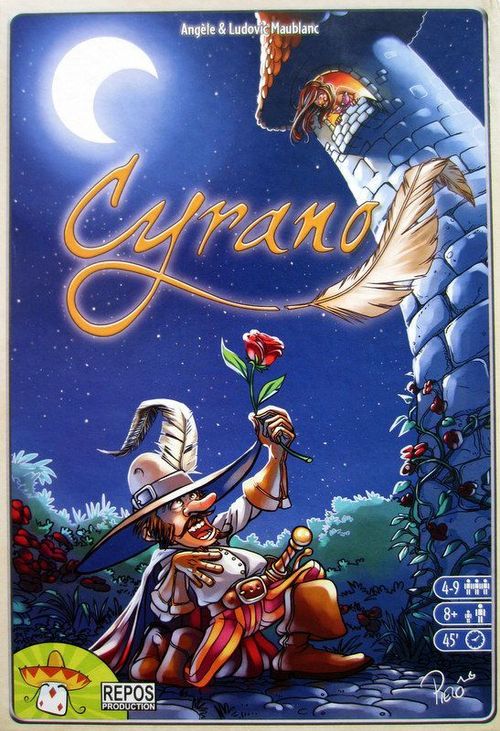
Cyrano
Cyrano Rulebook
Table of Contents
Table of Contents
Contents
- 1 notepad
- 81 vote cards (9 sets of 9 Symbol cards)
- 9 Symbol counters + 9 bases
- 9 pencils
- 55 multilingual Rhymes & Theme cards
- 1 rulebook
- 1 Card tower
Game Setup
- Each player takes a Symbol counter, which is placed in front of him/her, visible to all other players.
- Each player gets a deck of cards containing the symbols of every player, his/her own included. If there are less than 9 players, remove the cards of the unused symbol(s).
- The 55 Rhyme & Theme cards are shuffled and placed in a pile, face down, at the center of the table, near the card tower.
- Each player gets a sheet from the notepad and a pencil. On the left side of the sheet, the player will be able to compose his/her love poems. The right side of the sheet represents the tower at the bottom of which the would-be lover stands.
Each player gets:
- one sheet from the notepad
- one pencil
- one Symbol counter on its base
- one set of 9 cards with the symbols of each player (including his/her own)
When playing with less than 9 players, remove the unused symbols.
The Game
The game takes place over several rounds. In each round, the players will compose a quatrain (a poem with four lines). Depending on its originality and beauty, the players will be able to mark squares in their tower and thus allow the lovers to draw nearer to one another.
Game Round
Phase 1: Writing the Poems
The first player (determined however the players want for the first round) flips over the first card in the draw pile, inserts it in the card tower (from top to bottom) and announces the theme.
The first player then flips over the two following cards, inserts them in the tower and announces the two rhymes which must be used during the current round. (The first player puts the first 3 cards of the draw pile into the card tower, making sure to put the side corresponding to his/her language visible. You'll get 1 theme and 2 rhymes this way.)
The players can now start to write their poems while following the required theme and two rhymes. Two of the lines must end with one of the rhymes chosen and the other two with the other rhyme. The important thing when choosing words is to respect the phonetics (the way the rhyme sounds), as the spelling can be different.
Example: for the "-aid" rhyme, words "lemonade" and "maid" are correct.
There are no other constraints (the placement of the rhymes as well as the number of syllables in the lines do not matter). It is both useful and a good idea to title your poem.
The "example" words on the cards can be used by players when they can't find words that rhyme, but these won't be worth any points. (The players simultaneously write their quatrains, a 4 line poem.)
For your first few games, we suggest you wait for everyone to finish their poem… No point in stressing people out – it's just a game! Not to mention it's not always easy to get into poetry like this…
For later games, you can agree that when there are only 2 players left writing their poems, they only get one minute to finish. (Starting with the title, the players recite their respective poems. Each player repeats his/her 4 rhymes to see if he/she is the only player to have used them.)
Phase 2: Originality of the Poems
In turn, starting with the first player, everyone recites their poem, title first. What really matters for this game phase is the last word of each line. Once the poem is finished the player will have to re-read the four words which end his/her lines.
The other players must then tell him/her if they've used identical words to finish their lines.
For each word that he/she is the only player to have used (the "example" words don't count), the player can mark one new square on the ladder on his sheet, starting from the bottom.
Example: If the 4 words at the end of my lines are "Leave", "Cleave", "Beauty" and "Majesty" and only "Majesty" hasn't been used by another player, I'll only be able to mark one square on my ladder… that ought to teach me to be original! (The player scores the number of words he/she is the only one to have used. The would-be lover climbs the ladder.)
Once all the players have recited their poems and possibly marked their squares, the game moves on to the next phase.
When a player marks a ladder square with a ribbon, it means that the player has reached the floor with the corresponding color.
False or incomplete poem: If a player has not been able to finish his/her four lines, that player can still mark squares for any original rhymes found. If a player has made a mistake (a "-ime" rhyme instead of "-ine", for example), then the player does not score for the word, but will be able to score points for any other unique correct rhymes.
Phase 3: Beauty of the Poem
Before voting, the first player reminds everyone of each poem's title in order to refresh everyone's memory.
Then, each player secretly chooses the poem he/she has most appreciated. To do this, the player chooses the card with the symbol of his/her favorite poet for this round. It's okay to vote for yourself! (Each player votes for the poem he/she thinks was the most beautiful. Each player marks a square for every player who has voted like him/her. The belle comes down the tower.)
Advice: Start to sort your cards by discreetly putting aside those corresponding to poems you've liked while they are being read. It'll be easier for you to vote once all the poems have been read.
With this vote, the players will be able to make the woman of angelic beauty come down from her tower.
As soon as everyone has chosen, the players simultaneously reveal the card they've chosen!
Each player can mark one square on his/her tower for every player whose vote matches his/hers! The trick here is to show some good taste by guessing which player will get the most votes! These squares are marked in order from the top of the tower going downwards with each passing turn.
Example: I vote for Angelo as his poem seems the best. The votes are revealed and three other players have made the same choice. I can therefore mark 3 squares on my tower and make the woman come down 3 squares because I have good taste in poetry! (The game is won when the lover and the belle are on the same floor: the ribbon and curtain are the same color.)
End of the Game and Victory
To win the game, the lover must reach the same floor as his belle at the end of a game round.
If no one wins at the end of a round, a new round is played. The player to the left of the first player becomes the new first player.
If the belle arrives on a floor where her future lover is (the squares marked on the ladder and on the stairs have reached the same floor), the player who has managed to make them meet wins the game!
If, by chance, the belle is on a lower floor than the one you reach, she'll climb back up to meet her future lover (she's not a ditz)… isn't love wonderful?
If more than one player manages to make the lovers meet during the same round, the game is a tie… Friendship has a value all its own… even better though?
Example 1: I'm in front of the yellow floor, but my belle is still in the violet floor… I haven't won yet!
Example 2: I'm in front of the yellow floor and so is my belle… I win!
Example 3: I'm in front of the yellow floor, my belle's one floor below me. She comes up to meet me… I win!
In case of a draw, the players check to see who has reached the highest floor. If the draw remains, a rhyming duel takes place.
Rhyming Duel for Those Who Have No Friends!
If, at the end of a round, multiple players have won and no one wants a tie, the players check to see which player has reached the highest floor. If the tie still hasn't been resolved, it must be broken by a Rhyming Duel!
Randomly draw which duellist will get to speak first.
The other players draw a Rhyme & Theme card and announce the imposed rhyme that the duellists will have to use without giving the examples. Thus, there is no imposed theme for a Rhyming Duel.
The first duellist must make a sentence ending with the imposed rhyme. The next duellist in play order must then make a rhyming sentence… and so on.
When a player can't think of a new rhyming word, that player can ask for a new rhyme: The other players will draw a new Rhyme & Theme card and again announce the new rhyme without giving examples. Each player can only ask for one rhyme change during the duel.
If a player who has asked for a rhyme change draws a blank again, all players count down from 5 to 0. If the duellist still hasn't thought of something by the time the other players reach zero, that duellist is eliminated.
The duel ends when there's only one duellist left. That player wins the game!
(One rhyme & theme card is drawn. The rhyme is chosen but the theme is free. The first duellist to speak is drawn randomly and must recite one sentence ending with the chosen rhyme. The next duellist in the playing order then makes a sentence following the same rules. If a duellist draws a blank, he/she is allowed to ask for a different rhyme, but only once per Rhyming Duel. If that duellist ever draws another blank, he/she is eliminated. The duel ends when there's only one player left.)