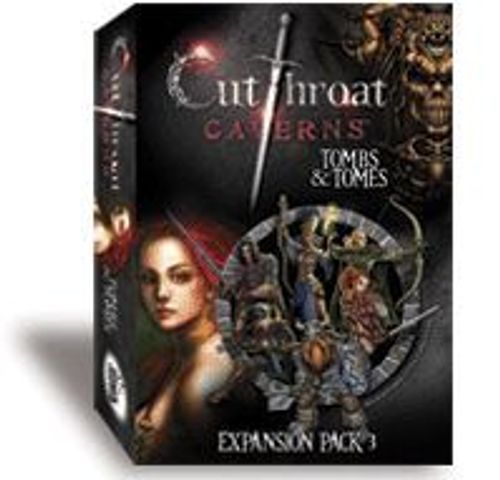
Cutthroat Caverns: Tombs & Tomes
Cutthroat Caverns: Tombs & Tomes Rulebook
Table of Contents
Table of Contents
Game Components
15 Encounter Cards • 15 Event Cards • 10 Relic Cards • 1 Quest Card • 2 Token Sheets
Double Sided ADVENTURE MODULE A1 & A2 - The Lady of Magtherium & Mad God's Maze
This is an Expansion Pack and not a complete game. You will need a copy of Cutthroat Caverns to play.
Cutthroat Caverns: Tombs & Tomes is the third expansion to our critically acclaimed game of dungeon delving and cooperative-backstabbing. In this set, you will find even more challenging Encounters and exciting additions to our expanded set of game mechanics that will greatly enhance the game and extend the replay value exponentially. PLUS - the adventure modules add layers of richness to game play while helping to introduce players to the new creatures. Just don't read them before you are ready to play!
New Rules/Mechanics
The Event Deck
TOMBS & TOMES comes with 25 Event Cards that give a context to each Encounter and makes playing even the most familiar Encounters new again. It may be that the room the Encounter takes place in has a nefarious effect all its own, that a once familiar creature will be enhanced in some unusual way, a side challenge between players has been proposed, or other game enhancing effects. Most will make the Encounters far more challenging or deadly. But as risk goes up, so do the rewards. For other Event cards will open a pathway to unique power items and far greater riches in the form of Relics.
Transcriber note: the printed component list above says 15 Event Cards, while this paragraph and the product line description say 25. Both are reproduced as printed.
Two Types of Event Cards
Event! Event cards change game play conditions during Encounters by adding additional challenges to the creatures you face in battle. They all begin with a character quote that gives flavor to the Event and a set of rules that govern how the Event will play out.
Treasure! These Event cards indicate that treasure has been discovered in the Encounter. In almost all cases, these Relics can only be claimed at the end of an Encounter by meeting the specific conditions of the card. Typically, earning one is a competition all its own.
All Event Cards also have an 'Activation' track located just under the artwork on the card. The circles represent the numbered Encounters you will face during the game, from Encounter #1 to Encounter #10 and higher. This is used in determining if an Event Card will trigger in a given Encounter.
A few have a 'star' in the lower corner. This signifies an Event that, in certain circumstances, could be very deadly indeed. Shuffle them into the deck at your own peril.
Playing with the Event Deck
Shuffle the Event Cards thoroughly, breaking up clumps of Event! and Treasure! Event Cards so they are well blended. Place the Event Deck face down near the Encounter Deck in the center of the table.
During the game, whenever an Encounter Card is revealed to be faced by the party, read the Encounter to the group as you normally would, taking care to note the TYPE of Encounter you face. If the Encounter is creature-based, draw an Event Card and place it face up next to the Encounter card.
NOTE: Event Cards are NOT drawn for Trap, Boon, Challenge or other non-creature / non-combat based Encounters. If you forget and draw one anyway, discard it without effect.
Next, note what number Encounter you face (as shown on the Monster Tracker) and see if that number appears on the Activation track of the Event Card. If it does not, discard the Event without effect. If it does, read the Event aloud to all players and take a moment to understand the implications for the creature you face this Encounter.
Each Event card will specifically state when the effect goes into play, though as a general rule, Events! activate immediately and Treasures! are resolved at the end of an Encounter. You will quickly see how the addition of this mechanic turns even the most familiar Encounters into new and interesting challenges for the group.
Relic Cards
Relic cards confer powerful abilities to their owners, other Relics gain them Prestige and some grant both. Make no mistake, Relics are the very stuff of legend and will open up many new possibilities for players.
Unlike standard 'Items' in the Base Game, which are discovered amid all the Attack and Action Cards of the Draw deck, Relic Cards can only be claimed through use of the Event Deck.
Note: In game terms, 'Relics' are 'Items'. As such, they can be stolen by 'Stab & Grab' and otherwise be affected by cards that interact with Items. 'Items', though, may not necessarily be 'Relics'. The Items (green jeweled cards) from the Base Game, for example, are not Relics.
Relics must be earned. Each Treasure! Event Card will outline the specific parameters for how Players will be awarded Relic Cards in this Encounter. You may find that this creates an interesting situation as you face the Encounter, in that it sets up a dual goal... laying the final blow on the creature AND meeting the requirements for earning a Relic.
When a Player comes into possession of a Relic, he/she places it face up next to their character card, as they would any Item. It may be used at anytime, given the limitations proscribed on the Relic Card itself. Many have continuous effects. There is no limit to the number of Items a Player may have.
The Adventure Modules
Cutthroat Caverns has often been called a 'diceless RPG'. That has never been closer to the truth than with the guided adventures that come in this set. Each Adventure Module is a self-guided, RPG-style story with a unique adventure hook that adds new dimensions to the winning conditions of the game. Basic game play has not changed, but fun tricks, traps and a story are woven in between the Encounters. You will also find decision trees built into the narrative that allows the party to control their destiny to a degree. Of course, the adventures are one-shots but you will find they add a layer of richness to the game and serve as a wonderful way to introduce the new Encounter Cards and other new elements to Players. Afterwards, the cards will be that much more interesting in the regular game.
That said, should you wish to replay the adventure with a new group of gamers, (or if you goofed and read the adventure before sitting down to play) you will simply need to allow the other players to make all the decisions during the game. If the situation forces you to make a decision, do so at random by flipping a coin or similar means. Of course, you could also choose to sit out and be the game's narrator. As the creator of the game and the writer of these adventures, I can tell you from experience that it is equally fun to run the game in this way.
For the same reasons, I can heartily recommend creating your own adventure modules and running your friends through your homemade horrors. Should you do so, we recommend setting up 9 to 12 Encounters, devising your own nasty tricks and traps to weave between the Encounters and building a narrative that hangs everything together. Additional winning conditions or on-going challenges help keep the adventure unique and exciting. And feel free to modify existing creatures to add new wrinkles or create completely new monsters of your own design - but just make sure that nothing you create unbalances the game unfairly. Have fun! I know I did.
Transcriber note: the text of the double-sided Adventure Modules A1 and A2 (The Lady of Magtherium and Mad God's Maze) is not printed in this rules document. It is a separate component and is not reproduced here.
New Glossary Items
Negative Prestige: This set includes tokens for Negative Prestige and introduces the concept of losing Prestige through certain actions, effects or items. It is now possible to have less than zero Prestige. Negative Prestige tokens are placed into your Prestige Pile as any other Prestige tokens or cards would be.
Active, Activated, Activation: Drawing an Event card does not necessarily mean it will have an effect. To be 'Activated', it must be drawn during a creature-based Encounter and the Encounter Number (from the Monster Tracker) of the Encounter you face must be listed on the Event Card's Activation Track.
Quest card: Even without a full adventure module, Quest cards can add to the winning conditions of the standard game. The Lady of Magtherium card roughly outlines those conditions and serves as an NPC character score card.
FAQ
Emperor Lich: This Encounter takes place in three phases. First, the players (who have survived to this final Encounter) must battle skeletons. Place a skeleton token into play for every living player. The skeletons all have 50 life points and attack players for 5 damage in Initiative order, lapping if it becomes necessary. They are worth 0 Prestige.
Once the last skeleton has been killed, their comrades, the players who died prior to this Encounter, automatically engage the party in battle. (Players who die during this Encounter are not raised) The dead players each have 100 life points, are considered creatures (not Players) and are worth 2 Prestige each. The trick is that they will be attacking you with Attack Cards, not a set damage value. So, yes, they can swing for 100 points of damage potentially. However, as undead, they are not as potent. They only have 4 card hands and must discard and redraw any Action Cards or Items they may draw - other than Critical Miss or Trip. They do not get dealt Initiative cards, but attack as 'creatures' at the end of the Round. (So yes, you may Counter Strike them)
Finally, once all the dead players are eliminated, the party automatically engages the Lich himself. Killing the Lich is the only part of the Encounter that grants Bonus Prestige.
Hivemind: If Hivemind attacks in a Round where a player has played 'I think he called you ugly too', the specific token that was attacked with that card splits off from the group and attacks the named player. It does not redirect the entire swarm.
Thantigist: Yes, you physically stand up and trade seats with the Player who has the Initiative card you were dealt in the first Initiative deal of the Encounter. You have effectively become the other character and now hold their hand, life points, Prestige, and Items. (Sure. You could pass everything to them, but it is a lot messier, less fun and lacks the impact of now viewing the whole game from a different perspective at the table.) Your strategy in how quickly you try to end the Encounter will be based on how happy you are in your new body.
Ragnarok: It is almost assured that several members of the party will 'die' facing Ragnarok. Fear not, for death is a transient state - so long as at least one of you survives to bring the others back. Bringing players back to life is an all or nothing thing. You can't pick and choose whom to bring back. But, if you were the last player standing, you'll certainly get more Prestige than if just one player died. Of course, you don't have to bring anyone back to life - but I'd be careful about that. You will likely need their help.
Barrier Magus: Yes, when the barrier is 'popped', all excess damage is applied to the Magus. No, popping the barrier is not a 'creature attack', so you can't play Counter Strike. If his barrier is up, the Magus attacks. If the barrier is down, he raises his barrier instead of attacking.
Event: "T'is the Fog of war." WHAT? It's simple, really. All cards are played hidden. Whether it is the attack card you 'set' or an Action card you play from your hand, you will tell people what it is - without actually showing it. You are on your honor. Yes, your honor isn't worth much and you can lie. But unless someone forces you to show your card by challenging you, it is the card you stated, regardless of its true nature. Of course, if you are caught in a lie, your card is countered and you lose 3 Prestige. (And if you didn't lie, they lose a prestige point) NOTE: We recommend moving the bead on the Monster Track as the damage is announced in this particular case. And should it come up during a fight with Clockwork Golem, Paradox or other creatures that play havoc with the damage stack, we advise you to skip this Event. It's just too much.
NOTE: At the time of this product's printing, a set of updated rules for the Base game was released. If you do not have the Core Rules Version 2.0, they may be downloaded at www.smirkanddagger.com. You will also find card addenda for Attack, Action and Encounter Cards listed in this area. No major rules changes have occurred, but the expanded rules and rewordings on some of the cards add clarity and consistency to the game.