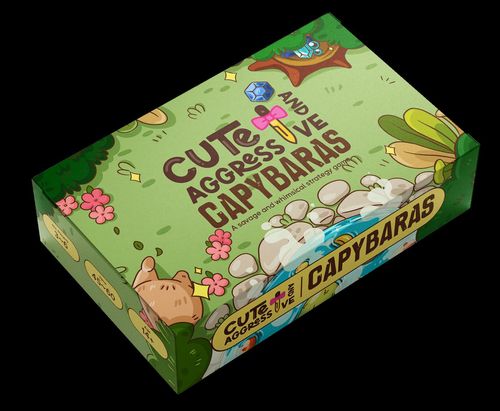
Cute and Aggressive Capybaras
Cute and Aggressive Capybaras Rulebook
Table of Contents
Table of Contents
Overview
Shhh! We're reading the rules...
Welcome to Cute and Aggressive Capybaras! Welcome to the savage, whimsical strategy game where you play as a capybara (because who wouldn't want to be one?).
You'll visit Hot Baths, collect (or even steal) Fruit, use powerful Items, and navigate unexpected Events on your quest. Whoever collects all the Fruit and returns to the Sacred Hot Spring wins!
What's in the Box
- 6 Hot Bath tiles
- 70 Terrain tiles
- 1 Sacred Hot Spring tile
- 1 Starting tile
- 44 Item cards
- 24 Event cards
- 42 Fruit cards
- 6 Capybara Mats
- 6 Fruit tokens
- 6 Capybaras
- 1 die
- 1 Rulebook
Table Setup
To start the game, follow these steps:
- Place the Starting tile in the middle of the table.
- Randomly choose four Terrain tiles and place them orthogonally around the Starting tile (their orientation doesn't matter).
- Place the Sacred Hot Spring tile (in diamond form) on top of the Starting tile. It will cover the paths below them, effectively replacing them.
- Shuffle all Item cards into one face-down pile, then do the same for all Event cards.
- Randomly choose one Hot Bath tile per player, then separate the Fruit cards and the Golden Fruit cards into uniform piles (set aside any Hot Bath tiles and Fruit cards that weren't chosen). Example: If there are three players, add three of each Fruit card and the respective Golden Fruit card. If there are four players, add four of each Fruit card.
- Randomly deal one face-down Hot Bath tile to each player (keep them secret because they can help you win your first Golden Fruit card).
- Deal five face-down Terrain tiles to each player (these form your hand for the Cute phase of the game).
- Make a single face-down pile of the remaining Terrain tiles per the table below.
Quick Reference
| Players | Terrain tiles per player | Fruit cards per fruit type | Extra Terrain tiles |
|---|---|---|---|
| 3 | 5 | 3 | 18 |
| 4 | 5 | 4 | 24 |
| 5 | 5 | 5 | 30 |
| 6 | 5 | 6 | 36 |
Lavender's Tips: Up for a challenge? Play with all Hot Bath tiles and Fruit cards. This increases the complexity level but... isn't that the point?
[Example setup for 3 players is shown as an image on page 7.]
How to Win
Be the first capybara to gather all Fruit cards from every Hot Bath tile (or steal them from other players) and make it back to the Sacred Hot Spring tile to claim victory!
How to Play
There are two phases to the game:
- Cute Phase: Building the map
- Aggressive Phase: Collecting Fruits
Let's dig into the details (puts on their reading glasses).
Cute Phase: Building the Map
Miles' Guide: He can help you with in-depth info, strategy, and edge cases. Turn to page 20.
Objectives
- Collectively build the map out of Terrain tiles.
- Once the map is complete, place your Hot Bath tile on top so that as many paths match as possible (if all four match, you start the game with a Golden Fruit card!).
Steps
- The player who last ate a fruit starts, and play proceeds clockwise from the first player.
- Starting from the Sacred Hot Spring tile, take turns placing orthogonally connected Terrain tiles (like dominoes), one per player per turn.
- Whenever you place a Terrain tile, take another one from the pile of extras into your hand (as long as that pile lasts, you should end your turn with five Terrain tiles in hand).
- Repeat this process until all Terrain tiles have been placed, using up the extra Terrain tile pile, and all hands are empty.
- Once all Terrain tiles are placed, roll the die to see who places their Hot Bath tile first. Symbols count as 0, and play proceeds clockwise from the first player. Proceed in play order to place your Hot Bath tiles on top of the map, following these rules on page 12.
There are five possible Path types on each Terrain tile and Hot Bath tile: wood, water, sand, rock, and flowers.
Flower Paths are wild and can match with any Path, including other flowers.
Turn to page 24.
[Sample finished map is shown as an image on page 11.]
Hot Bath Tile Placement
- Place them one at a time in turn order, not all at once.
- They cover the Terrain tiles below them, effectively replacing their Paths.
- Paths may not connect to the Sacred Hot Spring tile or any other Hot Bath tile.
- Paths extend to the corners of each Hot Bath tile, meaning that they must be placed in the form of a diamond.
- Orientation (in diamond form) doesn't matter. They can be sideways or upside down.
- Hot Bath tile Paths need to match with at least two of the Paths on the Terrain tiles they cover. Connecting Paths on adjacent Terrain tiles don't matter.
- If all four Paths on the Hot Bath tile match with the Terrain tiles they cover, you automatically get your Golden Fruit card!
- If they don't, don't worry! It's anyone's game, and there are lots of ways to get Fruit cards later on.
Miles' Guide: Hot Baths can also be placed on top of an empty space as long as the corners match at least two other Paths.
Perfect match! Get your Golden Fruit card.
Not perfect... but good enough for now.
[Sample complete map with Hot Bath tiles placed is shown as an image on page 13, with "Example perfect match" and "Flowers are wild" captions.]
Miles' Guide: A Golden Fruit Card is a unique Fruit card. Unlike regular Fruit cards, this card is not part of your hand but it counts as a Fruit for your victory. It can't be stolen or discarded. Place it in front of you on the table.
Turn to page 29.
Miles' Guide: Hot Bath tiles CANNOT be next to the Sacred Hot Spring tile or share the same Terrain tile with other Hot Bath tiles.
Turn to page 28.
Aggressive Phase: Collecting Fruits
Capybaras
These are the six capybaras that will compete for Fruit. Choose the capybara that fits your play style and prepare for a race to collect all Fruit cards.
- Lavender: Her favorite movie is "Mean Girls".
- Olive: Her favorite subjects are science and math.
- Sunflower: He loves iced coffee, pop music, and rom-coms.
- Miles: His favorite sport is making money.
- Luke: He's a "Star Wars" fan and loves computers.
- Chigüi: She believes all capybaras have beautiful souls.
Special Abilities
- Lavender, Olive, and Sunflower (+1 Item card icon): These three can draw an additional Item card during the Beginning of Your Turn section.
- Miles, Luke, and Chigüi (+1 Terrain tile icon): These three can orthogonally move an additional Terrain tile during the Beginning of Your Turn section.
Capybara Mats
These mats will help you on your turn during the Aggressive Phase.
The mat shows "Your Turn - How it works", your capybara's bio, and your capybara's Special Ability, along with an Action points tracker and your Fruit token to track your Action points.
Action points tracker:
- On each turn, you automatically get two Action points.
- Place your Fruit token on the corresponding Action points number.
- Move your Fruit token when you spend an Action point.
Miles' Guide: Action points are not cumulative between turns.
Objective
Collect all Fruit cards by visiting each Hot Bath tile (including the one you placed, if you don't already have that Fruit card) and returning to the Sacred Hot Spring tile.
Miles' Guide: During the Aggressive Phase, only regular Fruit cards can be collected. Golden Fruit cards will no longer be given.
Your Turn: How It Works
Start by placing all players' capybaras on the Sacred Hot Spring tile. Deal three face-down Item cards to each player (this will be your starting hand).
Proceeding in turn order, follow the steps below until someone reaches the objective.
Beginning of Your Turn
Optional Die Roll: At the start of your turn, you may choose to roll the die to gain extra Action points.
Here's what you might roll:
- 1, 2, or 3: Gain that number of additional Action points this turn and add them to your tracker.
- Special Ability icon: You lose your capybara's Special Ability for this turn.
- Event icon: Immediately draw and resolve an Event card, then skip the rest of your turn (go straight to End of Your Turn).
Special Ability: You may now activate your capybara's Special Ability if applicable.
During Your Turn
You automatically get two Action points and the die can give you extra. You can spend those Action points on any of the following, with each Action costing one Action point.
- Move on the map: Move your capybara one Terrain tile orthogonally (check Miles' Guide on page 25 for more info).
- Draw an Item card: Add it to your hand immediately.
- Play an Item card: Follow the instructions on the card to learn how they work.
You don't have to spend all Action points if you don't want to. But remember, unused Action points do not carry over to the next turn. Once you're finished, go to End of Your Turn.
End of Your Turn
If you end your turn on any of these tiles, do the following:
- Event: Immediately draw and resolve an Event card, if you haven't already resolved one this turn (e.g., by rolling the Event icon).
- Hot Bath: Add the corresponding Fruit card to your hand from the supply (you can only have one of each Fruit card type).
- Discard: If you have more than six cards in hand, discard down to six (this doesn't let you play their effects).
Miles' Guide: Your hand can have a maximum of six cards (Items or Fruits). It can become larger during other players' turns, but at the end of yours you must discard down to six.
The Ins & Outs
Miles' Guide
Welcome! Here, Miles will go deeper into game mechanics and resolve any issues or confusion you may have. Get familiar with these concepts to enhance your gameplay and become a master capybara!
Cards & Tiles
Item Cards
- Instant cards: These can be played at any time, including other players' turns, and they do not require Action points.
- Protective Amulet: "Your Actions, Item cards, Fruit cards, and Special Abilities can't be affected by other cards until your next turn." This prevents both positive and negative effects from other Item and Event cards. Note that this card itself can still be stopped, for example by a Karen Item card.
- Super Karen (Instant card): "Stop any capybara's Action, Event, Item card, or Special Ability. This card can't be stopped. I AM the manager!"
- Peekaboo: "Another capybara of your choice shows all Fruit cards in their hand and you show an Item card from yours. Shuffle all revealed cards face down, then choose one at random and add it to your hand. The other capybara adds the rest to theirs." You can't choose to shuffle Peekaboo with its own effect; it must be another of your Item cards in hand. If you choose a Fruit card you already have, you must return it to the corresponding Fruit deck in the supply.
Forced Movement Event Cards
- Some Event cards force capybaras to move against their will, because chaos is part of the fun! These events override normal movement rules and must be resolved immediately.
- In turn order, all affected capybaras must move according to the specific instructions of the Forced Movement Event being played.
- Wildfire (Event): "All capybaras on any non-Hot-Bath Terrain tiles with wood Paths must move to the nearest tile of their choice with no wood Paths."
Terrain Tiles
- Each Terrain tile has four Paths (see below for more info on Paths).
- Terrain tiles might include an Event in the center. They look like sparkly gems.
[Page 22 shows the Terrain tiles and Hot Bath tiles as illustrations, labelled: Regular Terrain, Event Terrain, Sacred Hot Spring, Hot Baths, Outer Paths, Inner Paths, and "Not a perfect match".]
Paths
- There are five types of Path: wood, water, sand, rock, and flower.
- Flower Paths are wild, meaning they can be placed next to any Path, including other flowers.
- Any Event tile or Item card that affects specific Path types will also affect all flower Paths.
- A connected Path occurs when two or more Terrain tiles have adjacent Paths of the same type.
Movement
- Normal movement: For most of the game, you can only move orthogonally (up, down, left, or right) along Paths. One Action point equals one Terrain tile of movement.
- Orthogonal by default: When an Item or Event card forces you to move, you must first try to do so orthogonally. Diagonal movement is only allowed if the card explicitly says so, or if it would otherwise be impossible to move.
- Note: Two or more players can share the same Terrain tile or Hot Bath tile.
Example Movement
Connected Paths, via the Item card "Carmen": Here, Miles moves through three Terrain tiles connected by wood and sand Paths.
[Example shown as an image on page 26.]
Forced Movement, via the Event card "Quicksand"
When the Quicksand Event card is drawn, in play order all capybaras standing on a Terrain tile with sand Paths must move to a different Terrain tile with no sand Paths.
- Sand Paths include flower Paths, since they count as wild.
- Hot Bath tiles are safe. They are not affected by Quicksand.
What if all nearby Terrain tiles also have sand Paths? If your capybara is surrounded by sand Paths (like in Miles' case), you must move to any outer Terrain tile that has no sand Paths, even if it's not normally a legal move. Alternatively, if a Hot Bath tile is reachable, you can move there instead and immediately collect its Fruit card (if you don't already have that Fruit card).
[Page 27 diagram labels: Neighboring Terrain tiles, Outer Terrain tiles.]
Hot Baths
During Cute Phase: building the map
- Ideally, you should place your Hot Bath tile on top of a Terrain tile whose corner Paths perfectly match, but it's still legal to place it anywhere on the map with at least two matching Paths.
- These cannot be placed next to the Sacred Hot Spring tile, on top of other Hot Bath tiles, or directly adjacent to already-placed Hot Bath tiles.
- Remember, perfectly matching all four Paths automatically gets you your Golden Fruit card!
During Aggressive Phase: collect Fruits
- Whenever your capybara lands on a Hot Bath tile, you immediately get its corresponding Fruit card and your turn ends (so you should try to spend your Action points beforehand).
- If any player forces your capybara to move onto a Hot Bath tile (for example, via an Item or Event card), you still get to collect the Fruit card (even if it's not your turn).
Sacred Hot Spring
- This is the starting tile to build the map.
- All capybaras start the game here.
- You must return here with all Fruit cards in hand in order to win.
- This tile is also considered a Hot Bath tile.
Golden Fruit Card
- These are unique Fruit cards that help you get your first Fruit before the Aggressive Phase. Unlike regular Fruit cards, they can't be stolen or discarded. When you get one, place it in front of you on the table. It isn't part of your hand, but it still counts as a Fruit for your victory.
- During the Cute Phase, you can obtain your Golden Fruit card if all four Paths on your Hot Bath tile match with the Terrain tiles they cover.
Events
- Events can change the outcome of the game at any time! They're activated when you roll the Event icon on the die or end your turn on a Terrain tile with an Event in the center. When you do, you must draw and resolve an Event card immediately.
- Moving through these tiles (due to an Item card, spent Action points, or even another Event) won't trigger an Event. Neither will being forced to move onto a Terrain tile with an Event by another player.
Lavender's Not-So-Secret Section on How to Secretly Win the Game
Cute Phase: Building Map
We encourage you to design a wild and creative map. The more unpredictable it is, the tougher the Aggressive Phase becomes. A chaotic layout makes it harder for capybaras to gather all the Fruit cards.
- Strategic talk is allowed! You can try to convince other players to place their Terrain or Hot Bath tiles in a way that benefits you (like not blocking your Paths). Just remember: players must use tiles from their own hand. Trading or giving tiles is not allowed.
- Pay attention to others. Watching how opponents place their tiles can reveal their plans, like setting up their own Hot Bath tile. Use this info to block or redirect them.
- Use your Hot Bath tile wisely. Place it where it disrupts others, either by blocking their potential spots or placing it far from the Sacred Hot Spring to make it harder to reach during the Aggressive Phase.
Aggressive Phase: Collecting Fruits
- We encourage players to use different card effects to be able to move faster, steal Fruit cards (muahaha), or stop other players.
- While the game can be a friendly race to explore and collect Fruit cards, remember that other players can always try to steal from or stop you.
Here are some card interactions examples:
- Magic Wand and Event cards: Play "Magic Wand" for luck-based Event cards. Use it on another capybara's turn to change their favorable result.
- Wolf Pack and Swan Attack: Use these Item cards to trap other capybaras behind a Hot Bath tile.
Prefer to learn by video? Check out the publisher's video gameplay tutorial at cuteandaggressive.com.