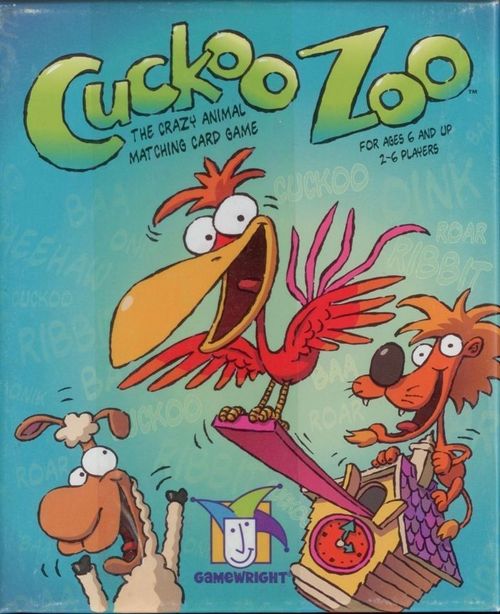
Cuckoo Zoo
Cuckoo Zoo Rulebook
Table of Contents
Table of Contents
Idea of the Game
This turbulent game is wilder, more colourful and crazier than everything you know. When you place a card on the table you have to make the matching animal sound. If you forget to make this sound, you get penalty cards. If you place down a red card you must not make any sound – except when you place down the red rooster. The first player who has no cards left wins.
Preparations
The oldest player shuffles and deals the cards. Each player gets eight cards, which he picks up. The remaining cards are placed as a drawing pile in the middle of the table. The topmost card will be put face up next to the draw pile – it's the first card of the discard pile.
The Beginner's Game
Cocotaki is a crazy game. When you play this game for the first time (especially with young children) you better start with the following basic rules. When the players know the basic rules well enough, you add the additional rules one by one.
The player to the left of the oldest player begins. Then the other players follow clockwise. If it's a player's turn he has to place down exactly one card. Which card he is allowed to play depends on the top card of the discard pile. He has to play a card with the same colour or the same animal as this card. The played card is placed face up on the discard pile.
Note: When you place a card on the table you have to make the matching animal sound.
Example: It is Max's turn. He has to play a green card or a card with a cow. Max plays a yellow cow and places it face up on the discard pile. At the same time he says: "moo!"
The new card on the discard pile determines the cards which the next player is allowed to play. REMEMBER: You can only play cards which have the same colour or the same animal as the card on the discard pile. Of course, you can also play an identical card, e.g. a yellow cow on a yellow cow.
Example: Lisa puts a yellow sheep on the discard pile and says: "baa!"
Note: When a player puts a red card on the discard pile, he must not make any animal sound.
Example: Katrin puts a red sheep on the discard pile and makes no sound.
Note: When a player puts a red rooster on the discard pile, he has to shout: "COCOTAKI!"
Example: Tim puts a red rooster on the discard pile and shouts: "COCOTAKI!"
Summary
- When you play a red rooster you have to shout "COCOTAKI!"
- When you play any other red card you must not make any sound.
- When you play any other colour you have to make the matching animal sound.
Note: Only the red roosters make "COCOTAKI!" – the other roosters make "cock-a-doodle-doo".
Butterflies
Butterflies are jokers. You can play a joker when it's your turn instead of playing a matching card (you can even play it on another butterfly). Butterflies make no sound. When you have placed a butterfly on the discard pile you can choose the colour which the next player has to play.
Example: It's Max's turn. He normally has to play a red card or a card with a rooster on it. Instead Max plays a butterfly and chooses green as the next colour ("I choose green."). Lisa, who is next, now has to play a green card.
Drawing a card
When a player is not able to (or does not want to) play a matching card, he has to draw the topmost card of the draw pile. Then it's the next player's turn. You cannot draw a card and play a card in the same round.
Mistakes
NOTE: A player who makes a mistake has to draw two cards immediately. Mistakes are:
- Make the wrong animal sound (e.g. placing a dog card and making "moo!").
- Make no sound if you have to (e.g. placing a green cat and making no sound).
- Placing a red rooster and not saying "COCOTAKI!".
- Placing a red card (except a red rooster) and make any sound.
When a mistake is not recognized, the player does not have to draw the two cards. Players must complain about the mistake before the next player places a card. Making a complaint later does not count. Every player can complain about a mistake.
A player who has only one card left immediately has to say "last card". When he forgets to say this he immediately gets two penalty cards.
End of the Game
When a player has placed his last card (and makes no mistake) the game ends and he is the winner.
NOTE: When he makes a mistake while placing the last card he immediately gets two penalty cards.
Advanced Rules
Now it's getting more turbulent. All the basic rules apply. Add the following rules:
Roosters
When a player plays a rooster (any colour) the next player misses a turn.
Example: Lisa plays a blue rooster and says "cock-a-doodle-doo". Katrin misses a turn. Then it's Tim's turn. He has to play a blue card or a rooster.
When the player who misses a turn plays a card, he has made a mistake. He has to pick up the card again and gets two penalty cards.
Donkeys
When a player plays a donkey (any colour), a donkey round happens. For a complete round only donkeys can be played. No other animals (even butterflies) can be placed. A player who cannot play a donkey has to draw a card from the draw pile. When the player who played the first donkey has his next turn, he can play whatever he wants (same colour, or same animal). When he plays a donkey again another donkey round happens. A player who plays another animal card in a donkey round makes a mistake. He has to pick up the played card and gets two penalty cards. When no one complains about the mistake the donkey round ends and the played animal card sets the new colour/animal for the next card.
More Advanced Rules
Each player gets ten cards at the start of the game instead of eight. When it is a player's turn he can play several cards. The first card must be matching to the colour or the animal of the topmost card of the discard pile. After the first card he can place as many cards with the SAME animal as he wants.
The player must make the matching sound for each card (or no sound for a red card).
Example: Tim first plays a card with a green cat on it. Next he plays two more cats. He has to make "miaow" three times.
Note: When a player plays several roosters the appropriate number of players miss a turn.
Example: Max plays two roosters. For the first he makes "cock-a-doodle-doo", for the second he makes "COCOTAKI!".
Lions
When a player plays a lion (any colour) the direction of the game is changed. The game is not played clockwise anymore, but counterclockwise. This means, that after a lion was played not the player to the left of the player who played the lion is the next player, but the player to the right is. When another lion is played the direction of the game changes again.
Note: When a player plays two lions in one turn the direction of the game remains the same. An even number of played lions (two lions, four lions, etc.) means that the direction remains the same; an odd number of played lions (one lion, three lions, etc.) means that the direction changes. When a player does not recognize the direction change and plays a card even though it's not his turn, he made a mistake and gets two penalty cards and he has to pick up his card again.