Cube
Cube Rulebook
Table of Contents
Table of Contents
Set-up of the Game
Place the gameboard between the players. It can easily be rotated so that the active player is able to look at the playing situation from all sides. All players set up a card holder in front of them and choose a twin cube of their choice that they put in front of them as well. In the 2- or 3-player game, unneeded twin cubes are removed from the game.
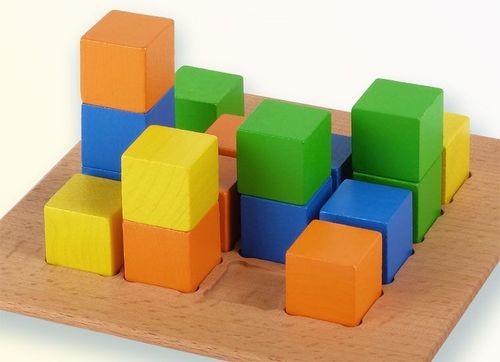
The individual wooden cubes are put into the cotton bag – except for one per color. These four remaining cubes are positioned on the corner spaces of the gameboard in any order; they form the starting set-up and may not be moved in the first game round.
Shuffle the task cards. Each player draws 3 cards and sticks them into their card holder without showing the other players.
Put the remaining task cards as a face-down draw pile next to the gameboard.
Object of the Game
Players try to recreate the color combinations of their task cards on the gameboard. The first player to fulfill the required number of task cards wins the game.
This number is:
- with 2 players – 7 task cards
- with 3 players – 6 task cards
- with 4 players – 5 task cards
This Is How You Play
The youngest player begins. Players alternate turns or, with more than 2 players, play in turn.
As the active player, you may:
-
Blindly draw one wooden cube out of the bag and place it on any space in the playing area.
The restriction is: There may be no more than 4 wooden cubes on top of one another.
or:
-
Move a wooden cube already on the gameboard to any different space.
The restriction is: The last-moved wooden cube is taboo for the next turn; it can be labeled with a marker. A wooden cube that has been overbuilt or is within a closed level (see illus. 1) may not be moved.
or:
-
Place your own twin cube (horizontally or vertically) (see illus. 2). However, this is allowed only after you have fulfilled the first task card.
The restriction is: After they have been placed, twin cubes may not be moved anymore; but other than that, they count the same as any other color cube.
The twin cubes allow players to secure their own positions or to obstruct an opponent's possible arrangements.
Illus. 1: A closed level applies if all spaces on one horizontal level are occupied. There are no closed levels in the vertical.
Illus. 2: Thanks to their dowel connection, twin cubes are adjustable so that they can be placed horizontally with a distance or vertically without a distance.
Fulfilling the Task Cards
In order to fulfill a task card, you recreate on the gameboard the combination depicted on the card. To do so, you must view the gameboard either from above or from one of its four sides (see illustrations 3, 4, and 5). Once you have fulfilled a task card, you show it to the other player(s) and then discard it face up.
You may rotate the task cards in your card holder in any direction anytime and fulfill them in any order.
On your turn, you try to place a wooden cube on the gameboard in such a way that you fulfill your own task cards. However, it may happen that you also inadvertently fulfill one or more task cards of another player. If that player realizes this, he may show and discard the respective card directly after your turn. After that, the next player has his turn.
After discarding a card, a new card is drawn from the face-down pile, so that all players always have 3 task cards in their card holder during the game. If the color combination on the new or on another task card in your card holder has already been fulfilled on the gameboard as well, you may show and discard this card, too, and draw again.
The different perspectives allow for multiple possibilities for fulfilling a task card.
The general rule is that an unobstructed view is always required! In this context, the row or the level of your arrangement on the gameboard doesn't matter. Arrangements on different levels or in different rows are also possible. Cubes hidden from view don't count. See also the examples in illus. 5 on p. 14 and p. 15.
Perspective 1: From Above
Illus. 3A: Fulfilling a task card within the same level
Illus. 3B: Fulfilling a task card on different levels
Perspective 2: From a Side
The active player rotates the board the way he needs it.
Illus. 4A: Fulfilling a task card within the same row
Illus. 4B: Fulfilling a task card in different rows
End of the Game
The first player to fulfill the required number of task cards wins the game. The current game round is still completed, though.
In case of a tie, the player who has placed his twin cube gets one extra point. If there is still a tie, each of the players involved draws one more card and tries to be the first to fulfill this card and win the game.
If all wooden cubes have been placed before the game ends, the player who has fulfilled the most task cards wins.
Game Variant
For a higher degree of difficulty, the game can be played by adding the following rule: Besides not taking any wooden cubes out of closed levels, you may now not take any cubes out of closed rows (4 cubes in a row) either.
Cube for a Solo Player
Cube as a brain teaser: You build arrangements of cubes that fulfill several predefined task cards at the same time. The more cards that need to be fulfilled, the more difficult it gets.