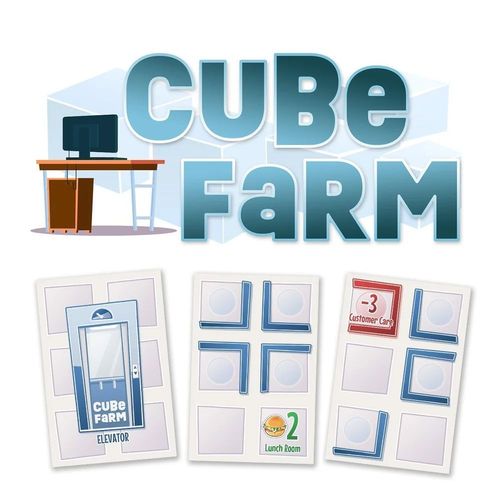
Cube Farm
Cube Farm Rulebook
Table of Contents
Table of Contents
What You Need
Each player needs several counters (stones) in a unique color. About 10 counters each will suffice, but there is no limit to the number you can use. You also need a way to keep score.
To Begin
Clear the table and put an Elevator in the middle to start each hand. Shuffle the rest of the deck and deal a hand of 5 cards to each player. If there are only 2 players, deal a hand of 6.
The player to the dealer's left takes the first turn. This hand ends when the last card is played. A full game consists of one hand for each player, or four hands if there are only two players.
On Your Turn
You will play one card to build the map, then you may occupy one empty cubicle with a stone. When everyone has played their cards out, the hand is scored.
Playing Cards
When you play a card it must align with the grid, and it must touch the existing cards. Figure 1 shows some examples of how cards can be played.
If an area too small for another card becomes completely surrounded, such as the gray area in Figure 1, that area becomes passable floor space. All other open table space, including enclosed space large enough to hold a card, is treated as impenetrable walls.
Elevators
There are three Elevators in the deck, and these can be played just like any other card.
Enlarging Cubes
If you play a card that enlarges a cube, such as the cube occupied by Player A in Figure 1, that cube becomes a single larger cube. If Player A was already in part of that cube, he would expand into the other part (adding another stone to the board) immediately. This also happens when you enlarge cubes with negative value, though you don't have to use stones to represent it.
You cannot attach a negative point cube to an occupied cube.
Playing Stones
Each stone represents an employee on your team. (Exception: A double-cube, such as Player A has in Figure 1, represents only one employee with a larger cube.) After the hand is played, you will score points based on how close your employees are to the point spaces, like the supply cabinet, water cooler, etc.
When you play a stone, that employee must be able to walk to the elevator from his cubicle. Employees can walk through open spaces and through bonus squares, but not through cubicles or walls. Sometimes the entire Elevator space becomes walled off and filled, making no new employees legal until another Elevator appears.
When you place a stone in an unoccupied double-cube, you place an extra stone, occupying the cube completely. The same is true for larger complexes of cubes, which are possible but rare.
You can't place a stone in a cube that's attached to a negative point cube. That's because the whole cubicle is already occupied by that negative point character (see the example below).
Figure caption: You can't place a stone in this cubicle because it's already occupied by the Vice President.
Figure caption: This is the only legal place to put a stone in this layout because no other cubes can currently walk to the Elevator.
Scoring
When the hand is played out, each cubicle scores points as follows:
Base Value: A cube's base value is one point for each stone inside it. Most cubes have a base value of one. Player A's double-cube in Figure 1 is worth two.
Bonuses: Every cube scores a bonus for every point space that's within the appropriate walking distance. Walking distance varies with the point space: you must be within 2 steps of a 2, 3 steps of a 3, and 4 steps of a 4 in order to score points for these spaces. Bonus spaces are worth their value in points, so a 2 is worth 2 points, a 3 is worth 3, and a 4 is worth 4 points.
It's possible to score several bonuses with one well-placed cube.
Negative Points: Negative cubes are worth negative points, and have the same range as the bonus spaces. If you are within 3 steps of a -3, or 2 steps of a -2, you must deduct those values from your score.
Note that the point spaces do not have to be able to "reach the elevator" themselves. If you have a cube leading to the elevator on one side, and a bonus space on the other, you have a very good arrangement, because no one can walk through your cube.
Scoring Examples
In examples below with no Elevator, assume that all the cubes are legal plays, and they all can reach the Elevator.
Base Value Only: Player A can't reach anything from this cube, so it scores only its base value of 1 point.
Figure caption: All compound cubes are worth 1 point for every stone in them. This single cube occupied by Player B can't reach the Photocopier in 4 steps or less, so it is worth only its base value of 2 points.
2-Point Bonus: Players C and D are within 2 steps of the Coffee Machine, so these cubes are worth 3 points each (1 for the base value, plus 2 for the Coffee Machine.) Player E is 4 steps away from the Coffee Machine, and gets no bonus.
The Elevator: You can't move through the Elevator, you have to walk around. Player A gets the bonus for this Photocopier, but Player B doesn't. That's because A is 4 steps away, but B is 5.
Multiple Bonuses: Player C gets the bonuses for the Laser Printer (3) and the Photocopier (4), making C's cube worth a total of 8 points. Player D can only get the bonus for the Photocopier, because she is 4 steps away from the (3).
Negative Points: Player E is 2 steps from the Soda Machine (2) and the Receptionist (-2) so he gets zero bonus for this cube. This cube is worth 1 point.
Extended Negative Spaces: Player A loses 3 points for this cube because it's three steps from the entrance to the Vice President's cube. Although it's not marked with a counter, the Vice President does expand into the neighboring cube.
Scoring Figure 1
Look back at Figure 1. If the hand ended at this point, here's how the board would be scored:
- Player A: Double cube, base value 2 points. Bonuses: 4 points for the photocopier, total score 6.
- Player B: Base value 1, bonuses 2, 4, and 4. Total score: 11.
- Player C: Scores the Photocopier, total score 5 points.
- Player D: Scores both the 3 and the 4, for a total value of 8.
- Player E: No bonus. Scores 1 point.
Some Extra Notes
While it's illegal to place a stone where it can't reach the elevator, there's no such restriction on the Vice President and the Receptionist. You can place them anywhere you like, and they will find their own way to the Elevators.
The open floor that you create by enclosing an area of empty table space is divided into squares like the rest of the cube farm. Just imagine the grid continuing through that space when you are counting steps for score.
Going first has some advantages in this game, going last has some others, which is why we keep score over several rounds.