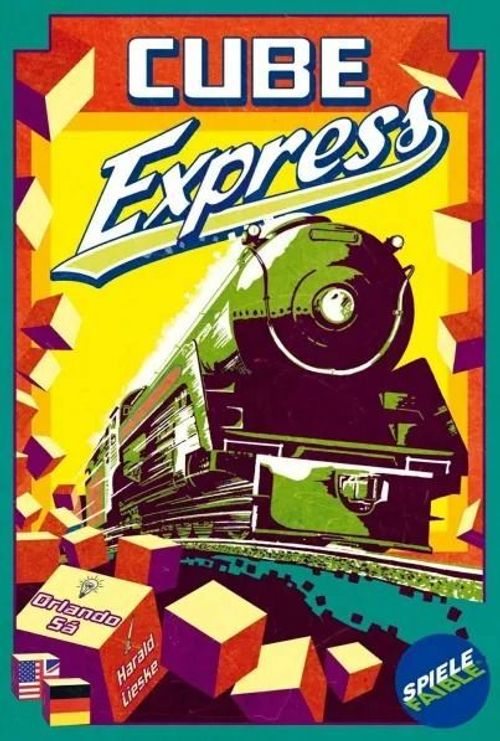
Cube Express
Cube Express Rulebook
Table of Contents
Table of Contents
Game Components
- 100 Wooden cubes (25 per player)
- 24 Stations (6 per player)
- 4 Wooden discs (1 per player)
- 8 Locomotives (trains) (2 per player)
- 14 Objective cards
- 1 Double sided central game board
- 6 9-victory points (VP) tokens
- 1 First player marker
- 44 Track tiles
- 4 Starting track tiles (1 per player)
- 1 Starting crossing tile
- 1 Scoring pad
- 4 Player boards
- This rulebook
Note: All game components are strictly limited to the quantity contained in the game box!
What a Cube Can Be
Depending on where it is placed or used, each cube can be the following:
- A dividend when it is placed or used in the dividend area of a player board.
- A resource (coal, wood, or iron) when it is placed or used in the corresponding storage area of a player board.
- A multi-purpose cube when it is placed or used in the reserve area of a player board.
- A passenger when it is placed on a city space or used there.
- A delivery completed when it is placed on a factory space or used there.
- A possession marker when it is placed on a production facility or used there.
Setup
The Game and Central Game Board
- Sort out the 5 starting tiles and place them in the center of the game area. Each player should sit facing their chosen player color, or players can randomly choose their player color. Adequate space should be left around the starting tiles. Note: The start-of-game icon indicates "start of the game", where depicted.
- Each player takes all game components of their player color and places a station and a locomotive (= train) on the starting tile of their color.
- Important: Even with fewer than 4 players, all 5 starting tiles are always used. The tile(s) of the unused color(s) will be empty at the beginning of the game and will remain so for the rest of the game.
- Place the central game board to one side of the gaming area, within easy reach of all players and with sufficient distance from the starting tiles. Depending on the number of players, use either the side for 2 players or the side for 3 to 4 players.
- Use all track tiles in a game with 4 players. With fewer than 4 players, certain track tiles are removed and put back in the game box:
- With 2 players, remove all tiles with the player-count icons (the 4-player icon and the 4-player-plus icon) on the back.
- With 3 players, remove all tiles with the 4-player icon on the back.
- Mix the track tiles used for this game face down, and each player receives 3 of them, which they look at but keep hidden from the other players. Stack the remaining track tiles face down next to the central game board.
- Draw 4 track tiles from the stack and place them face up below the game board at the designated spaces.
- Mix the objective cards face down and place one face up at each space above the central game board. Put the remaining objective cards back in the game box without looking at them. They will not be used in this game.
- In a game with 2 players, place 3 cubes of an unused player color on each objective card.
- Each player places their disc on the second space of the row of their color in the stock values on the central game board. Then, each player places one of their cubes on each of the 3 spaces marked with $ in the row with their own disc.
Player Board
Each player places the remaining game components of their player color on their player board:
- The 5 stations on the five rightmost spaces of the technology track at the top (the leftmost space remains empty).
- The (second) locomotive on the designated space.
- 2 cubes in the dividends area.
- The remaining 20 cubes in the reserve area.
Playing the Game
Cube Express is played over several rounds until one of the game end conditions is met. Randomly determine the starting player. They receive the first player marker and begin the game with their first turn. The other players take their turns in clockwise order. This continues until the end of the game, without changing the first player.
Each turn consists of the following 3 steps, performed in this order:
- I. Expand the railway network (mandatory)
- II. Move your own locomotive(s) (optional)
- III. Market (mandatory)
Additionally, anytime during their turn, each player can convert resources located in their storage areas as indicated by the arrows on their player board. (Coal, wood, etc. refers to cubes in the corresponding area; this applies throughout these rules):
- Convert 2 coal into 1 wood, with the other cube going into the reserve.
- Convert 2 wood into 1 iron, with the other cube going into the reserve.
- Convert 2 iron into 1 wood and 1 dividend.
- Convert 2 wood into 1 coal and 1 dividend.
Example: Henning has 1 coal, 2 wood, and 1 iron. However, he needs 2 coal for a delivery. So, he exchanges 2 wood for 1 dividend and 1 coal.
I. Expand the Railway Network (mandatory)
- The active player must play exactly 1 track tile from their hand and place it adjacent to at least one existing tile, ensuring that all tracks are connected. A track cannot be placed so that it connects to a side without tracks.
The track tile may be rotated as desired, as long as all tracks connect to adjacent tracks. If a track tile is placed adjacent to multiple others, all tracks must connect.
Important: A track tile must never be placed in a way that would connect two cities that already have a station to form one city! More about cities and stations to follow below.
Note: The player can always place the track tile with its back side up following the same rules. However, this should only be the last option if nothing else fits or is desired. The back sides are all identical and offer much less choices.
- Subsequently, the player performs the action in the center of the track tile (marked with the action icon), if possible and desired.
Depending on the played track tile, the actions are:
- Crossing: The player receives 2 dividends for each track connected to the crossing. They move this number of cubes from their reserve into their dividends area.
- Factory: The player immediately receives the resource shown in the center, marked with the action icon. They place one cube from their reserve into their corresponding storage area.
- Production Facility: The player may place 1 dividend on the tile to take ownership of this production facility. If another player later takes the resource depicted from this production facility, the owner increases their stock value (see Stock Value Track below).
- If a player does not have or does not wish to use a dividend, they can still play this track tile, but they cannot take ownership of the production facility.
- Each production facility can be owned by one player only, and ownership can be taken only at the moment the track tile is played. If this does not happen, it remains ownerless for the rest of the game (but still provides the resource).
- Example: Tom plays a production facility. He wants to take ownership of it and places 1 of his dividends on the tile.
- Train Station: The player may build 1 train station by placing the leftmost train station from their technology level track onto the train station space (thereby increasing their technology level).
- A train station can only be built at the moment the track tile is played (see below: restrictions on building train stations).
- If this does not happen, it remains without a train station for the rest of the game. If a player does not want or cannot build a train station, they can still play this track tile.
- If the player decides to build the train station, they must pay for it. The cost in cubes is equal to their technology level before construction (the empty space next to the leftmost train station on the track). They can pay from the following sources for this, mixed according to availability and at their own discretion:
Do not forget: The action in the center of a track tile can only be taken at the moment the tile is played!
II. Move Your Own Locomotive(s) (optional)
The player may move their locomotive or both once they have built the second one. The number of their movement points (MP) equals their current level of technology. This is always the highest number on empty spaces to the left of the unbuilt train stations. Movement points can be split as needed between both locomotives and do not need to be used up entirely.
The following rules apply to the movement:
- The locomotive can only travel on the railroad tracks of the track tiles.
- Traveling onto each new tile costs 1 MP.
- The locomotive cannot move back and forth but only in one direction, meaning forward.
- At the start of the movement, the player can choose the direction of the locomotive as desired, but once moving, its direction cannot be changed.
- Other locomotives, even your own, are not obstacles. Multiple locomotives can stand on a track tile, regardless of ownership.
- A locomotive must complete its movement before the second one, if any, can be moved.
Important: You may spend coal to receive more MP. For each coal you return from your storage area to your reserve, you gain 1 MP!
Building Your Second Locomotive
At the start of the game, each player has one locomotive. They can build their second locomotive from their player board by paying 1 coal and 1 iron from their respective storage areas, returning these resources to their reserve.
The second locomotive can be built at any time during Step II: Move your own locomotive(s). The player then places it at any of their own stations. If they have BP [sic; movement points] remaining in this turn, they can still use it for the second locomotive.
Example: Lucy performs Step II: Move your own locomotive(s) and decides to build her second locomotive first. She pays 1 coal and 1 iron, returning them into her reserve. She places the locomotive at one of her own stations on a tile. She has 5 movement points and can now split them between her 2 locomotives as she wishes.
Actions During Movement
When a locomotive is moved, it interacts with certain track tiles it travels on or over. A possible action is always indicated next to the track (never on the track itself, see Step I Expand Track Network) and does not display the action icon.
These are the possible actions:
- Production Facility: The player may take the depicted resource from this production facility and place it into their corresponding storage area (taken from their reserve).
- If they do so and this production facility is owned by another player, the owner increases their stock value by advancing their disc on the stock value track by 1 space.
- The player receives the resource even if the production facility is owned by nobody. If they own it themselves, they do not increase their stock value.
- Don't overlook this: The start-crossing gives a coal resource every time a player moves their locomotive onto or over it.
- Factory: The player may deliver the required resources by taking them from their respective storage areas (if there are any). This is done as follows:
- They place 1 cube on the scoring area next to the factory.
- They place 1 cube in their dividend area.
- They place 1 cube on an objective card of their choice.
- The following rules apply to a delivery:
- Whoever is first to deliver to a factory places their cube on the left space with the higher value (A). Only 1 cube can be placed there.
- Whoever is first to deliver to a factory increases their stock value by moving their disc up 2 spaces (C) on the stock value track on the central game board.
- All subsequent suppliers place their cube on the right space with lower value (B). Any number of cubes can be placed there.
- All subsequent suppliers increase their stock value by moving their disc up 1 space (D) on the stock value track.
- Each player can deliver to each factory multiple times (but, of course, only one player can be the first). Each delivery requires exactly one action - so you can only make one delivery per action, even if you have enough resources for multiple deliveries.
Storage Capacity
The total amount of resources a player can store in their three storage areas is limited. The maximum amount is always equal to the current level of their technology (the highest number on free spaces to the left of their unbuilt stations).
This limit applies at the end of a player's turn. As explained before, a player can exchange (convert) resources at any time during their turn. If a player has more resources in their storage areas at the end of their turn than their current limit allows and cannot or does not want to exchange further, they must discard excess cubes of their choice by returning them to their reserve.
Stock Value Track on the Central Game Board - Summary
A player increases their stock value
- by 2 spaces if they do the first delivery to a factory;
- by 1 space if they are not the first to do a delivery to a factory;
- by 1 space if another player takes the resource of a production facility that is owned by them.
When a player moves their disc on the stock value track past one of their cubes, they take that cube and place it as a dividend into their dividend area. The space where that cube was taken from remains empty for the rest of the game.
Selling Stocks
Important: At any time during their turn, a player may sell one or more of their stocks. For each space they move their disc to the left on the track, the player places 1 cube from his reserve into his dividend area as a dividend. The disc cannot be moved below 0.
When the disc is later moved to the right again and passes over an empty $ space, this is of no significance, as the cube that was initially there had already been taken.
III. Market (mandatory)
The player must pick up one of the face-up track tiles. This way, each player always has 3 track tiles on their hand.
Then, the player may place 1 of their dividends on the objective card that is in the same column above the taken track tile.
Note: No player may have more than 5 cubes on the same objective card!
The objective cards will be scored during the final scoring.
Finally, the player draws the top tile from the face-down stack and places it face-up in the now empty space. Their turn is over and the next player takes their turn.
Example: Tom ends his turn by taking 1 tile from the display; he chooses the third one from the left. He takes the tile and may now place 1 dividend on the third objective card from the left. He does so and places 1 of his dividend cubes there.
End of the Game
The end of the game can be triggered in 3 different ways:
- The stack of track tiles is depleted at the end of a turn (the player has placed the last track tile in the display). A final round follows, in which each player takes their last turn, but without Step III Market. Thus, they do not take a tile from the market and, consequently, cannot place a dividend on a target card.
- A player builds their last train station and receives a 9-VP token for it. All other players who have not yet taken their turn this round will take their final turn. Also in this case, all players have had the same number of turns, but there is no final round.
- A player reaches the maximum of their stock value track and receives a 9-VP token. All other players who have not yet taken their turn this round will take their final turn. Also in this case, all players have had the same number of turns, but there is no final round.
Any other players who build their last train station later and/or reach the maximum of their stock value as well receive a 9-VP token. However, this does not delay the end of the game (i. e., no additional turns will be played).
Final Scoring
After the game has ended, proceed to final scoring in the exact order listed below. Each player's victory points (VP) are recorded on the scoring pad.
- Objective cards: First, the objective cards are scored. This is done individually from left to right. For each player whose cubes are on the objective card(s), it is checked whether they have achieved the objective.
- Players who have not achieved the objective remove their cubes from that objective card and put them aside. They do not receive any VP.
- The player or players (in case of a tie) who now have the majority of cubes on that objective card receive for each of their own cubes there the number of VPs indicated below the card on the central game board for the majority.
- All other players receive for each of their own cubes there the number of VPs indicated below the card on the central game board for the non-majority.
- Passengers: Each passenger at a train station is worth 1 VP, regardless of who is the owner of the station. Each player counts their passengers by removing them from the cities and putting them aside to keep track.
- Factories: Each cube at a factory is worth the number of VPs as shown on the space where it is. Each player evaluates their factory cubes by removing them from the factories and putting them aside to keep track.
- Train Stations: Each train station is worth as many VPs as three times the number of house icons in its city (in other words, each house icon is worth 3 VPs). Each player evaluates their train stations by removing them from the cities and putting them aside (not on the technology track). This helps to keep track and ensure that no house icons are overlooked or mistakenly scored multiple times.
- Stock Value: The VPs for the player's stock value are indicated on the space where their disc is located.
- Dividends: Each cube in the player's dividend area is worth 1 VP.
The player with the most VPs is winner of the game and master of railroads! In case of a tie for the most VPs the tied player who has built more train stations is the winner. If there is still a tie, the tied player whose disc is further advanced on the stock value track is the winner. If there is still no winner, the tied players of the last tie share the victory.
Easily Forgotten or Overlooked Rules
- The action in the center of a tile can only be performed at the moment the tile is played, and never later.
- By spending coal, players can gain movement points.
- By moving backwards on the stock value track, players can receive dividends at any time.
Summary
I Expand the railway network (mandatory)
- Place 1 tile from your hand orthogonally adjacent to at least 1 other tile. Continue the track.
- 2 cities that already have a train station must not be connected by roads.
- Perform an action in the tile's center if desired. See details explained in the rules.
- Remember: You can also place a tile with its reverse side up.
II Move your own locomotive(s) (optional)
- Each move onto a tile costs 1 movement point (MP).
- Choose the direction of the locomotive at the start, then only move forward.
- You may build your second locomotive at any time during this step only.
- You may forfeit any MP.
- MP can be split freely between 2 locomotives, but one locomotive must finish its movement before the second one can move.
- Perform actions with track tiles during movement, if possible and desired. See details explained in the rules.
III Market (mandatory)
- Pick up 1 tile, refill the display.
- You may place 1 dividend on the objective card on top of the same column from which you took the tile.