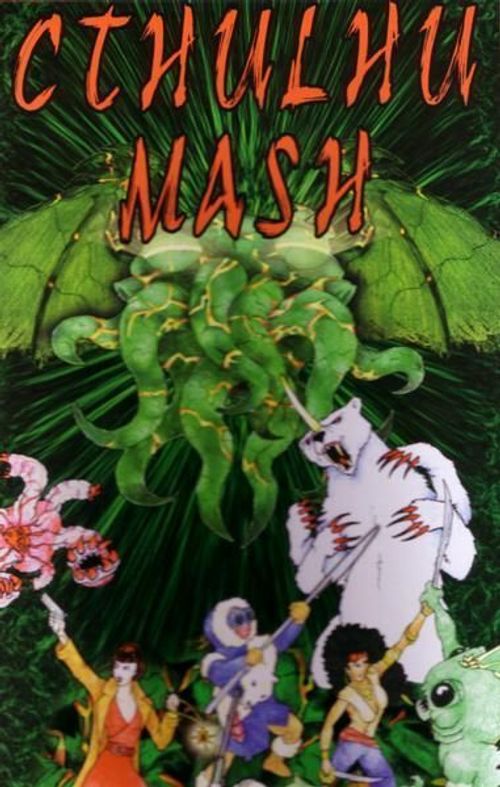
Cthulhu Mash
Cthulhu Mash Rulebook
Table of Contents
Table of Contents
1 Introduction
Edition note: Cthulhu Mash is the most up to date version of the original Ultra Vilelence, now Monster Mash I, rule set. However, Monster Mash I objects, monsters, characters, generators, and tile special rules will not be contained in this rule set and must be referenced when combining sets.
Across time, four souls stumbled upon secrets not meant for mankind and died…but not before going insane. Now, all four souls have been given a second chance at life but must relive and overcome their last and most terrifying days. Welcome to Cthulhu Mash (CM), an expandable, random tile, monster generating game where players can choose to play one of four characters: Arctic Explore, Mariner Merchant, Private Eye, or Psychotherapist. The object is to mash the monsters, destroy the generators, and acquire powerful objects to meet 1 of 3 victory conditions. See Victory Conditions, Section 3.2.
1.1 Arctic Explorer (19th Century)
A late 19th century Arctic Explorer escaped the clutches of the Gnoph-Keh to find a hidden city of the Elder Things.
1.2 Mariner Merchant (17th Century)
In the 17th century, a Mariner Merchant visited Port Innsmouth, which was filled with occultists worshiping Cthulhu and mating Deep Ones.
1.3 Private Eye (20th Century)
In the 1920's, a Private Eye investigating the disappearance of her farming parents revealed Star Vampires and Mi-Gos as the culprits.
1.4 Psychotherapist (20th Century)
At the turn of the 20th century, a Miskatonic Psychotherapist analyzing the dreams of his patients tapped into nightmares of Leng Spiders and Moon-Beasts.
2 Game Pieces and Set Up
2.1 Character Cards
The four 3x3 inch cards are the character cards. At the beginning of a game, players choose a character randomly or by die roll, with the highest die choosing first. Each character card contains the following statistics:
2.1.1 Melee
Melee is the die type used to make adjacent attacks. Diagonal attacks are not allowed. A character does not need an object to make a melee attack, which can be done with fists and kicks. There is no official facing rule. A character, monster or generator can attack a target that is in front, behind, to the left or to the right. Each melee attack expends 1 action. Rolling equal to or greater than a target's defense is a successful hit that inflicts 1 point of health damage (subject to modifications by objects). Usually, only 1 melee object at a time can be used for an attack.
A character can conduct a melee attack into one of the four "melee attack" spaces. (Diagram: the four spaces directly north, south, east and west of the character are marked "melee attack"; the four diagonal spaces are marked "melee attack not legal".)
[OPTIONAL RULE: Facing rules could be added at the players' discretion using any compatible miniature system.] {NOTE: Each space in CM follows the convention of 1 inch = 5 feet.}
2.1.2 Ranged
Ranged is the die type used to make ranged attacks that are within Line Of Sight (LOS), and at least 2 non-diagonal spaces or 1 adjacent diagonal space away. A character requires an object with ranged attack ability to make a ranged attack. Only the Private Eye begins with such an object. Monsters, generators, other characters and solid blue line tile grids are obstacles that block LOS. Generally a target is in LOS if the center of the origin space can see the center of the target space without crossing an obstacle. For purposes of LOS, a monster, generator or character occupies the entire space. Each ranged attack expends 1 action. Rolling equal to or greater than a target's defense is a successful hit that inflicts 1 point of health damage (subject to modifications by objects). Usually, only 1 ranged object can be used for an attack at a time.
Provided there is LOS, a character can fire a ranged weapon into any 1 space marked "ranged attack." {Note: some ranged objects, such as the Tommy Gun, allow a character to target several spaces marked "ranged attack" if LOS exists.}
[OPTIONAL RULE: A ranged or melee object placed on a player's character card signifies that the object is currently being held and ready for use in combat. A character must spend 1 action to switch to a different weapon in his/her inventory.]
(Diagram: a grid of spaces around the character. The four spaces directly north, south, east and west of the character are marked "not legal"; the four adjacent diagonal spaces and all spaces farther away are marked "ranged attack".)
2.1.3 Power-Up Kills
Power-Up Kills is the number of generators a character needs to destroy before drawing a random power-up that will improve his/her statistics. A player keeps destroyed generators off to the side of his/her character card. When a character destroys the number of generators equal to their power-up kill number, he/she can turn the generators in for a randomly drawn power-up. Generators that are turned in for power-ups are placed in the generator discard pile. If a character is killed, he/she loses all destroyed generators and power-ups.
2.1.4 Base Move
Base Move is the maximum number of movement points a character can expend in a move. A move expends 1 action. Unless otherwise noted on a tile, it costs 1 movement point to enter each tile space. Diagonal movement is prohibited. Solid blue lines and dotted blue lines are impassable. Characters cannot move through monsters or generators, and can only move through other characters in a Cooperative Game or with permission from the character. Monsters and movable generators (there are no moveable generators in CM) can move through other generators and monsters but not characters. Only 1 monster, generator or character may occupy a space at the end of movement.
Moving through a tile gate expends all remaining movement points. Picking up an object costs 1 movement point. It costs nothing to drop an object. A dropped object is placed in the current space occupied by the character. Handing off an object costs 1 movement point to the giver but nothing to the receiver.
2.1.5 Actions
Actions are the number of moves/attacks a character has each game turn. An action is expended when a character moves, makes a melee attack, makes a ranged attack, uses certain special character ability, jumps, operates equipment, pushes/grapples or uses a tile space, e.g., restoring health on a spawn space. A character will expend 1 action even if he/she uses only 1 movement point, e.g., moves onto 1 tile space. A character completes his/her actions before any monsters or generators who occupy the same tile complete their actions. Then, the next character in turn order completes his/her actions.
2.1.6 Defense
Defense is the minimum number an attacker must roll to score a hit when making a melee, ranged, push/grapple, operate equipment or special ability attack. Regardless of bonuses that may apply, a roll of 1 always misses while the highest number on a die type always hits, e.g., a 6 on a die-six.
2.1.7 Health
Health is reduced when an opponent scores a hit with a melee, ranged, or special ability attack. Some objects and player spawn spaces restore health. In Death Match and Capture the Flag, a player is re-spawned when his/her health is reduced to zero or below by a monster, generator, or hazard. If killed by a character, the player is out of the game. In Cooperative or Solo play, a player is out of the game when his/her character's health is reduced to zero or below by any means.
2.1.8 Mentality
Mentality is reduced when a player performs a special ability listed under his/her character's mentality. When a character's mentality marker is reduced to zero, he/she cannot use special abilities until his/her mentality is replenished. Some objects and player spawn spaces replenish mentality. The character descriptions below describe special abilities that use mentality.
2.1.9 Encumbrance
Encumbrance is the number of objects a character can carry at one time. (EXCEPTION: The dog sled and wheelbarrow do not count towards encumbrance.) Some objects and power-ups will increase a character's encumbrance number.
2.1.10 Jump
Jump is the number of spaces between the origin and target space a character can jump over at the cost of 1 action. Characters cannot jump over solid blue lines or jump diagonally. A die roll or running start is not required to perform this action.
2.1.11 Push/Grapple
Push/Grapple is a non-diagonal, adjacent attack that can be performed on monsters and other characters at the cost of 1 action. Special abilities or objects that require a push/grapple die role may also be used against moveable generators. A die roll equal to or greater than the target's defense allows the character to push/grapple the target onto any occupied space adjacent to or diagonal to the target but not through a blue lined or dotted blue line space. A push/grapple onto a dead end gate results in the death of the target.
2.1.12 Operate Equipment
Operate Equipment is performed when a player occupies a space that contains equipment, which a player wishes to use – usually against another monster or character. Operate equipment expends 1 action. In CM, the Mi-Go Mine Lab's drill and the Moon-Beast Moon Base's gate transporter are equipment. Refer to Tile Special Rules below for more information.
2.2 Health and Mentality Markers
The 48 health and 32 mentality markers are ½ x ½ inch pieces with red drops and blue skulls respectively. A player receives the number of health and mentality markers equal to the base health and mentality numbers listed on his/her character card at the beginning of the game and when re-spawned. The remaining markers are placed face up and accessible to all players. Health markers may also be used to track a monster's or a generator's health. A character cannot use any special abilities listed under his/her mentality when his/her current mentality marker total is zero. Certain power-ups and objects will increase a character's base health and mentality. However, health restoring or mentality replenishment objects, such as beef jerky or six-pack, will not restore/replenish beyond a character's current base.
2.3 Game Tiles
The 16 tiles that form the game's playing area are 6 ½ x 6 ½ inch squares. There are 4 character start tiles (Ts) and 12 non-character tiles (Tn). Ts are placed face up while Tn are shuffled face down and placed randomly according to the corresponding Tile Set Up below. The following are the CM character start tiles: Arctic Explorer – Base Camp; Mariner Merchant – Mariner's Ship; Private Eye – Train Station; and Psychotherapist – Miskatonic Medical School.
2.3.1 Tile Set Up
Tile set up layouts, as printed (rows read top to bottom):
| 1 or 2 Player Game | 3 or 4 Player Game |
|---|---|
| Ts | Ts Tn Tn Ts |
| Tn Tn Tn | Tn Tn Tn Tn |
| Tn Tn Tn | Tn Tn Tn Tn |
| Ts | Ts Tn Tn Ts |
[OPTIONAL RULE: Players are free to experiment with different game set ups.]
2.3.2 Gates
Gates are the blue half-ovals located on the middle edges of tiles. Gates serve as doorways from one tile to another. A space with a gate can be occupied without moving thorough the gate and is treated as a normal space. In a 1 or 2 player set up, a gate from the Ts must connect to a gate from the corresponding Tn. In a 3 or 4 player game, both gates on the Ts must connect to gates from both adjacent Tn tiles.
Passage to neighboring tiles is gained when a character expends 1 movement point to move through a gate (the origin space) onto the adjacent space of the adjacent tile (the destination space). Any remaining movement points from the current action are forfeit. If not yet revealed, the connecting tile is turned face up. The moving player then chooses how the destination tile connects with the origin tile except that a destination tile gate must be placed so that a gate connects with the origin tile's gate. If the tile is already face up, any monster, generator or character (even if immobilized) that occupies the destination space will switch positions with the moving player and move onto the origin space.
Being pushed/grappled into a gate is the other way a monster or generator can move through a gate. Otherwise, monsters and generators must stay in the rooms in which they were originally encountered. Attacks cannot be made through gates.
Wrap-around gate movement is permitted, which allows movement from one side of the playing area to the other side of the playing area, e.g., from a north tile gate to a south tile gate or from a west tile gate to an east tile gate, and visa versa.
Gates that do not connect with other gates are considered dead end gates. A character or monster that is pushed/grappled onto a dead end gate is eliminated from the game.
[OPTIONAL RULE: Gates that connect to adjacent or wrap-around walls can serve as one way passages to the destination tile. This effectively eliminates the dead end gate rule, unless a home tile's second gate is not adjacent to another tile in a 1 or 2 player game.]
On rare occasions in Death Match and Capture the Flag games, characters may not be able to reach each other due to lack of gate connections. When this occurs, characters have 1 more turn before they are teleported to their respective spawning spaces. Destroyed spawning spaces become operational. Players then re-shuffle all Tn and place them face down in the game start pattern. In effect, players begin the game over except that they retain all their power-ups, objects and destroyed generators.
2.3.3 Tile Lines
Solid Blue Lines are obstacles that prevent all attack types when an LOS check crosses its line. In addition, moving, jumping and flying actions are prevented into adjacent spaces when LOS from the origin space to the target space crosses a solid blue line.
Dotted Blue Lines prevent movement onto adjacent spaces and prevent melee attacks (but not ranged attacks) when an LOS check from the origin to the target crosses its line.
Dotted Red Lines indicate a tile hazard space that inflicts health damage or causes death when moved onto the space. However, there are some hazards that only take affect when being pushed/grappled onto them.
Dotted Yellow Lines indicate a tile or tile space that impedes or helps movement.
Dotted Green Lines indicate the effective range of a machine and the space a character must occupy to operate the machine. The Mi-Go Mine Lab drill and the Moon-Beast Moon Base's gate transporter are machines.
[OPTIONAL RULE: At the expense of simplicity, players may wish to add height advantage, hindrance, and blind space rules. Prior to the start of a game, players must agree as to which spaces add a +1 defense bonus when an attack crosses a hindrance, which spaces allow an attacker to fire a ranged weapon over other targets, and which spaces act as a blind space to ranged attacks from above.]
2.3.4 Tile Icons
Immobilization Icon is an inverted pyramid icon. This icon immobilizes a target (monster or character) when the target is pushed/grappled onto it. An immobilization icon has no affect on a character or monster that moves through a space that contains the icon. (EXCEPTION: Abhoth Marsh, Leng Plateau, and Mariner's Ship tiles have hazards that automatically immobilize if moved onto.) Instead, to take affect, a character must perform a successful push/grapple attack on an adjacent target that is adjacent or diagonal to the icon. To break free onto an adjacent space, an immobilized target must expend 1 action and roll the exact number(s) or less printed within the icon on a die-six. The immobilized target can attempt to break free as many times as he/she has actions. If an adjacent space is not open, the immobilized target cannot break free until a space becomes open.
A target that is immobilized cannot move, cast spells, use special abilities, use objects, or conduct melee or ranged attacks. (EXCEPTION: The Cock Fighter can still attack.) Immobilized targets are automatically hit with melee attacks but ranged attacks still miss on a die roll of 1. Often, a damage blood drop icon will accompany an immobilization icon. This damage occurs immediately and is inflicted only once, when a target is initially immobilized.
Operate Equipment Icon indicates a space with equipment that can only be successfully used when the character rolls his/her operate equipment die equal to or greater than the icon's number.
Boot Icon indicates that it costs an additional movement point (- #) to enter the tile space that contains the icon or to enter each space on a tile that is outlined by yellow dashed lines with a boot icon on the perimeter. -1 Movement Tiles include the Abhoth Swamp, Base Camp, Elder City, Ice Caves of Madness, and Ice Floats. Movement restrictions or bonuses do not affect things that fly unless they use ground movement.
Skull Icon is designated with a red skull. A monster, generator, or character (along with his/her objects) is automatically killed or destroyed when it moves or is pushed/grappled onto a red skull tile space. (Exception: things that can fly take no damage on these spaces unless immobilized into a hazard.) However, on a space that also contains an immobilization icon, elimination occurs only when a character, monster or generator is pushed/grappled onto the space.
Blood Drop Icon indicates a space that restores health (+ #) when a character moves onto the space and expends 1 action or inflicts health damage (- #) whenever a character, monster or movable generator moves or is pushed/grappled onto the space. (Exception: monsters that can fly take no damage on these spaces unless immobilized into a hazard.) However, on a space that also contains an immobilization icon, damage occurs only when a character, monster or generator is pushed/grappled onto the space.
Mentality Icon indicates a space that replenishes mentality (+ #) when a character moves onto the space and expends 1 action. {NOTE: Blood drop and mentality icons with (+All) are located in character spawning spaces.}
[OPTIONAL RULE: For a more difficult game, players may decide before the start of the game that monsters and moveable generators may use blood drop icon spaces to heal.]
2.4 Generators
The 48 generators (8 different types) are 1x1 inch pieces with a blue oval located on the bottom right corner. At the start of the game, the generators are randomly shuffled and stacked, picture side face down. Generators are created whenever a tile is revealed. The revealing player references Table 1, Determining Number of Generators, and rolls the appropriate die, given the number of gates on the tile, to determine the number of generators created.
Table 1: Determining Number of Generators
| Die Type | Die Roll | # of Gates | # of Generators |
|---|---|---|---|
| die-six | 1-3 | 2 | 1 |
| die-six | 4-6 | 2 | 2 |
| die-six | 1-2 | 3 | 1 |
| die-six | 3-4 | 3 | 2 |
| die-six | 5-6 | 3 | 3 |
| die-eight | 1-2 | 4 | 1 |
| die-eight | 3-4 |
2.4.1 Generator Placement
Placement of generators is determined by rolling two different colored six-sided dice. The white die corresponds to the column while the black die corresponds to the row. Players should consult Table 2, Row/Column Determination, to determine placement.
Table 2: Row/Column Determination (as printed: a grid headed "TILE NAME", with columns C1 to C6 and rows R1 to R6; the cells of the grid are blank in the source document.)
Generator placement is rolled again if the die roll indicates placement in a space that is surrounded by solid blue lines, dotted blue lines or dotted red lines, or contains a character, monster or other generator. Once all generator locations have been determined, the player to the left of the revealing player places the appropriate monsters as described in Monsters, Section 2.5.
[OPTIONAL RULE: Rolling an improper location destroys a generator and its objects. This will make for an easier game due to fewer encounters.]
2.4.2 Spawning Number
The blue gate icon, located on the bottom right hand corner of each generator piece, contains spawning numbers that are used to determine the chance on a die-six that a monster of the appropriate type will be spawned at the beginning of a player's turn. The player to the moving player's left makes the die roll for each generator present on the tile occupied by the character. {NOTE: All generator statistics are described in Section 2.5.3.}
Generators automatically spawn monsters whenever a player enters a room that contains generators, even if he/she returns to the same tile in the current turn.
2.4.3 Destroyed Generators – Creation of Objects
A destroyed generator yields a random amount of objects. The player who destroyed the generator immediately references Table 3, Determining Number of Destroyed Generator Objects, and rolls the appropriate die, given the generating number listed on the generator, to determine the number of objects created.
Table 3: Determining Number of Destroyed Generator Objects
| Die Type | Die Roll | Generating # | # of Objects |
|---|---|---|---|
| automatic | automatic | 1 | 1 |
| die-six | 1-3 | 1-2 | 1 |
| die-six | 4-6 | 1-2 | 2 |
| die-six | 1-2 | 1-3 | 1 |
| die-six | 3-4 | 1-3 | 2 |
| die-six | 5-6 | 1-3 | 3 |
| die-eight | 1-2 |
All objects are drawn randomly by the rolling player and placed picture side face down on the space of the destroyed generator. A character must expend 1 movement point to enter the location and 1 movement point to pick up each object. Because some objects may be traps, players should pick up each object in its stacked order and apply the object affects prior to picking up the next object.
Moveable generators that are push/grappled through a dead end gate or onto a skull icon will NOT generate objects.
2.5 Monsters
The 48 monsters (8 different types) are 1x1 inch pieces with a light blue/gray background. At the start of the game, sort the eight monster types into separate piles, picture side face up. Monsters are automatically spawned the first time a generator is created, whenever a player enters or reenters a tile, and when the character is respawned. Monsters may also spawn at the beginning of a character's turn. Refer to Spawning Number, Section 2.4.2, for more details. A monster will not spawn if the counter mix is depleted.
The following monsters are spawned by the corresponding generators:
| Monster | from Generator |
|---|---|
| Leng Spider | from Web Tunnel |
| Elder Thing | from Structure |
| Deep One | from Whirlpool |
| Moon-Beast | from Guard Cell |
| Star Vampire | from Mutilation |
| Cultist | from Cultist Idol |
| Mi-Go | from Mi-Go Gate |
| Gnoph-Keh | from Ice Cave |
2.5.1 Monster Special Abilities
Web Attack – Leng Spiders have this special ability, which immobilizes a target with a successful range attack. Web attacks are not cumulative. A target is only affected once per turn. Web attacks cause no damage. For each escape attempt, an immobilized target must expend 1 action and roll a 1, 2, or 3 on a die-six.
Flying – Elder Things, Star Vampires, and Mi-Gos can fly. Monsters and characters with this ability can fly over other monsters, generators, traps, hazards, and characters but not across solid blue lines. Stacking limits apply. When firing a ranged weapon, LOS rules do not apply except target spaces blocked by solid blue lines.
Swimming – Deep Ones have this ability, which allows them to move through or remain within a water space while ignoring hazards. Each water space moved through costs 1 movement point.
Charging – Gnoph-Kehs have this special ability, which is a movement/attack that costs 1 action and can be done once per player turn. A minimum of three movement points must be expended to conduct the attack. In other words, the monster must move at least 1 space prior to moving into the character's space to conduct the attack. The monster then must have enough movement points to move out of the character space after the attack.
Attach – Star Vampires have the ability to attach themselves to the target upon a successful melee attack. The initial attachment does no damage. However, for every action it remains attached, the vampire automatically does 1 point of health damage to the target. An attached Star Vampire shares the same space and moves with its target (this is the exception to the stacking rules). A character has three options - move, melee attack the Vampire, or conduct a push/grapple to detach it.
2.5.2 Placing Spawned Monsters
The player to the left of the tile revealing/moving player places the appropriate monsters when a generator spawns. Monsters must be placed in a legal space adjacent or diagonal to its spawning generator. A legal space is not bordered by solid blue lines, dotted blue lines or dotted red lines that cause death or damage (i.e., immobilization spaces are permitted), or a space that contains a character, monster or other generator. A monster will fail to spawn if there is no open legal space.
2.5.3 Monster/Generator Statistics
The attack and action rules, as described in Character Cards, Section 2.1, apply to monster and generator statistics. Some monster and generator pieces will not have all the icons described below. Starting with the upper right hand corner, the following are the monster/generator statistics:
- Explosion Icon is the die type used for melee attacks.
- Hand Icon is the number of actions available per player turn.
- Star Icon is the die type used for ranged attacks.
- Immobilization Icon shows this monster has a special attack.
- Shield Icon is defense.
- Blood Drop Icon is health.
- Boot Icon is the number of movement points available per action; special movement capabilities are also listed.
- Gate Icon is the number required to be rolled to spawn a monster and is the potential number of objects that will be found once the generator is destroyed.
2.6 Objects
The 72 objects (54 different types) are 1x1 inch pieces on a black background. At the beginning of the game, objects are randomly shuffled and stacked picture side facedown. Objects are created whenever a generator is destroyed. It costs 1 movement point to pick up 1 object. There are no penalties to drop an object, which can be dropped at any time during the character's turn. A dropped object is placed on the tile space occupied by the character when he/she decides to drop the object. There is no tile space stacking limits for objects. Objects do not block LOS nor do they prevent a character, monster, or movable generator from moving onto or through the space. A character's encumbrance number determines the maximum number of objects he/she can carry.
All objects are left in the space in which a character is killed. In some cases, a character will take damage to pick up objects left behind, e.g., the object is in a fire hazard. All objects are lost to the discard pile when a character dies in a space with a red skull or is pushed/grappled into a dead end gate. Monsters cannot use objects. Refer to the Objects, Section 5, for information on general piece description and specific object capabilities. {NOTE: Usually only one object type, e.g., a melee weapon, a shield, a movement object, etc., can be used at one time.}
[OPTIONAL RULE: Players could agree before the start of the game to let monsters use objects. The same rules governing a character's use of objects would apply. Set a monster's encumbrance equal to its actions.]
2.7 Power-Ups
The 28 Power-Ups (7 per player) are 1x1 inch pieces with white backgrounds and description boxes with black lettering. At the beginning of the game, power-ups are randomly shuffled and stacked, picture side face down. A character may earn a power-up in three ways:
- By destroying generators (Refer to Section 2.13, Power-Up Kills);
- By way of a special object; or
- By killing a character.
All power-ups are lost when a character loses all health/dies. [OPTIONAL RULE: For an easier game, a character's health and mentality are automatically restored to maximum levels when a power-up is drawn.]
2.8 Character Pieces; Player Spawn Space; Re-Spawning
The 8 character pieces are 1x2 inch pieces that are placed in pairs back to back into the 4 plastic stands. At the beginning of the game, and when a character is re-spawned, each player places his/her character on row 1, column 6 of their respective start tiles. This is the character's spawning space. Notice that the space contains either a (+All) mentality icon or a (+All) health icon.
When a character is killed in a non-cooperative game, he/she is re-spawned at the beginning of his/her next turn. Any other character, monster or generator in the re-spawning space is moved to an adjacent space. However, if an adjacent move is not possible due to the presence of an obstacle or the violation of stacking limits, the piece to be moved is destroyed. Re-spawning fully restores a character's health and mentality, but power-ups and objects are lost. Any generators in the room automatically spawn monsters when a character re-spawns. Characters do not re-spawn in a Cooperative Game.
[OPTIONAL RULE: Normally, moving onto a spawning space will replenish EITHER mentality OR health. For an easier game, players could decide before the start of play to allow a spawning space to fully restore both statistics.]
2.9 Spells
The 16 spells are 1x1 inch pieces on a pink and white background. At the beginning of the game, the spells are randomly shuffled and stacked picture side face down. Spells will be randomly chosen when a tome is discovered as detailed in Spells, Section 6.0.
2.10 Destroyed Markers
The 4 destroyed markers are 1x1 inch pieces with a red skull on a black background. At the beginning of the game, place these markers, picture side face up, off to the side. These markers are used when another player purposely destroys a spawning space. If this occurs, the character can no longer re-spawn and is eliminated from the game when killed by a monster or generator in non-cooperative games. In addition, a destroyed spawning space can no longer restore or replenish a character's health or mentality. A spawning space has a 3 health and a 5 defense.
[OPTIONAL RULE: Monsters and generators can use their actions to attack character spawn spaces.]
3 Beginning the Game, Victory Conditions & Special Rules
3.1 Turn Sequence
Each player rolls a die-six. Highest roll plays first; ties are rolled again. Play continues clockwise for the entire game. The following is the turn sequence for each player:
{NOTE: On each character's first turn, roll for generators and their placement on a character's start tile. Skip Sequence (1) and automatically spawn and place monsters.}
- Before the current player expends any actions, the player to the moving player's left rolls to spawn monsters for existing generators on the same tile as the moving player;
- The character expends actions to move, attack, jump, etc. until all actions are expended or the player announces his/her turn is completed. Movement onto a face down tile requires the player to immediately roll for generators and their placement. New generators automatically spawn monsters and are placed;
- Monsters and generators that are on the same tile at the end of a player's turn can expend actions to move and can only attack the player who just completed his/her turn. [OPTIONAL RULE: The player to the left controls the monsters and generators and can attack any character on the tile - not just the character that just completed all of his/her actions.]
- Next player's turn – restart sequence. As mentioned in sequence 3, a player's turn really begins with expending the actions of monsters and generators occupying the same room as the last player who just completed his/her actions.
3.2 Victory Conditions and Solo Play
Players can roll for or select from the following victory conditions:
- A roll of a 1-2 is Death Match or Team Death Match. The last surviving character or team wins. A character is re-spawned unless permanently killed as a result of an action by another character. A character is re-spawned at the beginning of his/her turn.
- A roll of a 3-4 is Capture the Flag or Team Capture the Flag – The first team to destroy the other team's spawning spaces wins. A character is re-spawned unless permanently killed as a result of an action by another character. A character is re-spawned at the beginning of his/her turn.
- A roll of 5-6 is Cooperative – Characters work together and win the game when all of the tiles' generators and monsters have been destroyed. However, a character does not re-spawn when killed by a monster, generator, or hazard. {NOTE: This victory condition is also used for solo play.}
3.3 Character and Tile Special Rules
The following are special rules that relate to characters and tiles.
3.3.1 Character Special Rules
Arctic Explorer has four special abilities. As an Explosives Expert, he rolls a die-ten and inflicts 1 additional health point of damage when attacking with explosives, i.e., Dynamite. His Winter Gear allows him to move normally over snow and ice, thus ignoring the boot icon movement penalty on such tiles. He has Exceptional Stamina, which allows him to expend 2 mentality points to avoid losing 1 health point when he is successfully attacked and hit. He is also Strong Footed, which adds +2 to his defense against all types of push/grapple attacks.
[OPTIONAL RULE: The Arctic Explorer begins the game with 1 stick or 1 bundle of dynamite. Withdraw the object from the object pile and place it with the Explorer at the beginning of the game.]
Mariner Merchant has three special abilities. Her Swashbuckler ability allows her to parry any melee attack when rolling a die-ten number equal to or greater than the attack number rolled that caused the hit. {NOTE: Some ranged attacks are considered melee attacks that can be parried, such as the swamp pole in Monster Mash I and Elder Thing's tentacle attack.} The Albatross Scout special ability costs 1 mentality and 1 action to reveal any 1 adjacent tile that has not been revealed. Generators are rolled and placed, but spawned monsters are not placed until a character moves into the tile. At the cost of 1 action, she can also do Healthy Fishing, which will heal 1 point of health for each point of mentality she spends when she is adjacent to water. This ability can also be used when adjacent to water that causes death or health damage; she suffers no damage.
Private Eye has three special abilities. With her Concealed Weapon ability, she begins the game with the .32 revolver. (Locate the revolver in the object pile and place it with the Private Eye.) Treat the .32 revolver as an object – counts towards encumbrance, is dropped when she dies, etc. The Escape Artist ability allows her to reduce her immobilization die role by 1 for each mentality she spends. She also has a Superior Spot Hidden ability, which allows her to add 1 to her object draw (destroyed generator, special object, such as the skeleton key, etc.) for 1 point of mentality. This can only be used once per draw event.
Psychotherapist has three special abilities. He has a Sedative Syringe, which is a melee attack that costs 1 action and immobilizes a target with a successful melee hit. This attack does no damage but the target is immobilized if hit and must roll a 1-3 on a die-six to escape. His second ability, Arcane Knowledge, allows him to start the game with a spell. Randomly draw a spell before the game starts and place it with the Psychotherapist. This spell is never lost, even if re-spawned. He also has Spell Memorization. For each mentality point and action he spends, he can memorize a spell as a special ability so that he retains it even after being re-spawned. With Memorization, he no longer needs to carry the tome that contains the spell, freeing up encumbrance and also allowing other characters to use the tome in cooperative games. He can only memorize a number of spells equal to his maximum mentality score of five.
3.3.2 Tile Special Rules
-1 Movement Tiles: Abhoth Swamp, Base Camp, Elder City, Ice Caves of Madness, and Ice Floats – Movement on each space of these tiles costs 1 extra movement point unless flying or certain objects are in use that negate the penalty, e.g. ice boots. The Arctic Explorer does not incur this penalty.
Abhoth Swamp – The immobilization icons are special. Non-flying characters, monsters, or moveable generators that move into or are pushed/grappled onto the quicksand will be immobilized. If the "trappee" does not free itself by the end of its next turn, the "trappee" will die and all objects are removed from play. If it escapes, an object is lost when a 1 is rolled on a die-ten. (Roll for each object.) Monsters and moveable generators will not move through spaces that inflict damage.
Ice Cave of Madness – Near the center of the tile is a mirror image of a whole gate that represents a one-way entrance in the ceiling. When this tile is revealed for the first time, the revealing character enters from the ceiling into the space with the mirror image. Access back to the adjacent tile through the ceiling gate is only possible with an object or spell that permits flying movement. The revealing character must place the tile so that the edge with no gate (the side with the tile name) is adjacent to the tile from which he/she exited.
Innsmouth Dock – There is a refreshment dispenser on the bottom left corner of this tile that will restore 1 health per 1 action expended on the space.
Leng Plateau – The immobilization icons are special. A non-flying character, non-flying monster, or moveable generator that moves into any of the icons is immobilized. A character, monster, or movable generator that is push/grappled onto any of the icons is also immobilized. For each action expended, the "trappee" must roll a 1 or 2 on a die-six to escape.
Mariner's Ship – The immobilization icon in the lower right (the squid tentacles) is special. A character, monster, or moveable generator that moves (even if flying) into or is push/grappled onto this space will be trapped. Notice that this ship is depicted as a split-level ship. Access between upper and lower levels is gained by use of either of the two ladders.
Mi-Go Mine Lab – The mine lab contains a drill in the bottom right hand corner of the tile. A character occupying the bin portion of the drill can spend an action to operate equipment against any target within the green lined area. Two health points of damage are inflicted on the target when a character's operate equipment die roll exceeds or equals the target's defense.
Miskatonic Medical School – The psychotherapy machine in the middle right-hand edge of the tile will restore 1 mentality or cause 1 health point of damage. If a character chooses, he or she can spend an action and roll a die-six for the results.
Moon-Beast Moon Base – The dotted green line space is a gate transporter that can be used to move onto any revealed tile's gate space. To successfully activate, a character who occupies the gate space must spend an action and roll equal to or greater than a 3 on his/her operate equipment die type.
4 Play Examples
4.1 LOS Example
In this example, a character, monster or generator (if applicable) can attack from the "Start" space all of the spaces designated "LOS" with either a melee or ranged attack as noted in the space. An important concept is that the walls extend only to the corner of a space. So, as long as LOS can be traced from center of the Start space to the center of the target space, LOS exists - even if the LOS is traced through the corner of a space with a wall ending. (See Arrow "A".)
(Diagram: a tile grid with the "Start" space and the spaces marked "Ranged LOS" and "Melee LOS" as noted in the example, with Arrow "A" tracing a line of sight past a wall end.)
4.2 Complete Turn Example
This is turn 0 for the Arctic Explorer. The character piece is placed in the start space and a die is rolled to determine how many generators will be placed on the tile. Since there are two gates, a die-six is rolled. If a 1, 2 or 3 is rolled, only 1 generator will be placed. If a 4, 5, or 6 is rolled, two generators will be placed. The Explorer rolls a 5 and two generators are randomly drawn from the generator pile – a Cultist Idol and a Moon-Beast Guard Cell. Next, a black and a white die-six are rolled to determine generator placement. The Explorer decides that the black die roll will correspond to the spaces running bottom to top and the white die roll will correspond to the spaces running left to right. The first die roll yields a black 4 and a white 5. The Cultist Idol is placed accordingly and it automatically spawns a Cultist. The "player to the left" of the Explorer places the Cultist in space b4/w4. Next, the Explore rolls a black 4 and a white 3. The Moon-Beast Guard Cell is placed accordingly and it automatically spawns a Moon-Beast. The "player to the left" places the Moon-Beast, choosing space b5/w3. The Explorer now takes his turn.
(Diagram: a tile labeled Base Camp with rows b1 to b6 and columns w1 to w6, showing the Cultist Idol, Moon-Beast Guard Cell, Cultist and Moon-Beast placements.)
If the Explorer had a ranged weapon, he would be able to use it against the Cultist Idol and the Cultist. The Moon-Beast Guard Cell and the Moon-Beast are not in the LOS of the Explorer. However, the Explorer must first find a ranged weapon to do a ranged attack. So, his first action is to move towards the Cultist Idol. (The Explorer has 4 actions and a 6 base move.) Following the example tile, he uses 2 of his 6 movement points and ends his movement just above the Cultist Idol. He ends his first action.
Using his second action, the Arctic Explorer attacks the Cultist Idol with a melee attack. The Cultist Idol has a 4 defense and 2 health points. The Explorer's melee attack uses a die-eight. To score a hit and inflict 1 health point of damage, the Explorer must roll a 4, 5 or 6. He rolls a 4 and the Cultist Idol loses 1 health point, which does not eliminate it from play.
For his third action, the Explorer again attacks the Cultist Idol and rolls a 7. The Cultist Idol loses its second health point and is eliminated from play. The generator is placed near the Explorer's character card so he can turn it in for a power-up when he eliminates two more generators of the same or different type. (His power-up number is 3.) He also rolls a die-six to determine how many objects were under the generator. Referencing the lower right corner of the generator, from 1 to 4 objects will be present. He rolls a 2 on the die-eight, and 1 object is placed face down in the space where the generator was. This ends his third action.
The Explorer uses his fourth and final action to move again. Because this is a new action, he has his full 6 movement points. He expends 1 point to move into the space with the object. He expends a second movement point to pick up the object and discovers it is the R'lyeh Text, which will have 1 spell written in it. However, because the Explorer has no actions remaining this turn, he will have to wait until another turn to see what spell is contained inside. (Remember that it costs 1 action to discover the spell.) The Explorer continues moving 4 more spaces and ends his fourth action and his turn. Play now turns over to the "player to the left", who controls the monsters and generator, which remain in the room.
The Cultist has 2 actions and 6 movement points. In its first action, the Cultist uses 4 movement points and moves towards the Explorer. This will end the Cultist's first action.
The Cultist expends its second action and uses a melee attack against the Explorer. The Explorer has a 4 defense. The Cultist uses a die-six for melee attacks, rolls a 2, and misses. No damage is assessed to the Explorer and the Cultist's turn is over.
The Moon-Beast now takes its turn. It also has 2 actions, but only 5 movement points. As the example illustrates, the Moon-Beast is 1 movement point short of getting into position to attack the Explorer. Nonetheless, the Moon-Beast will expend 1 action and position itself for next turn. The Moon-Beast's ends its turn without using its second action. Notice that the Moon-Beast moves over the Moon-Beast Guard Cell, which is a legal move (only monsters and generators can move over other monsters or generators), as long as the Moon-Beast does not end its movement on the Moon-Beast Guard Cell, the Explorer, or the Cultist.
The turn ends with the Moon-Beast using only 1 action and the Cultist using both of its actions. The Explorer is safe for now, escaping with no damage. Turn now passes clockwise to the next player. During the Explorer's next turn, the "player to the left" will roll a die-six to determine if the Moon-Beast Guard Cell will spawn a Moon-Beast. Then, the Explorer will expend his actions and any remaining monsters and generators on the tile will take their turn.
(Diagrams: the example shows the board state after each step, with the Explorer's Cultist Idol, Cultist, Moon-Beast Guard Cell and Moon-Beast positions and the action counts for each piece.)
5 Objects
{NOTE: A black "x" in red circle, by the object's name, designates a one-time use object.}
5.1 Red Lettered Objects
These objects require the character to expend 1 action to use (EXCEPTION: Cock Fighter).
.32 Revolver is a ranged weapon. This is an unlimited use object.
Acid Vial can be used as a melee weapon or ranged weapon. A successful hit inflicts 1 health point of damage in addition to the standard 1 health point of damage to the target. This is a one-time use object.
Anonymous Letter is a tome that has 1 spell. Refer to 5.5, Spells & Tomes, for further details on spell use. This is an unlimited use object.
Bolos are a ranged weapon for purposes of determining a hit. A hit indicates that the bolos have successfully immobilized a monster, moveable generator, or character. (Refer to Immobilization, Section 2.3.4.) A miss places the bolos in the target hex. A roll of 1 on a die-six is required to escape from the bolos. This is a one-time use object once a hit is secured.
Book of Dzyan is a tome that has 1 spell. Refer to 5.5, Spells & Tomes, for further details on spell use. This is an unlimited use object.
Buccaneer Blade is a melee weapon that adds 1 to the user's melee attack die roll. This is an unlimited use object.
Cthaat Aquadingen is a tome that has 2 spells. Refer to 5.5, Spells & Tomes, for further details on spell use. This is an unlimited use object.
Cock Fighter conducts 1 die-six melee attack in the owner's turn, moves with the owner, and cannot be killed. The cock attack does not expend an owner's action. This is an unlimited use object.
Dynamite Bundle is a ranged weapon that inflicts 2 points of health damage to all targets in a 3x3 space spread (does not explode through solid blue lines). The user expends 1 action to toss the dynamite into a target space, which is the center of the 3x3 spread. One ranged attack die roll is applied to all targets in the spread. This is a one-time use object.
Dynamite Stick is a ranged weapon that inflicts 1 point of health damage to all targets in a 2x2 space spread (does not explode through solid blue lines). The user expends 1 action to toss the dynamite into a target space then chooses the spread pattern. One ranged attack die roll is applied to all targets in the spread. This is a one-time use object.
Handcuffs are a melee weapon where a hit indicates that the cuffs have been successfully placed on a monster or character. (Refer to Immobilization, Section 2.3.4, with the exception that a handcuffed target can still move.) A roll of 1 on a die-six is required to escape from the cuffs. This is a one-time use object once a hit is secured.
Leng Glasses allows the user to pre-generate a non-revealed tile from an adjacent tile. The user rolls for and places generators but monsters are not placed until a character enters the tile. This is a one-time use object.
Magic Spear can be used as a melee or ranged weapon. If used as a ranged weapon, the spear automatically returns to the user after each ranged attack regardless of a hit or miss. This is an unlimited use object.
Mi-Go Electric Gun is a ranged weapon that adds 1 to the user's ranged attack die roll and has the ability to hit all targets that share at least 1 adjacent, non-blue lined, space. One ranged die roll is applied to all targets. Note that it is possible for the user to be connected to the "chain" thus potentially hitting himself or herself. This object has unlimited uses.
Mi-Go Mist Projector is a ranged weapon that has the ability to inflict damage in a 1x3x3 cone. The first space must be adjacent to the user. The cone then expands to a 3x3 space spread. One ranged attack die is rolled and applied to all targets in the cone. The mist will not pass through solid blue lined spaces. This is an unlimited use object.
Nameless Cults is a tome that has 1 spell. Refer to 5.5, Spells & Tomes, for further details on spell use. This is an unlimited use object.
Necronomicon is a tome that has 2 spells. Refer to 5.5, Spells & Tomes, for further details on spell use. This is an unlimited use object.
Net can be used as a melee or ranged weapon where a hit indicates that the net has been successfully anchored in the target space, immobilizing the monster or character. (Refer to Immobilization, Section 2.3.4.) For adjacent targets, roll a melee attack die. For ranged targets, roll a ranged attack die. A miss places the net in the target space. Note that the net ensnares targets in a 2x2 space spread. Thus, a successful hit on the target space indicates that monsters or characters in the other 3 spaces may also be immobilized. (Use the original to hit die against each target's defense.) A roll of 1 or 2 on a die-six is required to escape from the net. This is a one-time use object once a hit is secured.
Paralyzing Chime is a special item. When used, all monsters and generators (with attack ability) on the tile lose 1 turn. There are no line of sight restrictions. This is a one-time use object.
Pitchfork is a melee weapon that inflicts 2 health points of damage with a successful hit. This is an unlimited use object.
Ponape Scripture is a tome that has 1 spell. Refer to 5.5, Spells & Tomes, for further details on spell use. This is an unlimited use object.
R'lyeh Seashell allows the user to automatically control 1 Deep One within LOS, forcing the monster to move or attack for each action the character expends. The last Deep One controlled will not attack the character. This is an unlimited use object.
R'lyeh Text is a tome that has 1 spell. Refer to 5.5, Spells & Tomes, for further details on spell use. This is an unlimited use object.
Sacrificial Knife is a melee weapon that inflicts 2 health points of damage with a successful hit. Additionally, if a hit succeeds in killing a monster or character, the user heals 1 health point. The health point healed can exceed the users maximum health base. (This is not a permanent increase to the health point base.) This is an unlimited use object.
Shrewsbury's Manuscript is a tome that has 1 spell. Refer to 5.5, Spells & Tomes, for further details on spell use. This is an unlimited use object.
Skeleton Key is a special object that allows the user to draw 6 random objects from the mariner's chest on the Mariner's Ship tile. This is a one-time use object.
Sword Cane is a melee weapon that adds 1 to the user's melee attack die roll. This is an unlimited use object.
Tommy Gun is a ranged weapon that adds 1 to the ranged attack die roll and has the ability to inflict 1 health point of damage to all targets in a 3x2 space spread not blocked by solid blue lines. One ranged attack die is rolled and applied to all targets in the 3 wide by 2 deep space spread. Be cautious of LOS. This is an unlimited use object.
5.2 Green Lettered Objects
These objects can be used at any time by the character, do not require the expenditure of an action, are one-time use objects, and take effect immediately.
Cultist Wine replenishes 1 mentality point to the user.
First Aid Kit restores 2 health points to the user.
Herbs replenish 1 mentality point to the user.
Penicillin Vial restores 1 health point to the user.
Psychiatric Medicine replenishes 1 mentality point to the user.
R'lyeh Tablet allows the user to randomly draw (activate) a power-up.
Sack of Grits restores 1 health point to the user.
Temporal Clock allows the user to double their amount of actions for 1 turn.
5.3 Blue Lettered Objects
These are passive objects that do not require an action to use. These are unlimited use objects and are considered active at all times.
Bicycle adds 2 points to the user's movement base. Only one movement base object can be used at one time.
Cast Iron Skillet is a shield that adds 1 to the user's defensive base and a melee weapon that adds 1 to the user's melee attack die roll. Remember, only 1 shield type object can be used as a shield at a time.
Deep One Necklace gives the holder immunity to water hazards when moving through or when push/grappled onto them.
Dog Sled adds 2 points to the user's movement base and adds 6 points to the user's encumbrance base, allowing the user to carry up to six more objects. This object does not count towards encumbrance limitations. Only one movement type object can be used at one time.
Elder Sign Necklace adds 2 points to the user's mentality base while the object is in the user's possession.
Elder Thing Crystal has a power-up associated with it that may be used by other characters that hold the crystal. (Certain power-ups will be useless to other characters such as the Mariner Merchant's +1 Parry or the Arctic Explorer's +1 Explosive Damage.) The character that discovers the crystal randomly draws 1 of his/her power-ups, which stays with the crystal for the remainder of the game. If the character doesn't have a power-up remaining, then the crystal will remain useless until a character that has a remaining power-up gains procession of the crystal.
Ice Boots allows the user to ignore the -1 movement penalty on ice/snow tiles (Base Camp, Elder City, Ice Floats, and Ices Caves of Madness), thus giving the user full movement capability on such tiles.
Leng Web Shield adds 1 to the user's defense base and gives the user immunity to web based attacks. The web shield is a shield type object. Only 1 shield type object may be used at a time.
Mi-Go Brain Cylinder adds 1 point to the user's mentality base while the object is in the user's possession.
Mi-Go Living Armor adds 1 to the user's defensive base and absorbs melee or ranged attack damage. When the user is hit, he/she rolls a die-six. If a six is rolled, the armor absorbs the damage. Only one armor type object can be used at one time.
Wheelbarrow adds 5 points to the user's encumbrance base, allowing the user to carry up to five more objects. This object does not count towards encumbrance limitations.
Winter Clothing adds 1 to the user's defense base. Only one armor type object can be used at one time.
5.4 White Lettered Objects
These are hazards that are one-time use objects (EXCEPTION: Shoggoth Tissue) whose effects are immediate.
Book of Void destroys objects if a 1 is rolled on a die-ten. The character finding this book must roll for each object in his/her inventory to determine which, if any, objects are destroyed.
Cowpie causes the character to slip and lose the remaining actions in the current turn. If the character was on his/her last action, then the cowpie has no effect.
Mi-Go Earthquake immediately destroys all objects on the tile except those in a character's possession. One at a time, all characters, monsters, and generators ("targets") on the tile must roll a die-ten to determine if they die or live. If the die-ten exceeds the target's defense, the target loses a life. Roll again until the target dies or a miss is rolled. Continue with the next target until all targets have been have rolled.
Picture Gate randomly teleports the character to a tile, revealed or not (in this case, generate the tile). Players should decide how to determine the tile based on the number of tiles being played. Once the tile is determined, the character is placed in a space by the same method used to place generators. However, unless the space rolled violates stacking rules, the character is placed in the space rolled, suffering any effects including damage or death. If the character lands in an obstacle marked by solid or dotted blue lines, the character dies and all objects are discarded.
Shoggoth Tissue causes 1 or 2 health points of damage depending on the Shoggoth Type drawn. It then remains in the space as a permanent hazard.
Snare automatically immobilizes the character. (Refer to Immobilization, Section 2.3.4.) A roll of 1 or 2 on a die-six is required to escape from the snare.
6 Spells
{NOTE: Several entries in the printed rules refer to "5.5, Spells & Tomes". No Section 5.5 is printed; the spell and tome rules are the Spells section below (Section 6). Likewise, the printed reference "Section 2.13, Power-Up Kills" in 2.7 points to 2.1.3.}
Spells are gained by way of a tome object. (Exception: The Psychotherapist begins the game with a spell.) After spending 1 action reading the tome, the character randomly draws the number of spells listed on the tome and places the spell(s) with the tome. The spell(s) remains with the tome for the duration of the game. (Exception: Psychotherapist Spell Memorization.) The expenditure of 1 action and 1 mentality is required to cast a spell, which can only be done during the character's turn except when immobilized. However, a spell can be cast as many times as the character has actions in a turn. (Exceptions: Flesh Ward and Spectral Razor can only be cast once per player turn. Reflection and Temporal Dust can be cast at any time and do not cost an action to cast.)
Bind Enemy can be used as a melee or ranged attack and requires a successful to hit die roll to render the monster harmless. The monster will not move or attack the spell caster during its next turn. However, if the spell caster attacks the monster after the spell is cast, the spell will be broken.
Create Gate allows the user to move through any revealed gate. Any monster, character, or generator in the destination space will change places with the spell caster.
Flesh Ward adds 1 to the user defense base and 1 to his/her health base as long as the spell is active. When the spell caster takes health damage, the spell is broken but the spell absorbs 1 health point of health damage. Once broken, the spell can only be re-cast in the player's next turn.
Fly gives the user the ability to fly for 1 turn. See 2.5.1, Monster Special Abilities, Flying, for description of flying.
Freezing Wrack can be used as a melee or ranged attack and requires a successful to hit die roll to immobilize the target. (Refer to Immobilization, Section 2.3.4.) A roll of 1 or 2 on a die-six is required to escape from the spell. The spell is broken when the target escapes. Refer to 2.3.4 for additional immobilization details.
Grasp of Cthulhu can be used as a melee or ranged attack and requires a successful to hit die roll to immobilize the target. (Refer to Immobilization, Section 2.3.4.) A roll of 1, 2, or 3 on a die-six is required to escape from the spell. If the escape fails, the target incurs 1 health point of damage. The spell is broken when the target escapes.
Heal when cast, this spell restores 1 health point. This spell can be cast on the caster or on an adjacent character, monster, or generator.
Mental Regeneration when cast, this spell regenerates all mentality points. This spell can be cast on the caster or on an adjacent character, monster, or generator. If cast on the caster, the point spent in casting the spell is also regenerated.
Mental Suggestion can be used as a melee or ranged attack and requires a successful to hit die roll to control a monster for 1 action. For adjacent targets, roll a melee attack die. For ranged targets, roll a ranged attack die. The monster can be controlled to move up to their movement base or to conduct 1 ranged or melee attack.
Parting Sands allows the user to move through 1 adjacent solid or dotted blue lined obstacle but the caster must end his or her movement outside the obstacle in a legal space. If the caster is not next to the obstacle, the caster must first spend an action to move adjacent to it then spend an action casting the spell and moving through the object. The act of moving through is included in the action spent casting the spell.
Reach allows the user to steal an object from a target on a successful melee or ranged die-eight attack. (Use the defense of the target.) The spell can also be used to automatically pick-up an object that is in a tile space. This spell works against any target or object within LOS.
Reflection does not cost an action to cast. It does cost a mentality point and can be cast at any time to reflect a ranged attack back onto the attacker. The reflected attack uses the same number rolled by the attacker against the spell caster. The spell works against 1 ranged attack and must be re-cast to reflect subsequent attacks.
Sound Wave of Oblivion is an attack on all targets in a straight line not blocked by LOS. The attack can originate as a melee or ranged attack. Roll 1 die-six for all targets to determine hits. A hit inflicts 1 health point of damage.
Spectral Razor is a spell that gives the uses a special razor, which gives a plus 1 health damage bonus and a plus 1 to the melee attack die. The razor can be used as a melee or ranged attack weapon on a die-eight and lasts for 1 turn.
Steal Life can be used as a melee or ranged attack and requires a successful to hit die roll to take a health point from the target and bestow it to the caster. The stolen health point can exceed a character's base but does not permanently raise the base. A die-six is used for the attack.
Temporal Dust does not cost an action to cast but does cost a mentality point and can be cast at any time. This spell can be used to redo an action of the casting character or an action directed on the character. It is as if the previous action never occurred. Any one use object (e.g., dynamite) used in the action are returned, mentality spent is replenished and residual effects are reversed (e.g., blast radius). An action can only be redone once. For example, a character could move through a gate, revealing a tile for the first time and decide to use the temporal dust because he/she didn't like the way the room was generated. In another example, a character is hit, losing his/her last health point, and uses the spell to make the attacker re-roll its attack, hoping that the attacker misses the next time.
7 Optional Rules
Section 2.1.1 Facing rules could be added at the players' discretion using any compatible miniature system.
Section 2.1.2 A ranged or melee object placed on a player's character card signifies that the object is currently being held and ready for use in combat. A character must spend 1 action to switch to a different weapon in his/her inventory.
Section 2.3.1 Players are free to experiment with different game set ups.
Section 2.3.2 Gates that connect to adjacent or wrap-around walls can serve as one way passages to the destination tile. This effectively eliminates the dead end gate rule, unless a home tile's second gate is not adjacent to another tile.
Section 2.3.3 At the expense of simplicity, players may wish to add hindrance, height advantage and blind space rules. Prior to the start of a game, players must agree as to which spaces add a +1 defense bonus when an attack crosses a hindrance, which spaces allow an attacker to fire a ranged weapon over other targets, and which spaces act as a blind space to ranged attacks from above.
Section 2.3.4 For a more difficult game, players may decide before the start of the game that monsters and moveable generators may use blood drop icon spaces to heal.
Section 2.4.1 Rolling an improper location destroys a generator and its objects. This will make for an easier game due to fewer encounters.
Section 2.6 Players could agree before the start of the game to let monsters use objects. The same rules governing a character's use of objects would apply.
Section 2.7 For an easier game, a character's health and mentality are automatically restored to maximum levels when a power-up is drawn.
Section 2.8 Normally, moving onto a spawning space will replenish EITHER mentality OR health. For an easier game, players could decide before the start of play to allow a spawning space to fully restore both statistics.
Section 2.9 Monsters and generators can use their actions to attack character spawn spaces.
Section 3.1 The player to the left controls the monsters and generators and can attack any character on the tile - not just the character that just completed all of his/her actions.
Section 3.3.1 The Arctic Explorer begins the game with 1 stick or 1 bundle of dynamite. Withdraw the object from the object pile and place with the Explorer at the beginning of the game.
8 Cthulhu Mash Sanity Rules Variant for Cooperative Game Play
A piece of paper and a writing instrument will be needed to play this variant.
In H.P. Lovecraft stories, characters not only encounter physical hazards but must also contend with threats to their sanity brought on by witnessing horrifying events and acquiring knowledge not meant for man.
8.1 Character Sanity Points and Idea Statistic
A character's Sanity Points represent how much emotional trauma he/she can handle before succumbing to Temporary, Indefinite or Permanent Insanity. A character's Idea Statistic is used to determine whether a character develops Temporary Insanity. (Refer to Table 8.5.1.) Both of these values need to be written on a piece of paper.
Cthulhu Mash Character
| Character | Base Sanity Points | Idea Statistic |
|---|---|---|
| Arctic Explorer | 63 | 48 |
| Mariner Merchant | 42 | 36 |
| Private Eye | 56 | 48 |
| Psychotherapist | 56 | 60 |
Monster Mash I Character
| Character | Base Sanity Points | Idea Statistic |
|---|---|---|
| Die-Cast Messiah | 63 | 60 |
| Head Hunter | 49 | 24 |
| Master Caster | 63 | 36 |
| Mind Bleeder | 63 | 72 |
Sanity Points = (base Mentality number + base Health number) x 7 Idea Statistic = base Mentality number x 12
8.2 Sanity Check
Whenever a horrifying event is witnessed within LOS or certain actions are committed (refer to Section 8.3, Sanity Trigger), a character must make a Sanity Check on a die-one hundred. Roll a die-ten twice - the first roll is the ten's place and the second roll is the one's place - and compare the number rolled to his/her Base Sanity Points. Some actions, such as moving through gates or casting spells, automatically reduce Sanity Points without making a Sanity Check.
8.3 Sanity Triggers
Monster, Generator and Tile Sanity Triggers (refer to Tables 8.3.1, 8.3.2, and 8.3.3 respectively) are only applied once per game. Action Sanity Triggers (refer to Table 8.3.4) are applied every time the action is executed, though a Sanity Check is not always required. If something does not appear on any of the following lists, e.g., Innsmouth Dock tile, then it doesn't cause a Sanity Check or restore sanity.
The number to the left of the slash indicates the number of Sanity Points lost if the Sanity Check roll is equal to or less than the character's Base Sanity Points. The number to the right of the slash indicates the number of Sanity Points lost if the Sanity Check roll is greater than the character's Base Sanity Points. For example, the Mariner Merchant sees a Deep One for the first time. She must make a Sanity Check and rolls a 54. She has failed since her Base Sanity Points are a 42. She must now roll for sanity loss on a die-six and rolls a 4. She now has 38 Sanity Points but her Base Sanity Points are still 42 when she makes future Sanity Checks.
Table 8.3.1 - Monster Sanity Triggers
| Monster | Edition | Trigger | Sanity Loss |
|---|---|---|---|
| Cultist | CM | LOS | 0 / 1d3 |
| Deep One | CM | LOS | 0 / 1d6 |
| Elder Thing | CM | LOS | 0 / 1d6 |
| Gnoph-Keh | CM | LOS | 0 / 1d10 |
| Leng Spider | CM | LOS | 1 / 1d10 |
| Mi-Go | CM | LOS | 0 / 1d6 |
| Moon-Beast |
Table 8.3.2 - Generator Sanity Triggers
| Generator | Edition | Trigger | Sanity Loss |
|---|---|---|---|
| Star Vampire Mutilation | CM | LOS | 0 / 1d2 |
| Hell Hole | MMI | LOS | 1 / 1d8 |
| Lime Pit | MMI | LOS | 1 / 1d8 |
| Visceral Vat | MMI | LOS | 1 / 1d6 |
| Vortex | MMI | LOS | 0 / 1d3 |
Table 8.3.3 - Tile Sanity Triggers
| Tile | Edition | Trigger | Sanity Loss |
|---|---|---|---|
| Abhoth Swamp | CM | Entering | 1d6/2d8 |
| Base Camp | CM | Entering | 0/1d3 |
| Coastal Cavern* | CM | LOS Shoggoth | 1d6/2d6 |
| Cultist Temple | CM | Entering | 1d3/1d8 |
| Elder City* | CM | LOS Shoggoth | 1d6/2d6 |
| Family Farm | CM | Entering | 0/1d4 |
| Ice Cave of Madness |
- Does not apply if the character has already seen a Shoggoth on either the Coastal Cavern or Elder City tiles or has encountered the Shoggoth Tissue object hazard.
Table 8.3.4 - Action Sanity Triggers
| Action | Edition | Trigger | Sanity Loss |
|---|---|---|---|
| Cooperative Character | CM+MMI | Dies | 0 / 1d6 |
| Evil Mirror | MMI | Encounter | 1d6 / 2d8 |
| Life Drain Staff | MMI | Drain Life | 1 / 1 |
| R'lyeh Seashell | CM | Use | 1 / 1 |
| Sacrificial Knife | CM | Drain Life | 1 / 1 |
| Shoggoth Tissue* | CM | LOS | 1d3 / 1d10 |
| Spell |
- Does not apply if the character has already seen a Shoggoth on either the Coastal Cavern or Elder City tiles. ** This also includes using the Moon-Beast Moon Base Gate Transporter, Picture Gate hazard, and the Teleport Crystal from MMI.
8.4 Restoring Sanity
In addition to their normal qualities, the following objects/space restore sanity:
{Note: No object/space can restore sanity beyond a character's base unless specified.}
Cthulhu Mash Objects/Space
| Object/Space | Sanity Restored |
|---|---|
| Cultist Wine | +1 sanity |
| Elder Sign Necklace* | +8 sanity and +8 to the Base Sanity Points |
| Herbs | +1 sanity |
| Mi-Go Brain Cylinder* | +4 sanity and +4 to the Base Sanity Points |
| Psychiatric Medicine | +2 sanity |
| Psychotherapist Machine** | Roll d6 (gain 1 sanity or lose life) |
- The benefits of this sanity gain are lost if the character loses the object.
** Can be found on the Miskatonic Medical School tile. Benefits can be gained more than once until the character loses a life.
Monster Mash I Objects
| Object | Sanity Restored |
|---|---|
| Canned Brain | +1 sanity |
| Idol* | +4 sanity and +4 to the Base Sanity Points |
| Incense | +3 sanity |
| Mind Crystal | +2 sanity |
| Six-Pack | +1 sanity |
- The benefits of this sanity gain are lost if the character loses the object.
8.5 Developing Temporary, Indefinite and Permanent Insanity
Temporary Insanity occurs for one turn when a character loses 5 or more Sanity Points after one Sanity Check and makes a successful Idea Roll on a d100. Why a successful roll? This means that the character recognizes the significance of the disturbing event whereas someone who fails has been subconsciously protected from the trauma. Referring to the previous example above, let's say the Mariner Merchant actually rolled a 5. She now must make an Idea Roll. She rolls a 75, failing to recognize the event's importance since her Idea Statistic is a 36. If she had rolled a 36 or less, she would then roll on Table 8.5 below. She will still lose the 5 Sanity Points, making her current Sanity Points 37.
Table 8.5.1 - Temporary Insanity Effects*
| Die Roll (d6) | Effect |
|---|---|
| 1-3 | Lose Turn** |
| 4-6 | Lose Turn and Drop Random Object*** |
- A character suffering from Temporary Insanity is still susceptible to additional Sanity Checks.
** If the successful Idea Roll was made during a character's action, the character loses all remaining actions. If the successful Idea Roll was made during a monster or generator's action, the character loses his/her next turn.
*** Objects are dropped in the occupied character space.
Indefinite Insanity occurs when a character loses half or more of his/her Base Sanity Points. (For example, the Mariner Merchant would become indefinitely insane if her Sanity Points were reduced to 21 or less.) No Idea Roll is made. Every turn a character is indefinitely insane, he/she rolls a die-six for each action that he/she suffers from indefinite insanity. (Refer to Table 8.5.2.) Notice the character moves, defends or makes an adjacent attack. No other actions are permitted.
Table 8.5.2 - Indefinite Insanity Effects*
| Die Roll (d6) | Effect |
|---|---|
| 1 | Remain in space, unable to do anything but defend |
| 2 | Wander North 1d6 spaces** |
| 3 | Wander South 1d6 spaces** |
| 4 | Wander East 1d6 spaces** |
| 5 | Wander West 1d6 spaces** |
| 6 | Attack random adjacent space*** |
- A character suffering from Indefinite Insanity is still susceptible to additional Sanity Checks.
** Being in a daze or hysterical, a character will move through tile gates and hazards; even a skull hazard that results in death. A wanderer may not be able to complete his/her rolled movement because of living (characters, monsters and generators) and tile obstacles. Remember that some hazards only take effect when being push/grappled onto the space.
*** Attacks are made with the character's base melee attack. No objects, spells, special abilities, etc. are allowed. Potential targets may include another character. Make an appropriate die-roll for each action when there are multiple adjacent targets.
8.6 Ending Indefinite Insanity
One way to end indefinite insanity is when another character gives the insane character an object that improves sanity, such as Elder Sign Necklace, or administers a replenishing object, such as Herbs, that raises the suffering character's sanity back above the half value. The helping character must spend 1 action to hand off the object or one action administering a object from his/her inventory or from the suffering character's inventory. Another way to end indefinite insanity is when the suffering character manages to randomly move onto the Psychotherapy Machine on the Miskatonic Medical School tile. If this occurs, the suffering character rolls a die-six and if a 1-5 is rolled, the character's sanity is restored by 1 point above half and he/she ends indefinite insanity. If a 1 is rolled, the character loses 1 health point and sanity is not restored.
8.7 Permanent Insanity
As indicated above, a temporarily or indefinitely insane character may still make additional Sanity Checks. A character who loses all of his/her Sanity Points is permanently insane and has no hope of ever recovering. The character rolls on the Indefinite Insanity Effects table until the game is won or the character dies.
9 Cooperative Rules
These rules are used when players want to play a game in which they cooperate to win the game and want to start on the same tile.
9.1 Set-Up
Players agree on the start tile, which should be one of the player start tiles. Refer to 2.3 Game Tiles for character start tiles. The start tile is placed face up with any quantity of the remaining tiles placed face down connecting to each other. One gate from the start tile should be unattached to the other tiles. This gate is used by the characters to enter the tile.
9.2 First Turn
One at a time, characters enter the start tile. The first character to enter generates the room and completes his/her turn. When the turn is over, any monsters that remain on the tile take their turn. The next character enters the start tile and generators that are still on the tile automatically generate a monster. This follows the rule that when a character enters a tile that contains a generator, the generator automatically generates a monster. The character now completes his/her turn. Any monsters that remain take their turn but can only attack the character that just ended his/her turn. Continue this process until all characters have entered the tile.
9.3 Subsequent Turns
Subsequent turns follow the basic rules for play. Generators are rolled for generation, a character takes his/her turn, and monsters that remain can attack the character that just ended his/her turn. Follow this order for the remainder of the game.
9.4 Miscellaneous
When a character is killed, he/she is removed from play. Players should maximize their use of objects. A time and/or a turn limit can be imposed for a more challenging game.