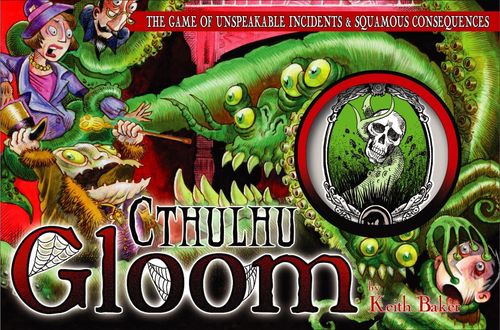
Cthulhu Gloom
Cthulhu Gloom Rulebook
Table of Contents
Table of Contents
Objective
In Cthulhu Gloom, you control a "family" of Lovecraftian protagonists, guiding them down a path of horror and madness to an untimely death. The goal of the game is frighteningly simple: you want your characters to suffer the most horrifying stories possible before succumbing to the oblivion of death, while keeping your opponents' characters happy, healthy, and annoyingly alive.
By playing Modifiers and Events on top of Character cards, you devise a terrifying tale for each of your characters, which will eventually end with his Untimely Death. Then he and all the chilling circumstances that led to his demise are set aside until the game's end.
The game ends when an entire family is eliminated, finally falling prey to the interdimensional doom that awaits us all. You then add up the visible Pathos points on your dead characters, along with points from Story cards you control. The player whose characters have been tormented the most — the one with the lowest total Family Value — wins the game.
Components
Cthulhu Gloom is a card game for 2 to 5 players, ages 13 years and up. Game play takes about 1 hour. In addition to this rules sheet, Cthulhu Gloom includes 20 Character cards, 54 Modifier cards, 11 Event cards, 20 Untimely Death cards, and 5 Story cards.
Setup
Before play begins, separate the Character cards and Story cards from the deck, then do the following:
Select Stories
Select two Story cards and place them face up in the center of the table.
Choose Characters
Each player chooses a family, and takes the 5 Character cards with that family's symbol below the illustrations.
Family Symbols
- Miskatonic University
- The Whateleys
- Village of Innsmouth
- Arkham Sanitarium
Place your Character cards face up in front of you on the table. Families that aren't chosen by a player are set to the side for the duration of the game.
In a 4-player game, each player should choose 1 Character to discard; families of 4 keep the game from running long. To play with 5 players, give the fifth player these extra Characters to make a new misfit family.
Draw Your Hand
The rest of the cards in the deck are shuffled and placed face down at the center of the table to form the draw pile. Each player then draws 5 cards from it to make up his starting hand.
A discard pile will form face up next to the draw pile during the game. If the draw pile ever runs out, reshuffle the discard pile to create a new one.
Now you're ready to torment your characters! The player who's had the most insane day goes first; if there's debate, the owner of the game decides. Play then continues clockwise around the table.
Game Play
When it's your turn, you make 2 plays then draw back up to your hand limit, in that order.
Make 2 Plays
First, make 2 of the following plays; it's fine to make the same play twice (except Untimely Deaths).
Play a Modifier: As either play, place a Modifier from your hand on any living Character, even if it's not your own. Modifiers contribute the Pathos points along their left edge to the Character's Self-Worth score, add a story icon, or give an effect.
Play an Event: As either play, follow the instructions on an Event card in your hand, then discard it. Events have an effect that's triggered when played.
Play an Untimely Death: As your first play, place an Untimely Death card from your hand on any living Character with a negative Self-Worth score, even if it's not yours. This secures those Pathos points until they're counted at the end. You can't play an Untimely Death as your second play, but a Modifier or Event may let you use it as a "free play."
Claim a Story: As either play, if you meet its requirements, you can take a Story card on the table or from another player and gain its benefits; place it next to your Characters.
Discard Your Hand: As either play, you may discard your entire hand. You don't get new cards until the end of your turn, though; if you discard as your first play, you may not be able to make a second play!
Pass: You don't have to make one or both plays if you don't want to.
Draw Back Up
After you've made your 2 plays, draw until the number of cards in your hand is equal to your current draw limit. Unless it's altered by card effects, your draw limit is 5 cards.
You aren't forced to discard cards; if you end up with 7 cards in your hand and your draw limit is 5, you simply don't draw until you have fewer than 5 cards.
Once you've drawn, the player to your left begins his turn.
Free Plays
Some Modifiers or Events allow you to play additional cards as "free plays" that don't count towards your 2 standard plays. You may play an Untimely Death as part of a free play.
Storytelling
Half the fun of Cthulhu Gloom is the stories that unfold as the game progresses. On your turn, it's up to you to explain the effects of your plays and how these chilling events have come to pass.
For example, you control Herbert West and play Was Searching a Sepulcher on him. What is he searching for? And if your opponent follows this play by saying Herbert Triumphed in Tenure or Married a Marsh, what did these have to do with what he found in the graveyard? What effect did they have on Professor Armitage, who'd been vying for that tenure position, or on Herbert's new in-law, Barnabas Marsh?
There are no right answers to these questions, and it's up to you how deeply you delve into these tales of terror. But when you play a card, try to explain how it fits that character's story … you'll have more fun if you do!
The Cards
The basic Cthulhu Gloom game uses 5 types of cards: Characters, Modifiers, Events, Untimely Deaths, and Stories. Cards are resolved in the order in which they're played.
The cardinal rule of the game is that you only pay attention to card elements you can actually see. Ignore those you can't. So a Character's Self-Worth score is the sum of its visible Pathos points. A continuous effect continues until its effect text is covered. And while a persistent effect is harder to remove, as soon as its upper right icon and central reminder are obscured, the effect ends.
Common Card Elements
Cards include one or more of the following elements:
Pathos Points: These are the numbers on the left side of the card, and there are 3 spaces for them. Combine all of the visible Pathos points on a dead character to determine its Self-Worth score, and add those together plus the points on Story cards you control to get your total Family Value.
Story Icons: Story icons are located on the right side of a card. They have no effect on their own, but frequently trigger or interact with other cards.
Flavor Text: Characters, Modifiers, and Events generally have italicized text in the main text plate. This has no effect on the game, but is fun to read aloud.
Effects: Most cards have a game effect. These are divided into categories:
Immediate effects trigger as soon as the card is played from your hand (for example, forcing a player to draw or discard cards, or bringing a Character back from the dead). If the card is later shifted from one Character to another, this doesn't trigger the effect again. Most Modifiers are immediate effects.
Response effects are those used during another player's turn as a response to a play, instead of being played on your turn. They say something like "Cancel ____ as it's played."
Continuous effects trigger when the card is played and remain in effect as long as the effect text is visible (for example, by increasing or decreasing a player's draw limit). If an effect's Modifier card is moved to another Character, the effect then applies to the new Character as long as its text is visible.
Persistent effects trigger when the card is played, but can remain in effect even after the card and its effect text is buried; an icon in the top right story icon space signifies this, along with a text reminder in the center of the card under the illustration. The effect remains active as long as the icon and text reminder are visible, and it applies to the new Character if its Modifier card is moved.
Certain effects are paired with a story icon requirement for either the Character or family it's played on:
Character requirements must be met by the Character the card is played on for its effect to trigger. For example, a card that says "If Character has [Horror icon]" means its target Character must have that story icon showing when it's played or else the effect doesn't work. The card can still be played on a Character without the right icon(s) — its effect just doesn't happen unless the required icons are visible when it's first played. Some cards have a standard effect given before a Character requirement effect; the standard effect triggers independently from the requirement effect.
Family requirements work the same way, but must be met by a combination of at least 2 living or dead Characters in your family for you to take an unclaimed Story card from the center of the table. For example, "Family must have [icon] [icon]" means you'd need 2 Characters each with 1 of the required story icons showing. To take a Story card from another player, you must control more Characters with the required icon(s) than he does; again, this must be at least 2 Characters. You don't lose a Story or its effect if you lose the required icons, but it makes it easier for another player to steal it from you.
Effects always apply to and are resolved by the player controlling the Character the card is played on, not the person who played it, unless the card says otherwise. So if you play a Modifier with the immediate effect "Draw 2 cards" on an opponent, he draws 2 cards, not you. If the effect includes skipping part of "your" turn, it again means your opponent; so "Don't draw back up this turn" would mean you don't lose your draw, he does.
Character Cards
Character cards have a black text plate with white text, like modifiers; they can be identified by the colorful character portrait in the center of the card and the family symbol beneath it. Character cards have no story icons, effects, or Pathos points — Characters start with no Self-Worth, as they're the basic foundation on which you build your tale of terror.
Modifier Cards
A Modifier has a black text plate with white text. Modifiers always have Pathos points, and many have story icons. Modifiers that have persistent effects include a central image, but most don't.
Playing Modifiers is how you inflict horrors on your own characters and cheer up your enemies. Generally speaking, you'll want to play Modifiers with negative points on your family and those with positive points on your opponents, but the effect of the card may give you a reason to break this guideline.
You can only play Modifiers on living characters, unless a card effect specifically says otherwise. But you may play Modifiers either on your own Characters, or on Characters controlled by other players.
Multiple Modifiers can be played on the same Character card; if a new Modifier card covers up the Pathos points, story icon, or effect of a prior Modifier, that element is overridden.
Event Cards
An Event has a transparent center, no story icons or Pathos points, and a grey text plate with red text. These single-use cards are played from your hand and then discarded, and give an effect.
Untimely Death Cards
An Untimely Death (and in Cthulhu Gloom, all deaths are untimely) has a grey text plate with black text, and a skull image in the center that covers the portrait of the Character it's played on. These cards turn worthless living Characters into valuable dead ones.
On your first play, you may place an Untimely Death on your own Character or on one belonging to another player. However, you may only play an Untimely Death on a Character with a negative Self-Worth score. Sane and happy Characters rarely die in these stories!
Some cards also have effects that can cause a death to occur on another player's turn, or as a free play; such cards can let you play an Untimely Death as part of your second play, effectively.
When an Untimely Death is played on a Character, set aside that Character card along with all the cards that have been played on it. Players can't play additional Modifier cards on a dead Character, and only a few Event cards affect dead Characters.
Story Cards
A Story card has an image in the center, a grey text plate with green text, and may have Pathos points or a persistent effect icon. A Story is a dramatic element that can impact a family … if you control a Story, you gain any points and effects listed on the card. But it can slip away and be claimed by another family!
You can only have one Story at a time; when you claim it, place it on the table in front of you. If you claim a second Story, move your previous one back to the center of the table.
Story Icons
- Blank: This opaque block covers up a previous icon, nullifying its effect.
- Goblet: This modifier deals with feasts, poison, and other food-related events.
- Horror: This icon refers to dangerous creatures, fungi from Yuggoth to terrifying shoggoths.
- Investigation: Lovecraft's heroes are always poking their noses where they don't belong. Now you can too!
- Madness: This icon suggests that your Character has been overcome by the horrors he's seen and has lost his grip on reality.
- Magic: You may be learning dark secrets, or become the victim of supernatural misfortunes.
- Romance: This icon deals with relationships, both good and bad.
- None: A clear space that lets a previous icon show through means that icon is still in effect.
Effect Icons
- Immediate
- Response
- Continuous
- Persistent
Sample Family in Mid-Game
The rulebook illustrates how Pathos points stack up into a Self-Worth score with a diagram of one family's five Character cards partway through a game:
- Herbert's Self-Worth is 0.
- Walter's Self-Worth is -40 (final).
- Asenath's Self-Worth is +10.
- The Professor's Self-Worth is -30.
- Edward's Self-Worth is -15 (final).
Winning
The game ends the instant the last Character in any family dies. Add up the visible Pathos points of all your own dead characters to get their Self-Worth score, and total those plus add any points from Story cards you control to get your final Family Value. The player with the lowest Family Value wins the game.
Only visible Pathos points count toward a Character's Self-Worth score; those that have been covered are ignored. You receive Pathos points at the end of the game only for your own dead Characters; your living Characters, and the dead Characters of your opponents, don't contribute to your total Family Value.