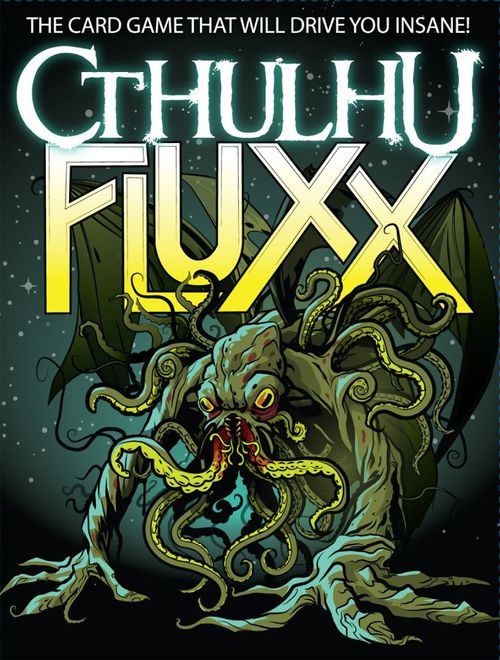
Cthulhu Fluxx
Cthulhu Fluxx Rulebook
Table of Contents
Table of Contents
Overview
Cthulhu Fluxx is an easy game to learn because every card carries its own set of instructions. Many folks find that the best way to learn is by jumping right into a game, but that usually works best if at least one player in the group has played a Fluxx game before. So, if this is the first time for everyone, someone in the group needs to read these rules. But don't worry, after you've played the game a few times, everyone will understand!
Setup
Place the Basic Rules card in the center of the table. Shuffle the deck and deal three cards to each player. Place the remainder of the deck face down next to the Basic Rules to form a Draw pile. At the beginning of the game, there will be no Goal or New Rule cards in play yet.
Going First
There is no rule for who gets to go first. You decide!
How to Play
Fluxx is a game about change, so it's a game that changes as you play it. It begins with just a couple of very simple rules, and becomes more complex as additional rules are added via special cards called New Rules.
Start by following the Basic Rules (draw one card & play one card), and adapt to all additional New Rules as they are played. Players take turns, going clockwise around the table, drawing and playing the indicated number of cards until someone meets the current Goal condition.
On Your Turn
- Draw the number of cards currently required.
- Play the number of cards currently required.
- Discard down to the current Hand Limit (if any).
Optional actions allowed by New Rules, Keepers, etc., may be performed at any point during this sequence.
When playing a card, you may choose any card in your hand. If you aren't sure how a card works, try reading the full text aloud as you play it.
Sample Game (in progress)
The rules sheet illustrates a sample game in progress, with these callouts:
- Goals are played to the middle of the table.
- Keepers are played face-up on the table in front of each player.
- New Rules are played next to the Basic Rules in the middle of the table.
- Creepers go next to your Keepers.
- Actions are used, then immediately discarded in the discard pile.
Card Types
Basic Rules
This is the starting point — the foundation on which the rest of the game is built. These initial rules will be superseded by New Rules during the course of play, but this card should remain on the table at all times. The Basic Rules are: Draw 1 card per turn and Play 1 card per turn (with no other restrictions such as Hand or Keeper Limits).
New Rule
To play a New Rule place it face up near the Basic Rules. If it contradicts a New Rule already in play, discard the old rule. New Rules take effect instantly, so all players must immediately follow the New Rule as required. This will often cause the player whose turn it is to draw or play additional cards right away, or it may cause other players to immediately discard some of their cards.
Example: After drawing 1 card, you play the "Draw 4" New Rule. Now the rules require you to Draw 4 cards on each turn, but since you only took 1 card before, you must immediately draw 3 more cards. The next player draws 4 cards. He plays the "Draw 2" which changes the rules again, but he draws no more, having already gotten (at least) 2 cards before. Since Draw 2 contradicts Draw 4, the Draw 4 is discarded.
Goal
To play a Goal place it face up in the center of the table, discarding the previous Goal (if any). The game begins with no Goal in play, so no one can win until one is played. The Goal applies to everyone; as soon as someone meets these conditions, they win! (Even if it's someone else's turn!)
Keeper
To play a Keeper take it out of your hand and place it on the table in front of you, face up. Most Goals require you to have a particular pair of Keepers, so playing a Keeper is always a good thing.
Action
Actions are used once and discarded. Just do whatever the card says, then place it on the Discard Pile. Actions can sometimes cause major chaos, and yet at other times, have no effect at all. Note that while some Actions may cause additional cards to be played, everything that happens as a result of an Action card is considered part of one "play."
Examples: If you play the Action called "Draw 2 and Use 'em" you will immediately draw two cards and play them both. If one of those cards is "Draw 3, Play 2 of them" you'd keep going, drawing three more cards, playing two cards and discarding the third. All of this activity would be counted as the playing of just one card.
Creeper
Unlike Keepers, which are things you want because they help you win, Creepers are undesirable cards which often prevent you from winning. Creepers are kept on the table in front of you in the same area as your Keepers.
Whereas Keepers stay in your hand until you decide to play them, Creepers are played automatically. As soon as you draw a Creeper you must place it face up in front of you and draw another card. This does NOT count as a "play." You might have to accept more than one Creeper at once as you draw cards, until you've drawn the required number of non-Creepers and added them to your hand. Note that this is true any time you draw a card, such as during an Action.
Example: If you play the Action called "Draw 3, Play 2 of them" you will start by drawing three cards. If any of those cards are Creepers, you would place them in front of you and redraw immediately until you have three non-Creeper cards, then you would choose which two of those to play.
Ungoal
The Ungoal is treated exactly like a regular Goal, but instead of causing a player to win, if the conditions of the Ungoal are met the game ends with all players losing.
Surprise
This type of card can be played at any time, even when it isn't your turn. Note that Surprises have two functions, one for during your turn, and one for out-of-turn. Surprises can also be used to cancel other surprises.
Meta Rule
This type of card changes the game like a regular New Rule, however, Meta Rules go into force at the start of the game and remain in effect until someone wins. Meta Rules are only added to the game if all players agree.
Winning
The game continues until someone meets the conditions of the current Goal. That player wins instantly, no matter whose turn it is!
Notes
If the Draw pile runs out, shuffle the Discard pile, turn it over to make a new Draw pile, and keep playing.
The game doesn't end until there is a clear winner. If for some reason two or more players meet the winning conditions simultaneously, the game continues until a single winner emerges.
New players may join at any time by being dealt a hand of three cards.
Regarding Discarding: Discarding a card is not the same as playing it. When a card is played all instructions on that card must be followed, if possible. You cannot simply discard unwanted cards; you can only discard if compelled to by a Hand Limit. (Yes, this means you could be forced to play a card that makes someone else win.)
Special Icons
This version of Fluxx also uses the following themed icons:
Investigator: This icon is used to label Keeper characters who are investigating Secrets Man Was Not Meant To Know.
Doom: Creepers and Keepers with this symbol on their stripes are said to be "Doomed." Some cards will bear 2 or even 3 of these icons, meaning they are worth that many Doom Points. These points will be totaled and compared in various situations. Note that there is a personal Doom count for each player, as well as an overall Doom count for the game, which is the sum of all players' personal Doom counts.
Anti-Doom: This icon is used to label items with a calming effect on the forces of Doom. As such, they negate Doom Points when totaling up Doom Counts.
Attachable Creeper: This icon appears on Creepers that attach themselves to Keeper cards in play, as a reminder of the need to keep these cards connected when required.
Frequently Asked Questions
Q: What happens if I want to play a New Rule but there's already a New Rule in the center on the table? Does it replace the old New Rule, or do they peacefully co-exist?
A: It all depends on contradictions. There's no limit on the number of New Rules that can be in play at once, as long as they don't interfere with each other. If the New Rule you are adding has nothing to do with the existing New Rule, both rules remain. However, if both rules are about the same thing, for example how many cards to Draw, then the new card becomes the rule and the old rule is discarded.
Q: What if a New Rule, such as Play 3, contradicts the Basic Rules?
A: The New Rule still supersedes the Basic Rules, but the Basic Rules card does not get discarded. To help avoid confusion, the New Rule can be placed to cover up the portion of Basic Rules it replaces.
Q: What if the Rules require me to Play 4 but I only have 2 cards?
A: Play as many as you can. Your turn ends when you have no cards left in your hand, even if you are supposed to play more.
Q: Suppose the rule is Play 2 and for my second play I change the rules to Play 3. Do I play one more card or am I done because I played 2?
A: All rules take effect immediately, so you would need to play 1 more card because the rules at that point had become Play 3.
Q: How do I interpret the Play All card? If, by playing my cards, I receive more cards in my hand, do those new cards have to be played as well, so that I will always end up with zero cards in my hand at the end of my turn as long as Play All is on the table?
A: Yes.
Q: If I play a Keeper, and I already had a Keeper, do I have to discard the first one to play the new one?
A: No. In this version of Fluxx, there are no Keeper Limit rules.
Q: Suppose there's a Hand Limit rule in play when my turn begins, but, during the course of my turn, the limit card is removed and discarded as a result of another Rule card or Action card. Is it still necessary for me to discard down to the limit that is no longer in play?
A: Nope! Just as Rules take effect immediately, their effects also cease the moment the rule disappears.
Q: Does a Hand Limit mean "hold the limit number, unless you already have fewer cards, in which case hold that lower number"?
A: Yes. It's not a quota that you must draw up to in order to meet, it's simply a cap on the number of cards you're allowed to hold.
Q: When discarding cards because of a Limit rule, do you get to choose what to discard, or is it random?
A: You get to choose.
Q: How do you get rid of Creepers?
A: There are various ways. Some Actions will allow you to move them to other players or discard them. Some Keepers have special powers that will allow you to get rid of Creepers. Sometimes the rules or other conditions will make Creepers irrelevant, or even desirable.
Q: Some Creepers say they must be attached to Keepers. If you have such a Creeper but no Keepers that it can be attached to, does it just hang around in front of you until an appropriate Keeper arrives?
A: Yes.
Q: What happens if there are Creepers in my initial hand of cards?
A: Before the first turn, all players look at their starting hand, and if they have any Creepers, they must immediately lay them down and draw to replace them until everyone is holding three non-Creepers.
Q: Do I get to play any cards or take any actions when it's not my turn?
A: When it's someone else's turn, there's not much you get to do — unless you have a Surprise (the only type of card you can play out of turn). But you will sometimes need to make minor decisions or perform card maintenance during other players' turns. For example, if someone plays a Hand Limit and you have more cards in your hand than are allowed, you'll need to decide what to keep and what to discard.
Q: Suppose I play Draw 2 and Use 'em and I draw two Goals, and one of them will cause my opponent to win. Can I play the two Goals in instant succession, with the one that doesn't make them win on top, so that they don't get to win?
A: No. Any time a Goal is played, it provides a chance for someone to win with those conditions. No matter how briefly that Goal is in play, it counts, and if someone meets the conditions in that instant, they win.
Q: Suppose if I draw a Creeper as one of the cards I get during Dreams and Omens? Do I give it away like any other card?
A: No. You must receive the Creeper yourself and draw again so that all of the cards you are distributing for the Action are non-Creepers.
Q: Does using a special option listed on a Keeper count as a Play, or is it a Free Action? For example, if you use the Necronomicon to move a Creeper... is that considered a "Play"?
A: No, special options provided by Keepers are Free Actions, not Plays.
Q: Since you can cancel a Surprise by playing another Surprise, can a 3rd Surprise card be played consecutively?
A: Yes. (Also, using a Surprise to cancel another Surprise never counts as a Play, even if you do it during your turn.)
Q: Do I get a replacement play if someone cancels one of my plays with a Surprise?
A: No.
Q: The Surprise called The Stars Are Wrong says "All other players must discard one Action, or a random card, from their hands." Does that mean you have a free choice, or must you discard an Action if you have one, and a random card only if you don't?
A: You can either discard an Action of your choice from your hand, or have someone else pick a card at random from your hand to discard.
Q: Can I play Twist of Fate out of turn when someone else plays Steal a Keeper to allow me to steal the Keeper they are stealing?
A: No. The other player didn't actually play the Keeper, they played an Action which let them take possession of a Keeper. You could play The Stars Are Wrong to stop the Action itself, but you would not gain the Keeper they were trying to steal. The Keeper would remain unstolen, with its original owner.
Q: Who trumps who: The Cultist or the Secret Cultist? That is, if someone has the Cultist in play, and someone else is holding the Secret Cultist, and the Dunwich Horror Ungoal is met, who wins?
A: The Secret Cultist wins over the regular Cultist.
Q: The Dreamer can get rid of Nightmares. What if the Nightmares are attached to the Dreamer?
A: The Dreamer can "cure" anyone of Nightmares, including himself.
Q: Can you answer more of my questions on the internet?
A: Yes! Please visit LooneyLabs.com for the latest FAQ updates!
Look for other Looney Labs games at a game store near you: http://roster.looneylabs.com