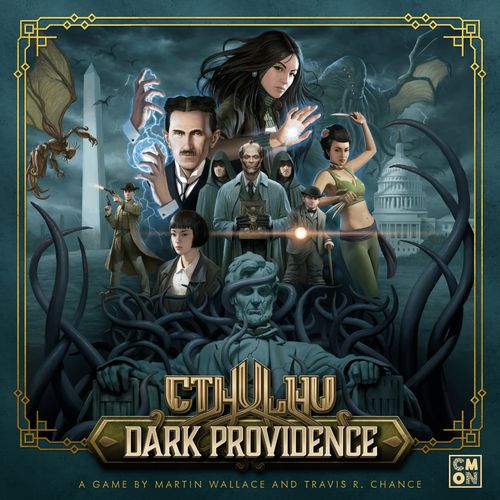
Cthulhu: Dark Providence
Cthulhu: Dark Providence Rulebook
Table of Contents
Table of Contents
Overview
Cthulhu: Dark Providence is a competitive game in which 1 to 5 players take on secret roles of Investigators, Cultists, or Dissidents of either of the 2 sides in a fight for the destiny of a country on the verge of ruin. Each player's Alignment determines how they score points at the end of the game, however, only a single player wins the game.
During the game, players use Influence cubes to bid for the right to claim Asset cards, take control of Cities, and gain Mythos cards. Each new Asset card acquired improves the players' deck and therefore the resources and actions they can perform during a turn. Trying to keep their Alignment secret and pushing the limits of their Agents' sanity, players perform a multitude of actions, swaying Recruited Agents to their side of the battle, assassinating other players' Agents, gathering additional help from powerful Mythos cards, locking other players from claiming cards, and sealing or protecting Gates, among others to gain Victory Points. At the end, the player with the fewest VP and any player sharing their Alignment are eliminated from the game, and only the remaining player with most VP wins the game.
Components
- 30 Frames (6 for Each Color)
- 1 Sanity Test Bag
- 95 Influence Cubes (19 for Each Color)
- 1 Plastic Stand
- 1 Game Board
- 1 Track Board
- 5 Player Dashboards (1 for Each Color)
- 6 Alignment Cards
- 50 Starting Cards (10 for Each Main Agent)
- 60 Primary Cards
- 13 City Cards
- 24 Mythos Cards
- 5 Player Aid Cards
- 5 Main Agent Tokens
- 22 Recruited Agent Tokens
- 8 Deep Ones Tokens
- 1 Mi-Go Token
- 12 Double-Sided Gate Tokens
- 12 Lock Tokens
- 6 Sanity Tokens
- 12 Insanity Tokens
- 1 Investigation Tracker
- 1 Ritual Tracker
- 60 Control Token (12 for Each Color)
- 1 Cthulhu Standee
- 1 Martial Law Token
- 3 Whateleys Tokens
Solo Mode Components
- 6 Elder Ones Cards
- 2 Cultist Cards
- 8 Cultist Behavior Cards
- 2 Cultist Tokens
Basic Concepts
Alignment
Each player in the game represents a side in the struggle for the fate of humankind, which is determined by their Alignment card.
Investigators seek to prevent the impending doom looming just outside of the edges of our world. Investigators score Victory Points (VP) by sealing Gates to dark dimensions, claiming Agents with Investigator VP (pink VP), and advancing the Investigation track. However, brave as they might be, their lives and sanity are always at risk. If at any point an Investigator is driven to Insanity, the game ends immediately (see pg. XX). The opposite of an Investigator is a Cultist.
Cultists seek to usher in an era of darkness and chaos whereupon their otherworldly masters will reward them for their servitude. Cultists score Victory Points (VP) by protecting Gates, assassinating Agents, claiming Mythos cards with Cultist VP (green VP), and advancing the Ritual track to bring about the end of the world as we know it. Their sanity is questionable, and so, Cultists driven to insanity don't trigger the end of the game, and in reward for their loyalty are immortal. The opposite of a Cultist is an Investigator.
Dissidents were once Cultists and Investigators but have since become disillusioned with their loyalty. All Dissidents score VP for assassinating Agents, for sealing and protecting Gates, and for the track corresponding to their former loyalty (Investigator or Cultist) but don't score for recruiting Agents or summoning Elder Ones. Since Dissidents are enemies of both sides of the struggle, concealing their identity is paramount and they suffer penalties if they ever have their Alignment revealed (see pg. XX). The opposite of a Dissident is a Dissident of the other type (eg. a Dissident Investigator is the opposite of a Dissident Cultist, and vice-versa).
Generic Victory Points (blue VP) are scored by players regardless of their Alignment (Investigator, Cultist, or Dissident).
Boards
There are 2 boards in the game: the Game board and the Track board. The main actions of the game take place on the Game board while the Track board is used to keep track of the players' Victory Points (VP) and their Alignment progression.
Game Board
Each City Space on the Game board shows:
- City Name
- City Asset Card Reminder: A reminder of the City Asset card's resources.
- City Space: Space in which Influence cubes are added to claim a City, lock tokens are added to block a claim action, and agents are placed and move through.
- City Control Slot: Used to mark when a player takes control over a City.
- City Control Value: Amount of VP immediately gained by claiming control of a City. This value also needs to be matched to assassinate in the City.
- Gate: Open gates to other dimensions that can be either sealed or protected during the game.
- Gate Value: This value needs to be matched in order to seal or protect a Gate and it's gained as VP at the end of the game.
- Primary Asset Card Deck Slot: Space in which Primary Asset cards are placed and Influence cubes are added to claim Primary Asset cards. The slot also lists an effect to resolve immediately when the deck is depleted.
- Route: Connects Cities. Each route has a cost to be paid to move through it. Cities connected by a single route are considered adjacent.
Track Board
The Track board shows:
A. VP Track: Used to track each players' VP. B. Investigation Track: Used to track the progression of the Investigators' side. C. Ritual Track: Used to track the progression of the Cultists' side. D. Mythos Cards: Row of Mythos cards available to be claimed as well as a reserve to add to the row during the game. E. City Cards: Reserve of City Asset cards, to collect when Cities are claimed. F. Cache: Reserve of primary Asset cards that, unless stated otherwise, don't enter the game. G. Limbo: Influence cubes used to claim are moved to Limbo until they are retrieved.
Cards
Asset cards form the player's decks and are used during the game to perform their actions. There are 3 types of Asset cards:
- Starting Asset cards: These are the 10 cards of their Main Agent and comprise a player's deck at the start of the game. Their card face shows a Resources area.
- Primary Asset cards: These cards are placed on Cities, on the Primary Asset cards deck slot, and can be claimed during the game by the players to improve their deck and sculpt their strategy. Their card face shows an Effect area.
- City Asset cards: Players gain access to these cards by claiming and taking control of a City. Their card face shows the City's Name.
Mythos cards provide powerful effects that players can use during the game but are never shuffled into a player's deck. A Mythos card's face shows its VP value and, where present, a Sanity Test icon — this means a Sanity Test must be performed after the card is claimed.
Agents
Agents are characters that players control during the game. Each player starts the game with a Main Agent and throughout the game can sway Recruited Agents to their side. Agents provide 1 additional Influence while present in a City Space for the claim action (see pg. XX). In addition, Agents may add Influence in the City Space they occupy, as well as perform actions through the use of card actions (see pg. XX) or have their own permanent effects (unique to Harry Houdini, Lillian La France, and Alice Ochs).
Each Agent token is double-sided. All Agents start the game with their regular side faceup and only through the effects of the Revenants card can be flipped to the other side (see pg. XX).
Main Agent cards show a Power value. Recruited Agent cards show Actions and, where present, a VP value.
Setup
The following is a setup for a 2-5 player game. For the solo setup and rules, see the Solo Mode section below.
-
Place the Game board in the play area within reach of all players.
-
Place the Track board to the right of the Game board.
-
Place the Ritual and Investigation trackers on the starting space of the Ritual and Investigation tracks, respectively.
-
Place the 18 Sanity Test tokens in the Sanity Test bag and leave the bag near the Game board.
-
Place the 13 City Asset cards in a faceup deck to the right of the City cards slot on the Track board.
-
Shuffle the 60 Primary Asset cards. Then, place a number of cards facedown in the deck area of each of the 12 Cities based on the player count:
- 2-3 player game: 3 cards per City.
- 4-5 player game: 4 cards per City.
Then, reveal to top Primary Asset card on each City. If an Agent card is revealed, add its corresponding token on top of the card.
-
Set aside the remaining Primary Asset cards in a facedown deck to the right of the Cache slot on the Track board.
-
Shuffle the Mythos cards and place the deck to the right of the Mythos card slot on the Track board. Reveal and place to the right of the deck a number of faceup Mythos cards based on the player count to create the Mythos row:
- 2-3 player game: 3 cards.
- 4-5 player game: 4 cards.
-
Each Player:
- Chooses a color and takes the corresponding Agent dashboard, 7 Influence cubes, 13 Control tokens, and 6 Frames. Leave the remaining Influence cubes in a general supply next to the board, sorted by color.
Let the insanity begin!
Gameplay
Cthulhu: Dark Providence is played over a series of turns, starting with the first player and proceeding clockwise. During their turn, each player:
- Performs 2 actions plus any number of free actions that they may have.
- Places any cards used to perform actions in the discard pile on their dashboard, as soon as the action is fully resolved.
- Draws cards from the top of their deck until they reach 5 cards in hand. If a player cannot draw a card because their deck has been depleted, they shuffle their discard pile to create a new deck, and continues to draw cards until they reach their hand size.
Then, once a player's turn ends, the next player in clockwise order takes their turn. Play continues this way until one of the end game triggers occurs, at which point scoring takes place and a winner is determined (see Game End).
NOTE: It is possible that cards may have effects that contradict a rule. If that ever happens, the card takes precedence over the rules.
Actions
Most actions require resources on Asset cards to be performed. A player may only ever use an Asset card for a single purpose:
- Use a single type of resource.
- Use its ACTION effect.
- Use its FREE ACTION effect.
When playing cards for resources to perform an action, players cannot play more cards than needed to meet the required resources for their intended action.
Any card with a RESPONSE effect has the listed effect triggered by a condition specified on the card (when a card is obliterated, or discarded, used for its ACTION effect, etc). A RESPONSE is not considered an action and therefore it does not count towards the 2 actions a player can take on their turn.
Obliterate
Effects may obliterate cards during the game. Whenever a card is obliterated, remove that card permanently until the end of the game, returning it to the box. If it's an Agent card, remove its token from the Frame, return the Frame to the player, and remove the token until the end of the game. City Asset cards cannot be obliterated. If a City Asset card would be obliterated, return it to the City cards area on the Track board instead.
EXAMPLE: On her turn, Agent Tuesday plays 2 cards from her hand: 1 Starting Asset cards with 1 Influence and Eunice Hunt with 2 Influence. She has the total of 3 Influence to add to any Primary Asset card, City Space, or Mythos card. Looking to acquire the Anarchists Primary Asset card in a future turn, she adds her 3 Influence cubes to the card.
Add Influence
A player may play any number of Asset cards from their hand with Influence to add that many Influence cubes from their personal supply to a Primary Asset card, a City Space, or a Mythos card. A player can only add Influence to 1 card or City Space as part of a single action. There is no limit to the number of Influence cubes that can be added to a card or City Space. Players cannot deliberately play more cards than needed. The only time players can add fewer Influence cubes than the number indicated is if they play a card with 2 Influence and they only have 1 available in their personal supply.
Claim (1st Action Only)
A player may use their first and only their first action to claim 1 Primary Asset card, Mythos card, or City in which they have the most Influence. In the event of a tie, unless stated otherwise, no player is considered to have the most Influence. Agents provide 1 additional Influence while present in a City for the claim action. However, a player must still have at least 1 Influence cube on the card or City in order to be able to claim it. Cards and Cities with a lock cannot be claimed. The claim action requires no cards to be performed.
NOTE: The Alice Ochs Agent adds 2 Agent Influence in her current City Space instead of 1.
When performing a claim action, the player follows these steps, in order:
- Places their Influence cubes on the card or City Space of a City they are claiming into Limbo. Any other player with Influence on that card or City Space retrieves all their Influence cubes back to their personal supply.
- Follows the steps required for claiming each type of card or City accordingly (see below).
- Resolves CLAIM effects on the claimed card, if any.
- Checks if the claimed card has a Sanity Test icon. If the icon is present, they must perform a Sanity Test (see Sanity Test).
IMPORTANT: Some effects allow players to claim cards or Cities throughout the game. This is still considered a claim action for the purpose of CLAIM effects, however players do not have to have Influence on the cards nor does it have to be their first action, unless stated otherwise.
EXAMPLE: Agent Friday starts his turn with Influence cubes on the Atlanta City Space, and on the Revenants and the Wyatt Earp Primary Asset cards. However, he only has the most Influence on the Wyatt Earp card. He then decides to use his 1st action to claim the card. He moves his Influence cubes from the Wyatt Earp card into Limbo and adds the card to his discard pile.
Each type of card has its own steps to perform when claimed:
Primary Asset card The player takes the card from the board and places it in their discard pile. If the card claimed is a Recruited Agent, the player takes the corresponding Recruited Agent token and slides their Recruited Agent token into a Frame of their color (regular side up). Then, the player places the Recruited Agent in the same City Space in which the Agent was claimed.
Then, they reveal the next card in that City's deck, if any. If the card revealed is an Agent, place the corresponding Agent token top of the card. If the card claimed was the last one in that deck, the player instead increases the Ritual track by 2 and add 1 Mythos card from the deck to the Mythos row.
EXAMPLE: Since Wyatt Earp is a Recruited Agent, Agent Friday takes the corresponding Agent token and places it on one of his Frames. Then, he places the Wyatt Earp Agent in the New Orleans City Space, as it was the City in which Wyatt Earp was claimed.
IMPORTANT: A player can only control 6 Agents at the same time. This includes their Main Agent, Recruited Agents, and Mi-Go (a special agent acquired through a Mythos card). A player cannot claim Agents if they already have 6 in play.
City The player places their Control token on the City control slot. If another player had control of the City, they take back their Control token. The player taking control of the City scores VP equal to the City's control value. Conversely, the player losing the control of the City, if any, immediately loses the City's control value VP. Then, the player claiming the City takes the City Asset card from the City card deck and adds it to their discard pile. If the City was claimed from another player, take the City card from the player's deck, hand, or discard pile. If the card was in the player's hand, they draw 1 Asset card to replace it. If the card was in their deck, they must reshuffle their deck afterwards.
NOTE: A player can never claim a City they already control.
EXAMPLE: Agent Monday starts his turn with the most Influence cubes on the Atlanta City Space. He decides to use his turn to claim the City. Since the City was under Agent Tuesday's control, she removes the card from her deck, reshuffling it, and gives it to Agent Monday. She immediately loses 3 VP for losing control of the City. Agent Monday replaces Agent Tuesday's Control token for his own, adds the card to his discard pile, and gains 3 VP. Finally, Agent Friday, who also had Influence on the City Space retrieves his Influence cubes while Agent Monday moves his cubes into Limbo.
IMPORTANT: Aside from cards that specifically state otherwise, taking control of Cities is the only way players gain VP during the game. All other VP are scored once the end of the game is triggered (see Game End).
Mythos card The player places the Mythos card next to the designated area of their Player dashboard. Some Mythos cards (Cthulhu, Mi-Go, and The Whateleys) also have components associated with it that must be collected as well. Do not add a new Mythos card to the Mythos row to replace the one just claimed.
EXAMPLE: Agent Thursday starts her turn with the most Influence cubes on the Yog-Sothoth Mythos card. She decides to claim the card, adds it next to her dashboard, and moves her Influence cubes to Limbo. Yog-Sothoth has a CLAIM effect, so Agent Thursday will gain an additional action during this turn.
Retrieve Influence
A player may play any number of Asset cards from their hand with Influence to retrieve the same amount of Influence cubes from City Spaces, Mythos cards, Primary Asset cards, and Limbo, in any combination. Influence cubes from the general supply cannot be gained through this action.
EXAMPLE: Agent Thursday plays 2 cards with a total of 4 Influence. She decides to retrieve 2 from Limbo, 1 from the Offering Mythos card, and 1 from the Boston City Space back to her personal supply.
Buy Influence
A player may play any number of Asset cards from their hand with Influence to gain Influence cubes of their color from the general supply and add them to their personal supply. For every 2 Influence played the player takes 1 Influence cube of their color. Any remaining quantity is lost. Once a player has taken all their Influence cubes from the general supply, they can no longer take this action.
IMPORTANT: The amount of Influence cubes is limited. If more Influence would be gained than available, limit the action to the amount available instead.
EXAMPLE: During his turn, Agent Friday plays 3 cards for a total 5 Influence to buy Influence. He takes 2 Influence cubes of his color from the general supply and adds it to his personal supply. The remaining 1 Influence is lost and cannot be used in this or any further action.
Travel
A player may play any number of Asset cards from their hand with Travel to move 1 or more of their Agents from one City Space to another through connected routes. The cost to travel with an Agent is the total amount of the route(s) between the City Space of their origin to their destination. The player can use this action to travel with any Agents in any Cities, traveling to multiple destinations, provided that they have enough Travel. Any remaining quantity is lost.
NOTE: The Lillian La France Agent can move to an adjacent City without paying its cost once per turn.
EXAMPLE: Agent Monday plays 2 cards for a total of 4 Travel. He uses 3 to travel with his Main Agent from Pittsburgh to Chicago and 1 to travel with Rock Samson from Charleston to Atlanta.
Manipulate Ritual/Investigation
A player may play any number of Asset cards from their hand with Ritual/Investigation to increase or decrease the corresponding track by the same amount played. Players may only increase OR decrease a single track with 1 manipulate Ritual/Investigation action (eg. a single action may only move 1 tracker in 1 direction). If the Ritual or Investigation tracker ever reaches the final space of their respective track, the end of the game is triggered. Perform the Game End steps immediately after fully resolving the action (see Game End).
EXAMPLE: During her turn, Agent Tuesday plays the New Orleans and the James Horus Rose cards to manipulate the Ritual track. She advances the Ritual tracker 3 spaces up.
Card Action
A player may play 1 of their Asset cards or use a Mythos cards to perform an ACTION effect listed on the card. Some cards have FREE ACTION effects. These are performed following the same process, however, they don't use either of the player's 2 actions for their turn.
The following is a list of common ACTION and FREE ACTION effects:
Assassinate
To assassinate an Agent, a player must:
- Have one of their Agents present in the same City Space as another player's Agent.
- Play an Asset card that allows that Agent to perform this action by:
- Playing a card from the corresponding Agent if they have Actions
- OR
- Playing a card that allows any Agent to assassinate
- Match the City's control value with power. Agents controlled by the player performing the action that are present in the City contribute their power to this action even if they are not performing the action. Then, any remaining power must come from Asset cards played from hand. Play any number of additional cards with power to match the total City control value. The card used to assassinate does not contribute its power, if any. If the player doesn't have enough power, the action cannot be performed.
- The player performing the action takes the corresponding Agent token and places it on the Crypt area of their dashboard.
- The player whose Agent was assassinated obliterates the Agent card. If the card was in the player's hand, they draw 1 Asset card from their deck to replace it. If the card was in their deck, they must reshuffle their deck afterwards. Then, they take their empty Frame and return it to their personal supply.
IMPORTANT: A player's Main Agent can only be assassinated if they have no other Agents and only if they have 5 or more VP on the score track. A player's Main Agent also cannot be assassinated if their Cultist Alignment was already revealed.
If a player's Main Agent is assassinated, reveal their Alignment card. If it's a Cultist card, cancel the assassination and continue the game as usual. If it's an Investigator or Dissident card, the end of the game is triggered. Perform the Game End steps immediately after fully resolving the action (see Game End).
NOTE: The Harry Houdini Agent can never be assassinated.
EXAMPLE: Agent Thursday's Recruited Agent Adsila Chavos is in the Atlanta City Space, along with Agent Friday's Recruited Agent Gerard Lascaux. In her turn, Agent Thursday decides to play Adsila Chavos card, which allows her to assassinate. In order to successfully assassinate in Atlanta, she needs to match its City control value of 4. Adsila Chavos has 1 power, so he proceeds to play 3 cards for a total of 3 power. Gerard Lascaux is then assassinated. Agent Thursday takes its token and places it in her dashboard, on the Crypt, returning the frame to Agent Friday, who obliterates the Gerard Lascaux card from their discard pile.
EXAMPLE: Agent Wednesday's Main Agent and Recruited Agent Harry Houdini are in the Indianapolis City Space, along with Agent Monday's Recruited Agent Father Lachlan. On his turn, Agent Wednesday decides to play the Vicious Conspirator card, which allows him to assassinate with one of his Agents and decides to assassinate Father Lachlan with his Main Agent. Since his 2 Agents combined have 3 power, matching Indianapolis' City control value, Father Lachlan is assassinated without the need of playing additional Asset cards. Agent Wednesday takes its token and places it on his dashboard, on the Crypt, returning the frame to Agent Monday, who obliterates Father Lachlan's card from their deck.
Seal or Protect Gate
To seal or protect a Gate, a player must:
- Have 1 of their Agents present in a City without a Gate token.
- Play an Asset card that allows that Agent to perform a seal or protect by:
- Playing a card from the corresponding Agent if they have seal or protect
- OR
- Playing a card that allows any Agent to seal or protect.
- Match the Gate value with power. Agents controlled by the player performing the action that are present in the same City contribute their power to this action even if they are not performing the action. Then, any remaining power must come from Asset cards. Play any number of additional cards with power equal to that Gate value. The card used to seal or protect the Gate doesn't contribute its power, if any. If the player doesn't have enough power, the action cannot be performed.
- Place their Control token on the Gate slot of that City with a Gate token from the general supply on the corresponding side (sealed or protected) on top of it.
- Perform a Sanity Test (see Sanity Test). If an Insanity token is drawn and if it was a Recruited Agent performing the action, the Agent is obliterated (Main Agents cannot be obliterated). Remove that Recruited Agent's corresponding token and Agent card from the game. If the card was in the player's hand, they draw 1 Asset card from their deck to replace it. If the card was in their deck, they must reshuffle their deck afterwards. Then, they take their empty Frame and return it to their personal supply.
EXAMPLE: Agent Thursday's Main Agent is in the Atlanta City Space. She plays a Starting Asset card that allows her to seal a gate. Then, she plays 2 cards from her hand, to add 3 power to her Main Agent 1 power, for a total of 4, matching the Gate value. She proceeds to add 1 Control token on the Gate slot and Gate token on top of it, sealed side up. As an effect of the card, the card is also obliterated. She will then perform a Sanity Test.
EXAMPLE: Agent Thursday and Agent Monday both have Influence on the Nikola Tesla Mythos card, but Agent Monday currently has more Influence. Looking to prevent Agent Monday from claiming Nikola Tesla, Agent Thursday then plays a Starting Asset card that allows her to place or remove a lock. She proceeds to place 1 Lock token on the card. Agent Monday will only be able to claim the card if he or another player perform an action to remove the lock in a future turn, and only if he still has the most Influence on the card.
Place or Remove Lock
A player may play 1 Asset card from their hand with a lock to place or remove a Lock token from a Primary Asset card, Mythos card, or a City Space. Cards and Cities with a lock cannot be claimed by any means unless stated otherwise. However, players may still add and retrieve Influence from a card or City Space with Lock token. A card or City Space cannot have more than 1 lock.
IMPORTANT: The amount of lock tokens is limited. If a lock would be placed but there are no tokens available, the action cannot be performed.
Discard Cards
A player may discard any number of Asset cards in their hand to their discard pile.
NOTE: Although discarding cards is a terrific way to get through your deck faster, remember that players only draw cards up to their hand size at the end of their turn.
Reveal Alignment
A player can only take this action if their Alignment isn't revealed yet and only if it results in them having enough VP to trigger the end of the game based on their player count.
The reveal Alignment action requires no cards to be performed.
The player reveals their Alignment card and immediately scores VP for:
- Gates they have sealed/protected, according to their Alignment.
- The range in which their Alignment tracker is located on the track.
This player doesn't score VP for these a second time during the Game End Scoring (see Game End). In addition, note that although ending the game in this way can be advantageous for a player, an unrevealed Alignment card is worth 3 VP at the end of the game, and, in the case of Dissidents, they also lose 3 VP for revealing their Alignment card.
NOTE: If the player miscalculated their VP and the end of the game is not triggered, they lose all VP scored from this action. Reset them to their previous VP total and turn their Alignment card facedown. They forfeit this action, as the Elder Ones scoff at their failure, and play continues as usual.
Pass
The player may decide to end their turn without performing further actions.
Sanity Test
Whenever a player claims a card with a Sanity Test icon or seals/protects a Gate, they must perform a Sanity Test by following these steps, in order:
- Draw 1 Sanity Test token from the bag.
- Place the token drawn in the Sanity area of their dashboard. There are 2 types of tokens that can be drawn:
- Sanity tokens: They are considered sane. These tokens don't contribute toward a player being driven insane.
- Insanity tokens: They are considered insane. Unless stated otherwise, a player with 3 Insanity tokens is immediately driven to insanity.
NOTE: Remember that if an Insanity token is drawn as a result of a seal/protect Gate action, any Recruited Agent performing the action is obliterated. Main Agents cannot be obliterated.
EXAMPLE: After protecting a Gate with a Recruited Agent, Agent Friday performs a Sanity Test and draws 1 Insanity token from the bag. This is his 2nd insanity token, and therefore the game continues. However, since the Sanity Test was performed as a result of protecting a Gate and an Insanity token was drawn, the Recruited Agent who performed the action is obliterated. Agent Friday removes the token and Agent's card from the game and returns its frame to his personal supply.
Driven to Insanity
A player that draws their 3rd Insanity token is considered to be driven to insanity. Reveal their Alignment card, if possible. If it's a Cultist card, play continues with the Alignment card revealed. If it's an Investigator or Dissident card, the end of the game is triggered. Perform the Game End steps immediately after (see Game End).
Game End
Play continues until one of the game end triggers occurs. Then, once the action that triggered the end of the game is fully resolved, proceed to scoring.
Game End Triggers
- A player reaches the required number of VP based on the player count indicated on the VP track by:
- 2-player game: 33 VP.
- 3-player game: 30 VP.
- 4-player game: 26 VP.
- 5-player game: 22 VP.
- A player gains their 3rd Insanity token and reveals their Alignment as an Investigator or Dissident
- A player's Main Agent is assassinated.
- The Ritual or Investigation tracker reaches the last space of their track.
- The Deep Ones Primary Asset card action is played, and all 8 Deep Ones are in play.
Scoring
Players score VP according to the General Scoring as well as their Alignment.
General Scoring:
- Each player scores 3 VP if their Alignment card was not revealed during the game. Then, they reveal their Alignment cards.
- Each player scores VP for any cards and Agents they have claimed with VP, such as the Danvers State Hospital, Herbert West, Kana Mishima, Randolph Carter, and Silver Key.
- Each player checks for any END GAME effects on their Mythos cards, which can provide additional VP and/or tie-breaking conditions.
NOTE: Make sure to double-check scoring for other cards scored during the game, such as Lost City and The Necronomicon, as well as Cities you control. In addition, remember that players that previously took the reveal Alignment action do not score for Ritual or Investigation tracks or sealed/protected Gates as they have already scored them.
Investigators Investigators score VP:
- Equal to the range in which the Investigation tracker is located on the track.
- Equal to the Gate Value on each Gate they have sealed.
- For each Recruited Agent they have claimed with VP.
Cultists Cultists score VP:
- Equal to the range in which the Ritual tracker is located on the track.
- 1 VP for each assassinated Agent in their Crypt.
- Equal to the Gate Value on each Gate they have protected.
- For each Mythos card they have claimed with VP.
- Equal to the number of Revenant Agents they control.
- 8 VP if they have claimed the Deep Ones card AND all 8 Deep Ones are in play.
Dissidents Dissidents score VP:
- -3 VP if their Alignment card was revealed during the game prior to scoring.
- Dissident Investigator: Equal to the range in which the Investigation tracker is located on the track.
- Dissident Cultist: Equal to the range in which the Ritual tracker is located on the track.
- Equal to the Gate Value on each Gate they have sealed and protected.
- 1 VP for each assassinated Agent in their Crypt.
Note: Dissidents don't score Investigator VP or Cultist VP on cards or Agents they have claimed as they are excluded for their abject disloyalty.
EXAMPLE: During their turn, Agent Monday assassinated Agent Wednesday's Main Agent. Agent Wednesday then reveals his Alignment as Investigator and the end of the game is triggered. The players then score their VP:
General Scoring
- Agent Monday, Agent Tuesday, Agent Thursday, and Agent Friday kept their Alignment secret until the end of the game and score 3 VP.
- Agent Wednesday, however, had his Alignment revealed and does not score any VP for Alignment.
- Agent Friday also claimed the Silver Key Mythos card and scores 1 VP.
Investigators Scoring
- Agent Monday reveals his Alignment as an Investigator and along with Agent Wednesday scores 2 VP corresponding to the range in which the Investigation tracker is in on the Investigation track.
- Agent Monday sealed the Charleston Gate during the game and scores 5 VP. He doesn't score any VP for his Recruited Agent Rock Samson, though, as he does not have an Investigator VP.
- Agent Wednesday did not seal any Gates during the game, but recruited 3 Agents with an Investigator VP, scoring 3 VP.
- Since he is an Investigator, he doesn't score any points for the Agent he assassinated.
Cultists Scoring
- Agent Thursday and Agent Friday reveal their Alignment as Cultists, and score 4 VP corresponding to the range in which the Ritual tracker is in on the Ritual track.
- Agent Thursday scores 1 VP for the Yog-Sothoth Mythos card she claimed and 1 VP for the Agent she assassinated during the game.
- She doesn't score any VP for sealing the Atlanta Gate, since she's a Cultist.
- Agent Friday protected the St. Louis Gate during the game, and scores 5 VP.
Dissident Scoring
- Agent Tuesday reveals her Alignment as a Dissident Investigator, and scores 2 VP corresponding to the range in which the Investigation tracker is in on the Investigation track.
- She also scores 5 VP for the Washington D.C. Gate she sealed during the game and 3 VP for the Chicago Gate she protected.
Determining the Winner
Once all players calculate their final score, eliminate all players from the Alignment whose player has the lowest individual VP. If a Dissident has the lowest VP, that player is eliminated. In the event of a tie for lowest score, Dissidents lose to Cultists, and they both lose to Investigators.
From the remaining players, the player with the highest score wins. In the event of a tie for the highest score, the player that has the most Mythos cards wins. If there is still a tie for the highest score, Dissidents lose to Cultists, and they both lose to Investigators. If there is still a tie, the tied players share the victory.
EXAMPLE: The players now add their end of the game scoring with the VP they acquired during the game for taking control of Cities and any immediate VP gained through cards.
- Agent Monday: Had a total of 4 VP for the control of Atlanta and scores 10 additional VP at the end of the game, for a total of 14 VP.
- Agent Tuesday: Had a total of 3 VP for the control of Indianapolis and scores 13 additional VP at the end of the game, for a total of 16 VP.
- Agent Wednesday: Had a total of 13 VP for the control of Arkham, New York City, Washington D.C. and scores 5 additional VP at the end of the game, for a total of 18 VP.
- Agent Thursday: Had a total of 3 VP for the control of New Orleans and scores 9 additional VP at the end of the game, for a total of 12 VP.
- Agent Friday: Had a total of 7 VP for the control of St. Louis and Pittsburgh and scores 13 additional VP at the end of the game, for a total of 20 VP.
Agent Thursday had the lowest VP. She and Agent Friday are eliminated from the game, since both shared the Cultist Alignment. From the remaining players, Agent Wednesday has the highest score and wins the game!
Solo Mode
Setup
Whenever playing a solo mode, perform the usual setup, with the following adjustments:
- When taking your set of player components, take an Investigator Alignment card and place it facedown next to your Player dashboard.
- Remove the following cards from the Mythos deck: Imposter, Mi-Go, and Pandemonium. They are not used in solo mode. Then, shuffle the remaining Mythos cards and place the deck to the right of the Mythos card slot on the Track board. Reveal and place to the right of the deck 2 cards to create the Mythos row.
- Shuffle the 60 Primary Asset cards. Place 2 Primary Asset cards face down in the deck area of each of the 12 cities. Then flip the top card in each City faceup.
- Randomly select an Elder One card and place it faceup to the left of your Player dashboard.
- Shuffle the 8 Cultist Behavior cards and place them facedown next to the Elder One card, creating a deck.
- Place the Cultists cards, in order, next to the Elder One card, with the unrevealed side up.
- Choose 2 of the unselected colors to represent the Cultists and take their respective Frames, Influence cubes, and Control tokens. Place 1 Cultist token in each Frame and the Influence cubes and Control tokens next to the corresponding Cultist card, forming their personal supply.
- Place Cultist 1 in Arkham and Cultist 2 in New York City.
- Place an Influence cube of an unselected color on the 6th space of the VP track. This represents the Elder One's score.
The player plays first. Let the insanity begin!
Gameplay
During the solo mode, the player and the Elder One alternate taking turns.
Player Gameplay
All rules of a multiplayer game apply to the player during a solo mode, with the following exceptions:
- Ignore any part of an effect that would interact with another player's hand, deck, or discard pile. Resolve the rest of the effect to the greatest extent possible.
- Whenever a Mythos card is claimed, slide the Mythos cards on the row to the left, toward the Mythos deck, taking the slot of the card claimed, if possible. If the Mythos row is ever depleted, immediately add a Mythos card to the row.
Elder One Gameplay
Each Elder One card shows its Name and its Actions (its unique goal and the effects it grants each Cultist).
The Elder One is considered to be a player, with the following adjustments:
- Each Elder One has a goal. If their goal is achieved, they immediately win the game.
- Each Elder One provides unique effects to the Cultists, that may be activated during their turn (see Cultist Effect).
- The Elder One does not have a hand of Asset cards or a discard pile. Unless stated otherwise, any Primary Asset cards claimed by the Elder One have their icon effects resolved (see Resolving Icon Actions) and then are obliterated. City Asset cards that would be obliterated are returned to the City cards area on the Track board as usual.
- All Insanity tokens gained by the Elder One are placed near the Elder One card. However, the Elder One cannot be driven to insanity. If the Elder One ever accumulates 5 or more Insanity tokens, the player reveals their Alignment card, and the end of the game is triggered at the end of the Elder One turn.
- The Elder One treats all Investigation icons as Ritual icons and all Ritual icons as Investigation icons.
Cultists
Cultist Cards show a Resources area and an Effect. Cultist Behavior Cards show a Resources area and a Behavior.
Cultists are considered to be the Elder One's Main Agents. Cultists follow these special rules:
- Each Cultist card is considered to be an Alignment card of the Elder One. The cards begin the game on their unrevealed side and are flipped to their revealed side if the corresponding Cultist is assassinated.
- If a Cultist is required to add more Influence than they have to a card or City Space, they add all they have. If they have none, they instead retrieve all their Influence from Limbo to their personal supply and move to the next City as they are considered to have failed the action.
- Cultist Agents do not contribute Influence to cards or City Spaces.
- The player cannot claim a City or a Primary Asset card in a City where a Cultist Agent whose Cultist card's unrevealed side is faceup, is present.
- Any VP scored by a Cultist is considered to be an Elder One VP. Unlike the player's score, any VP acquired by the Elder One is immediately scored. This also means that the Elder One starts the game already with 6 VP, 3 for each unrevealed Cultist card. Conversely, if a Cultist card is ever revealed, the Elder One immediately loses its respective VP (3 for each).
For Cultist actions, always consider a unique path during their turn, from Arkham to New Orleans.
There is a portal from New Orleans to Arkham that is only accessible to Cultists. Cultists in New Orleans consider Arkham an adjacent City. Whenever Cultists travel, perform an action, or have any effects that refer to the "next" City, always start from the City in which the Cultist currently is and follow the path until a City Space that meets the condition is reached.
Elder One Turn
The Elder One takes its turn by revealing the top card of the Cultist Behavior deck and resolving it. Each card has a line for each Cultist, indicating the actions that the corresponding Cultist attempts to perform. Once the card is fully resolved, the Elder One turn ends.
To resolve Cultist actions, perform the following instructions for each type of action.
Influence City Add the total Influence listed on the Cultist Behavior card and the respective Cultist card combined to the City Space in which that Cultist is currently present, if the City is not already controlled by a Cultist. If the City is controlled by the either Cultist the action fails.
Influence Primary Asset Card Add the total Influence of the Cultist Behavior card and the respective Cultist card to the Primary Asset card corresponding to the City Space in which that Cultist is currently present. If there is no Primary Asset card in that City, the action fails.
Influence Mythos Card Add the total Influence of the Cultist Behavior card and the respective Cultist card to the first card in the Mythos row without Cultist Influence. If all Mythos cards have Cultist Influence, add Influence to the first Mythos card without Influence of the Cultist taking the action. If all Mythos cards have Influence of the respective Cultist, add the Influence on the first Mythos card.
EXAMPLE: During the Elder One turn, the Cultist Behavior card revealed determined that Cultist 1 should add Influence to a Mythos card. To determine in which card the Cultist Influence should be added, the player checks the Mythos row, looking for the first card (from left to right) without any Cultist Influence. Since both cards on the row already have Cultist Influence, the player than looks for the first card without that respective Cultist Influence, and places 3 Influence on the second card of the row.
Claim City The Cultist claims the first City without a lock, where that Cultist has more Influence than the player. If there is no such City, the Cultist removes the lock from the first City Space where it has more Influence than the player. If no such City exists, the action fails.
After a Cultist claims a City, perform these steps in order:
- Place all Influence of the respective Cultist on the City Space into Limbo. Return all other Influence on the City Space to the player's personal supply and/or the other Cultist's personal supply.
- Remove the player's Control token, if any. If the player's control token was removed, reduce the player's VP by the corresponding City control value.
- Place a Control token belonging to the Cultist claiming the City in the corresponding City Space control slot and place a Lock token on the City Space, if possible.
- The Elder One scores VP equal to the claimed City's control value.
- Place the corresponding City Asset card faceup next to the Elder One card and resolve actions based on its icons for the Cultist that claimed it (see Resolving Icon Actions). If the card was in the player's hand, they draw 1 Asset card to replace it. If the card was in their deck, they must reshuffle their deck afterwards. After resolving the icons on the City Asset card, the card is obliterated and returns to the City cards area on the Track board.
Claim Primary Asset Card The Cultist claims the Primary Asset card in the first City where that Cultist has more Influence than the player on the Primary Asset card in that City. If there is no such Primary Asset card, the Cultist removes a lock from the first Primary Asset card where that Cultist has more Influence than the player. If no such Primary Asset card exists, the action fails.
After a Cultist claims a Primary Asset card, perform the following steps, in order:
- Place all Influence on the Primary Asset card belonging to the Cultist claiming it into Limbo. Return all other Influence on the City Space to the player's personal supply and/or the other Cultist's personal supply.
- Reveal the facedown Primary Asset card in that City Space. If there are no Primary Asset cards remaining in that City, advance the Ritual track by 2 spaces and add a Mythos card to the Mythos row.
- Resolve actions based on its icons for the Cultist that claimed it (see Resolving Icon Actions) then obliterate that Primary Asset card, unless stated otherwise by the Elder One card.
- If the claimed card has a Sanity Test icon, perform a Sanity Test for the Cultist (see Sanity Test, below).
Claim Mythos Card The Cultist claims the first Mythos card, without a lock, where that Cultist has more Influence than the player. If there is no such Mythos card, the Cultist instead removes a lock from the first Mythos card where that Cultist has more Influence than the player. If no such Mythos card exists, the action fails.
After a Cultist claims a Mythos card, perform the following steps, in order:
- Place all Influence on that Mythos card belonging to the Cultist claiming the Mythos card into Limbo. Return all other Influence on the Mythos card to the player's personal supply and/or the other Cultist's personal supply.
- Place the Mythos card faceup next to the Elder One card. Then, resolve actions based on its icons for the Cultist that claimed it (see Resolving Icon Actions).
- The Elder One scores 1 VP. If the Mythos card matches the Elder One, it scores 3 additional VP.
- Slide the Mythos cards on the row to the left, taking the slot of the card claimed, if possible.
- If the claimed card has a Sanity Test icon, perform a Sanity Test for the Cultist (see Sanity Test, below).
EXAMPLE: Cultist 2 has more Influence on the Hastur Mythos card and claims it during the Elder One turn. The other Cultist and player Influence are removed from the card and returned to their personal supply. Then, Cultist 2 Influence is moved to Limbo and the cards is placed next to the Elder One card. The Elder One immediately scores 4 VP, 1 for acquiring a Mythos card and 3 additional VP since it's the card matches the Elder One. All cards on the row are then slid to the left, taking the place of the card that was claimed. The Cultist 2 will then perform a Sanity Test.
Assassinate A Cultist can only assassinate if the player has a current score of 5 VP or more. The Cultist assassinates an Agent belonging to the player in the City Space where the Cultist Agent's token currently is. If there was more than one Recruited Agent belonging to the player present in the City, the player chooses which one is assassinated. If the combined total of power on the Cultist Behavior card, the corresponding Cultist card, and on all Cultist Agents present in that City Space matches or exceeds the City control value, the action succeeds. If, for any reason, the Cultist cannot assassinate the Agent (if the player has less than 5 VP and/or if the Agent is the player's Main Agent and they have no Recruited Agents on the board) the action fails.
After a Cultist successfully assassinates an Agent, resolve the following steps in order:
- Place the Agent's token next to the Elder One card. The Elder One scores 1 VP.
- If the assassinated Agent was the player's Main Agent, the player reveals their Alignment card and the end of the game is triggered at the end of the Elder One turn.
- If the assassinated Agent was a Recruited Agent, the player obliterates their corresponding Primary Asset card. If the card was in the player's hand, they draw 1 Asset card to replace it. If the card was in their deck, they must reshuffle their deck afterwards.
Protect Gate Place a protected Gate token on the Gate slot of the City in which that Cultist is currently present. If that Gate has neither been sealed nor protected and if the combined total of power on the Cultist Behavior card, the corresponding Cultist card, and on all Cultist Agents present in that City Space matches or exceeds the Gate value, the action succeeds. If, for any reason the Cultist cannot protect the Gate, the action fails. After a Cultist successfully protects a Gate, perform the following steps in order:
- Place the corresponding Cultist Control token on the Gate slot of that City with a Gate token from the general supply, protected side up, on top of it.
- The Elder One scores VP equal to the Gate value.
- Perform a Sanity Test for the Cultist (see Sanity Test, below).
Travel Cultists perform a travel action after they resolve their Cultist effect, fail at performing a different action, or when resolving a Travel icon action on a card they have claimed. Move the Cultist Agent to the next City Space, following the path. If this is not possible (due to the presence of Cthulhu or Martial Law token), simply move the Cultist Agent to the next City on the path into which it can travel. If travel to New Orleans or Arkham is not possible (due to the presence of Cthulhu or Martial Law token), the respective portal is moved to the closest City into which they can travel to following the path.
Cultist Effect Each Elder One card contains unique effects granted to each Cultist by the Elder One. Whenever a Cultist Behavior card with a Cultist effect is revealed, follow the instructions listed on the Elder One card. If, for any reason, the Cultist is unable to perform the effect, the action fails. Then, the Cultist travels to the next City. There are only 2 cards with the Cultist effect in Cultist Behavior deck. After both Cultist Behavior cards with the Cultist effect have been fully resolved, shuffle the discard pile back into the deck.
EXAMPLE: A Cultist Behavior card revealed determined that Cultist 1 should perform its Cultist effect. The player then checks the Elder One card for their corresponding Cultist effect and proceeds to add Influence to the next 3 Primary Asset cards, following the path.
Sanity Test Cultists perform a Sanity Test by drawing 1 random Sanity token from the Sanity Test bag. If it is a Sanity token, it has no effect and the token is obliterated. If it is an Insanity token, place it next to the Elder One card. If the Elder One ever accumulates 5 or more Insanity tokens, the player reveals their Alignment card and the end of the game is triggered at the end of the Elder One turn.
Resolving Icon Actions
After a Cultist claims any card, that respective Cultist resolves actions based on the card's resources. Each resource action is resolved one at a time, in the following order if present on the card:
- Influence: Add the total Influence listed on the Cultist card and claimed card combined to the Primary Asset card corresponding to the City Space in which that Cultist is currently present. If there is no Primary Asset card in that City, the action fails.
- Travel: The corresponding Cultist Agent travels a number of City Spaces equal to the total Travel listed on the Cultist card and claimed card combined.
- Protect Gate: Protect the Gate of the City in which that Cultist is currently present, by following the usual process for Cultists protecting Gates (see Protect Gate, above), adding the power of the claimed card to the total as well. If this is not possible or the total power is less than the Gate value, the action fails.
- Ritual (increase/decrease): Advance the Ritual track by the respective amount on the claimed card.
- Investigation (increase/decrease): Reduce the Investigation track by the respective amount on the claimed card.
Solo Mode Game End
Play continues until one of the game end triggers occurs.
Solo Mode Game End Triggers
Then, once the action that triggered the end of the game is fully resolved, proceed to scoring.
- The player or Elder One reaches or exceeds 35 VP.
- The player is driven to insanity.
- The Elder One gains its 5th Insanity token.
- The player's Main Agent is assassinated.
- The Ritual or Investigation tracker reaches the last space of their track.
- The Deep Ones Primary Asset card action is played, and all 8 Deep Ones are in play.
Solo Mode Scoring
The player scores VP for Investigators, following the usual rules.
Solo Mode Determine Winner
Once the player calculates their final score, they compare it with the Elder One's total score. The highest total VP wins. In the event of a tie, the player wins.