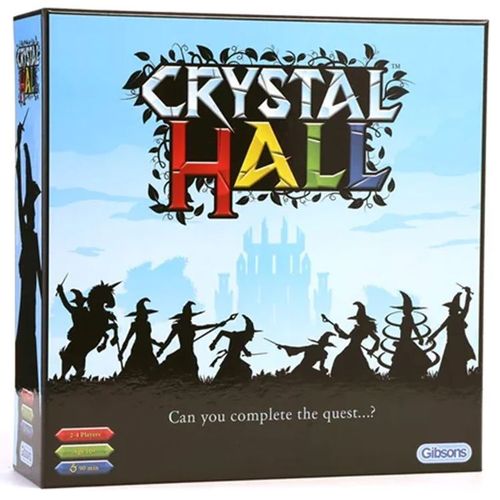
Crystal Hall
Crystal Hall Rulebook
Table of Contents
Table of Contents
The Basics
Crystal Hall is a game for 2-4 players, aged 10 and up. A typical 4-player game lasts about 90 minutes.
Each player controls a guild of 4 wizards that move around the board, flip magic tiles and cast spells.
To win the game, you need to collect 4 Crystals of Power, each of a different colour. To do so, you must position your wizards so that they are on a tile showing a Crystal of Power at the start of your turn.
Each turn is comprised of 4 phases: Gather, Magic, Discovery and Draw. In the Magic Phase, you are given 4 Units of Magic Power (UMP) which you can use to move your wizards and attack others. Certain magic tiles can increase or reduce this total.
During the game, wizards flip a multitude of magic tiles to reveal curses, potions, spells, Crystals of Power and other surprises. Some tiles have an immediate effect, some are only effective in the Gather Phase, and some can be used when required.
During the Draw Phase, you get a spell card, which you can play during your next turn to help with your quest or keep for later.
Advice for New Players
We recommend that you skim through the rules and check out the diagram on the back page before reading the entire booklet.
You don't need to read the rules for every spell and tile before you start playing; you can learn what they do as you uncover them.
For your first game, you might want to try a shortened version, where the winner is the first to acquire only 2 Crystals of Power. You may also wish to play with open hands.
Inside the Box
36 Magic Tiles. These are placed face down on the 36 central squares. Dark-backed tiles go on dark squares and light-backed tiles go on light squares. Tiles are turned over during the game.
- 4 x Potions
- 4 x Lenses
- 2 x Draws
- 2 x Cauldrons
- 4 x Crystal Tiles - one of each colour
- 2 x Red Warp
- 2 x Purple Warp
- 2 x Switches
- 2 x Staffs
- 4 x Blanks
- 2 x Swamps
- 4 x Compass Potions (one for each compass direction)
- 2 x Curses
12 Tokens. These look like magic tiles but have the same symbol on both sides. They are placed on squares of the board when players cast a freeze, curse or use shields.
- 4 x Freezes
- 4 x Shields
- 4 x Curses
16 Wizards (4 of each colour). Each player takes four of the same colour and places them on the four starting squares on their side of the board. If there are only two players, they should play on opposite sides.
16 Crystals of Power (4 of each colour). The first player who collects one of each colour wins the game. For a shorter game, agree two or three Crystals of Power as the winning criteria.
30 Spell Cards (containing 2 x 15 spells). Each turn, a player collects 1 spell card but can only hold 2 spell cards at once.
1 Dice.
There are 2 extra blank tiles and 2 blank spell cards included in the box so that you can replace lost ones or invent and design your own magic spells, tiles and tokens. These should be removed before starting the game if they are still blank.
Setting Up
Set up the pieces according to the picture below.
- Magic Tiles: Shuffle these thoroughly and place them face down, dark-backed tiles on dark squares and light-backed tiles on light squares, covering the central area of the board.
- Spell Cards: Shuffle the spell cards and put the pile face-down to one side of the board.
- Tokens: Put these to one side until required.
- Wizards: Set up the same number of guilds as there are players. If there are only two players, the guilds should be set up on opposite sides of the board. Place wizards on the starting squares.
- Crystals of Power: Place these to one side.
Quick Start Guide
Printed on page 6 and repeated on page 16 of the rulebook. The quick start text is reproduced as printed; the cost table is listed in Wizard Abilities below.
Ability cost in UMP: Cast spell 0; Move 1; Push 2; Squeeze 2; Regenerate 1 + quantity of Crystals of Power gathered; Shield 1 + quantity of Crystals of Power gathered; Use tile 0. UMP = Units of Magic Power.
Each turn comprises 4 phases:
Gather Phase. Note: If this is your first turn in the game, move straight to the Magic Phase. For each of your wizards standing on a crystal tile, gather the corresponding Crystal of Power. For each of your wizards standing on a cauldron tile, you have 1 extra UMP for the Magic Phase. For each of your wizards standing on a swamp, you lose 1 UMP for the Magic Phase.
Magic Phase. Each turn you have 4 UMP to spend on the abilities listed in the table above. See Wizard Abilities for details. Note: If this is your first turn in the game, you can only move.
Discovery Phase. Each player whose wizards are standing on face-down tiles flips the tiles to reveal what is underneath. If an Immediate Effect Tile is revealed, the player must resolve it. If it is a Pick Up Tile, the player should pick it up. If it is a Gather Tile, the player has to wait until their next turn to resolve it (see Tile List).
Draw Phase. At the end of the turn, draw a spell card. If this means you now have 3 cards, choose one card to discard (see Spell List).
How to Play (Detailed Version)
Getting Started
Set up the board as shown in Setting Up. Each player selects a guild of wizards. Roll the dice to decide who starts. The highest roller goes first. Play passes in a clockwise direction. Every turn consists of the following 4 phases:
1. Gather Phase - which tile are you on?
On your first turn, this phase will not apply since your wizards are on squares without tiles. For later turns, if any of your wizards are starting the turn on a Gather Tile (crystal, cauldron, or swamp), take a Crystal of Power or modify your UMP, depending on the tile (see Tile List). In addition, remove any freeze or shield tiles that you may have placed on your previous turn.
2. Magic Phase - what would you like to do?
Each turn, you start with 4 Units of Magic Power (UMP). However, your number of UMP may be altered by Gather Tiles during the Gather Phase. In the Magic Phase, you can use your UMP, spells and picked up tiles. UMP is used for wizard abilities (see Wizard Abilities). It does not have to be exhausted completely in a turn but cannot be saved for future turns. Tiles and Spells are explained in the Tile List and Spell List and have to be discarded face-up after use.
3. Discovery Phase - which tiles have been found?
After the active player completes the Magic Phase, each player whose wizards stand on face-down tiles flips the tiles to reveal what is underneath. Immediate Effect Tiles must be resolved straight away. Pick Up Tiles should be collected and saved by the players until they wish to use them in one of their future Magic Phases. Gather Tiles do not take effect until the next Gather Phase (see Tile List). UMPs, spells and picked up tiles can no longer be used once the Discovery Phase has begun. So make sure you have finished the Magic Phase before starting to discover.
4. Draw Phase - what spell will you get?
Draw a spell card and place it into your hand. You can only hold 2 spell cards at any given time. If you have 3 spell cards after drawing, look at the spells and discard one by placing it face-up onto the discard pile. If the draw pile is empty, shuffle the discard pile and create a new draw pile.
Victory
The first player to acquire one of each colour of the Crystals of Power - green, red, yellow and blue - is the winner. Alternatively, if only one player's guild remains on the board, that player has won.
Wizard Abilities (Using Magic Power)
During the Magic Phase, you can spend your Units of Magic Power (UMP) on any of the following wizard abilities. UMP can be shared between your wizards. Any UMP that has not been spent at the end of the Magic Phase is lost and cannot be carried over to the next turn.
Moving
Cost = 1 UMP per square moved. Wizards can move to any unoccupied adjacent square. They cannot move diagonally.
Pushing
Cost = 2 UMP per square moved. A wizard can push another wizard off the square they are occupying when they are adjacent to each other. Both wizards move in the same direction and the pushing wizard takes the pushed wizard's place. A push cannot be performed if there is a block immediately behind the victim, e.g. another wizard or the edge of the board. Tiles do not count as blocks and wizards can be pushed onto them.
Note: Eliminated wizards should be moved to the grey area behind your starting spaces to await regeneration.
Squeezing
Cost = 2 UMP. To use this ability, two of your wizards must be on adjacent squares on either side of an enemy wizard. The enemy wizard in the middle is eliminated from play. The attacking wizards remain on their original squares.
Regenerating
Cost = 1 UMP + number of Crystals of Power gathered. Eliminated wizards can be regenerated. Regenerated wizards are placed on one of the four starting squares. Regenerating is only possible if at least one wizard from the guild is still alive. If all four wizards are eliminated, the player is out of the game. Beware, the cost of regenerating increases with every Crystal of Power gathered, e.g., if you have 3 crystals, it will cost 1 + 3 = 4 UMP to bring a wizard back.
Shielding
Cost = 1 UMP + number of Crystals of Power gathered. A wizard can temporarily be protected from harm by using a shield token. The shield lasts for one round until your next turn. Shield tokens are explained in more detail below. Like regenerating, shielding will cost 1 UMP plus the number of Crystals of Power gathered so far.
Shielding Rules
A wizard with a shield is temporarily protected from harm caused by spells, pushing and squeezing. Wizards protected by shields are marked by a shield token placed underneath them. A shield can only protect a wizard for at most one round and the token must be removed after that round if it has not been broken before.
A shield can be broken by squeezing or any of the shield-breaking spells: fireball, electric current, electric net and earthquake. These spell cards are marked by a broken shield symbol.
When a shield is broken, the wizard is unharmed, but the shield token is removed immediately. The wizard is then vulnerable to attacks as normal.
Warp tiles can move shielded wizards.
Hint: Using a shield is the best way to protect a wizard on a crystal tile.
A player may only shield one of their wizards at any one time.
Shielded wizards are unaffected by freeze.
Tile List
Some of the tiles have an immediate effect, which takes place as soon as you land on them. Some have a delayed effect, which only takes place if you are on them at the start of your turn. And some are to be taken, kept and used later.
Immediate Effect Tiles
- Warp: Allows you to move your wizard to the other warp tile of the same colour. If it is occupied, wizards swap places. If the matching warp tile has not been discovered yet, move your wizard to one of your starting squares.
- Curse: Eliminates your wizard. Remove it from play. You may be able to regenerate it later.
Gather Tiles
Effects only take place if one of your wizards is standing on the tile at the start of your turn. All these tiles have a brown background.
- Cauldron: Adds 1 UMP to your Magic Phase. The tile is effective every turn your wizard starts on the cauldron.
- Swamp: Deducts 1 UMP from your Magic Phase. The tile is effective every turn your wizard starts on the swamp.
- Crystal: Lets you collect a Crystal of Power matching its colour, provided you have not already got that one.
- Final Crystal: If you have 3 Crystals of Power and one of your wizards enters the square of the 4th and final crystal tile, you collect it immediately and win the game!
Pick Up Tiles
Pick up tiles are kept by the player who discovered them for use in a future Magic Phase. All these tiles have a white background. Blank tiles are discarded when discovered.
- Potion: Gives you an extra UMP for that turn only.
- Lens: Lets you peek at one unturned tile or another player's spell cards. Only you are allowed to see this tile or the spell cards.
- Draw: Gives you a chance to take a new spell card. If this means you then hold 3 spell cards, choose one to discard.
- Staff of Diagonality: Means your wizards may move, push and squeeze diagonally for one turn. Spells may not be played diagonally, though.
- Compass Potions: Lets you move one of your wizards by one square in the compass direction corresponding to the letter on the tile: N = North, E = East, S = South, W = West. The compass is shown in the corner of the board.
- Tile Switch: Allows you to swap the position of any 2 unoccupied tiles. These tiles may be face-up or face-down. However, they may not be a face-up crystal tile.
Spell List
Each spell card has a short explanation, but this list provides more detail if needed. Spells can only be used during the Magic Phase and have to be resolved immediately when played. Spells do not cost UMP. You can hold at most two spell cards at a time. You may choose to use more than one spell on the same turn if you wish. Used spell cards are discarded face-up on the discard pile.
-
Curse: Enchants a square on the board so that all who pass through it perish immediately. Only empty squares with no wizards or magic tiles on them can be cursed. Place a curse token from the curse pile on the chosen square, it then acts as an Immediate Effect Tile.
-
Dragon Heart: Empowers your guild with the bravery and strength of a dragon to allow them to do more magic than normal. Increases UMP by 4 for the current turn.
-
Earthquake: Causes a terrible tremor and shakes up the board. All wizards move in a given direction according to the dice you roll and the instructions on the spell card. 1 = No effect; 2-5 = N/E/S/W respectively; 6 = Choose the direction. Shielded wizards lose their shield but do not move. Frozen wizards move but remain frozen. Any wizard whose path is blocked by the edge of the board or a shielded wizard does not move.
-
Electric Current: (This is the same spell card as Electric Net. You can choose which one you want to use.) Sends a crackling bolt of electricity between two wizards on the same horizontal or vertical line. One enemy wizard of your choice caught between your two wizards is eliminated. Shielded wizards lose their shield but are not eliminated.
-
Electric Net: (This is the same spell card as Electric Current. You can choose which one you want to use.) Casts a lightning sheet over your opponents so that you can eliminate up to 3 of them (of your choice). But be warned! Before you cast this spell, you'll need to position all 4 of your wizards in a rectangle with sides parallel to the board edges. The edges of the rectangle count as part of the net, and enemy wizards on this edge may be eliminated. Shielded wizards lose their shield but are not eliminated.
-
Fireball: Conjures a ball of fire to launch at an opponent. Choose one of your wizards to throw your fireball. Fireballs can only travel in a straight, not diagonal, line. Roll the dice and subtract 2 from the result. This is the number of squares the fireball will fly from your wizard. The first wizard in the line of fire is eliminated. Shielded wizards lose their shield but are not eliminated.
FAQs
-
Can wizards fall off the edge of the board? No.
-
Can I regenerate if my starting squares are occupied? No.
-
What happens if I use a shield on a wizard before flipping the tile it is on? The tile is flipped in the normal way. If it is a curse tile, the wizard dies. Curses are powerful dark magic and overcome the abilities of most wizards.
-
Can two wizards occupy the same square? No.
-
What happens if I lose all my wizards? You are out of the game.
-
If I'm moved on to a magic tile showing a Crystal of Power by an opponent just before my turn, do I still get the crystal at the start of my next turn? Yes.
-
What happens if I move onto a magic tile showing a Crystal of Power? If you have already gathered the other 3 Crystals of Power, then you immediately win the game. Otherwise, nothing happens. Crystal tiles are Gather Tiles and only have an effect in the Gather Phase.
-
What happens if I have unused UMP at the end of my turn? The UMP is wasted. It cannot be saved for future turns.
-
My question was not answered in the FAQ, how do we resolve it? Resolve this by either forming a consensus among the players, voting or using a dice to determine an unbiased outcome.
Variations and Inventing
- Two Crystal Game: For a speedier version, the first player to collect two of the Crystals of Power wins. This usually takes around 20-45 minutes.
- Open Play: Players play with open hands.
- New Spells: The game comes with some blank spell cards so you can create some of your own spells.
- New Tiles: The game comes with some blank tiles so you can create some of your own tiles.
Transcription note: the printed Quick Start panel reads "It this is your first turn" and "standing on a a swamp"; these are read here as "If this is your first turn" and "standing on a swamp".