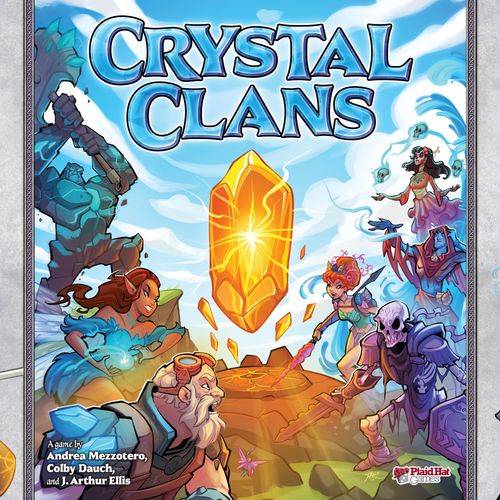
Crystal Clans
Crystal Clans Rulebook
Table of Contents
Table of Contents
Object of the Game
Crystal Clans is a 2-player battle card game in which players use time as a resource to summon troops from a clan deck and do battle to control the crystal zones. The first player to score at least 4 crystals by controlling the crystals zones wins.
Components
- 1 game board
- 1 initiative token
- 6 clan decks (27 cards per deck)
- 6 clan reference cards
- 2 player reference cards
- 15 crystal cards
- 1 Rulebook
Game Board
- Zone
- Home Zone
- Crystal Zone
- Initiative Track
- Initiative Neutral Spaces
- Draw
- Discard
- Reference Card Space
- Collected Crystals Space
Clan Cards
There are 2 sections to every clan card. The unit card section (top) takes effect when the card is placed on the battlefield. The battle card section (bottom) takes effect when the unit is played during battle as a battle card.
Unit Section
- Unit Name
- Unit Type
- Summon Cost
- Attack Value
- Defense Value
- Activation Cost
- Clan Signature Ability
- Unit Ability
- Deck Building Symbol (Not yet utilized in the game.)
Battle Section
- Battle Style
- Left Battle Effect
- Right Battle Effect
Clan Reference Card
Each clan's signature ability is listed on the clan's reference card.
- Clan Name
- Signature Ability
- Deck Building Symbol
Crystal Cards
- Name
- Cost
- Effect
Player Reference Card
Available Actions
- Summon (up to 3 units)
- Activate (Reorder, Move, Battle)
- Score
- Replenish (3 initiative)
- Invade (3 initiative)
Battle
- Play battle cards
- Resolve battle cards
- Apply damage
- Discard
Battle Order: Bold beats Guarded, Guarded beats Tricky, Tricky beats Bold.
Game Setup
- Place the game board in the center of the play area.
- Each player chooses a clan and collects that clan's deck, shuffles it and places it facedown on the 'draw' space on her side of the board.
- Each player places a player reference card and her clan's reference card in the reference card spaces.
- Each player draws 5 cards from her draw pile.
- Randomly determine which player will take the first turn of the game. The other player draws 1 more card from her draw pile.
- Place the initiative token on the '0' space of the initiative track.
- Shuffle the crystal deck and place it to the side of the game board.
- Reveal the top 3 cards of the crystal deck and place them face up next to that deck.
Note: Collected crystals may be stacked in the player's collected crystals space for easy access.
Taking a Turn
On a player's turn, she will perform one or more actions. Each time the player performs an action, she must pay for that action by moving the initiative token towards her opponent's side of the initiative track by a number of spaces equal to the cost of that action.
At the end of the active player's action, if the initiative token is still on her side of the initiative track, or is on a neutral space (the 1, 0 and 1 spaces), she must perform another action. If, at the end of an action, the initiative token is on her opponent's side of the initiative track (past the neutral spaces), it becomes her opponent's turn. Play will pass back and forth in this way until a player has won the game by scoring 4 crystals.
Note: If an action would push the initiative token past the last space on the initiative track, that action is not allowed. If another game effect would push the initiative token past the last space on the initiative track, the token stops on the last space.
Example: Taking a Turn
- The active player performed a summon action and has summoned a unit that has a summon cost of 5.
- She pays for that action by moving the initiative token 5 spaces toward her opponent's side of the initiative track.
- The token ends on her opponents side of the track, so it is now her opponent's turn.
Actions
There are 5 actions available to a player during her turn. Players may use the actions in any order and may use the same action multiple times per turn.
- Summon
- Activate
- Score
- Replenish
- Invade
Summon
To perform a summon action, choose up to 3 units from your hand and place them all in your home zone. Pay initiative equal to the totaled summon cost of those units.
Squads
When placing summoned units, organize those units into a squad by stacking the cards on top of one another. 1 unit alone in a zone is still considered a squad. The unit that is completely uncovered is considered to be the top unit of the squad.
The order that units are placed in your squad is important. The top unit is generally your first line of defense in battle. In addition, abilities marked with the battlefield icon are battlefield abilities, and are only active if that unit is on the battlefield and is the top unit of its squad.
Each player may only have 1 squad in each zone. Whenever 1 or more units are added to a zone that already contains a friendly squad, the new units are added to the current squad. The player who controls that squad may then reorder the units in that squad as desired. A squad MAY share a zone with an enemy squad.
A squad cannot have more than 3 units in it. If an action or game effect would ever cause there to be more than 3 units in a squad, the player who controls that squad must choose units from that squad to discard until there are only 3 units left in that squad. Discarded units are not considered to be destroyed for the purpose of other effects.
Activate
To perform an activate action, choose a squad to activate and perform the following steps in order. A squad can be activated multiple times in a row, so long as it is still your turn after completing the squad's activation.
- Pay Activation Cost
- Reorder
- Move
- Battle
1. Pay Activation Cost (required)
Pay initiative equal to the highest single activation cost among all units in that squad.
Example: The units in this squad have activation costs of 1, 2, and 1. Since the highest single activation cost of the squad is 2, it costs 2 initiative to activate this squad.
2. Reorder (optional)
The player may reorder the units in the activated squad. (Rearrange the order that units appear in the stack of cards that make up the activated squad.)
3. Move (optional)
The player may move some or all of the units from her squad into an adjacent zone. A squad cannot move out of a zone containing an enemy squad. If the squad is moved into a zone that already contains a squad the player controls, she must combine the squads and discard down to 3 units, once again reordering if desired.
4. Battle (optional)
Finally, if the activated squad shares a zone with an opponent's squad, the player may initiate a battle between those squads. To resolve a battle, execute the following steps in order.
- Play a Battle Card
- Resolve Battle Cards
- Apply Damage
- Discard Battle Cards
1. Play a Battle Card
Both players must choose a card from their hand as a battle card, and then reveal them simultaneously. If a player has no card in hand, she must play the top card of her draw pile as her battle card instead.
2. Resolve Battle Cards
Each player looks at the battle style of her opponent's battle card. Then each player looks at the battle effect of her own card to see which effect triggers. The left effect of a BOLD card always triggers versus a GUARDED card. The left effect of a GUARDED card always triggers versus a TRICKY card. And the left effect of a TRICKY card always triggers versus a BOLD card. In all other cases, the effect on the right triggers.
Note: Look only at the battle card section of the played battle cards to resolve them. The unit section does not affect the battle. Likewise, the battle card section of units on the battlefield have no effect on the game.
3. Apply Damage
The battling squads then simultaneously deal damage to each other. The amount of damage dealt by each squad is the totaled attack values of all the units in that squad plus any increases to the squad's attack provided by played battle cards or other game effects. Damage is dealt starting with the top unit of the enemy squad, continuing to the next unit when the first one is destroyed, and so on. A unit is destroyed and put in its owner's discard pile if it received damage equal to its defense value. Damage not sufficient to destroy a unit is ignored. Because damage is simultaneous, for the purposes of timing, all units that are destroyed as the result of damage from the battle are destroyed simultaneously. See Example: Battle.
+ defense: If a battle card effect or unit ability provides additional defense, the amount of damage received by the squad is reduced by that amount, before damage is applied to any individual unit.
Note: If one squad no longer exists or is no longer in the battle zone before applying damage, the battle immediately proceeds to the discard step and no damage is applied.
4. Discard Battle Cards
At the end of the battle, played battle cards go to their players' discard piles. EXCEPTION: If a triggered battle card effect included a return-to-hand symbol, the player who played that card may place it in her hand instead, even if it came from the top of the player's draw pile.
Example: Battle
- Player one (Blood Clan) spends 2 initiative, moving the initiative token from the 0 space to the 2 space to activate her squad and move it into an adjacent crystal zone. Player two (Skull) already occupies this zone so player one decides to initiate battle.
- Both players must play a battle card. Player one has no cards in her hand so she plays the top card from her draw pile facedown, Chieftains (TRICKY). Player two chooses to play Enchanter Malek (GUARDED) facedown from his hand. The battle cards are revealed and the effects trigger. Player one draws a card to add to her hand and player two gains 6 defense which is subtracted from player one's attack value.
- Player one's squad now has an attack value of 4 and player two's squad has an attack value of 8. Damage is dealt simultaneously starting with the top unit of each squad, and the top unit of each squad is destroyed. Player two's squad has 5 more attack value left, but it is not enough to destroy player one's "Condor" so the last 5 damage is lost. Player one now places her battle card in her discard pile. Because player two's triggered battle effect contained the return-to-hand icon, player two may choose to return his battle card to his hand.
- Each player is left with a two card squad in this crystal zone. It is now player two's turn and he may take any action. If he wants to initiate another battle, he would need to spend one initiative to activate his squad.
Score
Scoring is how a player obtains 4 crystal cards and wins the game. A player must control at least 2 out of the 3 crystal zones in order to take a score action. To control a zone means that the player has a squad in the zone and the opponent does not.
The player chooses any 1 of the 3 crystal cards face-up next to the crystal deck to score. She pays the initiative cost of the chosen card and places that card face-up in her collected crystal area, resolving any game effects that trigger upon gaining the crystal card. Then she replaces it with the top card of the crystal deck so that there are 3 face-up crystal cards next to the crystal deck.
Facedown Crystal Cards: Some crystal cards feature an effect that flips the card facedown. A facedown crystal card still counts as 1 of the 4 crystals needed to win, but the text on its face-up side no longer applies.
Replenish
To perform a replenish action, a player must pay 3 initiative. The player may discard any cards from her hand of her choice, and then may draw cards until she has 5 cards in her hand. If she already has 5 or more cards in her hand after discarding, she does not draw cards.
Invade
To perform an invade action, a player must control her opponent's home zone and must pay 3 initiative. She discards cards from her opponent's draw pile equal to her invading squad's total attack value. If her opponent is forced to reshuffle during the invade action (see "Reshuffling" below), the invade action ends after the reshuffle without discarding any more cards.
Reshuffling
Any time a player must draw or discard a card from her draw pile while her draw pile is empty, she immediately reshuffles her discard pile to create a new draw pile. Then, after the current action is completed, her opponent scores a crystal card without needing to control 2 crystal zones or pay the initiative cost of that crystal.
Example: Invade & Reshuffle
- Player one (Blood) paid 2 initiative to activate her squad and move it into Player two's (Skull) Home Zone. She then paid 3 more initiative to perform an invasion.
- Player one's squad has an attack value of 6, so Player two must now discard 6 cards off the top of his draw pile. Player two's draw pile is empty after discarding 4 cards so he is forced to reshuffle and the invasion ends.
- Because Player two had to reshuffle, Player one was allowed to claim a crystal card without having to pay the initiative cost for it.
Winning the Game
When a player has 4 or more crystal cards in her score area she immediately wins the game.
Clarifications
- When a card effect contradicts the rulebook, the card effect takes precedence.
- If 2 or more game effects or choices would ever seem to trigger simultaneously, the active player decides in which order they will resolve.
- Whenever a card is discarded for any reason, it always goes to its owner's discard pile. The owner of a card is the player that started the game with that card in her deck. It is possible for a player to control a card which she does not own. In that case, the unit still has the signature ability of its clan, etc.
Deck Construction
Currently, the types of cards and number of each card in each deck cannot be customized. Deck construction rules will be introduced at a future date, when more cards have been released for the game. To stay up to date on release news for Crystal Clans, visit plaidhatgames.com/crystalclans.
Initial Mulligan
Experienced players may optionally play with a mulligan for their initial hand draw during setup. At the beginning of the game, after players draw 5 cards but before the first player is chosen, each player may choose to shuffle any number of cards from her hand back into the draw pile and draw back up to 5 cards 1 time.
Glossary Terms
Actions: When it is a player's turn, she takes an action of her choice. After the action, if the initiative token is still on her side of the initiative track or in the neutral zone, she takes another action. Actions may be taken in any order, and the same action may be taken more than once during a turn. Some actions have some sort of requirement to be possible. Possible actions include Summon, Activate, Score, Replenish, and Invade.
Activated Squad: The activated squad is the squad that was chosen for activation at the beginning of an activation action. When a squad moves, if some units were left behind, only the moved units are considered to be activated.
Activate: To perform an activate action, a player must choose a squad she controls on the battlefield and pay that squad's activation cost. Then she may perform each of the following optional steps in order with that squad: reorder, move, battle.
Activation Cost: The activation cost of a squad is the highest activation cost of any one unit in that squad.
Active Player: The active player is the player currently performing actions.
Adjacency: Zones that share a border are adjacent.
Applying Damage: Applying damage is the third step of a battle. Each squad's attack value is applied as damage to the opponent's squad simultaneously. Damage is applied starting with the top unit of the squad and continuing to the next unit below once the top unit's defense has been reached. Units who receive enough damage to be destroyed are all destroyed and discarded simultaneously. Damage that was insufficient to destroy a unit is lost.
Attack Value: A unit's attack value is shown by the attack symbol on its card, plus any possible boosts to the unit provided by an ability. The attack value of a squad is the combined attack value of all units in the squad, plus any possible boosts to the squad provided by abilities or battle card effects.
Battle Card Effects: Most battle card effects are laid out by the text of that card effect, except for the following 3:
- + attack: This effect adds to the squad's attack value.
- + defense: This effect reduces the opponent squad's attack value before applying damage.
- Return-to-hand symbol: When discarding battle cards as the 4th step of a battle, if a battle card effect includes this symbol, the player who played that battle card may choose to keep it in hand instead of discarding it.
Battle Cards: The bottom portion of each card from a clan deck is the battle section of that card. This section only applies when a card is played as a battle card in step 1 and 2 of battles. Each battle card has 2 possible effects depending on the card's battle style and the battle style of the opponent's played battle card. The unit section of the battle cards do not effect the battle. When a battle card is played, it is not considered to be either discarded or in-hand until the discard step of the battle.
Battle Styles: Each card is one of 3 battle styles: bold, guarded, or tricky. In a battle, when resolving battle cards, look at your opponent's card's battle style, and then look at your own battle card to see which effect triggers as listed on the card. The left effect of a BOLD card always triggers versus a GUARDED card. The left effect of a GUARDED card always triggers versus a TRICKY card. And the left effect of a TRICKY card always triggers versus a BOLD card. In all other cases, the effect on the right triggers.
Battlefield Abilities: Battlefield abilities are abilities with the battlefield symbol. A unit's battlefield ability is only active while that unit is the top unit of a squad on the battlefield (i.e. while that unit is on the battlefield and its ability is showing). All other abilities are active at all times.
Battling: Battling is the last, optional step of activation. Battling consists of 4 steps: Play a battle card, resolve battle cards, apply damage, and discard battle cards. After a battle is over, a zone may contain 1 squad, 2 squads (a squad controlled by each player) or no squads.
Bottom Unit of Squad: The bottom unit of a squad is a card in a squad that is not physically covering any other units in that squad. If a squad consists of just 1 unit, that unit is both the top and bottom unit of that squad.
Cartographers: If there are less than 4 cards in a player's draw pile when Inform activates, merely look at the cards that are in the draw pile. Do not trigger a reshuffle.
Citadel Knights: If the Tactical ability is used while the opponent's draw pile is empty, a reshuffle triggers.
Clan: Within the Crystal Clans game, there are numerous clans. All cards sharing the same clan name (found in the 'unit type' section of a card) make up 1 clan. Example: Stone Clan, Blood Clan, Skull Clan, etc.
Combining Squads: Whenever a unit or a squad would be added to a zone (for example, due to moving or being summoned), if a friendly squad is already in the zone, the player who controls the units combines them into 1 squad, reordering the units if desired. If this results in a squad of more than 3 units, the player must discard units until there are 3 units in the combined squad.
Controlled Squad: The controller of a squad is the player who is able to activate that squad. Usually this is the player who summoned the units in the squad, although there are exceptions due to card effects. Squads should be oriented so that they are read right-side up by the person who controls them.
Controlled Zone: Controlling a zone means that a player controls a squad in the zone and her opponent does not.
Damage: (see applying damage)
Deck Construction: Deck construction refers to customizing which cards appear in your deck before a game. At the release of this rule set, deck construction is not allowed. Visit plaidhatgames.com/crystalclans to stay updated on news about future Crystal Clans releases and the introduction of deck construction rules.
Defense Value: A unit's defense value is shown by the defense symbol on its card. Defense boosts provided by battle cards or other card effects do not increase the defense of any individual unit; instead, boosts reduce the attack value of the opponent's squad while in battle.
Destroying Units: Whenever a unit is destroyed, due to applying damage in battle or a game effect that explicitly destroys a unit, that unit is discarded. Units destroyed due to applying damage in battle are destroyed simultaneously.
Discarding: Whenever a card is discarded, it is placed in its owner's discard pile. Discard piles are face-up at all times and the order of the discard pile does not matter. Units are discarded when they are destroyed, but other game effects may discard units on the battlefield, in hand, or from the top of a player's draw pile. Units that are discarded are not necessarily considered to be destroyed, unless they were discarded due to applying damage during battle or due to a card effect that explicitly destroys them.
Drawing Cards: Whenever a game effect leads to drawing a card, the player who draws the card takes the top card of her draw pile and adds it to her hand. There is no hand limit.
Enemy: The enemy is a player's opponent. An enemy squad is a squad controlled by the opponent. And enemy unit is a unit controlled by the opponent.
Enemy Squad's Zone: A zone is considered an enemy squad's zone if there is an enemy squad in the zone. It does not necessarily mean that the opponent controls that zone.
Entering a Zone: A squad or unit is considered to have entered a zone when it moves into the zone (usually during a unit's activation) or is placed in the zone (due to summoning or another card effect).
Facedown Crystals: Some game effects flip crystal cards facedown. A facedown crystal card still counts as 1 of the 4 crystal cards needed to win the game, but the text on its face-up side no longer applies.
Free Actions: Some game effects result in an action being free. When a free action is performed, no initiative is paid to perform the action.
Friendly: A friendly squad or unit is a unit controlled by the same player as the card with the "friendly" reference on it.
Gaining Initiative: Whenever a player gains initiative, move the initiative token toward the player gaining initiative a number of spaces equal to the initiative gained. If this would move the token past the last space on the initiative track, it stops on the last space.
Hand Limit: There is no hand limit in Crystal Clans. However, players with 5 or more cards already in hand after discarding cards during a Replenish action will not draw any cards.
Home Zone: Each player's home zone is the zone closest to that player.
Horde: Only the top unit in the squad needs to have the Horde ability in order for the squad to benefit from the ability. If at any point the top unit of the squad does not have the Horde ability, the player who controls the squad must immediately discard down to 3 units.
Initiative: Initiative is a resource that represents time in Crystal Clans. The initiative token tracks who has initiative and how much. On a player's turn, she must take actions until the initiative token is on her opponent's side of the initiative track, past the neutral (1, 0 and 1) spaces. Then play passes to her opponent.
Invading: To perform an invade action, a player must control her opponent's home zone and must pay 3 initiative. She discards cards from her opponent's draw pile equal to her invading squad's total attack value. If her opponent is forced to reshuffle during the invade action, the invade action ends after the reshuffle without discarding any more cards.
Moving: Moving is an optional part of an activation action, after reordering and before battling. During this part of activation, the player may move some or all of the units from her squad into an adjacent zone. However, a squad cannot move out of a zone containing an enemy squad. If the squad is moved into a zone that already contains a squad the player controls, she must combine the squads and discard down to 3 units, reordering if desired.
Neutral Spaces: The 1, 0, and 1 spaces of the initiative track are neutral spaces. On a player's turn, that player must take actions until the initiative token is on her opponent's side of the initiative track, PAST the neutral spaces.
Owner: The owner of a card is the player who started the game with that card in her deck. Whenever cards are discarded, they are always discarded to their owner's discard pile, which can occasionally be different than the controller's discard pile.
Paying Initiative: Whenever a player pays initiative, move the initiative token toward the opponent a number of spaces equal to the initiative paid. If an action's cost would move the initiative token past the last space on the initiative track, that action is not available. If any other game effect would move the token past the last space on the initiative track, it stops on the last space.
Placing: When a card effect places a card or squad somewhere on the battlefield, that is not considered a move and does not have the same restriction of not being able to move out of an enemy squad's zone. When a card is summoned, it is placed in a zone (usually the home zone) as well.
Remove From Game: Removing a card from the game means that the card returns to the game box and is not considered to be in any card pile or in hand or on the battlefield. A card removed from the game will never be placed back in any pile or in a hand or on the battlefield for the rest of that game.
Reordering: Reordering is when a player chooses the order of the units in a squad she controls. The top unit is the unit that is not covered by any other cards. Reordering can happen in 3 different ways:
- Reordering happens optionally as a step of the activation action, after paying the activation cost and before movement.
- Whenever a unit is added to a squad (for example, when summoning a unit), the controlling player may reorder at that time.
- Whenever 2 squads are combined (for example, when moving a squad into a zone that already contains a friendly squad), the controlling player may reorder the combined squad at that time.
Replenishing: To perform a replenish action, a player must pay 3 initiative. The player may discard any cards from her hand of her choice, and then may draw cards until she has 5 cards in her hand. If she already has 5 or more cards in her hand after discarding, she does not draw cards.
Reshuffling: Any time a player must draw or discard a card from her draw pile while her draw pile is empty, she immediately reshuffles her discard pile to create a new draw pile. Then, after the current action is completed, her opponent gets to take a score action without needing to control 2 crystal zones or paying the initiative cost.
Returning cards to hand: Some game effects return a card to its controller's hand. In this case, the player controlling the card places it in her hand whether or not the card had ever actually been in her hand.
Scoring: To take a score action, a player must control at least 2 out of the 3 crystal zones. The player chooses any of the 3 crystal cards face-up next to the crystal deck. She pays the initiative cost of the chosen card and places that card face-up in her collected crystal area, resolving any game effects that trigger upon gaining the crystal card. Then she replaces it with the top card of the crystal deck so that there are 3 face-up crystal cards next to the crystal deck.
Signature Ability: Each clan has a signature ability listed on its reference card. If a card from that clan has the title of that clan's signature ability on it, that card has that clan's signature ability. If a card from that clan does NOT have the title of that clan's signature ability on it, that card does NOT have that ability.
Simultaneous Effects: If 2 or more game effects or choices would ever seem to trigger simultaneously, the active player decides in which order they will resolve.
Sleep: Sleep reduces the attack value of the top unit of the opponent's squad to 0. The unit's printed value is considered to be 0, and any ability that affects the unit's attack value is nullified. Battle card effects that boost attack value and abilities that boost the squad's attack value are unaffected, even if there is only one unit in the squad.
Spirit Guide: If the left effect of the Spirit Guide battle card triggers while the opponent's draw pile is empty, a reshuffle occurs.
Squad Limits: Each squad may only have up to 3 units in it. Any time a game effect would cause there to be more than 3 units in a squad, the controller of that squad discards units of her choice from that squad until there are only 3 units in that squad.
Summoning: To perform a summon action, a player chooses up to 3 units from her hand and places them all in her home zone. Pay initiative equal to the totaled summon cost of those units. Although some card effects allow cards to be summoned to zones other than a player's home zone, a player may not summon units to two different zones during one summon action.
Titan Knights: The In Step ability also reduces its squad's activation cost for the purpose of opponent effects (example: Blue Oracles).
Top Unit of Squad: The top unit of a squad is a card in a squad that is not physically covered by any other units in that squad. If a squad consists of just 1 unit, that unit is both the top and bottom unit of that squad.
Tridents: Tridents summoned as a result of the Clone ability must be placed in the player's home zone as usual, unless another ability such as Shapeshifters' Shift says otherwise.
Turns: 1 turn may be made up of multiple actions.
Units Types: All units are either heroes or commons. There are 3 heroes in each deck and 24 commons. Each unit also has a clan to which it belongs. Finally, each unit has an additional descriptor in its unit type, which may be referenced by certain card effects. A unit has its type even if it is not the top unit of a squad on the battlefield.
Clan Signature Abilities
Each clan's signature ability is listed on its clan reference card. Signature abilities shown in this rulebook include:
- Flower Clan — Sleep: When applying damage in a battle involving this squad, the value of the top unit of your opponent's squad is considered to be 0.
- Meteor Clan — Predict: When this squad battles, before battle cards are chosen, you may declare BOLD, GUARDED, or TRICKY. If your opponent's battle card is that style, gain 1 initiative and you may draw 1 card.
- Water Clan — Flank: When this squad is in battle, you may deal damage starting with the bottom unit of your opponent's squad.
- Skull Clan — Undying: This unit may be summoned from your discard pile as if it were in your hand.