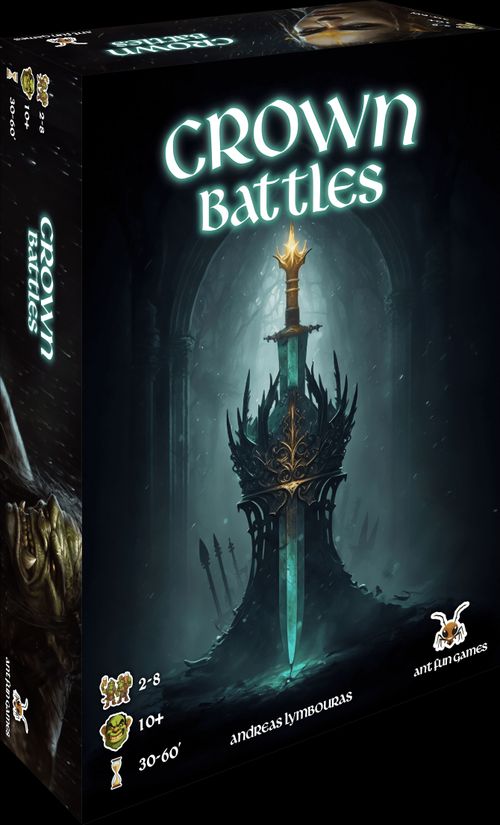
Crown Battles: Claim the Throne
Crown Battles: Claim the Throne Rulebook
Table of Contents
Table of Contents
Components
Basic
- 52 standard cards (4 suits with values 1-13 each)
- 4 trump cards
- 4 Peasant cards
- 2 Golems and 2 Dragons
- 16 Special Power cards
- 75 scoring coins
- 74 bidding tokens
- 8 Bubble Shield tokens
- 1 metal crown
- 1 Spinner
Expansion
- 64 Mission cards
- 32 square suit tokens
- 1 Dice
- Round Tracker
- 11 Round Type cards
Alliances mini-expansion
- 3 Round Type cards
- 8 Secret Note tokens
Base Game
Goal: To win the game, earn the most points by the end of all the rounds. You earn points by predicting the amount of tricks you will win in each round. If you predict correctly you earn points; if you predict incorrectly you lose points.
Base Game Setup
- Create the deck using 60 cards: all 52 standard cards, 2 Golems, 2 Dragons, and 4 Peasant cards. Shuffle the deck and place it face down.
- For a 2-player game, create a deck using 40 cards: Numbers 5-13 of all 4 suits from the standard cards, 1 Golem, 1 Dragon, and 2 Peasant cards.
- Place all coins to the side where everyone can reach them.
- Give each player bidding tokens valued from 0 to 10. Give 0-9 for a 7-player game and 0-8 for an 8-player game.
- Randomly choose a dealer and put the Spinner close to the dealer.
How to Play
Rounds
The number of rounds varies depending on the number of players. For example, in a 2-player game there are 10 rounds, while in a 5-player game there are 6 rounds. See the table below.
Turns & Rounds
- The dealer shuffles the deck and gives each player a certain number of cards based on the round. Each round, players get more cards. It starts with 2 cards and goes up by 2 each time. In the last round, the entire deck is evenly distributed among all players. For example, in a 5-player game the cards dealt per round are: 2, 4, 6, 8, 10, 12.
| No. of players | 2 | 3 | 4 | 5 | 6 | 7 | 8 |
|---|---|---|---|---|---|---|---|
| Total rounds | 10 | 10 | 8 | 6 | 5 | 5 | 4 |
| Dealt cards on each round | 2,4,6,8,10,12,14,16,18,20 | 2,4,6,8,10,12,14,16,18,20 | 2,4,6,8,10,12,14,15 | 2,4,6,8,10,12 | 2,4,6,8,10 | 2,4,6,8,9 | 2,4,6,8 |
- The dealer spins the suit Spinner, and the chosen suit becomes the trump suit for the round. X means no Trump, while the 4 colors let the dealer choose the suit for the round.
Before playing a trick: bidding phase
- Players declare the tricks they aim to win by placing bidding tokens in front of them, starting from the left of the dealer and going clockwise.
- A trick is when each player takes turns putting a card on the table. All the cards played together make up the trick.
- Players can also play it safe by bidding on two consecutive numbers, but they will only get half the points if they win. See Double Bidding under Scoring.
Playing Each Trick
- The trick starts with the player to the left of the dealer playing a card in the center of the table.
- In a clockwise order, each player continues to play a card face up. After everyone has played their card, the player who played the most powerful card wins the trick.
- The winner collects all the cards from the trick and displays them face down close to their bidding token.
- The winner of the trick leads the next one.
Playing card rules
- Players must follow suit if possible; otherwise, they can play any other card.
- Playing a different suit than the led suit loses, even if it is of a higher number.
- Dragons (D), Golems (G), and Peasants (P) are special cards and can be played at any time, even if the player has a card of the leading suit.
To win a trick
- The highest-value card of the lead suit wins.
- If a Trump suit card is played, the highest-value Trump card wins.
- If a Golem card is played, the first Golem card played wins.
- If a Dragon card is played, the first Dragon card played wins.
Example: If the trump suit is Yellow (or Elves), the Yellow 12 beats the Blue 13 (led suit), the Golem (G) beats the Trump suit, the Dragon (D) beats the Golem (G), and the second Dragon (D) loses against the first played Dragon (D).
Non-suited cards' powers
- Peasant (P): This card is worth 0.
- Golem (G): Beats all numbered cards.
- Dragon (D): Beats all numbered cards and Golems.
Ending a Round
- The round ends when all tricks are played. Players who made accurate predictions earn points, while those with incorrect predictions lose points. Negative points are possible. Flip the coins to indicate negative points.
- At the end of each round, the player with the highest score gets the crown. In case of a tie, no one gets the crown (as there is still no clear successor).
- In the next round, the dealer changes in a clockwise direction. The Spinner is also passed on.
Game End
The player with the highest score at the end of all rounds is crowned the winner. In case of a tie, replay the last round until there is a clear winner.
Scoring
Meeting your bid: Earn 10 points per trick and a 20-point bonus.
Example: If you bid 3 tricks but win all 3, you get a total of 50 points: 30 for each trick won plus 20.
Failing to meet your bid: Lose 10 points for each trick you go above or below your bid. Points can even go negative.
Example: If you bid 3 tricks but win only 1, you lose 20 points. If you bid 1 trick but win 2, you lose 10 points.
Double Bidding
Players have the option to bid two consecutive numbers.
- Meeting your bid: Successfully predict at least one of the two bids, and earn half the usual points. That is 5 points per trick plus a 10-point bonus. See the scoring table below.
- Example: If you bid 2-3 tricks and win 3, you get 25 points in total. That is half of the points you would normally get.
- Failing to meet your bid: Lose 10 points for each trick you go above or below your double bids.
- Example: If you bid 2-3 tricks and win 1 or 4, you lose 10 points. If you win 0 or 5, you lose 20 points.
Scoring table
| No. of TRICKS won | 0 | 1 | 2 | 3 | 4 | 5 | 6 | 7 | 8 | 9 | 10 |
|---|---|---|---|---|---|---|---|---|---|---|---|
| SINGLE BID | 20 | 30 | 40 | 50 | 60 | 70 | 80 | 90 | 100 | 110 | 120 |
| DOUBLE BID | 10 | 15 | 20 | 25 | 30 | 35 | 40 |
Special Cases
- If a player starts the trick with a Peasant (P) card, the next player sets the leading suit.
- If a Golem (G) or a Dragon (D) card starts a trick, players can play any card, regardless of the suit.
- When all players play a Peasant (P), the first player to do so wins the trick.
- If multiple Golem (G) cards are played in the same turn, the first one wins.
- If multiple Dragon (D) cards are played in the same turn, the first one wins.
Variation: Screw the Dealer
If the total bids from all players match the number of cards dealt, the dealer cannot bid that number. This rule aims to balance the game and prevent the dealer from having an advantage by strategically bidding last.
Special Power Cards
Set up
Replace up to 4 Peasant cards with Special Power cards from the main deck. Choose which and how many Special Power cards to include. For example, you can use 2 Peasant cards and 2 Special Power cards. If you're new, consider using just 4 Peasant cards without any Special Power cards.
Timing icons
- Hourglass: Take this action at the end of the ongoing trick.
- Lightning bolt: Take this action right after playing this card.
Action cards
- Alchemist (hourglass): Change the ongoing round's Trump suit to the suit of your choice or leave it as is. No Trump is also a valid option.
- Bishop (lightning bolt): Choose to see one of your opponent's hands.
- Bomb (lightning bolt): When played, the trick gets destroyed and no one wins it. You decide who will lead the next trick. Could also be yourself.
- Cursed (hourglass): Swap your cards with another player or make two other players swap their hands. Has no effect if played on the last trick of the round.
- Jester (lightning bolt): You can choose to change your bid for the round by +1 or -1. Swap your existing bid with your new bid token.
- Magician (lightning bolt): Players pass a card face down to the right or left, determined by the player of this card. Only this card's player sees the card pass to them before choosing which one to pass. Has no effect if played on the last trick of the round.
- Merchant (lightning bolt): Swap a card of your choice with a random card from another player's hand. You can also make two other players randomly swap one of their cards.
- Smuggler (lightning bolt, 2 actions):
- Swap before you bid: You have the option to swap one of your cards with a randomly drawn card from the deck before placing your bid.
- Swap during gameplay: Swap one of your cards with a randomly drawn card from the deck (or keep yours).
- Spy (lightning bolt): Look through the deck. You've got only 60 seconds! If there is no deck left, then this card has no action.
Non-Action cards
- Double-faced (lightning bolt): You can choose to use it as a Peasant card or a Golem card. State your choice when you play this card.
- Golem King (GG) (lightning bolt): Beats all numbered cards. Beats all Golem (G) cards. Doesn't beat any Dragon (D or DD) cards.
- Dragon King (DD) (lightning bolt): Beats all cards. It is the most powerful card in the game.
Notes
- Players can choose to buy a Bubble Shield protection for 20 points. Protects against trick and point theft (the Thief and the Witch).
- Special Power cards have the same power as a Peasant when played. Except for the following cards: Golem King (GG), Dragon King (DD), Double-faced, and Summoner, which can win the trick they are played in.
The Expansion Game
Now that you've got the basics of Crown Battles, get set for a thrilling gameplay with new fights!
Expansion Setup
Organize the fights
Select the Round Type cards you prefer to play in your game. The dealer shuffles the chosen cards and randomly reveals one for each round, determining the game type.
There are 14 options: Normal Bidding, Blind Bidding, Long Play, Leaked Suit, The Split, Stealth Play, Suit Precision, Missions, Blind Missions, Wagering, Duel Fights, Alliances, Missions-Alliances, and Suit Precision-Alliances.
Read the next sections for a detailed description of each round type.
Exclude certain Round Type cards based on the number of players:
- For 3-player games, exclude the Duel Fights card.
- For 2-player games, exclude the Stealth Play card, the Duel Fights card, and all Alliance cards (Alliance, Suit Precision-Alliance, Missions-Alliance).
Round Tracker
The dealer holds onto the Round Tracker and adjusts its dial to show the number of cards to deal for the round.
Normal Bidding
In this round, play the base game predicting the number of tricks you'll win.
Blind Bidding
This round is like a Normal Bidding round but with a twist. Players keep their bids secret.
Bidding phase: Secretly predict and choose your bids by using a set of numbered square bid tokens. Place your chosen token face down in front of you.
End of the round: At the end of the round, after all tricks are played, reveal your bids and earn points as in the Normal Bidding round.
Long Play
This round is like a Normal Bidding round but with a twist. After each player plays their first card, the trick continues, and everyone plays a second card. This means that players will win half of the cards dealt as tricks. If there is an odd number of cards in the round, play the last trick as in the Normal Bidding round.
Stealth Play
This round is like a Normal Bidding round but with a twist. Once the trick leader plays a card, all other players place their cards face down. After all cards are played, flip them to reveal the winner of the trick.
Leaked Suit
This round is like a Normal Bidding round but with a twist. Before bidding, players choose one suit to reveal. Then players reveal all cards in their chosen suit simultaneously face up. Then bidding starts clockwise from the dealer, just like in Normal Bidding. All revealed cards remain part of players' hands and can be played normally.
Peasants (P) or Special Power cards cannot be chosen as a suit for the reveal. Golems (G), Dragons (D), Golem King (GG), and "Dragon Slayer" (DD) are considered the same suit, so if players choose to reveal them, they have to reveal them all. (The rulebook prints "Dragon Slayer (DD)" here; the card is the Dragon King (DD) described above.)
Variations
- Players can reveal suits one by one in clockwise order.
- The dealer decides which suit all players have to reveal.
- Randomness: Spin the Spinner to determine the suit to be revealed. In a clockwise order starting from the dealer, players randomly choose only one card to reveal from the player on their left. Then players reveal all cards for that suit.
The Split
In this round, there are two separate smaller rounds. Players split their hand of cards into two equal halves and place 2 separate bids, one for each half of cards. If the number of cards in hand dealt is odd, the larger portion is played in the second round.
Bidding phase: Players place their 2 bids in a clockwise manner, just like in the Normal Bidding round.
Scoring
- Meeting your bid: Players earn 10 points for each trick won and an extra 10-point bonus for every correct hand. Example: If a player bids 2 for the first hand and 1 for the second, they score 50 points: 30 for tricks and 20 as bonus points. The only exception is when players predict to win 0 tricks in both bids; they still earn 10 bonus points in total.
- Failing to meet your bid: Failing to meet a bid results in a loss of 10 points for each missed trick in just that specific bid. Each correct bid for a hand earns 10 points. Also, no bonus points are given.
Suit Precision
In this round, players must be precise in their bids, predicting both the number of tricks they'll win and the suit for each trick.
Setup: Give all players one token for each suit, totaling four tokens.
Bidding phase: In this example, the player bids that will make 2 red suits and 1 blue suit for the round.
How to win a suited trick
- Winning without a Trump: A player wins a trick of a certain suit if they win a trick led by that suit. Example: If the leading card is a blue suit, the winning player must place it under the blue suit bid for everyone to see.
- Winning with a Trump suit: The player who wins a trick with a Trump suit can choose to put it under the leading suit or the Trump suit.
- Winning with Golems or Dragons: The player who wins a trick using a Golem or a Dragon card can choose any suit to put the trick on.
Scoring
- Meeting your bid: Get 10 points for each trick won and an extra 10 bonus points for every suit where at least one trick is won. Example: if you bid 1 blue, 1 green, and 1 red suit and win all 3 tricks, you score 60 points: 30 for tricks and 30 as bonus points. The only exception is if you predict to win 0 tricks in all suits; you still earn 10 bonus points.
- Failing to meet your bid: If you fail to meet your bids, lose 10 points for each missed bid in that suit. For each correct trick you win for a suit, gain 10 points. You will also miss all the bonus points. Example: the player loses 10 points in the Yellow suit for the extra trick but still earns points for predicting the other suits. Also, no bonus points are gained.
Double-bids
- Meeting your bid: If you choose to double-bid, you earn 5 points for each trick won and a 5-point bonus for each suit you win at least one trick in. For the non-double-bid suits, you still get 10 points for each trick and a 10-point bonus for that suit.
- Failing to meet your bid: If you fall short on your bids, lose 10 points for each missed bid in that suit. However, for each correctly predicted double-bid trick, gain 5 points. You will also miss all the bonus points. Example: the player did extra tricks in Blue and Green suits, losing 10 points for those suits only. They still earn points for predicting the rest of the suited tricks: 10 for their single-bid predictions and 5 for their double-bid ones. Also, no bonus points are awarded.
Special cases
- In a Suit Precision round, if a player plays the Thief card, they can steal a trick from opponents but must place the stolen trick under the same suit of their bid.
- If all players play Peasant cards, the first player wins and chooses where to place the trick among their suit predictions.
Missions
Players are given 5 Mission cards to choose one from. When ready, players then reveal their chosen Missions one by one, starting from the player to the left of the dealer and proceeding clockwise.
- Failing your Mission: Players who fail their Mission rotate it sideways 90 degrees and lose 20 points.
- Achieving your Mission: Players who complete their Mission rotate it in the opposite direction and earn points based on the Mission's assigned value.
Setup: Shuffle all the Mission cards and place them to the side where everyone can reach them.
Example: For a 4-player game and on a round where each is dealt 6 cards, check this cell to find the points that can be won (4, 5-7). The printed example tables below are circled at that cell.
Mission card tables printed in the rulebook (rows are the number of players, columns are the number of cards dealt in the round):
Win a trick using a Trump suit
| Players \ Cards | 1-2 | 3-4 | 5-7 | 8-10 | 11-13 | 14-16 | 17-20 |
|---|---|---|---|---|---|---|---|
| 2 | 0 | 5 | 10 | 10 | 10 | 10 | 10 |
| 3 | 5 | 10 | 15 | 15 | 15 | 15 | 15 |
| 4 | 10 | 15 | 20 | 20 | 20 | 20 | - |
Win either 0 or 1 tricks
| Players \ Cards | 1-2 | 3-4 | 5-7 | 8-10 | 11-13 | 14-16 | 17-20 |
|---|---|---|---|---|---|---|---|
| 2 | 5 | 15 | 35 | 65 | 100 | 140 | 190 |
| 3 | 0 | 5 | 10 | 30 | 50 | 75 | 100 |
| 4 | 0 | 0 | 5 | 10 | 25 | 45 | - |
Win none of the first 1 trick
| Players \ Cards | 1-2 | 3-4 | 5-7 | 8-10 | 11-13 | 14-16 | 17-20 |
|---|---|---|---|---|---|---|---|
| 2 | 5 | 0 | 0 | 0 | 0 | 0 | 0 |
| 3 | 0 | 0 | 0 | 0 | 0 | 0 | 0 |
| 4 | 0 | 0 | 0 | 0 | 0 | 0 | - |
Win at least 4 tricks
| Players \ Cards | 1-2 | 3-4 | 5-7 | 8-10 | 11-13 | 14-16 | 17-20 |
|---|---|---|---|---|---|---|---|
| 2 | - | 30 | 20 | 5 | 0 | 0 | 0 |
| 3 | - | 40 | 30 | 20 | 5 | 0 | 0 |
| 4 | - | 45 | 35 | 25 | 15 | 5 | - |
Transcriber's note: these tables are read from the printed images, which are low-resolution in the published PDF; a few cells were checked at higher render resolution and the values above are the best legible reading. A fifth example card printed on the same page, "Win 2 tricks in a row," has a points table too small to read reliably in the published PDF, so it is omitted here.
Rulings
- If a Mission is undoable in a particular round, draw another one until you find a feasible Mission. Also, if you draw a duplicated Mission, switch it for a different one from the deck.
- For example, if you get a Mission "win at least 4 tricks," but the most tricks you can win in that round is only 3, you can't complete the Mission. Or if you draw a Mission that says "Win a trick using a Trump suit" and there is no Trump suit in the round, you can't do it either.
- Some Missions offer 0 points for specific rounds because they are easy to achieve. Choosing these Missions can be a better strategy than failing and losing 20 points.
Variation: order of Missions reveal
When ready, players reveal their chosen Mission simultaneously.
Blind Missions
This round is like the Missions round but with a twist. Players keep their Missions secret. Refer to the Missions round rules for more details.
Wagering
In this round, everyone contributes 20 points to a pot. Those who make correct predictions share the pot, rounding down to the nearest 5, while the remaining points go to the bank.
- Meeting your bid: Example: If 3 out of 5 players win a total pot of 100 points (20 points each), each of the three players receives 30 points (rounded down to the nearest 5). The remaining 10 points go to the bank.
- Failing to meet your bid: If a player fails to meet their bid, they lose all the points they bet. If no one wins, the pot carries over to the next Wagering round.
- Optional addition: Players can increase bets by wagering an extra 10 or 20 points, earning double as a bonus from the bank. Keep wagers separate for clarity. Example: If a player bets 20 extra points, they get a 20-point bonus from the bank. If the player fails to meet their bid, they lose their extra bets.
Notes
- Double-bidding is not allowed in this round.
- Players with negative points must receive negative points from the bank and use separate bank coins for their bets.
Duel Fights
In Duel Fights, the dealer pairs players, and they play against each other. All players make predictions for their bids just like the Normal Bidding round. The player closest to the dealer in a clockwise order starts the bidding in each group.
If there is an odd number of players, one group will have 3 players.
Duel Fight: both winners
If both players predict correctly, they get 10 points for every trick won, but without any bonus points.
Duel Fight: one winner
The winning player not only gets points for their correct bids, like in Normal Bidding, but also takes points equal to what the losing player loses due to missed bids. Example: if one player bids 3 tricks and succeeds, earning 30 points, and the other bids 3 but only gets 2, the winner also takes 10 points from the player who missed their bid.
Duel Fight: no winners
If both players fail to meet their bids, the player with the smaller margin of error receives points equal to 10 times the difference in misses from the other player. Example: If one player missed their bid by 1 (bidding 2 and taking 3 tricks), and the other player missed by 3 (bidding 0 and taking 3 tricks), the first player who missed by less gets 20 points from their opponent: 3 - 1 = 2, 2 x 10 = 20. If there is a tie in misses, no points are awarded, and both players lose their points to the bank.
3-Way Fight: all winners
If all players predict correctly, they get 10 points for every trick won, but without any bonus points.
3-Way Fight: winners example
The winning players get points for their correct bids, similar to the Normal Bidding round. Additionally, they divide the aggregate amount of points lost by the losing players, rounding down to the nearest 5.
- One winner: If one player bids 3 tricks and successfully gets all 3, they earn 30 points. If the other 2 players bid 3 tricks but only get 2 tricks, they each lose 10 points just like the Normal Bidding rules. However, they will give their losing points to the winner.
- Two winners: If two players bid 3 tricks and win all 3, each earns 30 points. If the third player bids 3 tricks but only manages to get 2 tricks, they lose 10 points according to the Normal Bidding rules. But those lost points are divided between the winners.
3-Way Fight: no winners
If all players miss their bids, the player with the smallest margin of error earns points equal to 10 times the difference from the other players who missed their bids. Example: if one player missed their bid by 1, another by 2, and the third by 3, the player who missed by the least gets points from the others. In case of a 2-player tie, players split the points from the third losing player. If there is a 3-player tie, no points are given, and all players lose their points to the bank.
Alliances (Mini-Expansion)
Set up: Give all players a "Secret Note" token.
"Secret Note" token: Team members shouldn't talk during the game, but they can show a card of their choice to their ally once per round. You can use this ability when it's your turn; just flip the Alliance token afterwards.
Notes
- Do not play any Alliances round in the final round, to give every player a fair chance to win.
- Individual bids are still decided independently, with no communication between team members.
- Only one team member can make a double-bid.
Normal Bidding Alliances
In this round, players pair up in teams of two, with the dealer determining team formations. In case of an odd number of players, the dealer chooses who plays solo.
While each player sees their hand and places individual bids, points are earned based on the team's overall bid, which must be successfully won. The combined bid results from adding both players' bids.
Example: If one team member bids 1 and the other bids 3, their combined bid is 4 tricks. This can be achieved by the following scenarios: either player wins 2 tricks; or one player wins 4 tricks while the other wins 0. Regardless, the team must fulfil the total bid, irrespective of individual bids.
Scoring
- Teams scoring:
- Meeting your bid: The successful team earns 10 points for each trick they collectively made plus a 10-point bonus. For example, if one player bids 2 and another bids 3, making a combined bid of 5, each player receives 60 points (10 points per trick plus a 10-point bonus).
- Failing to meet your bid: If the team falls short of their bid, they lose 10 points for each trick missed. For example, if the combined bid is 5 tricks but they make 7, each team member loses 20 points.
- Solo scoring: The solo player will make 20 points for each trick they win plus a 10-point bonus. For example, if the player bids 2 and makes 2 tricks, the player receives 50 points. If the solo player falls short of their bid, they lose 10 points for each trick missed.
Double-bids
Players can opt for a double-bid, earning half the points for each trick and half the bonus, totaling 5 points. For example, if one player bids 0-1 and another bids 1, the combined bid is 1-2. Similarly, if one player bids 1-2 and the other bids 2, the combined bid becomes 3-4. If the team's combined bid is 3-4 and they complete 3 tricks successfully, each team member gets 20 points (15 points for tricks plus a 5-point bonus).
Transcriber's note: the printed phrase "totaling 5 points" is kept as printed; the worked example that follows (15 for tricks plus a 5-point bonus) shows the 5 refers to the bonus.
Missions-Alliances
In this round, players pair up like in Alliances, but it's a Missions round too. Each player is dealt 5 Missions and chooses one. To earn points, both teammates must accomplish their Missions.
- Failing your Missions: If one fails, no points are awarded; if both fail, they lose 40 points each.
- Achieving your Missions: If both succeed, they collectively earn points from their individual Missions.
Suit Precision-Alliances
In this round, players pair up like in Alliances, but it's a Suit Precision round too. Just like in Suit Precision, each player predicts tricks for each suit. They make individual bids, but the team earns points only if they collectively win the total predicted tricks.
Combine both players' bids to determine their total bid. It doesn't matter which player wins the tricks; both must reach their combined bid.
Example: If one member bids for 1 blue and 2 green tricks, and the other bids for 1 red and 2 green tricks, their total bid is 1 blue, 4 green, and 1 red trick. If one player makes 1 blue and 4 greens, and their teammate wins only one red, that is still a win for the team.
- Meeting your bid: If the team wins all their predicted tricks, they earn 10 points for each trick they collectively predicted, same as the Suit Precision scoring. Example: If one team member bids 2 red suits and 1 green suit, and another team member bids 2 blue suits and 1 green suit, their team's total bid is 2 red suits, 2 green suits, and 2 blue suits. In this scenario, both players earn 10 points for each of the 6 tricks they bid together. Additionally, they receive a 30-point bonus (10 for each suit), resulting in a total of 90 points for each player on the team.
- Failing to meet your bid: Both players lose points equal to the total they were off, following the regular Suit Precision scoring system rules. Example: If one team member predicted 2 red suit tricks and the other one predicted 1 red suit trick, but together they won 4 red suit tricks, both team members lose 10 points for that suit prediction.
Refer to the Suit Precision round rules for more details.
Gameplay Suggestions
Time
For a quicker game, play fewer rounds by:
- Using fewer cards.
- Dealing two additional cards each round, starting with 2 in the first, 4 in the second, etc.
Setup suggestions by player count
Exception: double bidding is not allowed in the round where each player is dealt only one card.
2 players
- 20-30 minutes, 10 rounds (in each round add 2 more cards when dealing 2,4,6,8,10,12,14,16,18,20 or 1,3,5,7,9,11,13,15,17,20): Numbers 5-13 of all 4 suits; 1 Golem; 1 Dragon; 2 Special Cards.
- 20-30 minutes, 10 rounds: Numbers 10-13 of all 4 suits; 1 Golem; 1 Dragon; 2 Special Cards.
- 35-45 minutes, 14 rounds: Numbers 6-13 of 3 suits; 1 Golem; 1 Dragon; 2 Special Cards.
- 35-45 minutes, 14 rounds: Numbers 8-13 of all 4 suits; 1 Golem; 1 Dragon; 2 Special Cards.
3 players
- 25-30 minutes, 10 rounds (in each round add 2 more cards when dealing 2,4,6,8,10,12,14,16,18,20 or 1,3,5,7,9,11,13,15,17,20): All suits and all numbers; 2 Golems; 2 Dragons; 4 Special Cards.
- 35-50 minutes, 14 rounds: Numbers 5-13 of all 4 suits; 2 Golems; 1 Dragon; 3 Special Cards.
- 45-60 minutes, 19 rounds: All suits and all numbers; 2 Golems; 1 Dragon; 2 Special Cards.
- 45-60 minutes, 20 rounds: All suits and all numbers; 2 Golems; 2 Dragons; 4 Special Cards.
4 players
- 30-45 minutes, 8 rounds (in each round add 2 more cards when dealing 2,4,6,8,10,12,14,15 or 1,3,5,7,9,11,13,15): All suits and all numbers; 2 Golems; 2 Dragons; 4 Special Cards.
- 45-60 minutes, 15 rounds: All suits and all numbers; 2 Golems; 2 Dragons; 4 Special Cards.
5 players
- 35-45 minutes, 6 rounds (dealing 2,4,6,8,10,12): All suits and all numbers; 2 Golems; 2 Dragons; 4 Special Cards.
- 30-40 minutes, 10 rounds (deal 2 on the first round; skip rounds 1 and 3; dealing 2,4,5,6,7,8,9,10,11,12): All suits and all numbers; 2 Golems; 2 Dragons; 4 Special Cards.
- 35-45 minutes, 12 rounds: All suits and all numbers; 2 Golems; 2 Dragons; 4 Special Cards.
6 players
- 30-45 minutes, 5 rounds (dealing 2,4,6,8,10): All suits and all numbers; 2 Golems; 2 Dragons; 4 Peasant Cards.
- 45-60 minutes, 10 rounds: All suits and all numbers; 2 Golems; 2 Dragons; 4 Special Cards.
- 45-60 minutes, 11 rounds: All suits and all numbers; 2 Golems; 2 Dragons; 4 Peasant Cards; 6 Special Cards.
7 players
- 30-45 minutes, 5 rounds - 67 cards (on the 1st round deal 2; add 2 more cards when dealing; 2,4,6,8,9): All suits and all numbers; 2 Golems; 2 Dragons; 7 Special Cards.
- 40-60 minutes, 9 rounds - 67 cards: All suits and all numbers; 2 Golems; 2 Dragons; 7 Special Cards.
8 players
- 30-45 minutes, 4 rounds - 68 cards (on the 1st round deal 2; add 2 more cards when dealing; 2,4,6,8): All suits and all numbers; 2 Golems; 2 Dragons; 8 Special Cards.
- 45-65 minutes, 8 rounds - 68 cards: All suits and all numbers; 2 Golems; 2 Dragons; 8 Special Cards.
Create your own play
Change up the game by dealing all cards at the start and decreasing each round's cards, or play a set number of rounds with random card deals each time.