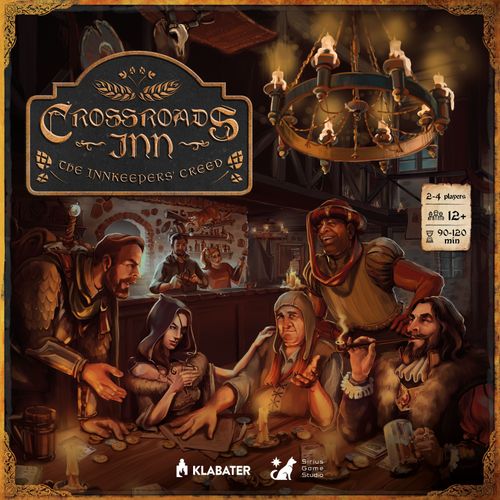
Crossroads Inn: The Innkeeper's Creed
Crossroads Inn: The Innkeeper's Creed Rulebook
Table of Contents
Table of Contents
Basics
2-4 players / 90-120 minutes / Age: 12+
Game Content
- 1 Rulebook
- 1 Progress Board
- 1 Reputation Board
- 4 Player's Inn Boards
- 24 Player tokens in 4 different colours
- 4 Innkeeper's Player Figurines
- 36 Gossip Tokens in 3 different colours
- 12 economic gossip tokens [green ribbon]
- 12 political gossip tokens [blue ribbon]
- 12 traveller's gossip tokens [red ribbon]
- 60 Gulden Tokens
- 20 1-gulden tokens
- 15 2-gulden tokens
- 10 5-gulden tokens
- 10 -1 Debt Tokens
- 5 -2 Debt Tokens
- 74 Ingredients Tokens
- 9 Honey tokens
- 9 Venison tokens
- 9 Root spices tokens
- 9 Citrus tokens
- 9 Black tears tokens
- 9 Berries tokens
- 5 Pumpkin tokens
- 5 Herbal spices tokens
- 5 Epic cheese tokens
- 5 Fish tokens
Setup
Game setup for 4 players.
-
Place the Reputation Board and the Progress Board on a table in a way that will let all players reach the tokens on the boards.
Reputation Board
- Five social groups among which the player will be building their reputation. Those include Distressed, Outlaws, Travellers, Townsfolk, and Nobles. Each group has their own Reputation track and Special Action.
- Reputation track of the social group whose symbol can be seen on the left side.
- Prestige that will be added to the scores at the end of the game. Its value depends on the space where each players' tokens are placed.
- Special Action activation space. The five actions on the right end of the tracks are each related to one of the five social groups shown at the beginning of the tracks. The player performs the action when their pawn lands on this space.
- The description of the Special Action of the given social group.
- The effect that comes to life when a player's reputation on the given track would drop below 0. The player's token remains on the 0 space.
- The effect that comes to life when a player's reputation on the given track would pass 12. The player doesn't place their token on this space, it remains on 12.
- Starting spaces, where the players place their Player Tokens at the beginning of the game.
Progress Board
- The Inn Prestige Track. The player with the highest score at the end of the game wins.
- The starting space on the Inn Prestige Track. Each player places there their Innkeeper's Player Pawn at the beginning of the game.
- The effect of passing the 40 Prestige points limit. The player takes a 40-Prestige Tile and moves their pawn on the space equal to the remaining Prestige points.
- The Investment Track for the tier I (silver bracket) Inn Tiles.
Before Starting the Game
Playing for the first time? When playing for the first time it is recommended that each player puts their 4 Basic Inn Tiles randomly on their Player's Inn Board, without using the game mechanic allowing the players to choose tiles from among those selected. So you can skip the 1-3 steps below. If you want to make the game even simpler, you can completely ignore these tiles. Treat the corner spaces as unavailable. In such a case, the game ends when the first player covers the 16 spaces of their Inn Board.
STEP 1: From the four randomly picked Basic Inn Tiles each player selects one tile with which they'll start the game. For the moment the tile should be placed on the table, face down. The other 3 tiles should be passed on to the player to the left, without showing the rest of the players what they are.
STEP 2: From the next 3 tiles each player picks 1, which once again they keep on the table, face down. They then pass the other 2 to the player on the left.
STEP 3: From the next 2 tiles each player picks 1, which once again they keep on the table, face down. They then pass the last one to the player on the left.
STEP 4: The last tile the players receive they put on the table with the other 3 they got. Each player then turns the tiles face up and places them on their Player's Inn Board, each one on one of the four corner spaces. When placing the tile, the player receives all of the things it offers (in order left to right, if that matters). Some tiles have their own specific effect, such as for example the Garden Patch.
ATTENTION!
The player can never have less Prestige than 1; less Inn's Revenue than 1 and more than 10; more Reputation among any social group than 12 or less than 0. The player sometimes receives additional effects when they update the status of their tokens, which might cause them to surpass the limits of the above-mentioned values. These effects affect:
- Reputation Track: If the player's level on the track was to fall to less than 0, they lose the amount of Prestige points equal to the amount of spaces by which they would fall below the limit. Example: If a player standing on a space 1 on any Reputation track was to fall by three spaces, their token ends on the space 0, and they lose 2 Prestige points at the same time. If the player was to pass the maximum limit of 12 Reputation points, they perform the special actions of the given social group (only once, no matter the number of spaces by which the Reputation would have increased).
- Inn's Revenue: If the player was to exceed the 10 revenue limit, they get a bonus 1 gulden, no matter the amount by which they would pass the limit.
- The player's Prestige cannot be lower than 1. If the player was to lower it by performing an action (changing the guest's impression, building tiles), they may not perform the given action. On the other hand, if the player's Prestige was to fall below 1 due to actions of another player (using the political gossips), that player can use their action, but it will not have any effect on this player's Prestige score.
Special Spaces on the Reputation Tracks
If at any moment during the game a player stops on or passes the Special Action space (no matter if it's due to losing or getting points) on the Reputation Track of any social group, they perform the Special Action. If the player CANNOT perform the given Special Action (at any moment of the game), but the effect forces the player to perform it, the player doesn't perform the action anyway. There is no limit to Special Actions the player can perform during a single turn.
Special Actions:
- Distressed - Draw one gossip of a type of your choice.
- Outlaws - Roll the Random Events Dice and perform one of the following effects based on the outcome of the roll:
- Discard one of your gossips
- Lose 1 Reputation Point on the Nobles track (printed as "Noble's track")
- Decrease the Inn's Revenue on your Player's Inn Board by 1
- Gain 2 Reputation points on the Outlaws track
- Gain 3 guldens
- Gain 1 Reputation point on the Townsfolk track and 1 on the Travellers track
- Travellers - You may choose one of the actions below and perform it:
- Draw two Recipe cards from the top of the deck. Choose and keep one. Discard the other one on the discard pile.
- Discard 1 recipe card from your hand onto the discard pile.
- Choose another player and take a random Recipe Card from their hand. The given player may then draw a new Recipe Card from the deck.
- Townsfolk - You may choose one of the actions below and perform it:
- Exchange 1 of your reserved tiles for any Inn Tile on the Investment track or a tile from the top of the Inn Tiles' discard pile. The tiles exchanged have to be of the same tier.
- Choose another player and exchange one of your reserved Inn Tiles for one of that player's reserved Inn Tiles.
- Put one of your reserved Inn Tiles back into the pouch with the tiles of the same tier. Receive 2 guldens.
STEP 5: At the beginning of the game each player receives as many Gulden Tokens as it's indicated by their token on the Inn's Revenue track.
ATTENTION! The limit of the Gulden Tokens kept in the Chest at any moment of the game is 20. If at any moment the player was to receive more guldens than the limit allows, they do not receive them. There is no limit to the amount of Debt Tokens which have to always be paid back at the end of the turn, if it's possible.
STEP 6: At the beginning of the game every player draws one political gossip, one traveller's gossip, and one economical gossip, which they put on their Inn Boards on the indicated spaces.
ATTENTION! The limit of any one type of a gossip at any moment of the game is 3. If at any moment the player was to receive more gossips than the limit allows, they do not receive those gossips.
STEP 7: Each player draws two cards from the Recipe Deck. Recipe cards are additional goals for the players. Once a recipe is completed, the player instantly receives the rewards it offers. The players have to keep the Recipe Cards in their hand in a way that will prevent other players from seeing their contents.
Recipe card layout
- The name of the Recipe.
- The illustration of the Recipe.
- Ingredients which the player must own to prepare the dish. The player always needs only one of each ingredient for a given recipe. Once used, the given ingredients are discarded.
- Reward for completing the recipe.
STEP 8: Now create the Investment Track on the Progress Board. Take 4 random tiles from each pouch with the Inn Tiles and put them next to each other, face up, on the tracks indicated by their tiers, I or II. You'll be buying these tiles during the game.
STEP 9: The oldest player starts the game, since the oldest child is always first in line to the throne. From thereon the turns go clockwise.
If you don't like the age-based system of choosing the first player, you can come up with another one. After all, you are all the king's bastards and thus have an equal say in the matter.
Playing the Game
Each turn is divided into actions which the player may or has to take. Each action is explained below.
THE ORDER OF THE ACTIONS:
- Moving the resources from the Chest to the Pouch.
- Changing the Guest Impression.
- Using gossips as special actions.
- Investing in the inn.
- Reserving.
- Building the inn.
- Completing recipes.
- Updating the tokens.
- End of the turn.
1. Moving the resources from the Chest to the Pouch
During the game the players use resources which have to be kept on two types of spaces. One of them is the Chest.
In the Chest the player keeps their money-related tokens gained during the turn (Guldens and Debts), as well as guldens which the player did not use during the turn. The resources inside the Chest cannot be used during the turn. They can be used only next turn. The Chest space is on the player's Inn Board.
The second type of a space used to keep resources is the Pouch. In the Pouch the player keeps resources earned during the last turn, which can be spent this turn. The Pouch doesn't have its own space on the Player's Inn Board. The Pouch is the name for the resources removed from the Chest and kept next to the Player's Inn Board.
Into the Pouch the player moves guldens taken out of the Chest and placed next to the Player's Inn Board. Into the Chest the player moves resources from the Pouch at the end of the turn. This way no resources should be lying in the place known as the Pouch at the end of the turn.
2. Changing the Guest Impression
The player can change the general impression the guests from each of the 5 social groups get. On the Player's Inn Board there are two spaces indicated by door icons. The open door symbolizes +1 Reputation point and the closed door symbolizes -3 Reputation points.
Changing the impression the guests get makes one of the social groups feel more welcome, while deterring another one from coming.
The player chooses one social group tile from their 5 Guest Tiles and places it on the closed door space, thus losing 3 Reputation points with that group. This status is updated immediately on the Reputation tracks on the Reputation Board. Next they choose the second social group and place its tile on the open door space, thus getting +1 Reputation points with that group. This status is updated immediately on the Reputation tracks on the Reputation Board.
ATTENTION! The player can perform this action only once per turn. When using this action again the player cannot put the same Guest Tiles on the same spaces (but they can switch their places). If the player's token on the Reputation tracks on the Reputation board passes a Special Action space because of the shiftment of the Guest Tiles, the Special Action of the given social group always activates.
3. Using gossips as special actions
The player may at the beginning of their turn use actions based on their gossips, discarding the required amount of those back onto the given gossips' stack.
GOSSIP ACTIONS:
Economic gossips:
- a. Spend 1 economic gossip - the player receives 2 guldens.
- b. [2 players] Spend 2 economic gossips - the player steals from another player a gulden and a gossip of their choice.
- c. [3-4 players] Spend 2 economic gossips - the player steals 1 gulden each from two of their opponents and puts them in his or her Pouch.
Political gossips:
- a. Spend 1 political gossip - the player receives +1 Reputation on the track of a social group of their choice (Distressed / Outlaws / Travellers / Townsfolk / Nobles).
- b. [2 players] Spend 2 political gossips - the player decreases by 1 Reputation of any player. After that the player receives +1 Reputation on a track of a social group of their choice. If this causes any player's token to pass or stop on a Special Action space, the player whose turn is currently taking place performs the action instead of the other player.
- c. [3-4 players] Spend 2 political gossips - the player decreases by 1 the Reputation of 2 of their opponents on a chosen social group Reputation track (the player may choose a different track for both players). If this causes any player's token to pass or stop on a Special Action space, the player whose turn is currently taking place performs the action instead of the other player.
Traveller's gossip:
- a. Spend 1 traveller's gossip - the player discards all the Inn Tiles from a chosen track (I or II tier) onto the tiles' discard pile. Then draw new tiles and place them on the track.
- b. Spend 2 traveller's gossips - the player switches one of their ingredient-giving Inn Tiles (there doesn't have to be an ingredient token on it) from their inn with an ingredient-giving Inn Tile that's a part of another player's inn. During the exchange the players exchange the ingredient tokens on the tiles as well, if any were present. If there wasn't any ingredient token on a given tile, a token should be placed on it, same as when an ingredient-giving tile is normally bought and placed on the Inn Board. No other actions, effects, or updates happen, except for receiving the new ingredient tokens. The tiles can only be placed on the spaces that were covered by the tile with which the new tile is switched. This exchange cannot take place if its outcome would go against the active Kingdom Cards.
ATTENTION! A special action of one of the three types of gossips can be used only once during one turn. Which means a player can have three special actions, as long as they come from three different types of gossips.
4. Investing in the inn
The player may buy during a turn a total of 2 Inn Tiles, choosing them from any tier of the Inn Investment tracks or from their own Reserved Tiles. The cost of the tile can be seen at its top. The cost is usually in guldens, which have to be spent to buy the given tile. Some of the tiles have an alternative cost and can be paid by using gossips. If so, the player decides how they're going to pay for the given tile.
Inn Tile layout
- A single cost of the tile.
- Two alternative costs of the tile; the player chooses which one they're going to pay.
- The name of the tile.
- The tier of the tile (silver bracket = tier I, gold bracket = tier II), showing in which pouch and on which Investment Track it belongs.
- (Only Special Guests) The social group they represent.
- (Only Workers) The social group they represent.
- The effect the tile has when it's placed on the player's Inn Board.
- The ingredient the tile offers. When the tile is placed on the Player's Inn Board, the player receives the given ingredient.
- The negative effect of the given tile. Negative effects are present only on the Services tiles.
- One of the four types of tiles: Yellow - Inn's Furnishing; Brown - Services the inn offers; Blue - Inn's Workers; Red - Special Guests that visit the inn.
ATTENTION! Acquired tiles have to be placed next to the Player's Inn Board in the order they were bought, because that's the order in which they will be placed on the board later during this turn.
After buying any Inn Tile, all tiles to the left of the one bought have to be instantly moved to the right, and a new tile is drawn from a corresponding pouch and placed on the far left space of a given Investment track.
5. Reserving
The player may reserve 1 Inn Tile from among those on the Investment Tracks. The reserved tile is then placed on the special space on the Player's Inn Board and can be bought next turn, during the Investing in the inn phase of that player's next turn.
Buying a reserved tile does count as one of the two tiles that can be bought during a turn.
ATTENTION! The player can have max 2 reserved Inn Tiles at the same time. They cannot reserve a new one until they buy one of them.
At the end of the Reserving phase all face-up Inn Tiles in the Investment Tracks should be moved right, and the far right tiles should be discarded onto the tiles discard pile next to the Progress Board. Tiles of each tier have their own discard pile. After this is done, new tiles for each tier should be drawn and put on the free spaces of each track.
ATTENTION! There cannot be two identical tiles on the same track. If a tile drawn from a pouch turns out to be identical to one already on one of the Investment Tracks (for example there's already a "Servant" tile), the duplicate tile should be put back into the pouch and a new one should be drawn.
ATTENTION! If you run out of the Inn Tiles of a given tier, the corresponding discard pile should be put back into its pouch and new tiles should be drawn. If there are no tiles of a given tier on the discard pile, the empty spaces remain empty.
6. Building the inn
The player places acquired Inn Tiles - in the order they were bought - on their Player's Inn Board on empty spaces (the only exception to this rule is building over the Basic Inn Tiles. More on that at the End of the Game section, page 25).
a. If the player puts a tile on a free space - they receive all of the things it offers (in order left to right, if that matters): increases in Reputation, Prestige, or Inn's Revenue, as well as Gossip, Gulden, or Debt tokens. Once all of the outcomes of the tile are realized, it should be placed on the Player's Inn Board face down (illustration up).
For example: The player buys the Steel cages Services tile, paying for it with 3 economic gossips. Once the player puts it in their inn, they move their Reputation token on the Outlaws track 3 spaces forward. Then they receive 6 guldens, which they place in their Chest, as well as move their token on the Inn's Revenue track back by 2 spaces.
ATTENTION! All gulden tokens acquired by placing the Inn Tiles on the Player's Inn Board should be placed on the Chest space. They can be used the soonest next turn, when they are moved to the Pouch.
The max revenue of the inn, recipe ingredients, Prestige, and Reputation should be updated immediately when a tile is put on the board.
b. If the player put a tile on a Basic Inn Tile - first they reduce the bonuses given by the now-covered tile; next they receive effects of the new tile. If the player is incapable of reducing a bonus of a tile that's about to be covered, the tile cannot be covered (the only exception being the Garden patch tile, which offers bonuses when it's covered).
7. Completing recipes
The player may complete any amount of recipes, as long as they have enough Ingredient Tokens on their tiles.
ATTENTION! The only way to refill the Ingredient Tokens on a given tile is exchanging it with another player's tile by using the special action offered by the traveller's gossips.
Each recipe card's ingredient has its own Rarity Symbol (shown as one, two or three diamond gems):
- One diamond - a common ingredient, used in cheap recipes. There are four tokens of each such ingredient in the game.
- Two diamonds - a more expensive common ingredient. Used for more advanced recipes. There are four tokens of each such ingredient in the game.
- Three diamonds - a rare ingredient, much more expensive. Needed for expensive recipes. There are two tokens of each such ingredient in the game.
Note: the counts printed with the rarity symbols (four and two tokens) differ from the Game Content list above (for example 9 Honey tokens and 5 Pumpkin tokens). Both are transcribed as printed.
8. Updating the tokens
Following the actions above, the player updates the state of their tokens in the Chest:
The player receives the amount of guldens equal to the position of their pawn on the Inn's Revenue track on their Player's Inn Board. Guldens unused during the turn should be moved from the Pouch to the Chest.
Having updated the state of the guldens, the player updates the state of the Debt Tokens. If the player has no debt tokens, their turn ends.
For each Debt Token the player has to remove one gulden from the Chest. If the player can pay back a Debt Token they have to do it. Unpaid Debt Tokens remain in the Chest. Paid back Debt Tokens should be removed from the Chest.
9. End of the turn
The player ends their turn when they update the state of their tokens above. Then comes the turn of the player to the left, and so on, moving clockwise.
End of the Game
The player who covered all of the 16 spaces on their Player's Inn Board (the 4 basic spaces - the corners of the inn - can too be covered, but they do not count towards the conditions of ending the game), may during their turn End the game. Once they decide the game ends, all players who had less turns than the First Player play their last turns, after which the game ends and the players start counting up the Prestige points.
However, if the first player who covered all 16 spaces on their board does not announce the end of the game, another player who covers all 16 spaces of their inn board may do so. If no player ends the game, the playthrough lasts until every player has covered all 16 spaces of their inns. Then the game ends immediately.
Scoring
At the end of the game the players count up their points according to the rules below:
- Each social group Reputation track gives the players Prestige points bonuses according to the place where their Player token was at the end of the game. Those bonuses are one-time, at the end of the game, and they update the player's score on the Prestige track.
- Each unspent 3 guldens in the Chest are turned into 1 Prestige point.
- Each unused gossip equals 1 Prestige point.
- Each unused ingredient token equals 1 Prestige point.
- Each unpaid Debt Token equals -1 Prestige point.
- Each uncompleted recipe equals -2 Prestige points.
The player who got the most Prestige points wins the game. In case of a draw, the game is won by the one of the tied players who has the biggest Reputation among the Nobles, and if there's still a draw, the game is won by the one of the tied players who has the biggest Reputation among the Townsfolk.
Legend
Basic Inn and Inn Tile descriptions
- Cost (1 gulden): The cost of a single Basic Inn or Inn tile. Can be paid from the Pouch. The paid guldens go back to the general pile of the guldens.
- Alternative cost (10 guldens OR 3 gossips): The alternative cost of the Inn tile. Can be paid from the Pouch (the paid guldens go to the general pile of guldens) OR by using an indicated number of the given type of a gossip (the used gossips go to the general pile of gossips of their type). The example icon shows a red-ribbon traveller's gossip.
- Tier icon (two example tiles): The tier of the given tile (I or II). The tier indicates in what pouch the tile should be kept, as well as on which Investment Track it should be later placed.
- Single effect (one "?" with +/-): The singular effect of the given tile. It can affect the Reputation board, the Progress Board, or the Player's Inn Board. The effect can be either positive or negative.
- Double effect (two "?" with +/-): The double effect of the given tile. Both outcomes take effect, if possible.
- Triple effect (three "?" with +/-): The triple effect of the given tile. All three outcomes take effect, if possible.
- Dice: Roll dice.
- Recipe Card (card icon): Recipe Card.
- Special Action (star): Special Action on the Reputation Track.
- Inn's Prestige (beer mug): Inn's Prestige.
- Gulden (coin): Gulden, the basic currency in the game.
The effects on the tiles and cards
- Prestige (beer mug, +N): Move your pawn forward or back on the Prestige track by the number of spaces indicated by the number under the beer mug icon. The positive value moves forward, the negative value moves back.
- Inn's Revenue (coins, +x/-x): Move your token forward or back on your Inn's Revenue track on your Player's Inn Board by the number of spaces indicated by the number under the coins icon. The positive value moves forward, the negative value moves back.
- Gulden (+N): If the value of the effect is positive, you receive the amount of guldens indicated by the value. If the value of the effect is negative, you receive that many Debt Tokens.
- Specific gossips (economic / political / traveller's, +N): You receive the number of economic / political / traveller's gossips indicated by the value of the effect.
- Any gossip (mixed gossips, +N): You receive the number of any gossips (economic, political, or traveller's) indicated by the value of the effect. You may choose to receive different types of gossips.
- Ingredient (fruit icon): Receive one token of the indicated ingredient and put it on the tile's back.
- Reputation, given groups (five group icons, with values such as +3 and +1): Move your token on the Reputation Track of the given social group (Distressed, Outlaws, Travellers, Townsfolk, Nobles) by the number of spaces indicated by the number under the effect. A positive value moves the token forward, a negative value moves it back.
- Reputation, any group (figure with +?): Move your token on the Reputation Track of any one social group by the number indicated by the value shown.
- Recipe Card draw (card with +2): Draw a Recipe Card from the deck to your hand. If the player covers a Basic Inn Tile with this icon with a new Inn Tile, they have to discard from their hand X random cards.
Workers
Workers are the blue tiles. Each Worker group contains the tiles listed under it.
- Scoundrels - Scammers, crooks, and con artists who bring profit from questionable sources. Better not to ask too many questions. This group includes: Tinhorn / Crook / Swindler
- Caretakers - They take care of guests, take orders, wash the dishes, and keep rooms tidy. Their additional advantage is that they listen to many rumors during their work. This group includes: Servant / Maide / Housekeeper
- Labourer - Handymen that can fix any problem in the inn. In addition, they carry heavy objects and take care of the crops. Sometimes they hit the bottle during work. This group includes: Drudge / Workman / Foreman
- Kitchen Staff - Good cooks are necessary for good taverns, and every chef should constantly update their repertoire with new recipes. And don't burn the dishes. This group includes: Kitchenhand / Cook / Chef
- Watchman - The inn brings in many different gentlemen, and the guard's task is to make sure their 'manly' affairs take place outside the building. The guards sometimes have too much fun at their job. This group includes: Thug / Bouncer / Veteran
Ingredients
The ingredients found on tiles and cards are: Honey, Root spices, Venison, Citrus, Black tears (Black sesame), Berries (of different types), Herbal spices, Pumpkin, Fish, and Epic cheese.
Kingdom Cards
Kingdom Cards Descriptions
- #1 - I wanna see you! The Workers tiles have to be placed next to the Furnishings tiles. It's surely bound to help them work better. Just make sure they don't spend all their time on a throne.
- #2 - Table by the window, sir! The tiles with ingredients can be placed only on the outer ring of the inn. Garden patches inside the building do not sound like a good idea for the interior design.
- #3 - Lucky 7 The inn has to meet the basic requirements of the kingdom, so there cannot be more than 7 tiles of the same type. Seven was the favourite number of the previous king. Ironically, according to the rumours he died trying to eat seven grapes at the same time - and choking on them.
- #4 - Vanity lane The Special Guests tiles can be placed only in a vertical OR a horizontal line. The line is defined by the first tile placed on the Player's Inn Board. Nowadays everyone wants to be special.
- #5 - Make some room! The Services tiles cannot be placed next to each other. We have everything our clients may need. Especially privacy.
- #6 - Looking busy The tiles bought during the same turn cannot be placed next to each other. To save some guldens I will leave the rest of the construction job to my uncle. It doesn't matter that he's a baker.
- #7 - Thank you sir! Tiles placed on the inner ring immediately grant a bonus of 1 gulden, while the tiles on the outer ring give the player one Debt token. Surely my neighbour won't notice that I've slightly stepped on his land.
- #8 - This guy must be a collector For 2 players: place on this card 1 gossip of each type and 2 gulden tokens. For 3/4 players: place on this card 2 gossips of each type and 4 gulden tokens. Placing three Inn Tiles of the same type in one line (horizontal or vertical) on the Player's Inn Board gives the player a bonus indicated by this Kingdom Card. The bonus is paid from the card, not the general stacks of resources. Tiles that have already been a part of a line that gave the bonus cannot be parts of the new bonus-giving lines (a fully new verse or column has to be created). So that the clients don't go places where they cannot spend any money. The bonuses offered by completing a line of a given type: 3xRed - traveller's gossip; 3xBlue - political gossip; 3xBrown - economic gossip; 3xYellow - 2 guldens.
Chart of Kingdom Cards combinations
The chart is a grid with Kingdom Card numbers 1 to 10 on both axes. Each cell where a pair of cards meets is one of three kinds, per the legend: interesting and simple (marked with a green mug), neutral (marked "-"), or difficult and planning-wise challenging (marked with a pink crown). The diagonal and the lower-left area of the grid are shaded and are not combinations.
Cards in the upper-right area, row card (first) by column card (second):
| Row | Col | Kind |
|---|---|---|
| 1 | 5 | Interesting and simple |
| 1 | 8 | Difficult and challenging |
| 1 | 10 | Difficult and challenging |
| 2 | 9 | Interesting and simple |
| 4 | 6 | Difficult and challenging |
| 4 | 8 | Interesting and simple |
| 7 | 9 | Interesting and simple |
| 7 | 10 | Interesting and simple |
| 9 |
All other cells in the upper-right area are neutral. The source does not explain the shading; it is read here as the cells that are not valid pairs, and this reading is a judgement call.
Special Guests
The Special Guests (red tiles) are characters that visit the inn. The rulebook gives a flavour biography for each one (Alstero, Kobi, Estelle, Hubu Gross, Vermelha, Meilan, Renmy, Iduna, Nameless, Lilith, King Ludo, Ganis, Calisterre, Nillesio, Letima). The biographies are flavour text and are not transcribed here. The individual Special Guest tiles are not listed in the rulebook.