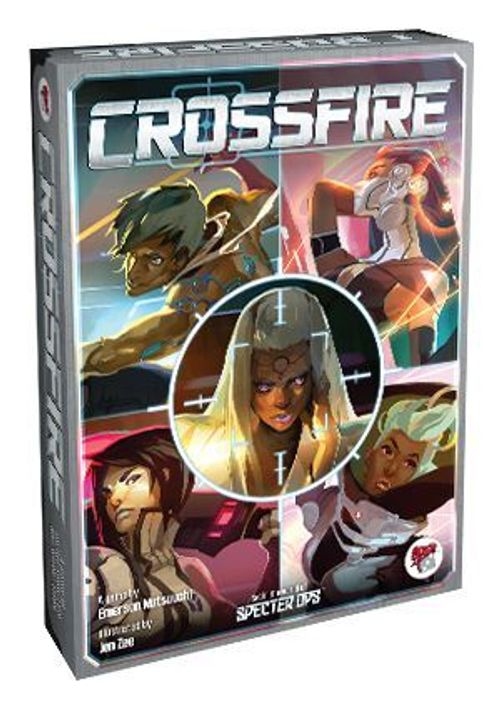
Crossfire
Crossfire Rulebook
Table of Contents
Table of Contents
Components
- 19 Role Cards
- 3 Sniper Shot Cards
- 1 Sandtimer
Role Cards
Each role card shows four things:
- Name: The name of the role.
- Armed: A role with the gun symbol on it is "armed."
- Special/Standard: Special roles are only used after players have learned to play with the standard roles.
- Effect: This text informs a player how to win when playing with the role. On some special roles, it also reminds a player of any special ability that role may have.
For example, the AGENT card shows the role name "Agent," the armed (gun) icon, that it is a Standard role, and the effect text "You win if the VIP is not shot."
Crossfire Mode
In Crossfire Mode, players are mostly split into a blue team and a red team. The red team will try to find and shoot the VIP. The blue team will try to keep the VIP from being shot.
Setup
| # of Players | 5 | 6 | 7 | 8 | 9 | 10 |
|---|---|---|---|---|---|---|
| VIP | 1 | 1 | 1 | 1 | 1 | 1 |
| Agents | 1 | 1 | 2 | 2 | 3 | 3 |
| Assassins | 1 | 2 | 2 | 2 | 3 | 3 |
| Decoy | 1 | 1 | 1 | |||
| Red Decoy | 1 | 1 | 1 | |||
| Blue Decoy | 1 | 1 | ||||
| Bystander | 1 | 1 | 1 | 1 | 1 | 1 |
- Choose a dealer.
- The dealer gathers the correct role cards (use the chart above), shuffles them and deals a card to each player.
- Each player looks at the card dealt to them, passes it to the left, then looks at the card just passed to them.
- The dealer shuffles her card together with the cards of her neighbouring players, then randomly deals them back out to herself and her neighbours. The players look at their new cards. Continuing clockwise around the table, every third player will do the same, shuffling their card with their neighbours and looking at the new cards. This continues until all cards have been shuffled in this way. Use the seating diagrams below as a guide through this process.
- Start the timer and begin play.
The number of times each player's card gets shuffled depends on player count and seating position, following this pattern around the circle of players (numbered clockwise starting from the dealer as player 1):
- 5 players: Player 5's card will get shuffled twice.
- 6 players: no player's card is shuffled twice.
- 7 players: Players 1 & 7's cards will get shuffled twice.
- 8 players: Player 8's card will get shuffled twice.
- 9 players: no player's card is shuffled twice.
- 10 players: Players 1 & 10's cards will get shuffled twice.
Gameplay
Players have 3 minutes to gather information from the other players by discussing what roles each of the players saw during setup and by looking at what roles players are claiming to be.
Important! At the start of play, players should simultaneously claim a role by orienting their card backs with the role they are claiming to be facing away from them. The back of each role card is divided into four labeled sections — Agent, Bystander, VIP, and Undeclared — arranged around a "player position" marker, so whichever section faces away from the player shows what they are claiming to be. In the rulebook's example, the player is claiming to be an Agent.
A player may change the orientation of her card at any time to change who she is claiming to be. Players are free to lie and generally say anything, but under no circumstance can a player reveal her role cards before time runs out.
Time's Up...
Once time runs out, players will countdown 3, 2, 1. Then ALL players will simultaneously point their finger/gun at 1 other player.
The dealer will read this script out loud:
- "If you're not armed, put your gun down"
- "Agents, reveal your role card."
- "If you have been shot by an agent, put your gun down and reveal your role"
- "VIP, reveal your role card. Are you shot?
- Yes – "Red team wins"
- No – "Blue team wins."
Note: Some cards have alternate win or loss conditions and those are checked and declared now.
Sniper Mode
In Sniper Mode, one player will be a Sniper. The Sniper will attempt to shoot all of the Assassins in play.
Setup
| # of Players | 6 | 7 | 8 | 9 | 10 |
|---|---|---|---|---|---|
| Sniper | 1 | 1 | 1 | 1 | 1 |
| VIP | 1 | 1 | 1 | 1 | 1 |
| Agents | 1 | 1 | 1 | 2 | 2 |
| Assassins | 2 | 2 | 2 | 3 | 3 |
| Decoy | 1 | ||||
| Red Decoy | 1 | 1 | |||
| Blue Decoy | 1 | 1 | 1 | ||
| Bystander | 1 | 1 | 1 | 1 | 1 |
| Shots | 2 | 2 | 2 | 3 | 3 |
- Choose a player to be the Sniper. Place the sniper role card face up in front of that player.
- Choose any player, except the Sniper, to be the dealer.
- Using the Setup chart above, the dealer gathers the correct role cards, shuffles them and deals a card to each player, except the Sniper.
- Give the Sniper a number of Sniper Shot cards equal to the number of Assassins in play.
- Each player looks at the card dealt to them, passes it to the left, then looks at the card just passed to them.
- The dealer shuffles her card together with the cards of her neighbouring players, then randomly deals them back out to herself and her neighbours. The players look at their new cards. Continuing clockwise around the table, every third player will do the same, shuffling their card with their neighbours and looking at the new cards. This continues until all cards have been shuffled in this way. Use the seating diagrams in Crossfire Mode as a guide through this process. The Sniper isn't involved in any of this shuffling.
- Start the timer and begin play.
Gameplay
Before time runs out, the Sniper must place a Sniper Shot card in front of each player she suspects is an Assassin.
Time's Up...
- Once time runs out, players that received the shot card are shot and reveal their roles.
- If all Assassins are shot, blue team wins.
- If the Sniper shot a Bystander or the VIP, the red team wins.
- If neither team has won yet, all Assassins who haven't been shot reveal their role cards. The Sniper counts down from 3, 2, 1 then each surviving Assassin simultaneously points their finger/gun at another player. All players reveal their cards.
- If the Assassin(s) shot the VIP, and haven't shot the bystander, the red team wins. Otherwise, the blue team wins.
Going for Points
Players may play multiple games and keep score by awarding the winners of each game a point. After a predetermined number of games have been played, the player(s) with the most points wins.
Strategy
To win Crossfire, use your investigative instincts. Your first clue is the roles other players are claiming to be. If too many players claim the same role, someone is lying. Your second clue is the cards you saw during set-up. Do the players to your left and right say they saw the same cards that you saw? If so, perhaps you have found allies. If not, you may want to point your gun in their direction. Each player has valuable information - if you can put the pieces together. For your first game, consider asking each player to declare what she saw during set-up and see what happens.
You also need to use social deduction to win. Who is talking straight, and who is lying to your face? When should you lie? Some roles need to conceal their identities, while others seek the truth. Look your fellow players in the eyes and learn their secrets.
Adding New Roles
Once you have become accustomed to the standard roles, try adding in some of these special roles. Below are descriptions of each of the special roles, details about how the role works, and rules for which cards to remove from a game and which cards to add to a game in order to include that special role.
Enforcer
You win if the VIP is not shot. You count as an Agent. You point and fire 2 guns instead of 1.
The Enforcer is considered an Agent, but points and shoots with 2 fingers/guns instead of 1.
- Mode: Crossfire
- Players: 5-8
- Remove: 1 Agent and 1 Bystander
- Add: 1 Enforcer and 1 Assassin
Bodyguard
You win if the VIP is not shot. You count as an Agent. Instead of shooting the person you point at, you protect them.
The Bodyguard is considered an Agent. The Bodyguard does not shoot at the player it points to, instead it protects that player. Protecting a player causes 1 of the shots being fired at that player to be blocked (ignored).
- Mode: Crossfire
- Players: 5-10
- Remove: 1 Agent
- Add: 1 Bodyguard
Bomber
If you are not shot, you win and everyone else loses.
If the Bomber is not shot, he wins and everyone else loses.
- Mode: Crossfire or Sniper
- Players: 5-10
- Remove: 1 Bystander
- Add: 1 Bomber
Peace Keeper
You win if no Bystanders are shot. Instead of shooting the person you point at, you protect them.
The Peace Keeper wins if no Bystanders are shot. The Peace Keeper does not shoot at the player it points to, instead it protects that player. Protecting a player causes 1 of the shots being fired at that player to be blocked (ignored).
- Mode: Crossfire
- Players: 7-10
- Remove: 1 Agent and 1 Assassin
- Add: 1 Peace Keeper and 1 Bystander
Protester
You win if the VIP is shot and you are not shot. If you are shot, both you and the shooter lose. You count as a Bystander.
The Protester is considered a Bystander. The Protester only wins if she was not shot and the red team won. If the Protester is shot, the player who shot the Protester loses, even if his team won. If the blue team wins more in your play group, consider adding the Protester to the game.
- Mode: Crossfire or Sniper
- Players: 5-10
- Remove: 1 Bystander
- Add: 1 Protester
Supporter
You win if the VIP is not shot and you are not shot. If you are shot, both you and the shooter lose. You count as a Bystander.
The Supporter is considered a Bystander. The Supporter only wins if she was not shot and the blue team won. If the Supporter is shot, the player who shot the Supporter loses, even if his team won. If the red team wins more in your play group, consider adding the Supporter to the game.
- Mode: Crossfire or Sniper
- Players: 5-10
- Remove: 1 Bystander
- Add: 1 Supporter