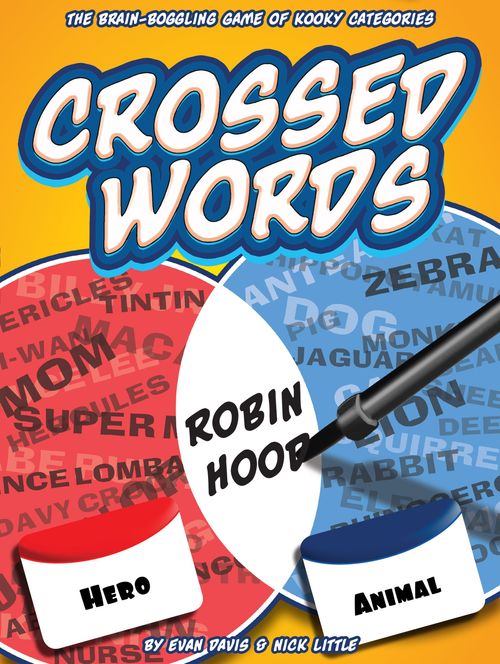
Crossed Words
Crossed Words Rulebook
Table of Contents
Table of Contents
- What is all this stuff? (Contents)
- How do I play this game? (Setup)
- Um…it seems like all I've done is set up the game. How do I play? (Gameplay)
- So what kind of answers are acceptable to play?
- Well, okay, but when do I stop? (End of the Round)
- Great, so how do I win?
- Okay, how do I keep score?
- Right, so how do I win? (Game End)
What is all this stuff? (Contents)
- 110 category cards
- 54 dry erase discs (9 in each color)
- 6 dry erase markers
- 1 insert
How do I play this game? (Setup)
- Get your friends together (3-6 people can play) and gather around the box you opened to find these rules.
- Remove everything from the box including the plastic insert. Have each player grab a marker and the nine discs with the same color on the back.
- Set the insert in the middle of the table. Set the box aside.
- Separate all the category cards by color into four decks and shuffle each deck separately facedown.
- Draw a card from the white "Starts with…" deck and place it faceup to the left side of the insert next to the top row.
- Take a look at the border of that "Starts with…" card. Each has colored half circles along the top and left edges. Those tell you what color cards to deal for the remaining spots on the top and left sides of the insert. So, if the top of the card has a blue bar, a red bar, and a green bar, deal a blue card, a red card, and a green card in the three corresponding empty slots along the top of the insert. When finished, you should have three cards along the top of the insert and three along the left side.
- Now start playing!
Um…it seems like all I've done is set up the game. How do I play? (Gameplay)
Oh, right. Well, that part is not quite as easy (but pretty close). If you've at least followed step #2 above correctly, you should each have a marker and nine dry-erase discs of the same color. If you followed the rest of the steps, you should see in front of you a game board that looks like a grid, with three columns, three rows, and nine empty spaces. Your goal is to fill as many of those empty spaces as possible with your discs. Wait!!! Don't just start throwing discs in! In order for them to count, you have to write something on those discs.
Specifically, if you want credit for one of those empty spaces, you have to throw in a disc that contains a word or phrase that fits the categories of both the card above it and the card to the left of it. Once you have thought of an answer that fits both categories, write it on one of your discs and toss it facedown into the corresponding space. But act quickly! As you're writing your answers down, so is everyone else.
So what kind of answers are acceptable to play?
Homonyms
Homonyms are two words that sound the same or are spelled the same. In Crossed Words, homonyms are allowed AND encouraged.
Example: If the card above a space reads, "Plants & Animals," and the card to the left of that space reads, "Musicians & Bands," you could write "The Beatles" on one of your discs and throw it into that space.
Answers Within Answers
"But wait," you're thinking, "some of these spaces are impossible!" Well, let me clue you in on a rule to make things a little easier: When I said that the answer you write on the disc has to match the categories written on both the card above it and to the left of it, that's not strictly true. It's fine to write as your answer a word or phrase where the whole answer satisfies just one of the two cards, and part of the answer satisfies the other card.
Example: If the card above a space reads, "Cartoon Characters," and the card to the left of that space reads, "Places in the USA," you could write "Yosemite Sam" on your disc and toss it in.
Heck, it doesn't even have to be a whole word, even part of a word or phrase will work. "red" is clearly part of the answer.
Example: If the card above a space reads, "Colors," and the card to the left of that space reads, "Boy's First Names," you could write "Fred" on your disc and toss it in, since the color red is clearly part of the answer.
Hold on, What are proper nouns?
When writing down answers to satisfy any of the green Proper Nouns cards, make sure to use proper nouns! Proper nouns have two distinct features: They name a single, unique entity, and they begin with capital letters. Examples: Atlanta, Martin Luther King Jr., Nintendo, Indianapolis Colts, etc.
Example: If the card above a space reads, "Proper Nouns: Pro Sports Teams," you could answer "Bears" but not "football team."
Just remember, the answer you write down must satisfy at least one of the two categories in its entirety. So now that I've given you a rule to make it a little easier on you, let me hit you with the rule to make it harder: if you want your answer to count (and you do), you want to make sure none of your friends have come up with the same answer for that space, because only unique answers count. Because of this, if you're worried that someone else might write in the same answer as you, feel free to put in more than one disc (with different answers) in the same space.
That's it! Start writing, and toss some discs in!
Well, okay, but when do I stop? (End of the Round)
Ah, good question. As soon as someone places all nine of their discs in some combination of spaces, that person has to count, "one Crossed Words, two Crossed Words, three Crossed Words, four Crossed Words, five Crossed Words!" When they finish, the round is over and everybody has to stop writing.
Great, so how do I win?
Well, first you probably want to know how to keep score.
Okay, how do I keep score?
Good question! At the end of the round, after someone triumphantly finishes counting "five Crossed Words," you start deciding who scores points. Starting with the first space in the top row, have someone take out all the discs in a space and read all the answers out loud. Go ahead and throw away any answers that are word for word duplicates (like I said, only unique answers count). All the remaining answers are checked to see if they match both categories. If there's a disagreement, then everyone except the player who wrote the controversial answer votes on whether the answer should count or not. You can argue all you like for your answer, but at the end of the day, a majority of the other players have to agree that an answer meets both categories in order for it to be counted. If the vote is tied, the answer is accepted.
Once all the discs in a space have received a vote, each player with at least one accepted answer adds exactly one disc to the scoring pile (just make a scoring pile to the side of the board). No matter how many answers you put in a single space, you can only score one disc per space.
After you've counted and voted for each of the nine spaces, take a look at the scoring pile. The player with the most discs in the scoring pile (so the player who had accepted answers in the highest number of individual spaces) scores 3 points, the player with the second-most scores 2, and the third-most scores 1. You can use the category cards from this round to keep track of your score. For example, give the player with the most accepted answers three category cards. In case of a tie, the tied players both score the points of the position they're tied for. If you run out of cards from the round, use cards from any of the decks to track your score.
When a round is over and points are assigned, each player takes all of their discs back and wipes them clean. Deal out a new "Starts with…" card and the five category cards it indicates and play another round.
Example scoring round
Example: Bob pulls all of the discs out of a space where the two category cards are "Colors" and "Musicians & Bands." The first disc is Abby's. It says "Pink." That is an accepted answer because pink is a color, and there is a musician named Pink. The second disc is Bob's. His answer is "Green Day." Another accepted answer! Green is a color, and Green Day is a band. The third disc is Candi's. It says "Prince loved purple." While this answer does contain a color and a musician, this is not an acceptable answer because the entire answer is not used for either category. The fourth disc is another one of Bob's discs. This disc says "Pink Floyd." This is an accepted answer. It does not exactly match Abby's "Pink" answer, so neither is eliminated. The last disc is Candi's. It says "Green Day." Since this matches an answer that Bob gave, both discs are eliminated.
Abby and Bob place one disc in the scoring pile since they each had an answer that was accepted and unique, "Pink" and "Pink Floyd" respectively. Candi doesn't place a disc in the scoring pile because one of her answers wasn't accepted and the other was a duplicate.
Right, so how do I win? (Game End)
At the end of any round that any player has 7 or more points, the game ends and that player with the most points wins. If multiple players are tied with the most points, then whoever scored the most points in the last round wins the game. In short, you are in a race to 7 points. That's how you win!