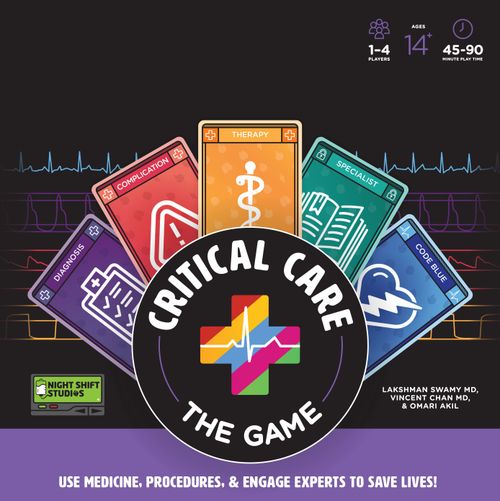
Critical Care: The Game
Critical Care: The Game Rulebook
Table of Contents
Table of Contents
Components
- 4 Patient Charts
- 12 Patient Cards
- 4 Doctor's Badges with Critical Care XP
- 1 Nursing Station
- 4 Reference Cards
- 4 Injury Dice
- Injury Tokens (Blood, Brain, Heart, Inflammation, Lung and Wild)
- Crisis Tokens
- Goals of Care Tokens
- Social Determinants Tokens
- 1 Kidney Basin (token storage tray)
- 12 Code Blue Cards
- 26 Specialist Cards
- 27 Diagnosis Cards
- 51 Complication Cards
- 155 Therapy Cards
- 50 Pager Alert Cards
- 9 Blank Critical Care Cards included for you to add in your own designs! Share them with us on Social Media with #TeamCriticalCare and they may make it into a future update!
Setup
-
Each player begins with a Patient Chart, a Doctor's Badge, a Goals of Care (GOC) Token, a Social Determinants (SD) Token, an Injury Dice and a Reference Card.
-
Each player places their Goals of Care (GOC) Token on their Patient in the GOC start position.
-
Search the SPECIALIST deck for the Critical Care Nurse and place it on the Nursing Station slot marked with the Critical Care icon.
-
Shuffle the SPECIALIST deck and place 5 SPECIALIST cards face up above the Nursing Station.
-
Place the Kidney Basin (token storage tray) in the middle of the play area. This is the Injury/Crisis supply.
-
Shuffle COMPLICATIONS, PAGER ALERTS, and THERAPY decks separately and place them in the central play area, leaving space for a discard pile for each deck. Shuffle the CODE BLUE deck and place it off to the side to be used if needed.
-
Give each player 1 Patient Card and DIAGNOSIS randomly and place them on their Patient Chart in the indicated spaces.
Social Determinants (SD) tokens: You can add or remove an SD token from any or all patients to adjust the difficulty of the game. An SD token reduces the amount of injury your patient can tolerate and adds a permanent "Crisis" to the status of your patient. Read more about Social Determinants of Health on Page 14.
-
Skip this step if playing Critical Care for the first time. Place the Social Determinants token on the injury that is labeled on each Patient Card.
-
Next, determine your patient's past medical history! Some of the COMPLICATIONS have been marked by the Critical Care icon on the back. Distribute one of these marked cards to each patient face-up. Place these cards next to your patients. Look at the CONDITION: at the top of the card and add any tokens that are noted there onto the corresponding spaces on the Chart. Return any other Complications into the COMPLICATIONS deck.
Gameplay
Objective: The team wins if every patient has all of their Injury and Crisis tokens removed or has advanced their Goals of Care to completion.
The SD token does not need to be removed to win the game - in fact, it cannot be removed from your patient during gameplay.
Day Progression
The game takes place over 7 rounds, each of which represents 1 day of the week in the ICU. Each round consists of four phases: ROUNDING, COMPLICATIONS, THERAPY, and CONSULTING.
All players complete ROUNDING and COMPLICATIONS phases at the same time. Players then determine the number of PAGER ALERT for the round.
Players then take sequential turns in clockwise fashion. On a turn, a player will resolve any PAGER ALERTS and then play up to 12 hours of THERAPY cards for their shift.
After their shift, the player discards their hand and draws 6 new THERAPY Cards.
After all players have completed their individual turns, players will work together for the simultaneous CONSULTING phase.
Rounding Phase
-
Place a Crisis token on the next day of the week, starting with MONDAY. Check your DIAGNOSIS for additional effects each time you start a new day!
-
Add an Injury or Crisis to the Chart for each Rounding icon on their DIAGNOSIS and COMPLICATION(S). There are different Rounding icons with unique effects.
- Add the Blood, Brain, Heart, Inflammation, Lung or Crisis token shown on the icon (each icon has a plus sign).
- Roll the Injury Dice and add the Injury or Crisis that is rolled to your Chart (see Injury Dice on page 6).
- Read this card's description for Rounding effects.
Don't have space to add another injury? Time to roll the dice - check out the next page for details!
-
Remove an Injury/Crisis token from the Chart for each Rounding icon on their THERAPIES and return it to the Injury/Crisis supply.
- Remove the Blood, Brain, Heart, Inflammation, Lung or Crisis token shown on the icon.
- The Wild removal icon allows you to remove any injury or Crisis token that you choose from your patient, except for the permanent SD token.
Example: This patient started with SDOH on Inflammation, 1 Lung and 1 Inflammation. On ROUNDING, the DIAGNOSIS adds 1 Heart, 1 Blood, and 1 Crisis. The COMPLICATION adds 1 Lung and 1 Inflammation.
Injury Dice
When an Injury token needs to be added to a Chart and that Injury row is full of any combination of Injury & SDOH tokens, then an Injury Dice is rolled to add an Injury or Crisis.
If you roll an Injury that has an available space, add that Injury token. If you roll an Injury that does not have an available space, add a Crisis token instead!
Injury Dice are used on some cards as instant effects and also during Rounding.
The Injury Dice icon on a card means roll the Injury Dice and add the injury or Crisis that is rolled to your Chart.
Complications Phase
-
After Rounding, each player must Draw for COMPLICATIONS. Draw a COMPLICATION for every Crisis and SDOH token on your Chart.
-
When you draw a COMPLICATION, it only affects your Patient if they have ALL the Injury/Crisis tokens shown within the CONDITION: of the COMPLICATION. If not, discard it.
Injury blocked by the SD token does NOT count as an Injury to fulfill a CONDITION: on a COMPLICATION.
-
If the CONDITION: matches the injury on your Chart, apply any instant effects immediately. If any recurring effects are present, place the card to the left of the Chart.
This is the draw for Complications icon! Whenever you see it, draw Complications equal to the number of Crisis and SDOH tokens on your Chart. When you encounter a card with this icon (marked with a 1) it means you draw one Complication.
If the COMPLICATION has no ROUNDING icons, discard it after applying its effects. If the COMPLICATION has ROUNDING icons, place it to the left of the Chart. Those effects will be applied in future ROUNDING phases.
Example: The patient has 1 Crisis and 1 SDOH, so two COMPLICATIONS are drawn.
-
PULMONARY EDEMA DOES affect this Patient because they have a Heart injury on their Chart. The instant injuries are added to the Chart and the card is discarded.
-
SHOCK DOES affect this Patient because they have 2 Heart injuries on their Chart after the immediate effect of PULMONARY EDEMA. The instant Heart injury is added to the third slot filling out the row. The instant Inflammation injury CANNOT be added as the row is full and the Injury Dice is rolled instead. The Injury Dice adds a Crisis to the Chart. The card is then placed on the left of the Chart because it has a ROUNDING effect which will activate during the next ROUNDING phase.
You do not draw additional COMPLICATIONS for any Crisis that were added as a result of COMPLICATIONS drawn this phase.
Some effects are conditional and may not affect your patient. Example: if HYPERNATREMIA were drawn instead, it DOES NOT affect this Patient because they have no Brain injury on the Chart, so it is discarded.
Therapy Phase
Pager Alerts
To begin the THERAPY phase, each player will look at their hand for any BEEP BEEP! THERAPY cards. If present, they should announce that they have been BEEPED.
Players count the total number of BEEP BEEP! THERAPY cards. Each player will pick up one PAGER ALERT card per BEEP BEEP! THERAPY and place them face down on their Patient Card.
Each individual PAGER ALERT card will be resolved at the start of each player's turn before playing THERAPY cards.
Do not replace the BEEP BEEP! THERAPY card with an additional THERAPY card.
BEEP BEEP! card: Add 1 PAGER ALERT card face-down onto each patient. Alert players that a BEEP BEEP! THERAPY was drawn.
Example: In a three player game, the three players count BEEP BEEP! THERAPIES in their respective hands. Vince had 0, Omari had 1, and Lakshman had 1 for a total of 2 BEEP BEEP! THERAPIES. Each player picks up 2 PAGER ALERTS and puts them face down on their patient. The BEEP BEEP! THERAPIES are discarded. Vince starts his turn by revealing the pagers and resolving them one at a time, as do the other players on their respective turns.
Therapy Cards
- You may play up to 12 HRS of THERAPY from your hand or from the Nursing Station onto ANY Patient in the ICU. Each THERAPY uses 3, 6, 9, or 12 HRS unless a card effect says otherwise.
- Apply the one time effects on the right side of the THERAPY at the time it is played.
- The active player who uses the THERAPY Card with a Critical Care XP icon gains the Critical Care XP from the card's effect, even if the card was played on another player's patient.
- If there are any ROUNDING icons on the THERAPY, place it to the right of the Chart. These effects will apply starting on the next ROUNDING phase.
- To end your shift, you may place THERAPY cards from your hand onto empty Therapy spaces in the Nursing Station or replace existing Therapies; discard the remainder of your hand and draw 6 new THERAPY cards.
- As a team, you may store up to 3 THERAPY cards at the Nursing Station.
Healing Icons
These healing icons are found on Therapy cards. Each allows you to remove one Injury/Crisis token from your Patient.
- Instant effect icons (each with a minus badge): Blood, Brain, Heart, Inflammation, Lung, Crisis and Wild. The minus badge means these Injury and Crisis tokens are moved to your Critical Care XP on the Doctor's Badge.
- Rounding effect icons (each with an X badge): Blood, Brain, Heart, Inflammation, Lung, Crisis and Wild. The X badge means these Injury and Crisis tokens are returned back to the Injury/Crisis supply.
Therapy Card Types
THERAPY cards are categorized into DIAGNOSTIC, INVASIVE, STAFF and MEDICATION cards. These categories may have important interactions with PAGER ALERTS or other THERAPIES.
Example POCUS card: this POCUS allows you to heal one of any injury from the Chart. It uses 3 HRS and has a Radiology Specialist Icon, which relates to the upcoming CONSULTING phase.
Rapport Bonus
Injury and Crisis tokens that are healed can be placed in Critical Care XP on the Doctor's Badge or the Patient's Rapport Bonus.
At any time while a Patient's Rapport Bonus is full, you may discard all of the tokens and activate its effect. The effect may only be used once per patient per day.
Example: POCUS was played (using 3 Hrs) and a Crisis was healed and placed in the patient's Rapport Bonus. CARDIOVERSION was played (using the remaining 9 Hrs) healing 3 Heart injuries, which are placed in the player's Critical Care XP on the Doctor's Badge. Then, a Complication is drawn for the Heart injury. After the Complication is resolved (not shown), the THERAPY shift ends as 12 Hrs have been used.
ROUNDING effects will activate during the subsequent ROUNDING phase.
Goals of Care
This icon represents palliative care and understanding your patient's Goals of Care. If the token reaches the end of the Goals of Care path, congratulations, the patient is sent home on hospice. Flip over the Patient Card and DIAGNOSIS, discard all COMPLICATIONS and THERAPIES.
Whenever a THERAPY is used that has a Goals of Care icon, move your GOC token along the track based on the number of Crisis and SDOH tokens that are on the Chart.
Example: If the Chart has 3 Crisis and 1 SDOH and then Social Worker is played, move the GOC 4 spaces forward to 5.
Consulting Phase
After all players have completed their THERAPY shifts, you can call in SPECIALISTS to the ICU to help provide care for your Patients.
Specialist Effects
SPECIALISTS in the ICU have passive effects and/or effects that can be activated during the CONSULTING phase.
Doctor Badge Effect
Once per game, each Doctor may activate their Doctor Effect during the CONSULTING phase. You may tuck up to 2 On-Call SPECIALISTS under the Doctor's Badge and replace them from the SPECIALISTS Deck.
"Call In" Criteria
SPECIALISTS are "Called In" by discarding the number and type of Injury listed from your Doctor's Badge, then placing them in the Nursing Station. The team may use a combination of tokens from any player's CCXP to call in a SPECIALIST.
Whenever an On-Call Specialist space is vacant, replace it with a SPECIALIST from the top of the deck.
- Specialists that are "called in" are placed in the Nursing Station and are considered "in the ICU." The Critical Care Nurse starts every game in the Nursing Station in the ICU.
- Any Specialist in the ICU may be replaced by another if the call in criteria are met.
- The third slot in the Nursing Station may be used for either a THERAPY or a SPECIALIST.
Specialist Icons
Procedures, Education, Emergency, Pharmacy, Radiology and Respiratory.
Some SPECIALISTS equip the entire unit with extra abilities that are activated by playing a THERAPY with the matching SPECIALIST icon.
Social Determinants of Health (SDOH)
Although serious health problems can develop in anyone, many of the issues we see in the hospital are driven by Social Determinants Of Health (SDOH). These non-medical characteristics including neighborhood, economic stability, access to health education & care, and broader social & community context can all impact health. In the ICU, we recognize this in the patient coming in with severe infections in the setting of uncontrolled diabetes - who cannot access or afford a healthy diet and medications, or safe stable housing, which are all critical for keeping diabetes in check. SDOH is the understanding that some patients have greater obstacles to maintaining good health.
SDOH in Critical Care: The Game
We are using the SD Token to represent SDOH in Critical Care. You can increase the difficulty of the game by adding 1 or more of these tokens to your patient during the game's setup. The SD Token reduces the amount of injury your patient can tolerate and adds a permanent "Crisis" to the status of your patient.
Each patient in the game has a backstory to tell you more about who they were prior to coming into the ICU. Check out the back of each Patient card to find out more about their life!
Goals of Care (Background)
In the ICU, we start to discuss the Goals Of Care (GOC) the first time we meet any patient. Discussing a patient's GOC can help us understand what types of care may or may not make sense as their condition continues to evolve. For many patients, the GOC is to prioritize life over everything else - including comfort and dignity. But many people come to the ICU at the end of life or with catastrophic injury. For these patients, aggressive interventions and life support may cause suffering and prolong life without a real chance of living the way they would want to. We advise families on decision making that is most in line with the patient's wishes. Although these conversations are ideally initiated long before the patient comes to the ICU, it is not uncommon for the patient and family to have these discussions for the first time in an ICU. Not infrequently, these GOC discussions move faster when patients are sicker or more obviously suffering.
An initial GOC discussion may include trying to prolong life with all interventions that have a good chance of helping a patient recover while limiting suffering by avoiding aggressive interventions unlikely to help a patient recover. This could lead to placing a "Do Not Resuscitate (DNR)" order for the patient. DNR means that if the condition worsens and life support such as CPR or intubation would be the next step in escalating aggressive care, we will at that point "let nature take its course" and focus instead on the patient's comfort and supporting their family as they approach end of life. Sometimes, before that emergency occurs, these conversations result in changing the patient's "goal" from prioritizing life to prioritizing comfort and dignity. This may result in transfer home or to a "hospice" facility, or it may result in the patient dying peacefully and comfortably in the ICU itself. It often includes removal of invasive devices and cessation of life sustaining therapies. Many clinicians and staff assist with these conversations, especially the Palliative Care specialists - clinicians board certified in managing pain, suffering, and conversations around the end of life.
Goals of Care in Critical Care: The Game
We are using a GOC Track and a GOC Icon to represent Goals Of Care in Critical Care. Reaching the end of the GOC Track symbolizes sending the patient home on hospice. This is successfully caring for the patient and "winning" the game - no matter how much Injury or Crisis they have. Each time you play a card with the GOC icon you will advance on the GOC Track. The number of spaces you advance depends on the patient's Crisis level. We added Goals Of Care to the gameplay based on some incredible feedback from Dr. Talia Lewis. You'll even see Talia's name on the Palliative Care SPECIALIST card!
End of Game
You are the best doctors and win if your patients are all either (1) stabilized or (2) sent home on hospice.
(1) Patient Stabilized
Patients are stable if they have all Injury and Crisis on their Chart removed, except for the SDOH token.
(2) Patient Sent Home on Hospice
Patients are sent home on hospice when their GOC token is moved to the final space on the Goals of Care track.
When either (1) stabilized or (2) sent home on hospice occurs, the patient card and diagnosis are flipped over marking their transfer out of the ICU regardless of the number of COMPLICATIONS that may remain.
Players with Patients who are removed from the game by conditions (1) or (2) remain in the game. They ignore the ROUNDING and COMPLICATIONS phases as they do not have Patients, but they participate in THERAPY phases - i.e. resolving PAGER ALERTS cards and playing Therapies to help the remaining Patients. They'll also contribute to the CONSULTING phase and any other aspects of the game.
At any time during the game, if a single patient succumbs to an unsuccessful CODE BLUE, the game ends immediately and all players lose.
If any patient survives to the end of Sunday without a CODE BLUE, the game is a draw.
Code Blue
If a patient's Crisis level reaches the Code Blue icon on the Chart, a CODE BLUE occurs.
Draw 1 CODE BLUE card for each player in the game and place it in front of the Patient that is undergoing the CODE BLUE.
All players must collectively discard Injury or Crisis tokens from their Doctor's Badges to match all tokens shown on all the CODE BLUE cards, or the game ends in a loss.
Specialists in the Nursing Station can also help you to complete CODE BLUE cards.
Example card (Myocardial Infarction): Discard the CCXP above or remove the Cardiologist from the Nursing Station to successfully complete this CODE BLUE.
If players resolve all CODE BLUE cards by discarding tokens or specialists, gameplay continues, but first:
- Remove 5 Crisis from the Chart, and place an SDOH token on the first slot of the Crisis Track.
- If this Patient has another CODE BLUE, the game ends in a loss.
Card Typos Addendum
- Therapy Card "Change Nurse" should say "Charge Nurse".
- Therapy Card "Benzos" should be a "Medication", not "Diagnostic".
- Therapy Card "IV Antibiotics" should say "Remove Bacteremia" not "Remove Endocarditis".
- Therapy Card "IV Antibiotics" that has the description related to salts in the body should say "IV Electrolytes".