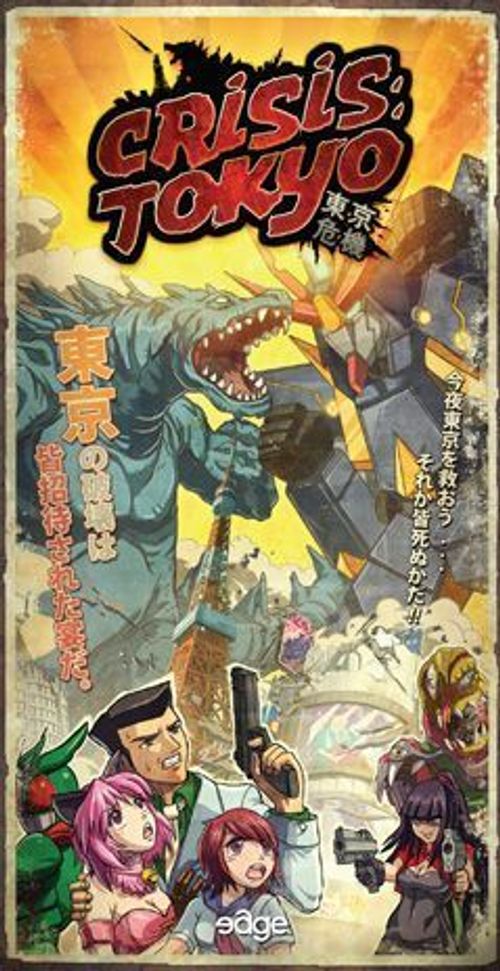
Crisis: Tokyo
Crisis: Tokyo Rulebook
Table of Contents
Table of Contents
Introduction
What Is This?
Crisis: Tokyo is a non-collectible card game which, apart from being in no way educational, is designed for 2 to 5 players. To play you only need the contents of this box. Games usually last 60 minutes.
Object of the Game
In Crisis: Tokyo the players play the parts of movie villains. Only one of them can be the Lord of Evil who brings destruction to Tokyo, in order to rise as the undisputed master of the world. To do so they will use monsters that carry out their will, and heroes that thwart the plans of their rivals.
Contents of the Game
The game consists of 110 cards. There are 24 District cards, 40 Character cards and 40 Event cards. In addition there are 5 Quick Reference cards and 1 Favor of the Gods card.
The Cards
In Crisis: Tokyo there are three different types of cards: District, Character and Event. Of these, the Character and Event cards have a particularity: they are double cards.
Double cards. Most of the cards in this game are Double cards. When a Double card is played, one of its two halves is chosen, which will be the play. That half is placed facing the centre of the table, and while the card remains in play it is considered only as that half. The unplayed half must be ignored.
District Cards
Since destroying Tokyo all at once is impossible, as the long filmography of Godzilla proves, it must be done in parts, levelling one District at a time. Each District is represented by a card:
- Name of the District to be destroyed.
- Resistance. Indicates how difficult it is to level it depending on what it is attacked with.
- Special rules. Indicates any specific effect the District has.
Character Cards
Character cards represent the actors of the low-budget film in which, sooner or later, every game of this game will fall apart. Character cards are double cards.
- Icon. Indicates whether the Character is a Threat or a Hero.
- Name of the Character.
- Special abilities it has.
- Power spheres. Indicate how it fights and how much power it has.
There are two types of Characters, distinguished by their icon:
- Threats: The evil minions that attack and destroy. These creatures will serve to level Tokyo and place the city under the control of their owners.
- Heroes: The brave (and unconscious) defenders of the city. They will act under the control of the Lords of Evil to stop the Threats that their opponents send.
The power spheres, located on the right side of the card for each Character, give an idea of the nature of its way of fighting, and combats are resolved with them. The more spheres, the more powerful the Characters.
Some Characters also have special abilities. Some of these abilities are preceded by a symbol and are called Talents.
- Talents: Abilities that some Characters have, or that they acquire during the game through some Gifts. A single Character can have several Talents. Using a Talent requires spending an action, and doing so prevents the Character from using Talents again that turn.
Event Cards
These cards, also Double cards, reflect the Events that can happen in the eternal Conflicts over the coveted city. They are read in a very similar way to Character cards.
- Icon. Indicates what type of Event it is: Occurrence, Gift or Plot.
- Name of the Event.
- Effects produced by the Event.
There are three different types of Events, which are distinguished by their icon:
- Occurrences: Have an immediate effect and are destroyed after being resolved. This can be right after being played, at the end of the turn, or at some other moment that the card expressly indicates.
- Plots: Affect the whole game. When a Plot is played it is placed in the centre of the table, and any other Plot that was previously in play is destroyed. Only one Plot can be in play at a time.
- Gifts: Are played on a Character and have an effect on that Character. If a Character leaves the game, all the Gifts it had are destroyed. They may also be played on the Characters of other players. Some Gifts contain Talents, granting them to the Characters that acquire them.
In addition, some effects add or subtract spheres from the cards they affect; this is indicated with these icons:
- Adds spheres of the indicated type.
- Subtracts spheres of the indicated type.
Setting Up the Game
First the Character cards are shuffled and placed in the centre of the table, forming the Character deck. The same process is repeated with the Event and District cards, forming the Event deck and the District deck respectively. Next, the five top cards of the District deck are placed face up in the centre of the table: these cards will constitute Tokyo. Finally, each player draws three cards from the Character deck and three from the Event deck. Once all this is done, it only remains to determine at random which player goes first.
To do this, the Favor of the Gods card is used: it is placed on the centre of the table and spun. The player it points to is the chosen one.
Playing Area Layout
In the centre of the table are placed the cards that make up Tokyo, the decks, and the Plot card that is in play at that moment. Next to each deck are placed the discard piles (in the source, "pila de descarte"), where the cards of each type that are destroyed or discarded are placed. The players' Reserves are placed visibly in front of each player.
Turn Sequence
During their turn, each player may carry out two actions. There are five different types of action:
- Draw a card.
- Recruit a Hero.
- Play an Event card.
- Use a Talent.
- Attack Tokyo (counts as two actions).
All options require spending one action, except attacking Tokyo, which requires two actions. When a player has resolved all their actions, the turn passes to the player to their left.
Exception! During the first turn of each player, that player has only one action instead of two, so no player can attack Tokyo on their first turn.
Drawing Cards
If a player is told to draw a card without specifying from which deck, the player themselves chooses whether to draw from the Event deck or the Character deck. If an effect allows drawing several cards, they may be drawn from different decks. At the moment one of the decks runs out, its discard pile is shuffled to form a new deck.
Maximum hand size! A player cannot hold more than seven cards in hand. If at any moment they have more, they must discard down to seven. The discard is immediate and nothing can be done until it is finished.
Recruiting Heroes
Recruiting a Hero means putting a Hero card into play from the hand, ready to defend Tokyo when it is attacked. The recruited Hero is placed in the player's Reserve.
Maximum Reserve size! A player cannot have more than three Heroes in their Reserve. If any player has more (for example, by recruiting a fourth Hero), they must destroy a Hero of their choice until only three remain. No player may do anything until this process is finished.
Playing Event Cards
A player may play an Event card by spending one action. That Event may be of any of the three types: Occurrence, Plot or Gift.
Using Talents
A player may use a Talent of one of the Characters in their Reserve as an action on their turn. It is possible to use Talents of different Characters in the same turn as long as the necessary actions are available.
Attacking Tokyo
If a player decides to attack Tokyo, a Conflict begins. How to resolve it is explained later.
Power Spheres
The strength of Characters in combat is measured in spheres; the more spheres, the more powerful the Character. However, there are five different types of combat power, represented by the following power spheres:
- Martial arts (close combat): martial artists, warriors.
- Technological weapons: robots, scientists, vehicles.
- Monstrous attributes: monsters, animals.
- Firepower: military personnel, war machines.
- Mystic powers: mages, mystical beings, magical girls.
Therefore, it is not only important how many spheres a Character has, but also which power those spheres correspond to.
Other Spheres
In addition to the five power spheres there are three special spheres that do not represent specific powers:
- Grey sphere. Some Characters have no power spheres; this is shown on their card with a grey sphere. If a Character has its spheres reduced to zero or fewer, it is also considered to have that grey sphere printed on its card.
- Wildcard sphere. When a card with wildcard spheres is played, its player chooses one of the five powers. All the spheres printed on the card will be considered spheres of that type for as long as that card remains in play.
- White sphere. When a District has white spheres as its resistance value, it indicates that it has that number of resistance spheres for any of the five powers.
The Dragon
Each of the five powers is tactically superior to two others in combat. This is reflected in the Dragon diagram, which you will see on the reverse of the Character cards.
- Example! Martial arts is superior to Technological weapons and Monstrous attributes. This means that a martial artist would have a certain advantage when fighting a robot or a monster using their respective powers.
- Another example! Firepower is superior to Mystic powers and Martial arts, so a mage or a martial artist would be at a certain disadvantage when fighting against a regiment of soldiers.
The Dragon is read from tail to head (counter-clockwise). Read in that direction, each power is superior to the next two.
Therefore, when determining which Character is more powerful, what matters is not only the number of spheres it has, but also how many its rival has and of what type.
- Superiority! When the power a player is using is tactically superior to the power its opponent uses in a combat (as explained above), we say that the player has Superiority. This gives a certain advantage, explained in the section on Conflicts.
Conflicts
Even the most mediocre villain knows that on the battlefield there is only one strategy for always coming out alive: not being there.
When a player decides to attack Tokyo, a Conflict begins at that moment. It is divided into six steps.
Sending the Threats
The attacking player declares which District of Tokyo they attack and plays one or two Threats from their hand into the Conflict. They then declare which of the five powers they will use for the attack. The power used may be any of them, even if the Threats do not initially have spheres of that type.
Seeking a Defender
The player to the right of the attacking player decides whether to defend the District, in an attempt to prevent its destruction. If they prefer not to defend, the decision passes to the player on their right. This is repeated until a player decides to defend or until all the players declare that they will not. At no time can a player defend a District against their own attack.
Important! If a player has already defended Tokyo, they cannot do so again until they have played their next turn.
Deploying the Defender
If a player decides to defend, a Conflict with defenders takes place. First, the defending player deploys any number of Heroes from their Reserve into the Conflict to fight against the Threat. Once the deployment is done, the defending player must declare with which of the five powers they will defend. The power used may be any of the five, even if none of the defending Characters has spheres of that type.
Attacking and Defending Sides
We call the attacking side the set of all the cards that the attacking player has within the Conflict. The defending side is, therefore, the set of all the cards that the defending player has within the Conflict as well.
Combat
A Conflict with defenders must be resolved with a combat. During combat, both players will alternately carry out a manoeuvre, starting with the defending player. Manoeuvres can be used in three different ways:
- Play an Event card.
- Use a Talent of a Character within the Conflict or in the Reserve.
- Pass.
When a player decides to pass, they can no longer carry out further manoeuvres for the rest of the combat. The combat is resolved as soon as both players have passed.
If There Is No Defender!
If no player defends, a Conflict without defenders takes place. In this case the attacking player is entitled to carry out a single manoeuvre instead of carrying out the combat.
Resolving the Combat
Each player adds up the total number of spheres on their side of the power they are fighting with. If one of the players has Superiority over the other, they add two spheres to their total for as long as this lasts. However, if a side has a total of zero spheres when the Conflict is resolved, it is not entitled to that bonus. Finally, the player with the greater number of spheres is the winner of the combat.
Victory of the Attacking Player!
If the attacking player wins, the defending side is completely destroyed and the attacking side may attempt to level the District.
Victory of the Defending Player!
If the defending player wins, the attacking side is destroyed and the cards of the defending side return to their players' Reserves. The attacking player is not entitled to level the District and the Conflict ends. The defending player draws, as a reward, as many cards as there were Threats on the attacking side at the moment the combat was resolved.
Tie!
If both sides add up the same number of spheres, both sides are destroyed and the Conflict ends without result.
Leveling Districts
If the attacking player is successful (either because there were no defenders or because they won the combat), they proceed to level the District. To determine whether the attacking side levels the District successfully, it must add up the total number of spheres on its side of the same power that was used to attack, and compare it with the resistance value that the District has for that power.
If the attacking side equals or exceeds that resistance value in spheres, the District is levelled. Otherwise, if the number is lower, or the District has no resistance value for the power with which it is being attacked, the attempt to level fails. Remember that if a District has a resistance value in white spheres, the player may level it with any of the five powers.
When a player successfully levels a District, they place it in their Reserve and draw a card as a reward. If the attempt fails, the District remains in Tokyo, intact. Finally, whether the District was levelled or not, the attacking side is destroyed and the Conflict ends.
Important! Whenever a District card leaves Tokyo, the top card of the District deck is revealed and placed in its place.
End of the Game
Victory is a simple goal: it is an easy lady to conquer, but since she is capricious she may not stay on our side for long.
The game ends immediately when one of the players has four Districts in their Reserve. That player is the winner. However, it is possible to agree on a different number before starting the game if the players prefer.
Example of Play
The best way not to trip over any stone on the path is to walk ten steps behind someone.
In a 4-player game, Manuel, Luis, Rebeca and Fernando face each other. The second round of the game begins, starting with Manuel.
Manuel decides to attack Tokyo as the action he will take on his turn. He had wanted to do so on his first turn, but had to wait, and chose to draw a Character card. At that moment a Conflict is established.
Manuel deploys by playing a Threat card, a "Master of the Eagle's Claw", and declares that he attacks the District of "Harajuku". Finally he chooses that the power with which he attacks is Martial arts (his Threat has five spheres of that power) and completes the attacking side with it. The next step is to decide whether any player will defend the District. The player to his right, Luis, decides not to do so, so the decision passes to Rebeca, who is the player to Luis's right. Rebeca decides she will defend "Harajuku" and deploys the only Hero she has in her Reserve on the defending side, a "Retiring-in-Two-Days Cop". She announces that, as she cannot place any more Heroes to defend the District, she declares which power she defends with: Firepower, of which she has two spheres.
Once the sides are determined, it is Rebeca's turn to play first in the combat, and she decides to make a manoeuvre by playing an Occurrence called "Dimensional Portal", which allows her to take the first card of the Character deck and put it into play. In this case she will play the Hero on the card on the defending side. Rebeca reveals the card: the Hero is a "Soldier from the Future", which is placed beside the "Retiring-in-Two-Days Cop" and adds its Firepower spheres to the defending side, making a total of three. According to the Dragon, Firepower is superior to Martial arts, so the defending side receives a bonus of two additional spheres, leaving the situation tied. After resolving the effect, the "Dimensional Portal" card, being an Occurrence, is destroyed and goes to the Event discard pile. The "Soldier from the Future" also has a Technological weapons sphere, but as it entered the defending side after Firepower had been declared as the power to use, that sphere is not added to the combat.
It is Manuel's turn to make a manoeuvre. He chooses to play an Event and puts into play an Occurrence called "Recoil Shot", which reduces one of the Firepower spheres of Rebeca's "Soldier from the Future", leaving it with two spheres (four, if we take into account the Superiority bonus). In addition, Manuel draws a card thanks to the effect of "Recoil Shot" and chooses to draw from the Event deck.
Rebeca has nothing to help her in this situation, so she announces that, instead of making a manoeuvre, she will pass. Manuel, who is winning, also decides to pass. Both having declared that they pass, the combat is resolved. Both players add up the spheres of the powers with which they fight. Manuel has five spheres of Martial arts and Rebeca has two of Firepower, which, adding the Superiority bonus, gives her a total of four spheres of Firepower. Five spheres against four: the attacking side wins the combat.
The attacking side is victorious and all the cards of the defending side are destroyed. Rebeca sends the "Retiring-in-Two-Days Cop" and the "Soldier from the Future" to the discard piles. Next, Manuel attempts to level the District. To do so he compares the Martial arts spheres he has added with the resistance values of the District. Having added five Martial arts spheres and exceeded the value of three Martial arts spheres of the District, he succeeds. "Harajuku" is levelled and the card is placed in his Reserve. Manuel is entitled to draw a card as a reward and chooses to draw from the Event deck.
The Conflict ends and the attacking side is destroyed. Manuel sends the "Master of the Eagle's Claw" and the "Recoil Shot" to their discard piles. Finally, he reveals the top card of the District deck and places it in the centre of the table, where the District that was levelled used to be. His turn ends and it is Luis's turn.
Luis decides to deploy a Hero: he plays a "Mystery-Solving Schoolgirl" and declares that he will play an Event, specifically a Gift called "Sniper Rifle", on the "Mystery-Solving Schoolgirl". The card is placed beside it, after which his turn ends, as he has already used the two actions available to him on his turn.
It is Rebeca's turn. Having used several cards in her attempt to defend "Harajuku" and having lost her Hero, she decides to draw a Character card as her first action and an Event card as her second.
Finally, it is Fernando's turn. As Fernando has a "Kind Alien" in his Reserve with an interesting Talent, he decides to use it as his first action of the turn. Thanks to the Talent of the "Kind Alien", he puts the "Soldier from the Future" into his hand. Fernando would like to use the Talent of the "Kind Alien" again, but a Talent can only be used once per turn, and in addition this card is destroyed by its own Talent. Instead, he plays a Plot called "Fight for the Spoils" and sends the Plot that was previously in play to the Event discard pile. Having done this, his turn ends, so it is Manuel's turn to play his third turn.
Optional Rules
At times it is necessary to show your rivals what you are worth. Sometimes that means dying, other times returning from among the dead.
After a few games you may want to try more possibilities within what the game offers. Crisis: Tokyo was designed to accept several levels of rules. Here we propose a set of optional rules for a faster game.
Resources
At the start of their turn, each player may draw a card without spending any action.
Collateral Damage
When attempting to level a District, the attacking side compares all the powers of which it has any sphere with the resistance values of the District. If any one of those powers equals or exceeds any of the resistance values, the District is levelled even if that power was not the one used to attack.
Brute Force
If the attacking side has 8 or more spheres of the power it is attacking with when it attempts to level a District, the District is levelled even if it has no resistance value for that power.
Advanced Rules
A Lord of Evil is always burning with desire to level Tokyo in the most spectacular way, through new and sophisticated ways of satisfying his thirst for destruction. With the advanced rules, which you can find at www.edgeent.com, that task will be even more fun, if that is possible.
Final Notes
A Lord of Evil must always keep in mind the possibility of not getting on well with the gods.
The Text of the Cards
If the text of a card contradicts a rule in the manual, the card's text is applied. Many cards are made precisely to allow you to do things that the rules would normally prevent you from doing.
Negative Values
Whenever a value in spheres, such as the number of power spheres of a Character or the resistance values of a District, is reduced to a value below zero, it is considered to have a total of zero spheres, or in other words, a grey sphere.
100% Casualties
During a combat, it is possible that one of the two sides is left without Characters. In that case the combat has not yet ended: it may be most natural to surrender, but it is not obligatory. Some cards allow you to add Characters to your side in the middle of combat, so all is not yet lost.
Heroic Threats
A twisted player may take advantage of the effect of some cards to place a Threat in their Hero Reserve. Sorry, but Threats are beings that love destruction and, in some cases, have goals of their own. Any Threat will be destroyed automatically if it passes to a player's Reserve.
The Favor of the Gods
It is impossible for the rules to cover every situation that may arise. If a disagreement arises between players and the rules do not make clear what to do, the Favor of the Gods card will be used, just as at the start of the game, to see who is in the right. The opinion of the gods is best respected; they do not usually have a sense of humour.
The Three Jade Rules
I. You can only take one action on your first turn.
II. Attacking Tokyo will cost you two actions.
III. If a card contradicts a rule in this manual, the effect of the card must be applied.