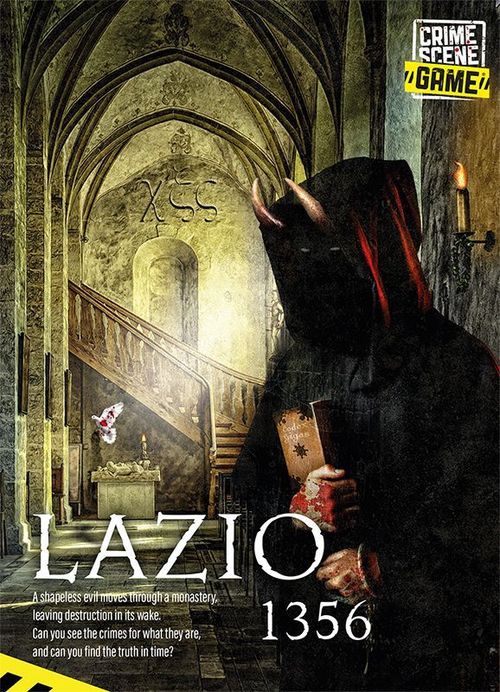
Crime Scene: Lazio 1356
Crime Scene: Lazio 1356 Rulebook
Table of Contents
Table of Contents
Goal of the Game
The goal is to carry out the investigation step by step, solve the puzzles and uncover the story behind the crime, so that at the end you can make the right decision.
Contents
- 60 cards:
- 31 Clue cards (Indizkarten)
- 11 Reputation cards (Reputationskarten)
- 9 Document cards (Dokumentkarten)
- 9 Hint cards (Hinweiskarten)
- 1 scene image (Szenenbild)
- 1 case folder (Fallakte)
- 1 storybook ("Lazio 1356 – Die Geschichte")
- 1 rulebook (Spielanleitung)
You also need a pen and paper.
Setup
- Place the scene image in the middle of the table. The scene image is divided into 30 numbered fields. During your investigation you must find clues and other details on the scene image. Their field numbers lead you to the correct Clue cards, which in turn lead you to new clues on the scene image, and so on.
- Sort the cards by their backs and form four face-down stacks. Important: do not look at the fronts of the cards! Arrange the cards of each stack either in ascending numerical order or, for letters, in alphabetical order. The top card of the Clue cards shows the inscription "Start". The top card of the Document cards shows the letter "A", and so on. Place all stacks next to the scene image.
- Keep the storybook ready. The storybook contains the largest part of the story, which is divided into several paragraphs. It is also an important component for your investigation.
- Prepare a sheet of paper and a pen. You may want to take notes during the investigation.
The Cards
- Clue cards (Indizkarten) continue the story and form the core of your investigation. They contain text and picture puzzles.
- Document cards (Dokumentkarten) are needed to check the solutions of the picture puzzles.
- Hint cards (Hinweiskarten) help you if you get stuck on a puzzle. Caution: for each hint you need, you lose a Reputation card!
- Reputation cards (Reputationskarten): by the end of the game you should still have as many of these as possible, so that you can make the right decision.
Gameplay
Read Chapter 1 of the storybook. Then turn over the top Clue card "Start" and read it as well. Place the card face up on the table. It represents the start of your investigation. Make sure there is enough free space around this card on the table so that further Clue cards can be laid out next to it during the game. This area is called the Clue board (Indiztafel).
Depending on whether you uncover a Clue card with a text puzzle or a picture puzzle, you proceed differently. Text puzzles move the story forward, but you must solve the picture puzzles first.
Text Puzzles
- Read the text carefully. Then look for the underlined word. This is the target word (Zielwort).
- Now search the scene image for the object that corresponds to the target word.
- Object found? Perfect! The field number on which you found the object corresponds to the number on the back of the Clue card, which you must now look for in the stack to move forward.
Picture Puzzles
- Look at the card carefully and try to find the correct solution (Lösung) based on the traces shown. Note the result. Important: the solution is always a number, and can also be a combination or the result of several numbers!
- Now turn over the Document card with the letter shown on the picture puzzle (A to I), and check whether your solution is among the suggestions A) to D).
- No, the solution is not there? Then try again. Perhaps you overlooked an important detail. If you need help, you may also look at the corresponding Hint card (see "Do you need help?" below).
- Yes, the solution is there! Bravo!
- Look at the code to the right of the solution. The code always consists of three numbers separated by dashes (XX-XX-XX). These three numbers indicate which target word you must find, either in the storybook or on an already uncovered Clue card. The target word is always an object or a number.
- The first number determines the paragraph (Absatz), the second the line (Zeile), and the third at which position (Stelle) the target word is.
- Example: 15-3-3 means that the target word is in the storybook in the fifteenth paragraph, in the third line, in third position.
- Now find on the scene image the object that corresponds to the target word.
- Object found? Perfect! The field number on which you found the object corresponds to the number on the back of the Clue card, which you must now look for in the stack, to move forward.
Repeat this sequence until you reach the end of the game.
The sequence is as follows:
- Scene image → field number → Clue card
- Clue card with a picture puzzle → solution → Document card → code → storybook or Clue card
- Clue card with a text puzzle → target word → scene image → field number → Clue card
The Clue Board
Always lay new Clue cards face up next to the most recently laid card on the Clue board. The rosary beads (Schnurteile) printed on both cards must match in colour and must connect in a straight line. The Clue cards must always be laid out in landscape format and in the same orientation. Sometimes you need to shift the cards slightly. Clue cards without rosary beads are set aside.
If the rosary beads do not match, something has gone wrong. Put the Clue card back face down in its stack and examine the scene image again carefully. Perhaps you will now find the correct field number.
Special Clue Cards
Black-and-white striped rosary beads on a Clue card show that you need additional Clue cards to solve the puzzle. The number of black-and-white striped rosary beads shown on the Clue card tells you how many.
- For a text puzzle, the number of black-and-white striped rosary beads also tells you how often the object corresponding to the target word appears on the scene image.
- For a picture puzzle, follow the black-and-white striped rosary beads on the card. They show the objects you must find again on the scene image.
Once you have found all the objects, the field numbers on which you found them correspond to the numbers on the backs of the Clue cards, which you must now look for in the stack.
Important: for the rest of the investigation, no Clue cards are laid on the Clue board at black-and-white striped rosary beads. These cards remain open on your Clue board until the end of the game.
Addition Symbol
If you find this symbol on a Clue card (two rectangles joined by a plus sign), you must follow the traces in the picture or text puzzle and add up the corresponding field numbers on the scene image.
Do You Need Help?
If you get stuck on a puzzle and cannot continue, look for the Hint card with the letter (A to I) shown on the current puzzle. Read the Hint card. It contains a tip that helps you solve the puzzle.
Be careful: for each hint you use, you must remove the top Reputation card of the stack from the game. Put it back in the box unseen.
Note: a complete solution walkthrough is available on the publisher's website: www.piatnik.com/spiele/gesellschaftsspiele/crime-scene
End of the Game
Once you have played through all Document cards (A to I), the storybook will ask you to make a decision.
- Turn all remaining Reputation cards face up and lay them side by side in ascending numerical order. For missing Reputation cards, leave a space free.
- The letters you now see give you a final hint. Choose the one of the three given options that you consider correct.
- Find the corresponding Clue card in the stack.
- Read the story to the end and find out whether you have successfully completed the investigation.