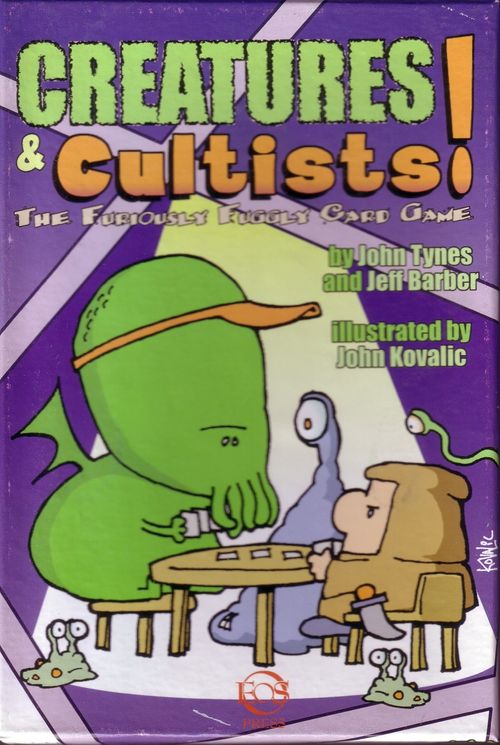
Creatures & Cultists
Creatures & Cultists Rulebook
Table of Contents
Table of Contents
Components
Your Creatures & Cultists game should include the following:
- 128 high quality cards
- 8 cult sheets
- 1 instruction pamphlet, which you're reading now
- 3 six-sided dice
Beyond this, all you need to play are some pencils, and possibly more six-sided dice if you're greedy and don't feel like sharing (and what true cultist wants to do that?)
Setting Up
First, you should probably visit your kitchen. Get a soda or some milk.
Second, take out your cards and enjoy the art. Or don't and just shuffle them all into one big stack, waiting to enjoy the art in play. It's up to you. If it's too much to shuffle or the stack keeps falling over, split the cards into two semi-big stacks.
Third, hand out the eight cult sleets. These sheets are all the same. You can spot them because they all say "CULT" in big letters. Always save one sheet, so you can photocopy more. If you're forgetful and have access to a computer, you can always download the sheet and print more from the www.eos-press.com website.
Fourth, give each player (up to 5! 4 is best!) a play sheet. Then drink your soda or milk, because it's getting warm. Each player should also have a pencil. If you're going to share pencils, make sure they've been disinfected.
Fifth, finally something fun to do. Each player picks their cult. You can use a favorite cult from the real world (such as the Moonies or the Sierra Club), one from fiction (such as the Oompa-Loompas or the Cult of Cthulhu), or one you make up yourself (such as the Boy Scouts of Azathoth or the Gene Pool Rangers). Each player then writes the name of their cult on the cult sheet. Write it twice, in the two spots where it says "Cult."
Sixth, each player writes down their Cult's credo on the cult sheet, where it says "Credo." The credo should be some sort of saying, slogan, or chant that the Cult they're playing would use. Examples of credos include: "We aren't crooks either!" (the Minions of Nixon); "Iä! Iä! Cthulhu Fhtagn!" (the Cult of Cthulhu); "2-4-6-8, fold, spindle, mutilate!" (the Rebel Postmen).
Seventh, each player should design their own Cult Symbol, and draw it in the "Cult Symbol" box on the cult sheet. The symbol should be simple and easy to draw, because you'll be drawing it a lot in the game. If you want to be a wimp, you can just use your initials, or the initials of your cult.
Eighth, each player needs to determine their Cult Skills: Sorcery, Conjuring, and Thuggery. These appear with boxes on the cult sheet. For each skill, roll two six-sided dice, and then add three to the roll. Obnoxious Rule: if any of these rolls come up doubles (two 3's, two 5's, etc.), don't use that roll. Instead, roll again and use that one. No skill can be generated using doubles, period. Why? Sorry, only Third Circle Initiates are allowed to know that.
Ninth, each player should place their sheet in front of them. All the rows of Conjurers and Thugs should be facing out, towards the other players.
Tenth, you or someone you trust should give each player six cards.
Eleventh, get everyone some soda or milk, you greedy pig. When the game is over, remember to carefully put all the cards and dice back into your Creatures & Cultists box, and store it where nobody can sit on it.
How To Win
As a cult on Planet Earth, you are competing with the other players. To win you must do one of two things: either destroy all the other cults (difficult to do), or summon your deity to destroy the Earth (slightly less difficult to do). Don't think that one is more preferable; if you destroy all the other cults you can assume that you will then summon your deity and destroy the Earth anyway, just to rub it in. Either way is a completely valid way to win.
Your Cards
There are six types of cards in Creatures & Cultists. Each card is labeled, so you won't get them confused. Whenever you use a card, you discard it. However, cards that have effects beyond the current turn or round may be left on the table for as long as they are in effect, so their effects won't be forgotten. When you reach the end of the deck, re-shuffle and keep going.
The types of cards are:
- Mondo. These must be played as soon as your turn begins. Their effects are immediate, and most are good. Examples: Resurrect Your Mentor, Alliance With Ghouls, and Use The Library.
- Event. These cards may be played at any time during your turn. They are always played on another player's cult, and take effect immediately. They are almost always bad for the cult you play them on. Examples: Bad Dental Plan, Mistaken for the KKK, and Assassination.
- Sorcery. These cards are played like events, as many as you like, at any time during your turn. To use one, just make a roll against your Sorcery skill and follow the directions on the card. Examples: Power Drain, Dread Curse of Azathoth, and Acrid Aroma of Appleton.
- Thuggery. These cards are used to attack another player's cultist. Some Thuggery cards affect more than one cultist at a time; follow the directions on the cards. To be used, you pick one of your cultists, who actually performs the attack. Thuggery cards usually have a bonus to your Thuggery skill. Examples: Brass Knuckles, Molotov Cocktail, and the infamous Big Honkin' Truck.
- Conjuring. These cards are used just like Thuggery cards, except they are Cthulhuoid monsters, not weapons, and use the Conjuring skill rather than Thuggery. Examples: Chthonian, Byakhee, and Cthugha.
- Defense. These cards are used to defend against attacks made with Spell, Combat, or Monster cards. There are only three types of Defense cards. Elder Sign defends against Sorcery and Conjuring cards. Dodge defends against Thuggery cards. It's A Bluff! brings any single just-killed cultist back to life. Dodge must be played when another player announces an attack, but before he or she rolls the dice. Only Elder Sign and It A Bluff! can be played after an attack has actually been made.
Your Cultists
On each playing sheet you'll find three rows of cultists. These are your fanatic followers. There are two kinds: Thugs and Conjurers. Thugs beat up people. Conjurers summon monsters. It's a living.
Each cultist has a point value, shown by a big number at the top of their box. Whenever you kill another player's cultist, you get that many Fuggly Points. You'll find a box for circling your current Fuggly Points in the middle of the cult sheet.
Each cultist also has a pair of die roll modifiers. You see, your Thug cultists can not only beat people up, they can also summon monsters. And your Conjurer cultists can not only summon monsters, they can also beat people up. But neither is very good at the other's job. The first low of cultists is the weakest. [sic: "low" is meant as "row".] Moving up the sheet, each row gets stronger, as shown by the higher bonuses, smaller minuses, and higher Fuggly Point values.
Those modifiers affect the skill listed when that cultist uses it; if your cult has a Thuggery skill of 6, and you're attacking with a [3 Thuggery Thug, your Thuggery skill for that attack will he 9. [sic: "[3" is printed where a modifier is meant; the example's arithmetic (6 + 3 = 9) shows the modifier is +3.]
The center two cultists on any row are always the weakest on that row. The outermost cultists are always the strongest.
Only one row of cultists is in play at any time. At first, this is the bottommost row. This row, the Current Row, is the source of all your attacks. It is also the only row that other players can attack. The current row does not change until all the cultists on that row are dead. If you have only one cultist left on a row, you can only attack with that cultist. Other players can only attack that cultist. Note: there are some cards that allow attacks against rows other than the current one. Follow the directions on such cards.
Order of Play
There are two terms you need to understand: turns and rounds. Each player gets a turn; that's when you play Mondo cards, launch attacks, etc. When every player has had one turn, that's a round.
- At the beginning of each round, every player rolls a die: Whoever rolls lowest (re-roll any ties) is favored by the stars for this round.
- The player who is favored gets a +2 bonus for any and all roll they may make during the entire round, whether it is during their turn or someone else's. Since you always want to roll low apply the 2 bonus to whatever number you are trying to roll under. This means that if you are favored and you make a Thuggery attack, you add 2 to your Thuggery before rolling.
- Once the favored cult has been determined, everyone draws cards, to a max of 6. Then the player on the right of the favored cult goes first, and play always continues to the right. That way, the favored cult goes last when everyone else has been weakened; of course if they're summoning their deity, that means everyone else gets a parting shot at them.
- After the last player in the round (the favored player) takes his or her turn, the players all make the low-die roll again to see who will be favored in the new round, and play continues.
Yes, this means that play does not go in a continuous circle - each round the order is different. As an example, let's say Genocide Jeff, Panama Prima, and Jonny Pagan are playing. They all roll a die and Jeff is favored by the stars. This round, the order of play will be Prima first (sitting at Jeff's right), then John, then Jeff. After Jeff turn is over, they roll again. This time Prima is favored by the stars. So the order for this round will be John (sitting at Prima's right) then Jeff, then Prima.
Playing the Game
At the beginning of every round, before the favored-by-the-stars roll is made, every player draws cards from the deck to replenish their hand. 6 cards is the standard hand, but some cards change this. Anyone who draws a Mondo card plays it at the start of the turn, and then re-draws to replace the Mondo card. Continue until you have no Mondo cards in your hand, and you have a full hand.
In your turn, you can do any of the following, in any order:
- Play an Event or Spell card. Pick a player to play the card on, then follow the card's directions. See "Events & Spells."
- Play a Thuggery or Conjuring card. This is how you attack other cults. See the "Attacking" section, below.
- Discard. You may discard as many cards as you want, even your entire hand, and re-draw at the start of the next round
- Summon your Deity. If you are favored by the stars, you may be able to summon your deity and win the game. See "Summoning your Deity" for details.
Die Rolls
You'll be making a lot of die rolls in the game. All die rolls (except for rolling your skills at the beginning) are made with three six-sided dice. You always want to roll low. To succeed, you'll need to roll equal to or below whichever skill (and modifiers) is needed.
Anytime you roll a total of 3, 4, or 5 you have Spooged! Believe it or not, this is good. Very good. Most cards you use will tell you the effects of a Spooge. If nothing else, a Spooge is always a success. For the effects of Spooges with Thuggery or Conjuring cards, see "Attacking," below.
Anytime you roll a total of 16, 17, or 18 you have Boofed! Not surprisingly, that is bad. Very bad. Most cards you use will tell you the effects of a Boof. If nothing else, a Boof is always a failure. For the effects of Boofs when attacking, see "Attacking," next.
Attacking
There are two types of attacks. Every attack must be made with an appropriate card; if you have no cards to attack with, you cannot attack. The two types of attacks are Thuggery and Conjuring. A Thuggery attack requires a Thuggery card. A Sorcery attack requires a Sorcery card. [sic: "Sorcery attack" is printed where a Conjuring attack is meant, since the Conjuring attack rules that follow use the Conjuring card.]
To make an attack, you must pick one of your cultists in the current row to make the attack with. Remember that any cultist, whether a Thug or a Conjurer, can make either type of attack. Just use the appropriate modifier for that cultist.
During your turn, each cultist in your current row can make one attack of each type, Conjuring and Thuggery. That means each of your cultists has up to two attacks during your turn.
Thuggery Attacks. To make a Thuggery attack, you select a cultist in your current row, choose a combat card, and then choose a cultist on another player's current row to be the target. Declare this to the others: "This cultist" (point to it) "is attacking this cultist" (point to it) "with this Thuggery card" (display it). You don't have to say these exact words.
Add or subtract your cultist's Thuggery modifier, then add the Thuggery modifier on the combat card. Add any other modifiers on your cult, due to cards or being favored by the stars. Then, roll three dice. If the total of your roll is equal to or less than your Thuggery skill (with all modifiers!), but you did not roll a3, 4, or 5 [sic: "a3" is printed where "a 3" is meant], you have succeeded in your attack. But, the victim gets a chance to resist. They must roll equal to or less than their Thuggery skill (with all modifiers!), divided in half, on three dice. Round up any fractions. It's not much of a chance, but that's the point.
If the defense roll fails, you've killed the cultist. Draw your Cult Symbol in the box for that cultist on the victim's sheet, and then add that cultist's Fuggly Points (the big number at the top of the box) to your total. If the defense roll succeeds, your attack failed.
If the total of your roll is greater than your Thuggery skill (with all modifiers), but you did not roll a 16, 17, or 18, your attack failed.
If your Thuggery attack failed, either because you failed the roll, or because the player successfully defended, the player you attacked can make a counterattack. This is made just like a normal attack, but the player can only attack with the cultist you just attacked, and can only attack the cultist you just used to attack with. Cards with multi-cultist attacks must include that cultist in the attack. However, the counterattack can be with Thuggery or Conjuring.
If the counterattack fails, the exchange between those two cultists is over. A failed counterattack cannot in turn be counterattacked.
If you Spooge when you make your Thuggery attack roll (that is, you rolled a total of 3, 4 or a 5), it is automatically a success. The victim gets no defense roll.
If you Boof when you make your Thuggery attack roll (that is, you rolled a total of 16, 17 or an 18), it is automatically a failure. The victim may counterattack, with a +2 bonus.
If the victim Spooges when she makes her defense roll, she may counterattack, with a +2 bonus.
If the victim Boofs when he makes his defense roll, his cultist dies and you get to keep your Thuggery card in your hand, rather than discarding it.
Conjuring Attacks. To make a Conjuring attack, you select a cultist in your current row, choose a Conjuring card, and then choose a cultist on another player's current row to be the target. Declare this t6 the players: "This cultist" (point to it) "is attacking this cultist" (point to it) "with this Conjuring card" (display it). You don't have to say these exact words. [sic: "t6" is printed where "to" is meant.]
To use a Conjuring card, you must first control the monster on the card. This requires a Conjuring toll. [sic: "toll" is printed where "roll" is meant.] Like with Thuggery, your Conjuring skill is affected by both the cultist's individual modifier and by the modifier on die card. Unlike Thuggery, many of the cards have minuses to your Sorcery skill. [sic: "Sorcery skill" is printed where the Conjuring skill is meant.] Why? The bigger and nastier the monster, the harder it is to control.
But using the bigger monsters pays off: the second number on the Conjuring card is the number the victim has to roll under to survive. The bigger the monster is, the harder it is to avoid.
So, you pick your attacking cultist, you pick your card, you pick your target. Then figure up all your modifiers and try to roll equal to or less than your Conjuring skill with three six-sided dice.
If you succeed and you don't Spooge, your victim tries to roll below the monster's number with three six-sided dice. Unlike Thuggery attacks, the victim isn't rolling against their own skill. This means that some modifiers won't apply: the targeted cultist's Thuggery and Conjuring modifiers, for example, don't apply because the cultist isn't rolling against Thuggery or Conjuring.
If you fail and you don't I tool, nothing happens. No counter-attack, nothing. You discard the Conjuring card. [sic: "I tool" is printed where "Boof" is meant, since the next sentence describes a Boof on the attacker's roll.] If you Spooge when you in your Conjuring roll, the victim is killed outright, and gets no defense roll. [sic: "when you in your" is printed where "when you make your" is meant.] If you Boof when you make your Conjuring roll, the monster attacks your cultist instead! Make the defense roll as described above.
If the victim Spooges on his defense roll, he may counter-attack with Thuggery or Conjuring. If the victim Boofs on his defense roll, the cultist dies and you may keep the Conjuring card in your hand instead of discarding it. [sic: "It the victim" and "If the victim" are the same sentence; the printed text begins "It the victim Spooges", read as "If the victim Spooges".]
Note that if you are the victim due to a Boofed Conjuring roll, neither of the victim Spooge or Boof effects apply. The Conjuring card is always discarded in such cases.
Event & Sorcery Cards
To use either of these cards, you just pick a cult to play it on. No you can't use them on yourself unless it says so. [sic: "No" is printed where "Now" is probably meant.] Then, follow the instructions on the cards. Note that neither type of card originates with one of your cultists, the way Thuggery and Conjuring cards do. You just play them directly.
Sorcery cards are magical spells. To use one, you must roll equal to or less than your Sorcery skill, with any modifiers that are appropriate. If you succeed, follow the directions on the card.
Event cards are, needless to say, things that happen. Some of them require a roll to be made. If it doesn't say who should make the roll, the person playing the card should do it.
Many Sorcery & Event cards have effects that last beyond the current turn. Leave such cards sitting face-up on the table, so no one will forget them. They don't count as cards in your hand; just like discarded cards, they've been played and can be replaced next time you draw.
Using Fuggly Points
Every time you kill a cultist, you add their Fuggly Point value to your total. So what do you do with the points?
At any time, you can give yourself a bonus on a die roll by spending Fuggly Points from your total. Each pair of Fuggly Points you spend gives you a +1 bonus. Those Fuggly Points are, of course, lost from your total. Fuggly Points never go below zero.
Some cards also provide special uses for your Fuggly Points. Follow the directions on the card.
Summoning your Deity
To summon your cult's deity to destroy the Earth and win the game, two requirements must first be met. First, you must be favored by the stars this round. Second, you must have the minimum Fuggly Points at the start of the round. These points represent your success as a cult, and thereby show how pleased your deity may or may not be with your performance. The amount you need depends on how many players are in the game:
- Two players: twenty-five Fuggly Points [sic: printed "twenty-live"]
- Three players: twenty Fuggly Points
- Four or more players: fifteen Fuggly Points
If you meet both of these tests - and note that your Fuggly Point total is not a secret, so other players will keep an eye on you when you have enough - you may attempt to summon your deity when it's your turn (yes, you still have to play any Mondo cards).
Just announce that you're going to do so ("Here comes Hastur!" or whatever). Then, as the rest of the players look on in agony, you try to roll equal to or less than your Sorcery skill to pull it off: Remember to include whatever modifiers are appropriate, especially the +2 bonus you have for being favored.
If you fail, everyone laughs at you and you feel silly. Subtract from your total the minimum Fuggly Point amount you had to have to summon your deity. Your turn is over. Ouch!
If you Boof, your deity swallows your cult whole. You're out of the game. Double Ouch!
If you succeed, jump around and shout and laugh at the other players. You won! Your deity is even now striding his massive bulk across the landscape, crushing towns beneath him as he rolls onward. Enemy cults fall like matchsticks as your deity snuffs out their lives. Soon, of course, your deity snuffs out yours, too, but hey - that's life as a cultist.
Strategies
A lot is determined when you first roll your three skills. Invariably, some player will get really screwed with a horribly low skill, and someone else will get a really high one. That's fine; that's why skills are determined randomly rather than being assigned points from a total or something. What you have to do, obviously, is play to your strengths. Remember that Thugs can summon monsters, and Conjurers can use guns. At first, they're at big minuses, but as you get to the second and third rows the minuses get lower and the cultists get stronger. This is intentional; as play goes on and the first row wears down, more powerful cultists are allowed into play.
We really don't recommend playing Creatures & Cultists with less than four players and no more than five. Three can play more-or-less okay, but having just two players is rather pointless except to learn the rules.
Cards that permanently or temporarily decrease another cult's skill or skills are great. If a certain cult already has one of these on them, play another on them. You want to take out other cults as fast as you can, killing as many cultists yourself as possible.
Several really powerful cards exist. Create Gate is one, as is the Tommy Gun. Use these to your best advantage: Tommy Gun is perfect when the current row is untouched (and therefore completely eligible for the card's effect), but if there is only one cultist left don't waste it.
When you try to Summon your Deity, don't forget to spend any Fuggly Points you have above the minimum in order to improve your die roll.
Conjuring and Thuggery attacks are very different. If you have low-power monsters, just use them right away - they're long shots at best. But the high-power monsters are excellent for knocking out the high-value cultist in a row, if you can control them.
Speaking of, if you get opportunities to increase your skills, go for Sorcery, then Conjuring, and then Thuggery-depending on which are high to begin with. Almost no one wins by being the last survivor. Summoning your deity is really the key to winning, and for that you need Fuggly Points and a good Sorcery score.
It's a good idea to put skill-penalty cards on a player who already has one. When several players do this to one, it's possible to take that player out of the game quickly.
If someone has the minimum Fuggly Points and is favored, everyone should know it. Watch your opponents' Fuggly Point totals. When someone gets a shot, hit him with any penalty cards you can to hurt his chances.
Finally, there are 6 blank cards for you to use. They're done in a lighter color so to make it easy for you to write on them. We recommend you use those fancier rolling-writer pens or fine-point Sharpies, and be sure to label them the same way the regular cards are, up in the upper left-hand corner. You can of course put on your own art. The backs won't look any different, so they'll play the same.
Design Notes
1993 Edition
Creatures & Cultists first appeared in the fourth issue of The Unspeakable Oath, to acclaim and consternation. Acclaim because readers liked it, especially because they could make up their own cults every time. Consternation because, as published in TUO04, many of the cards were folded in half and some had staple holes. There wasn't much we could do about it at the time, but we thought, since TUO04 is out of print, it was time to re-release the game on its own. We've added a few more cards, but not much else has changed. You should feel free to discard or alter the rules to whatever you find the most playable.
This is the third re-release, in fact, of Creatures & Cultist and the second to be sold through hobby shops. The first stand-alone release was sold only at GenCon/Origins '92 and through the mail. This one includes some new cards, more of the old cards, and completely rewritten rules. The rules aren't much different, just easier to refer to and clearer.
[Acknowledgement omitted.]
The functions of the different cards should become clear during play. Making up your own is a good idea - the more the merrier! We would really appreciate hearing from you if you try the game out. Corrections, suggestions, and especially new cards would be very welcome.
Finally, Creatures & Cultists owes a big debt to one of the greatest card games ever created, Craig Taylor's Naval War from Avalon Hill. Naval War is a game I played with my parents a lot as a kid, and it embodies the principles of game design I most admire: compactness, variety, and easy of play. Spin-offs of the original game have come along: Modern Naval Battles is quite good. Enemy In Sight and The Challenge are lesser efforts.
Some of what Craig did in Naval War you'll find in Creatures & Cultists. Why? Because it works. Creatures & Cultists has a lot of its own flavor, but certain elements of game theory owe a debt to Naval War. If you like Creatures & Cultists, I suggest you pick up its spiritual predecessor sometime and have a blast. I always did.
2004 Edition or: The Good, The Bad, and the Fuggly
Eos Press and Pagan Publishing have always had a good relationship. Whether from working with individual Pagans and their projects (as with Dennis Detwiller's GODLIKE rpg) or just sharing booth space at Conventions, we've always gotten along well. So it was hardly a big jump, when Eos [sic: printed "Los"] started making and publishing Cardgames (starting with Greg Stolze's Abuse: The Final Insult), to talk about Creatures & Cultists. C&C just sort of naturally came up in conversation, and there was no debate about the new art. [Art credit omitted.] While the artist is popular in the industry, that was hardly the main criterion for wanting him on the project. Rather, it was because his work is always funny. Who would be better to illustrate the Furiously Fuggly Cardgame (already funny in its writing!) than with a whimsical and personable funny art style? No contest, there. So this Edition came to be, and we're very happy to have been in the right place and the right time with Pagan Publishing to bring this game back to full waking life.
We hope it brings you many hours of squamous fun!