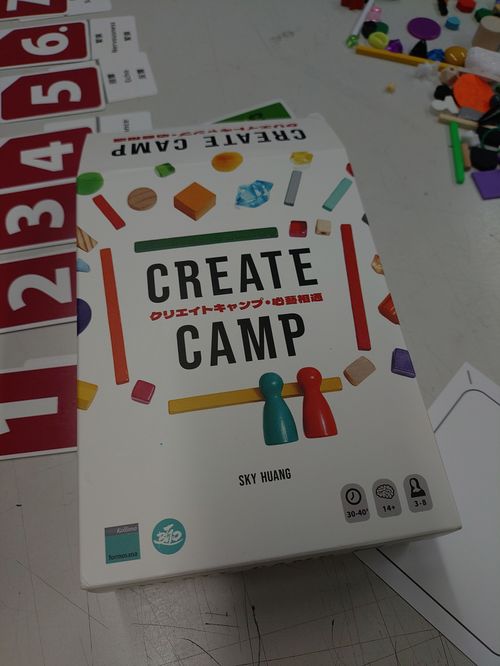
Create Camp
Create Camp Rulebook
Table of Contents
Table of Contents
Game Components
- 11 Number cards.
- 11 Inspiration cards.
- 88 Selection cards (8 sets of 11 cards).
- 190 Task cards, rated 1 to 4 stars (the more stars, the higher the difficulty).
- 8 Frame cards, with a white side and a black side.
- 200+ Creation parts.
Note on the Creation parts (as printed): this part of the box is hand-packed, so contents vary somewhat from box to box. The publisher does not supplement missing parts. Players are welcome to add their own parts, and abstract parts are recommended over concrete ones.
Game Setup
-
Each player takes 20 parts at random. Set the remaining parts aside as a supply stack.
-
Choose the difficulty of the tasks. Tasks are rated 1 to 4 stars; the more stars, the higher the difficulty. Following the table below for the number of players, draw task cards at random, place them in the centre of the table, and place the Number cards on the upper half of the task cards. Set the remaining task cards aside for use in later rounds. Return the remaining Number cards to the game box. (Example: with 5 players, use 8 task cards and Number cards 1 to 8.)
-
Following the table below for the number of players, each player takes one set of Selection cards and Frame cards. Return the rest to the game box. (Example: with 3 players, each player takes the Selection cards numbered 1 to 9 and 2 Frame cards. With 5 players, each player takes the Selection cards numbered 1 to 8 and 1 Frame card.)
-
Following the table below for the number of players, take out the Inspiration cards and set them aside, ready for use. Return the extra cards to the game box. (Example: with 5 players, use Inspiration cards 1 to 8.)
| Number of players | 3 | 4 | 5 | 6 | 7 | 8 |
|---|---|---|---|---|---|---|
| Task cards | 9 | 11 | 8 | 9 | 10 | 11 |
| Frame cards | 2 | 2 | 1 | 1 | 1 | 1 |
| Selection, Number and Inspiration card numbers | 1-9 | 1-11 | 1-8 | 1-9 | 1-10 | 1-11 |
Game Flow
The game is played over 3 days (rounds). Each day (each round) is divided into 4 phases:
- Creation phase
- Deduction phase
- Presentation phase
- Re-arrangement phase
Creation Phase
Each player draws one Inspiration card at random. (With 3 or 4 players, each player draws 2 Inspiration cards and creates 2 works.) The remaining 3 cards are set aside, face down.
Read the Task cards on the table with the corresponding numbers, and create one work per Frame card, following the task of one number per Frame card. (Example 1)
During creation, a player may use only their own parts, and each work must use at least one part.
Frame cards have a black side and a white side. Use whichever side suits the needs of the creation. A creation area is not limited to the inside of the Frame card; you may also create without a Frame card, but you must clearly indicate the creation area to all players. Parts may be placed freely, flat or stacked.
(The source illustrates Example 1 with an Inspiration card "1", the Number card "1", and the Task card "Bomb" as the basis for the work. The illustration is not reproduced here.)
During creation, you may not use arranged numbers, letters, arrows, relative positions, or general symbols to indicate a number or an Inspiration. For example: you may not arrange parts to represent the number 1 to depict Work 1. You may not arrange the letter A to represent an apple. You may not arrange arrows to point to the upper-left and represent the work in the upper-left. You may not arrange the general symbols $ or € to represent money or Europe. (Example 2)
(Example 2 illustrates, with crossed-out examples, arrangements of numbers, letters, arrows and symbols that are not allowed. The illustration is not reproduced here.)
Once a work is complete, push it to the centre of the table and indicate the direction from which the work is to be viewed.
During creation, you may not look at other players' works, nor explain what a part represents; the work must express itself. Once the creation of a work is complete, it may not be corrected or adjusted.
Deduction Phase
After the creation phase ends, observe the Task cards on the table and all players' works. Through the connections between them, choose 3 Task cards that cannot be linked to any work. Take the Selection cards with the corresponding numbers and keep them in hand. Set the other cards aside temporarily. (Example 3)
(Example 3: Adam's own work is Number 1, "Bomb", and he believes the other players' works are 3, 4, 5 and 6. Adam chooses the remaining Selection cards 2, 7 and 8, which cannot be linked to any work, and keeps them in hand.)
Presentation Phase
Wait until all players have finished the deduction phase. Starting with the player who finished last, going clockwise, each player presents their own work and the Inspiration behind it. Then they reveal the number of their Inspiration card.
After each player's presentation, any other player who has a Selection card with the same number as the presenter's Inspiration card reveals it and places it face up in front of them. For each Selection card of that number that another player plays, the presenting player takes one part of their choice from the supply stack. (Example 4)
(Example 4: Adam presents his work, inspired by Number 1 "Bomb". Mary and John each reveal a Selection card showing 1 from their hands. Adam takes 2 parts of his choice from the supply stack.)
Once all players have presented their works, each player checks how many Selection cards remain in their hand. This shows how many tasks the player correctly guessed as having no matching work. According to the number of Selection cards they still hold, each player removes parts of their own choice from play and returns them to the supply stack: 6 parts if they hold 3 cards, 3 parts if they hold 2 cards, 1 part if they hold 1 card, and no parts if they hold 0 cards. (Example 5)
(Example 5: If Adam has 3 Selection cards left in his hand, he chooses any 6 of his parts and returns them to the supply stack. If Mary has 2 Selection cards left, she chooses any 3 of her parts and returns them. If John has 1 Selection card left, he chooses any 1 of his parts and returns it.)
Re-arrangement Phase
Exchange the Task cards on the table again (the difficulty may be adjusted). Every player dismantles their own work and takes back all the parts they used. Take back all Selection cards. Return the Inspiration cards, and shuffle them thoroughly again. The game then proceeds to a new day (round), beginning with the creation phase.
End of the Game
The game ends after 3 days (rounds). The player with the fewest parts remaining at the end wins and earns the Art Master's praise. If players are tied, they share the victory.